Luscious leek for lunch

Tags

, , , , , ,

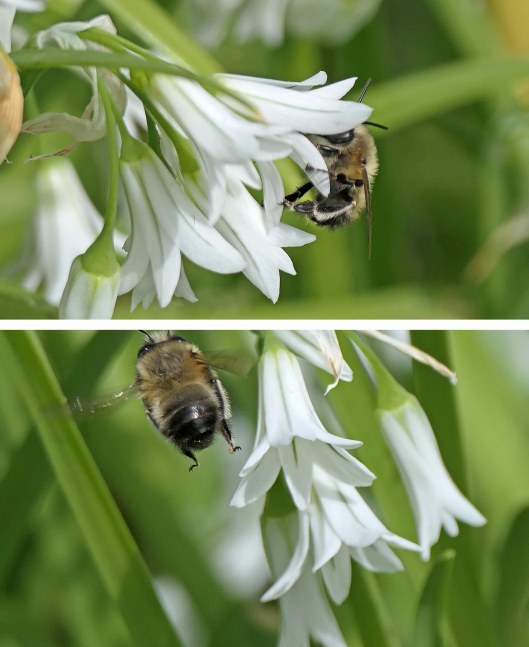
Today’s short local meander was rather smelly, firstly with swathes of Wild garlic (which will feature in an upcoming post) and also this lush area of Three-cornered leek (or Three-cornered garlic, Allium triquetrum), which was attracting lots of insects.
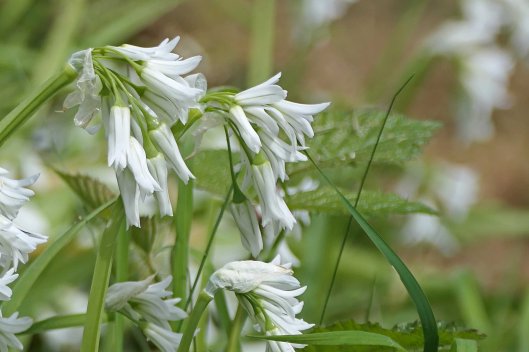
First up, a tiny solitary bee.

Then, several Dark-edged bee-flies came hovering in to view, long spiky legs dangling below and long tongues poking in to the flowers to feed.
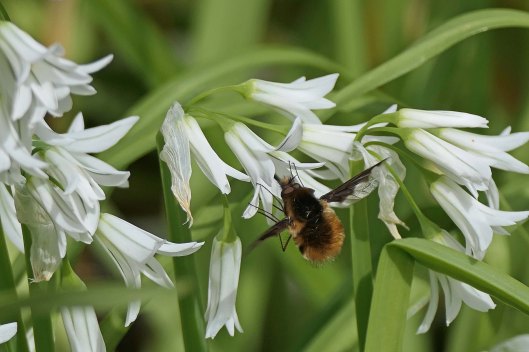
And then this brute showed up, the first Hairy-footed flower bee I’ve managed to photograph this year, just.
Greenland Wheatear

Tags

, , , , , , ,

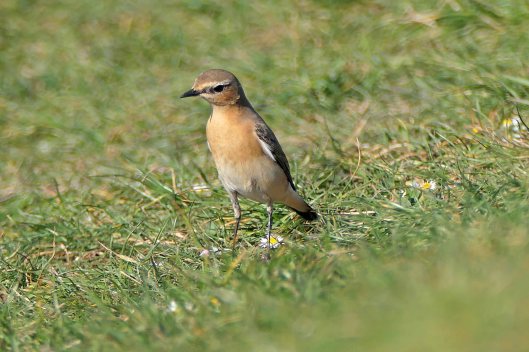
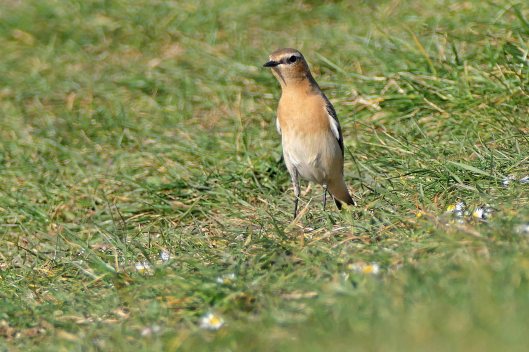
I struggle to distinguish between the ‘usual’ Wheatears we see passing through my area and the Greenland Wheatear, one of four subspecies that has the scientific name Oenanthe oenanthe leucorhoa and is usually seen only in the spring as it heads from its overwintering locations in African countries like Kenya to its breeding grounds in Greenland, Iceland and north-eastern Canada. So, when one of our more expert local birders announced the arrival of this Greenland Wheatear on Cardiff Bay Barrage, I went down for a look.

It was certainly a very handsome bird, and I’ve since tried to familiarise myself with some its key features. Given the requirement for its long-haul flight, it’s probably no surprise that Greenland Wheatears are longer winged than the subspecies that fly from Europe to Britain to breed. The Greenland’s relatively large size, longer legs and upright stance are also diagnostic.

They are often described as rotund and pot-bellied, which this bird didn’t really seem to be, but then it had just flown all the way from central Africa so probably needed to feed up to replenish its fat supplies. Fortunately, it wasn’t too bothered by the numerous people and dogs walking in the area, and did seem to be finding plenty of insects to snack on. I’m not sure I could yet confidently identify a Greenland Wheatear without expert help, but this was certainly a stunning bird to see and watch and photograph.

What an effort!

Tags

, , , , , , , ,

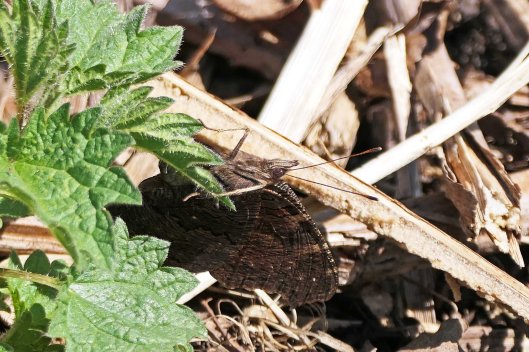
As I write this, my fingers are still stinging. And none of my photos are sharp, partly because ‘Ouch!’ but also because I didn’t want to disturb the clutch so was trying to move the leaf as little as possible. But, when I watched their beautiful mother laying the first of these yesterday, I knew I had to go back today to see how many she’d produced.

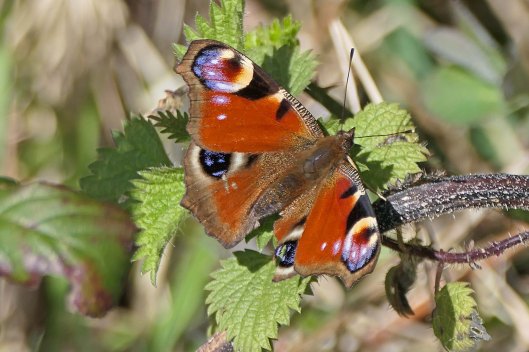
And here she is, the gorgeous female Peacock butterfly, clinging on to a Stinging nettle leaf. You might just be able to see how her abdomen is curved up towards the underside of the leaf where she is depositing her eggs. My guide book tells me that a female Peacock ‘lays her eggs in batches of up to 400 eggs, a process that can take over two hours’. What an effort! I will, of course, be looking out for when the tiny caterpillars emerge, in approximately two weeks’ time.

Mystery: on a pine tree

Tags

, , , , ,

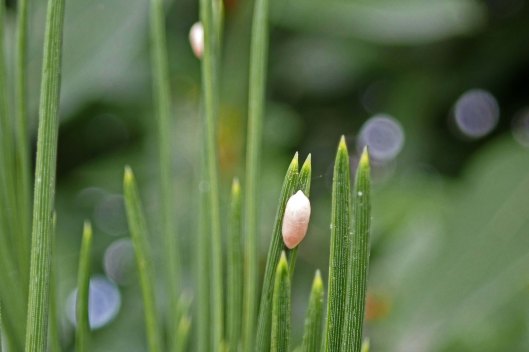
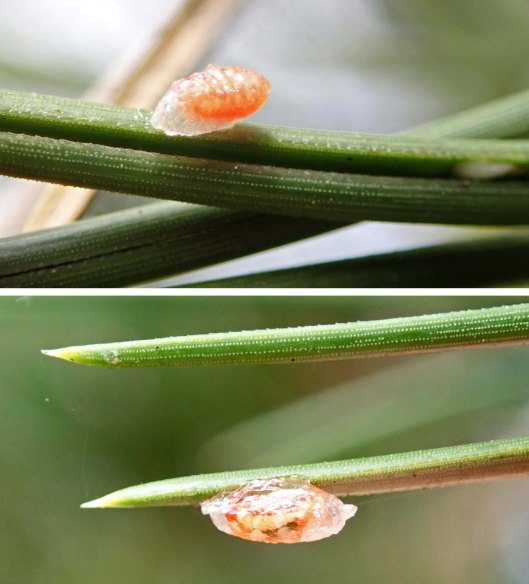
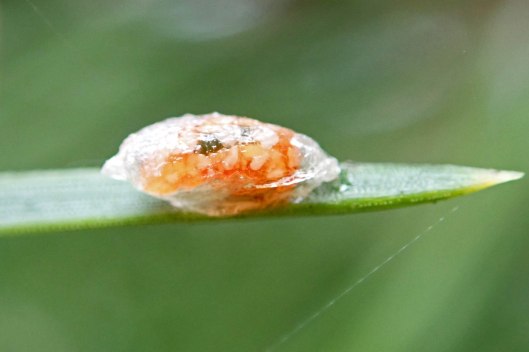
As the spring and summer progress, this first ‘mystery’ post may well develop in to a mystery series, depending on how many intriguing things I manage to find and how many I don’t manage to identify. These first mystery items were found recently when I was looking more closely than usual at Pine trees to see if I could spot any more Pine ladybirds. I did find one more of those lovely creatures but I also found these ‘things’, dotted sparsely around, attached to the Pine needles.

No amount of googling has produced any similar images or information and, when I asked for help on social media, I was inundated with helpful people saying they were Pine scale, which, after checking the lifecycle of those scales, I’m fairly sure they’re not. They look to me like some kind of egg sac or pupal case, with a tiny creature growing and developing inside.

In an attempt to solve the mystery, I plucked a couple of Pine needles, with the things attached, off one tree, and I’ve brought them home, stuck them in a jar on my kitchen window sill. Whether or not something will emerge remains to be seen and, rest assured, I will definitely write another blog post if that does happen. In the meantime, if any of you has any bright ideas, please do share them in the comments.

Holly blue and Small white

Tags

, , , , ,

Two for the price of one today!
It’s always a joy to see the blue butterflies emerge; it’s like a tiny piece of the sky has fallen to earth and is flitting amongst the flowers and shrubs and along the trees and hedges. The first to appear locally are the Holly blues. My first, on 2 April, was in an unlikely place; as I walked past, it flitted out from the street-side hedge of a house a few streets away from where I live. There was no Holly or Ivy in sight but perhaps those larval plants were growing in a nearby back garden that I couldn’t see in to.

Next to appear, just a couple of days later, was a Small white that was already looking a bit tatty. It seems its short life was proving to be a challenge, escaping from bird attacks or, perhaps, getting snagged in vegetation. My second Small white was pristine, feeding along a field edge so abundant with Blackthorn blossom that the area had attracted six species of butterfly: as well as the Small white, there were Speckled wood, Comma, another Holly blue, Brimstone, and my first Orange-tip of 2025 (which will feature in a future blog, as soon as one stays still long enough for a photo).

Mining bees

Tags

, , , , ,

Mining bees, the Adrenidae, are notoriously difficult to identify I find, and, as my brain is already swimming with factors to consider when identifying spiders (and other life stuff that is happening in the background), I don’t have the mental capacity to tackle bees at the moment. Maybe they can be next year’s project.

In the meantime though, I can still appreciate how exceedingly cute they are, especially when they sit still for a few moments (which isn’t often) and allow me to get some close up photos (also not often).

Spider: Larinioides cornutus

Tags

, ,

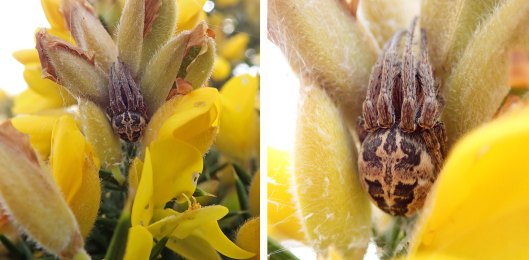
I was looking for weevils when I spotted these two spiders on the same Gorse bush at the Cardiff Bay Wetlands Reserve recently. (This was a bit freaky: I need both distance and reading glasses but don’t like bifocals so, when I’m out walking, I have to push my distance specs down my nose and get my head close to small things to see with my unspectacled eyes.)

I initially thought these two spiders were Agalematea redii but quickly realised I was wrong about the first one I found. It is, in fact, Larinioides cornutus, a species that prefers living on vegetation in damp places but can also be found on built structures in those areas. It’s common in the south of Britain, becoming less so the further north you travel. The Spider and Harvestman Recording Scheme website has a map and lots of interesting information.

And, though it looks different to my untrained eye, it turns out that the second spider is also Larinioides cornutus. The very helpful British Spiders social media person on Bluesky explained: ‘The second looks like Larinioides cornutus as well. Although the alpha form of Agelenatea redii has quite similar patterning, it has a noticeably smaller and rounder abdomen – one of those things that’s obvious when you meet it!’ I’m hoping I meet it a little more distantly than I did with the two shown here!

Pretty drooping weeping flowers

Tags

, , , ,

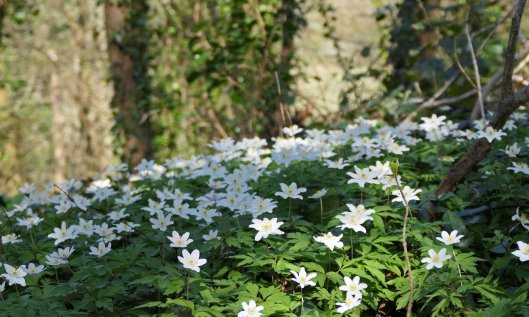
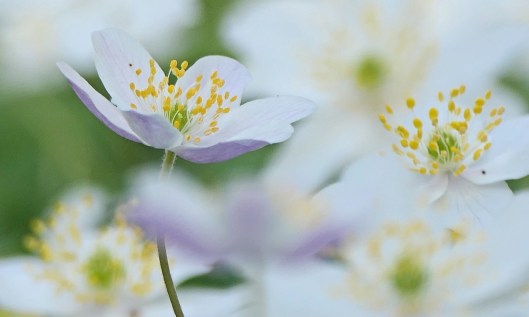
‘The Wood anemone’, a poem by John Clare (1793-1864)

The wood anemone through dead oak leaves
And in the thickest woods now blooms anew,

And where the green briar and the bramble weaves
Thick clumps o’green, anemones thicker grew,

And weeping flowers in thousands pearled in dew
People the woods and brakes, hid hollows there,

White, yellow and purple-hued the wide wood through.
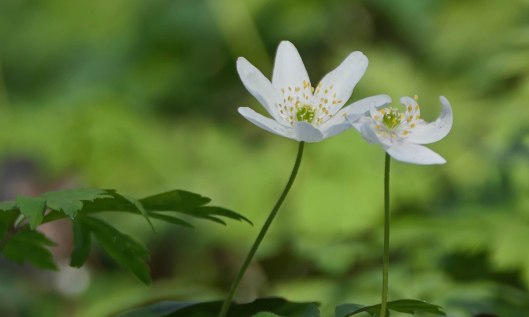
What pretty drooping weeping flowers they are:

The clipt-frilled leaves, the slender stalk they bear
On which the drooping flower hangs weeping dew,

How beautiful through April time and May
The woods look, filled with wild anemone;

And every little spinney now looks gay
With flowers mid brushwood and the huge oak tree.

Slug: Ambigolimax

Tags

, , ,

For some reason the national recorder for slugs thought I’d used a photo app to identify this slug, which I’ve never done. Maybe he just assumed everyone uses them these days, and, in this case, he was ‘afraid the photograph app which you have used has led you astray’. The truth is that I’d googled, and searched various online websites, and couldn’t work out what this slug was so had just recorded it as one of the Arion species. I even managed to get that wrong – turns out this is one of the Three-band slugs (though, I have to admit, I can only see two bands) and ‘At present we cannot tell which of the two species it is without dissection so it has to be recorded just as Ambigolimax‘. I’ll know for the future.

Peacocks aplenty

Tags

, , , ,

I didn’t see my first Peacock butterfly (Aglais io) of the year until 30 March, which is much later than usual – these are butterflies that overwinter as adults so can emerge from hibernation on warm sunny days even in winter. Now, just six days later, my count is up to eight, as we – and the butterflies – bask in a spell of unseasonally dry and warm spring weather.

I’ve discovered that, when I first see a new butterfly species each year, I have a tendency, a predilection, a need even to photograph every single one I see, as if taking their image makes them real – or perhaps it’s just my attempt to capture the heartfelt joy I feel at seeing butterflies on the wing, and relive that feeling when I’m looking at my photographs at home. After a few days, and having seen several, I begin to relax and focus more on taking better images – at least, I think the photograph below, taken today, is better than the earlier ones above.