A demanding duck

Tags

, , , , ,

Not content with quacking at me from the water below the boardwalk where I was standing, this very handsome male Mallard decided he would improve his chances of successfully begging for food by flying up and perching on the boardwalk’s handrail. First, he tried smiling at me – at least I think this is meant to be a smile …

240418 mallard (1)

When that didn’t work, he waddled carefully towards me and quacked very loudly …

240418 mallard (2)

Unfortunately for him, I didn’t have any food with me, but I did take the opportunity to take quite a lot of photos as he posed.

Sunday’s gift

Tags

, , , ,

I was trudging slowly along a muddy path, trying not to slip (it’s happened before), so I wasn’t paying attention when my first Orange-tip butterfly (Anthocharis cardamines) of the year flitted up in front of me, disturbed from feeding on a flower of Herb Robert. Typically, it flew back along the way I had come, meaning I had to retrace my slippery steps while trying to keep an eye on where it landed once, twice, three times. By the time I got to the start of the path, the butterfly had disappeared and, though I lingered a while, it didn’t reappear.

240417 orange-tip

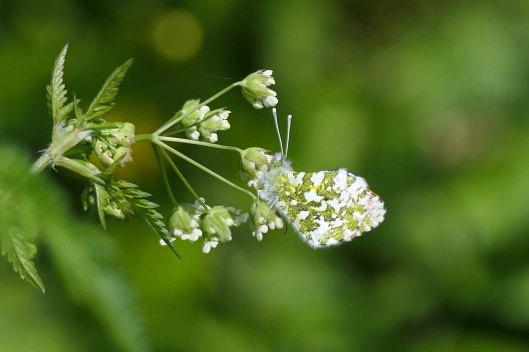
On my way home, I was more lucky and spotted my second Orange-tip of the year. I could easily have missed it, so well camouflaged was it amongst the lush new growth of Cow parsley plants, but the breeze had picked up and it was having to flap its wings just a little to hold on to its perch. The flash of its orange tips gave its location away.

Where’s Wally Whitethroat?

Tags

, , , , , ,

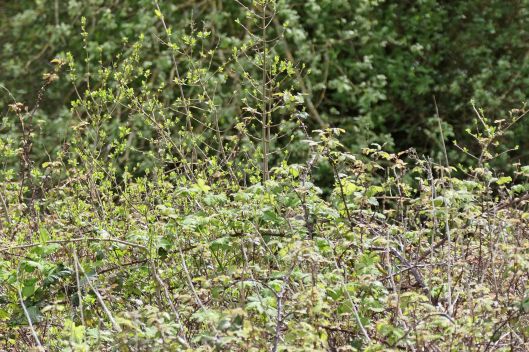
The Brits amongst you, and maybe other nationalities (who might know him as Waldo), will no doubt have heard of ‘Where’s Wally?‘, a series of puzzle books where the illustrator has ‘hidden’ the character Wally in a huge crowd of people. Well, in my version, instead of looking for Wally in a crowd, I was trying to pick out my first (Common) Whitethroat (Sylvia communis) from where it was joyously singing in a scrambled mass of bramble scrub. If you look carefully, you might just be able to spot its head.

240416 wheres wally whitethroat

The national butterfly of Finland

Tags

, , , , ,

No, I haven’t been on a whirlwind trip to Scandinavia, more’s the pity. I’ve just read that the Holly blue (Celastrina argiolus) is not only native to Britain but can also be found throughout the Palearctic, and is the national butterfly of Finland. Well done the Finns for recognising the beauty of this gorgeous creature. And well done this particular Holly blue for sitting still for a few minutes yesterday so I could grab a few quick photos.

240415 holly blue

WildflowerHour: Tree flowers

Tags

, ,

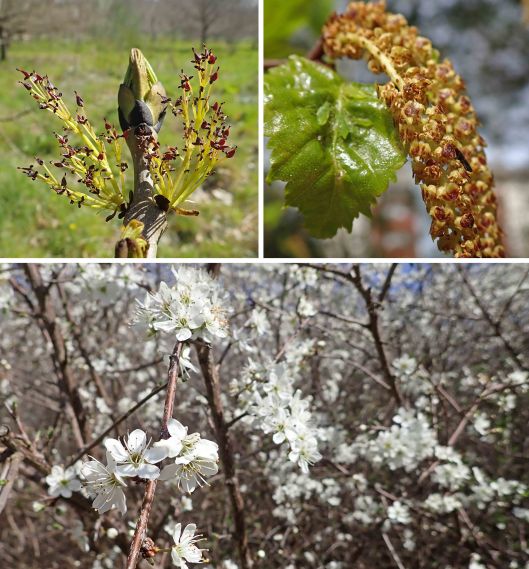
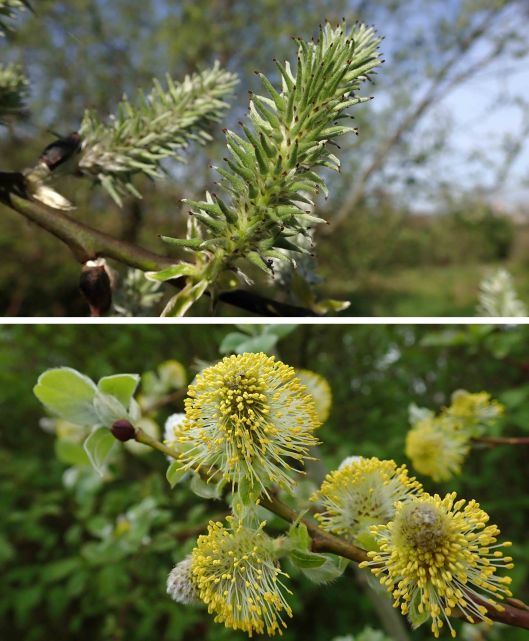
The challenge for this week’s #WildflowerHour on social media was to find as many tree flowers as possible. Here’s my contribution …

240414 ash birch blackthorn

Ash, Birch (not sure which species), and Blackthorn

240414 cherry laurel hawthorn

Cherry laurel (probably a garden escape) and Hawthorn

240414 maple field norway ornamental cherry

Field and Norway maples, plus I couldn’t resist adding an ornamental Cherry in to the mix, as they’re looking so gorgeous at the moment.

240414 willow female male

Goat willow, I think, female above and male below – Goat willows are dioecious, i.e. male and female flowers are on separate trees.

Sand martin magic

Tags

, , , , , ,

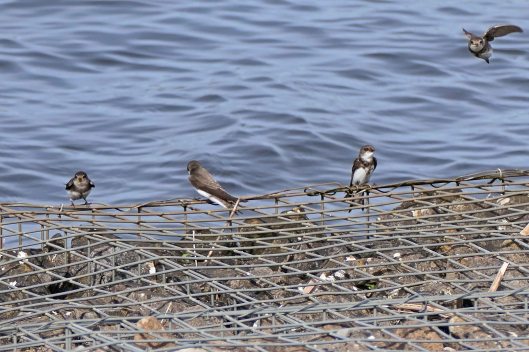
Although I saw the Sandwich tern again and a large huddle of Turnstones, as well as lots of other birds, the stars of my circuit of Cardiff Bay yesterday were the Sand martins, which are now here in large numbers. As I walked across the Barrage, these gorgeous little birds were buzzing constantly overhead, flitting low over the water just off the edge of the Barrage grass, then coming in to land and preen on the gabions.

240413 sand martins (1)

Being able to see those martins up close was a delight but things only got better. Sand martins nest in the holes along the concrete edges of the old dock by Tiger Yard, and that area was just alive with birds, seemingly arguing about ownership of particular holes, gathering nesting material, and generally going out their Sand martin business. Some of those beginning to make their nests comfortable were landing on the dock edge to gather moss and grasses. They were behind railing but less than a metre from me so, by staying still, I was able to get a few good close ups. They were simply magical to watch!

240413 sand martins (2)

My first Large white

Tags

, , , ,

I’d just got home from walking a circuit of Cardiff Bay when a local birder and butterflier sent me a message to say there were some nice butterflies to be seen in a nearby park so out I went again for a look-see. He was right! Though I didn’t see the Green-veined white he had spotted, I did see the beauty shown below, my first Large white butterfly (Pieris brassicae) for the year, and my first two Holly blues, though neither paused long enough for a photo.

240412 large white

Another new arrival

Tags

, , , ,

Spring migration is well underway now, with new bird species being sighted by keen-eyed local birders almost every day. My eyes are not so keen these days but, on Monday, with binoculars, I did manage to spot my first couple of House martins (Delichon urbicum) amongst a large flock of Sand martins feeding over Cardiff Bay. The two species can be difficult to tell apart especially in dull weather when the blue upper plumage of the House martin is not so obvious. However, when they’re flying, it was relatively easy to distinguish between the two species – the Sand martins have a brown bib whereas House martins have solid white underparts. As the birds were quite distant, I wasn’t able to get any clear photos so you’re being treated (ha!) to another of my very amateur drawings.

240411 house martin

An American comes to town

Tags

, , , , , ,

We’ve been fortunate to have a rare avian visitor in Cardiff recently, a drake Lesser scaup (Aythya affinis), a bird more usually seen in North America, a ‘Nearctic vagrant’ as it’s described in an excellent photo identification guide on the Bird guides website. I first saw this bird (a lifer for me) on 4 April at Cardiff Bay Wetlands Reserve, where it was snoozing among the flock of Tufted ducks and Great crested grebes. With its glossy green-tinged head and grey mantle I could pick it out easily enough, though, with its similarity to Greater scaup, I would’ve struggled to identify it as a Lesser scaup if I hadn’t been told what it was.

240410 lesser scaup (1)

That Bird Guides article describes the Lesser scaup as having the small, compact body proportions of a Tufted duck and the plumage of a Greater scaup but with a distinctive head shape – this is less rounded than a Tufted duck, is tuft-less, and has a steeper forehead with a rear crown ‘bump’.

240410 lesser scaup (2)

The bird has moved around the local area, from a couple of different spots in Cardiff Bay to north Cardiff’s Lisvane reservoir, then back to the Bay again. I got a second, closer look on 8 April, though the bird kept its head down and snoozed all the time I was nearby. Obviously, the long flight from North America is very tiring!

A new beetle

Tags

, , ,

A few days ago I found this new beetle sitting on the wall of some local houses. It’s a member of the Hydrophilidae family of water scavenger beetles, though this is actually one of Sphaeridium species, which are dung beetles. The UK Beetles website reports that ‘four [of these species] occur in the UK and three are common and widespread, they are medium sized, 4-7.5 mm. oval and distinctively coloured, they live in wet dung and both adults and larvae are predatory’, and on Wikipedia I discovered that the larvae of these little beetles predate the larvae of flies that breed in dung. The particularly odd thing is the urban location where I found this beetle, as they’re usually found near cattle. Perhaps it had inadvertently hitched a ride in someone’s car or on someone’s dog.

240409 Sphaeridium sp