Cosmeston’s Waxwings

Tags

, , , ,

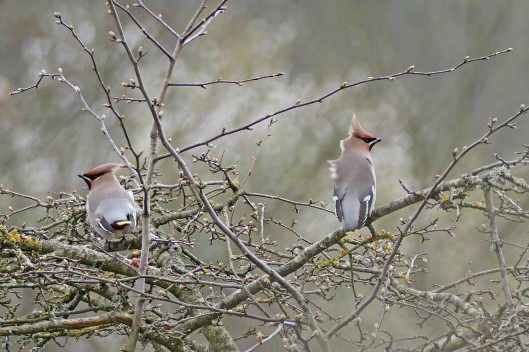
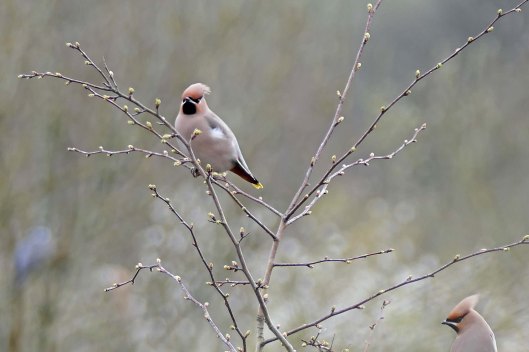
For the second time this winter, we’ve been blessed with visiting Waxwings at Cosmeston Lakes Country Park.

240309 waxwings (1)

First spotted by our resident expert birder last Saturday, 2 March, they’ve alternated between feeding low down on the remaining Hawthorn berries and hips of wild rose bushes and, when the sun’s been shining, flycatching from the tree tops.

240309 waxwings (2)

I’d seen them distantly twice flycatching, so I was absolutely delighted during Thursday’s wander around Cosmeston to find all four birds snacking on hips in a location where I could use a hedge as a hide to get very close views.
240309 waxwings (3)

Waxwings are such stunning birds, and this has been a magnificent Waxwing winter!
240309 waxwings (4)

City Hall’s Black redstart

Tags

, , , , ,

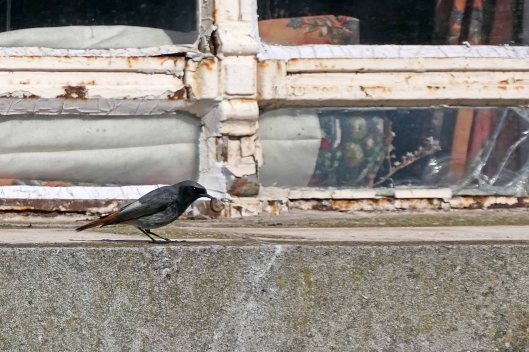
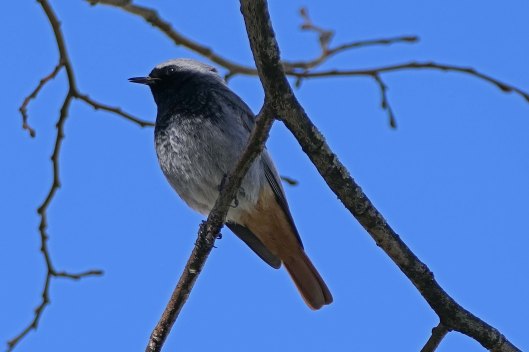
The main reason I walked in to Cardiff city centre on Wednesday was to see this handsome little dude, the Black redstart that’s been spending his winter months around City Hall.

240308 black redstart (1)

Although we have these birds in Cardiff Bay, they are distant, mostly spending their time in wasteland behind a high fence, whereas the City Hall bird is really quite confiding, coming to within a few feet of his admirers and seemingly unconcerned about all the local passers by and vehicular traffic.

240308 black redstart (4)

One birder who was watching the Black redstart while I was there said he thinks this is the same bird that has returned to City Hall three years in a row, and I can certainly understand why it would, as it was having great success finding caterpillars to eat. How birds can spot these amongst the grass from more than six feet away is beyond my understanding.

240308 black redstart (3)

For me, though, the best thing about the time I spent watching this Black redstart was listening to his almost continuous singing, not something I’ve heard very often before. It was magical!

240308 black redstart (2)

Peregrine

Tags

, , , , ,

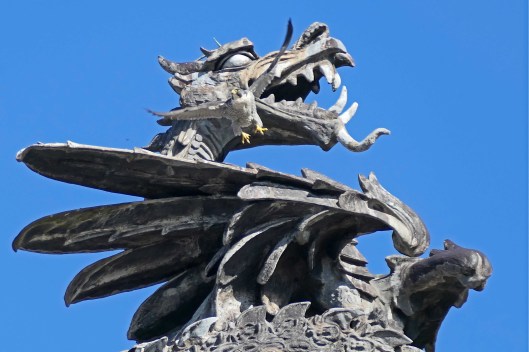
As well as the Grey heron I blogged about yesterday, my jaunt in to Cardiff produced other excellent bird sightings, as I’d hoped it would. This was one of the other stars, one of the pair of Peregrine falcons that live around the dome and clock tower and rooftop of Cardiff’s City Hall (photo below taken a few years ago but I thought it would help to illustrate the location).

240307 peregrine city hall (1)

When I arrived, this Peregrine had just returned to its dining place with a lunchtime snack, probably one of the local feral pigeons. As it plucked its prey, feathers flew out in all directions.

240307 peregrine city hall (2)

Then, something – perhaps the arrival of its mate – prompted the bird to abandon its food to fly across from the dragon on top of the dome to the nearby tower, and, by sheer chance, I caught the take off.

240307 peregrine city hall (3)

A little later, I watched a sneaky Magpie making its way slowly up towards where the abandoned food lay, presumably hoping to scavenge a snack, but the Peregrine spotted it, swooped across from the clock tower and chased the Magpie down and across the front of the building. Somehow, the Magpie managed to nip on to a window ledge, avoiding the Peregrine by inches. Sadly, I didn’t get any footage of that drama but it was magnificent to watch.

Focus

Tags

, , , ,

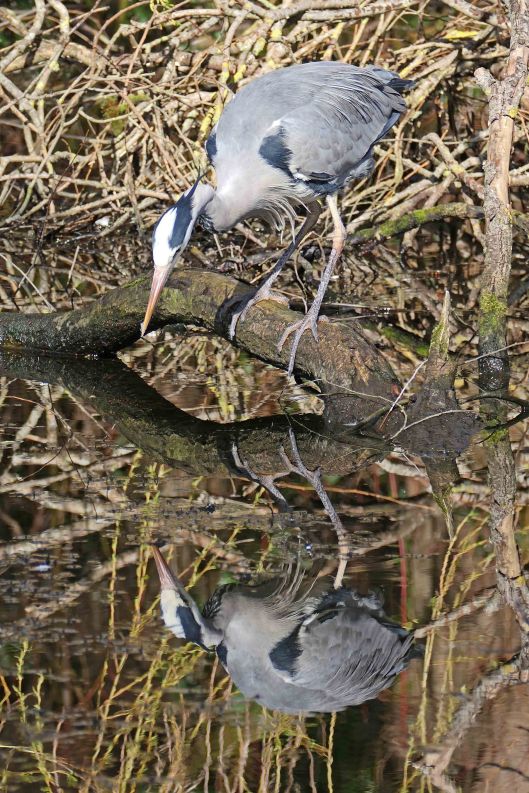
The focus, the intense concentration, the ability to remain completely still – these are all traits I admire in Grey herons, and the performance of this particular bird on one of Cardiff’s canals this morning was a fisher’s masterclass. Sadly, though I watched it for at least 20 minutes, it didn’t actually catch anything. In fact, I’m not sure how many fish there are in those canals. But, the bird deserves a gold medal for trying!

240306 grey heron

Two Woodlarks

Tags

, , , ,

Sunday was a red letter day. Not only did we have four Waxwings dotting around parts of Cosmeston Lakes Country Park but one of our local birders found two Woodlarks in a nearby field. Woodlarks (Lullula arborea) are rare birds for my area, only usually seen on migration by those with the skills to recognise them in flight and the patience to watch the skies for several hours every morning – not me, in either case. And I’d only ever seen one Woodlark previously, at Thursley Common in Surrey, in May 2019, on a short trip with some birding mates.

240305 woodlarkLuckily, when I heard the news about the sighting, I was within (fast) walking distance of the field where the birds were and managed to get there in time to meet up with the finder and two other birders. The birds had moved since first being spotted, and they are quite small, and the field was full of clumps of stubble large enough to hide the larks, and their cryptic plumage means they almost disappear into the background, so we struggled to spot them for a while. Fortunately, one of the other birders had his thermal imager with him, which helped enormously with re-finding them, and I was able to enjoy good scope views of the birds preening and feeding. It was impossible to find the birds with my camera so I’m illustrating this post with my drawing (not done from memory, but rather from images I found online; the BTO has an excellent video about Skylarks and Woodlarks if you want to see what the birds really look like).

Weevil number 3

Tags

, ,

For some unknown reason, the insects I’m seeing most often so far this year are weevils (there was An early weevil, on 16 February, and Weevil: Dorytomus taeniatus last week, on 28 February).

240304 weevil (1)

I’ve seen today’s weevil species at two different locations so far, and I’m thinking you’ll be able to guess what type of weevil it is from the plant it’s on. So, how about giving it a try? Name the weevil!

240304 weevil (2)

Name that rosette, 2

Tags

, , ,

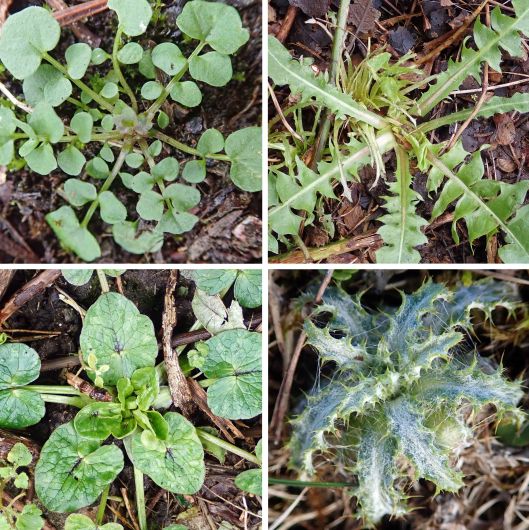
I dipped my toe in to the ‘name that rosette’ waters very briefly back in February 2022 (Name that rosette, 1, 13 February 2022), very quickly realised it was much more difficult than I had anticipated, and yanked my toe rapidly back out again. However, this week’s challenge for #WildflowerHour on social media is about identifying plant rosettes, so I thought I’d have another try. I admit I chose plant’s that are relatively easy and cheated a bit by finding flower-less rosettes next to those with more advanced growth and flowers already beginning to bloom, which helped tremendously. So, I’m fairly confident that these rosettes are Bittercress (Cardamine sp) – not sure if it’s possible to tell at this stage which species this will become; Dandelion (Taraxacum officinale agg.); Lesser celandine (Ficaria verna); and Woolly thistle (Cirsium eriophorum).

240303 rosettes

Pochard, red-listed

Tags

, , , , , ,

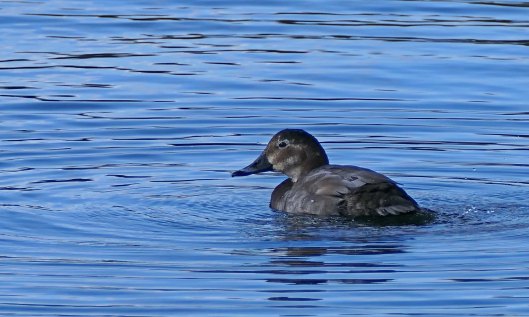
Even in the short time I’ve lived in Wales, the numbers of Pochard (Aythya ferina) I see each winter have declined, and my observations are confirmed by the facts: Pochards are now red-listed in the UK. According to information in the British Trust for Ornithology’s publication Into the Red, both the breeding and non-breeding populations of these birds have declined as have the ranges both breeding and non-breeding birds occupy, and they are classified as globally threatened by the IUCN (the International Union for Conservation of Nature).

240302 pochard male

So, it’s always a great pleasure when I do see Pochards on the local lakes and waterways. This male, with his fiery russet head, and female, with the mottled brown plumage that is so typical of female ducks, have been present at Cosmeston Lakes Country Lake this past week.

240302 pochard female

Rhizobium radiobacter

Tags

, , , , , ,

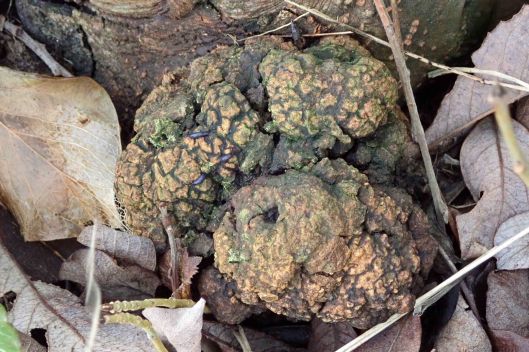
This is a strange one! I found some odd galls on a couple of willows (Salix species), large round lumpy masses around the base of the trunks, smaller lumpy growths further up the trunks and on the branches.

It turns out these are caused by a plant pathogen. I found a pdf on The British Society for Plant Pathology website, with the following explanation:

Rhizobium radiobacter is a soil-living, gram-negative, motile rod-shaped bacterium. It is a biotrophic pathogen that can alter the physiology and morphology of its host plant without killing it, resulting in tumourlike structures or galls. Prior to 2001, gall forming R. radiobacter was called Agrobacterium tumefaciens.

The pathogen enters the plant tissue through wounds, and the galls, also known as Crown galls, can be found on a huge variety of plant species. The one-page BSPP pdf has more information if you’re interested.

My first Palmate newt

Tags

, , , , , ,

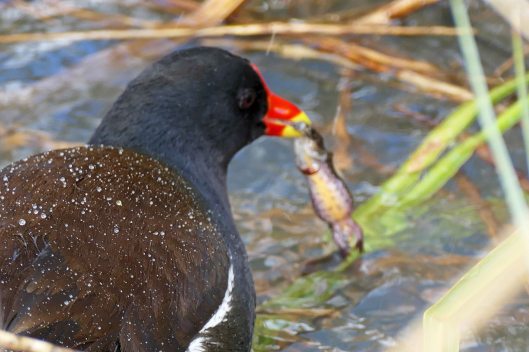
On Monday, I saw my very first Palmate newt (Lissotriton helveticus).

240229 palmate newt (1)

Unfortunately …

240229 palmate newt (2)

The Moorhen was treating the newt in almost the same way a cat sometimes plays with a mouse, dropping it, picking it up again, twirling it round, bashing it against the water and reeds. And, surprisingly, it didn’t eat the newt, just dropped it in the water and stalked away when some people came noisily walking along the adjacent boardwalk.
p.s. I’m hoping at some stage to see a live newt!