First Comma

Tags

, ,

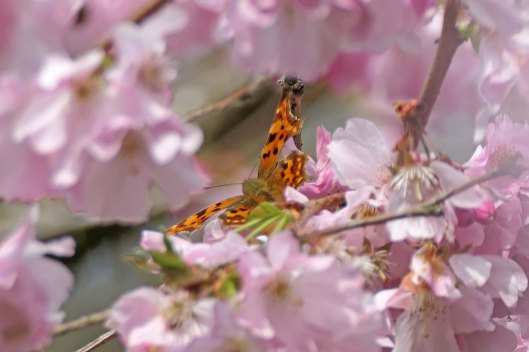
During Monday’s walk I finally saw my second butterfly in 2024, my first Comma, and this was my first photo of a butterfly this year – the first butterfly I saw was a Red admiral fluttering most unexpectedly outside my train window on a sunny day in January. My Comma is not the sharpest but I rather love the frothy pink of the ornamental Cherry blossom surrounding it.

240319 comma

Greenbottle

Tags

, , , ,

I was enjoying seeing a few flies and hoverflies out and about in the sunny sheltered spots during yesterday’s local meander but this little one, in particular, caught my eye with its iridescent green shimmer. It’s one of the so-called Greenbottle flies, a species of Lucilia, and is most likely the commonest of those species, Lucilia sericata, as it seems to have the correct identifying features. The Naturespot website entry lists these as a ‘pale basicosta and a single anterodorsal bristle on the mid tibia’, which may make you say ‘What???’ out loud, as I did, but fortunately they include photos to illustrate what this gobbledygook – er, scientific anatomical description refers to.

240318 greenbottle

Green-flowered wildflowers

Tags

, , , , , , , ,

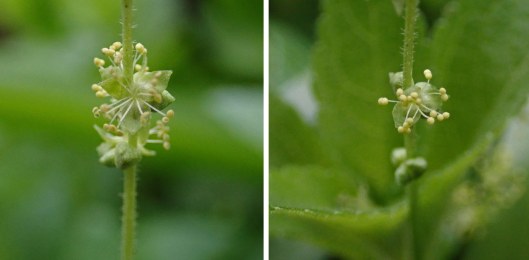
As the Wildflower Hour team wrote on social media when announcing this week’s challenge: ‘Some of the loveliest wildflowers are green! Can you find one for this week’s challenge?’. Well, yes, I can. In fact, I found three on yesterday’s meander, and I’m sure there must be more that I missed. My finds are:
240317 dog's mercury

Dog’s mercury (Mercurialis perennis). I didn’t know until today, when I was reading the First Nature website, that ‘Dog’s Mercury is an extremely poisonous plant and when eaten it has been known to cause vomiting, jaundice and coma.’ Of course, you’d have to be pretty stupid to eat it, but some foragers are pretty stupid!

240317 petty spurge

Petty spurge (Euphorbia peplus), a common sight along the edges of lanes and pavements, and scattered across any patch of waste ground. It’s just getting started again in my area after being knocked back by the cooler winter weather and the interminable rain.
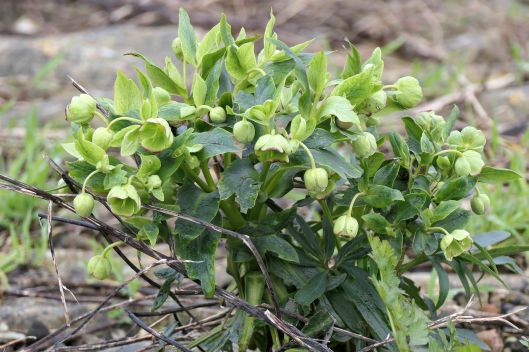
240317 stinking hellebore

Stinking hellebore (Helleborus foetidus). This was a surprise find along a local river embankment and, though Stinking hellebore is a UK native, because of its sudden appearance in that location, I think this particular specimen is probably a garden escapee.

A flatmate

Tags

, , ,

240316 daddy long-legs

This is just one of my current flatmates, the biggest one, but I know for sure that there are others. Its territory is my stairwell, though it most often parks itself, as shown below, under the alarm box. My other flatmates are not Daddy long-legs, but other spider species. There’s a tiny crab spider, which just appeared around the side of my laptop screen, as if to say ‘What about me?’ – it’s now been moved to a house plant, and there are a couple of equally tiny jumping spiders, which I find very cute, that spend most of their time amongst the plants along the window sills. Do you have spidery flatmates?

Name the singer

Tags

, , ,

The occasion in this short video was the first time I heard this beautiful melody in 2024, on 3 March, about 10 days earlier than in previous years. The next day I heard two more, in different separate locations, the following day yet one more. The miracle of migration is just so incredible; every year I am amazed and overjoyed when the birds return and begin to sing. Can you name the singer, and have you heard one yet?

A Little gull in the Bay

Tags

, , , , ,

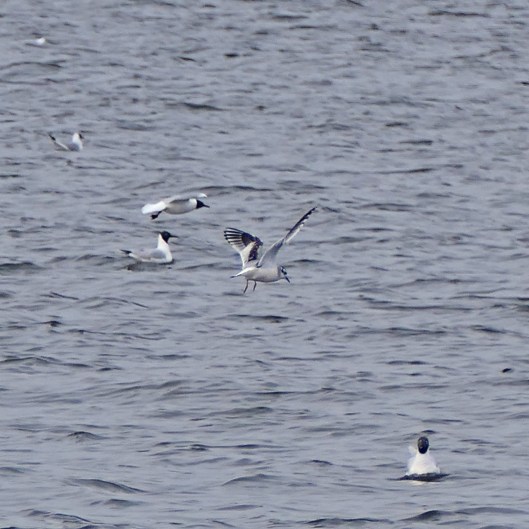
With more than 1000 Black-headed gulls currently feeding in Cardiff Bay, it took some help from my birding friends for me to locate this gorgeous 2cy Little gull (Hydrocoloeus minutus) on Sunday, though yesterday I managed to find it for myself. You just need to get your eye in, as its flight is quite distinctive, and so too is its size and colouring. These events – this accumulation of Black-headed gulls and a fleeting visit from a Little gull – are quite normal for this time of year as the gulls pass through en route to their breeding grounds.

240312 little gull

A bumblebee and its mimic

Tags

, , , , , ,

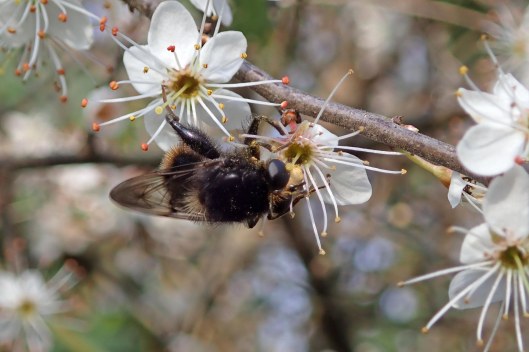
Though there was a cold nor’easterly wind blowing, occasional sunny periods brought out a few insects during my visit to Cardiff’s Grangemoor Park last Friday, and I was lucky enough to spot a couple of Buff-tailed bumblebee (Bombus terrestris) queens feeding on Blackthorn blossom.

240311 buff-tailed bumblebee

Even better, on one tree I found one of Britain’s larger hoverflies, one that mimics bumblebees, a Large bearfly (Criorhina ranunculi), one that can often be seen in early Spring on the blossom of willows, Blackthorn and Wild cherry. This hoverfly’s tail end can be white, orange or red in colour (this one’s was reddish); to see these variations, and his superb images of this hoverfly, check out Steven Falk’s Flikr album.

240311 Criorhina ranunculi

Willow catkins

Tags

, , , , , ,

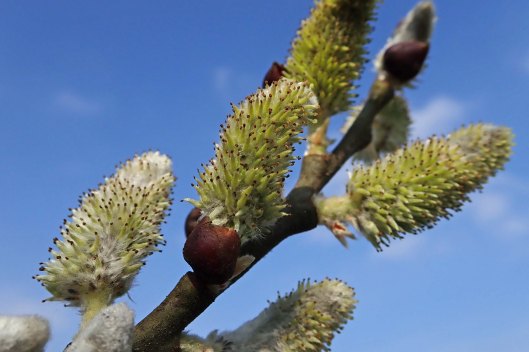
It’s that time of year when pussy willow – the gorgeous male catkins of the Goat willow (Salix caprea) and Grey willow (Salix cinerea) – is gracing the trees.

240310 willow catkins (1)

In Flora Britannica, Richard Mabey writes that ‘Because so little else was in leaf or flowers at this early season [early Spring], sprays of sallow have frequently been used as “palm” to decorate churches at Eastertide.’

240310 willow catkins (2)