Lifer: Waxwings

Tags

, , , ,

I’ve been waiting, and waiting, and waiting, trying to be patient, not always succeeding. Then, finally, this week, Waxwings arrived at a park in north Cardiff, just a train ride away from home. I’m sure the four Scandinavian stunners felt right at home in the freezing temperatures today – not so the 20 or so birders waiting for the birds to come down from the treetops to eat the berries on the row of Rowan trees edging the park’s central path. Unfortunately, the Waxwings only came down to feed for a very short time while I was there but these were my first ever Waxwings so I was more than happy! Have you seen any this year?
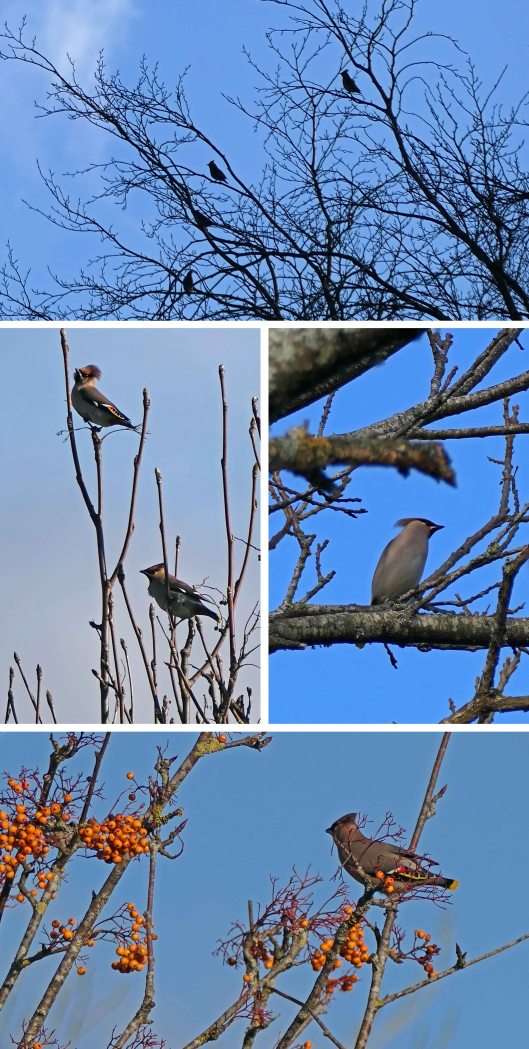
240113 waxwings

Three fungi on Ash keys

Tags

, , , , ,

When I’ve searched Ash keys (seed pods) previously for fungi, I’ve found the two most common, which are Diaporthe samaricola (the small black dots on the upper, seed portion of the ash key, in the image on the right below) and Neosetophoma samarorum (the much smaller, black speckles on the lower, wing part of the key, in the same image) (see Ash key fungi, January 2021).

During recent checks, however, I found a third fungus, the three all flourishing quite happily side by side on one set of keys. The third fungus is white, slightly woolly and minute, and it might be something like Flagelloscypha minutissima, but without examining it and its spores under a microscope (which I don’t have) I can’t be sure.

Pete Redshank returns

Tags

, , , , , ,

Every year I worry just a little about our local ringed Redshank, affectionately named Peter for the fact that s/he was ringed at Peterstone Great Wharf, just along the coast from Cardiff (see Tracking Mr Redshank, March 2017). This handsome bird is at least eight years old, possibly older, as it was ringed as an adult in February 2016. And each year our local Redshanks brave the perilous north Atlantic twice, to fly to Iceland to breed and then return to our shores to over-winter. Fortunately, our Pete has made it safely back; s/he was seen by another local birder late last year, and I finally caught up with our local celebrity last Sunday.

240111 pete redshank

Wild word: phenology

Tags

, , , ,

Phenology: noun; the study of cyclic and seasonal natural phenomena, especially in relation to climate and plant and animal life (Oxford Dictionary).

In 2020 I was amazed to find my first Lesser celandine of the ‘spring’ flowering on 8 January (First Lesser celandine of 2020). This year, I was even more amazed to find my first even before the turning of the year, on 29 December, and then located another two flowers at a different site on my 1 January walk around Cardiff Bay. The way our changing climate is affecting plant phenology (i.e. how flowering times are influenced by seasonal weather variations) is just crazy.

240107 lesser celandine

Out they pop

Tags

, , , , ,

Invertebrates in the winter: some warm sunshine in a sheltered spot and out they pop: my first hoverflies of the year, several species of fly, a couple of Honey bees and a queen Buff-tailed bumblebee.
I should probably add that these images were taken on Sunday, before freezing Baltic air came blasting in from the east, causing temperatures to plummet. I imagine these critters have all now taken shelter once more, in amongst dense vegetation like Ivy or within cosy holes in the earth.

240108 invertebrates awake

Good timing

Tags

, , , ,

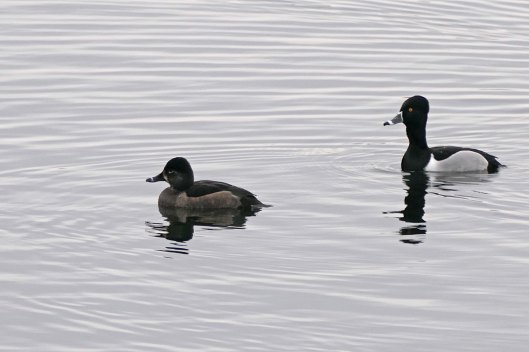
I timed my visit to the north Cardiff reservoirs extremely well last Thursday because, unbeknown to me, the previous day had seen the arrival of a handsome male Ring-necked duck, drawn no doubt by the presence of a female, who has spent much of the winter cruising about Lisvane Reservoir. She had enjoyed the company of another female for a short while and a male – perhaps the same male – for a few days as well, but has spent most of her days with the good numbers of Tufted ducks, Mallards, Coots and Little grebes that live in this reservoir’s shallow waters. I was also lucky that they were relatively close to the edge of the reservoir, which enabled me to get some reasonable photos of the male and female together. I’m not sure what had attracted their attention when I took this image – I never realised their necks could extend this far!

240108 ring-necked ducks

Winter 16

Tags

, , ,

The wet and windy weather may have passed but now it feels more like proper winter, with daytime high temperatures in single digits. Still, there are wildflowers to be found in bloom, some that we would usually see in a couple of months time rather than this early in the year. These sixteen are those I found on a walk around the outskirts of my town yesterday and this morning.

240107 winter16

A lovely Loon

Tags

, , , , , , ,

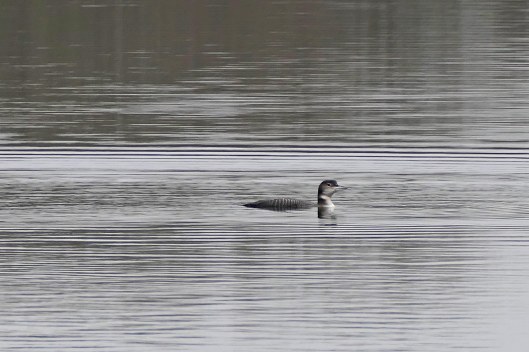
Finally, on Thursday, we had a break in the almost constant procession of wet and windy weather that made miserable many of my winter walks in December. To make the most of this, I caught the train to north Cardiff and enjoyed a wonderful walk around the recently reopened Llanishen and Lisvane Reservoirs, through the still muddy Nant Fawr woodland, and on down to Roath Park Lake. The highlight for me of this walk was getting relatively close views of the Great northern diver (Gavia immer) (what my American viewers would call a Common loon) that has been overwintering in Llanishen Reservoir. The bird was still some distance from me so my photos don’t do justice to how beautifully patterned this bird is but it was a pleasure to watch its constant diving.

Fungi keep fighting back

Tags

, ,

240105 oysters (2)Back in October, I posted about two species of fungi colonising human-built structures, Jelly ear growing on the painted sides of a PortaCabin and an unidentified wood-loving species sprouting from the boardwalk railing at Cardiff Bay Wetlands Reserve (Fungi fight back, 27 October 2023).

During one of my circuits of Cardiff Bay in December, I found another example of fungi fighting back, these lush Oyster mushrooms on a finger post alongside the path to the Bay Barrage.

240105 oysters (1)

Viburnum cushion scale

Tags

, , , ,

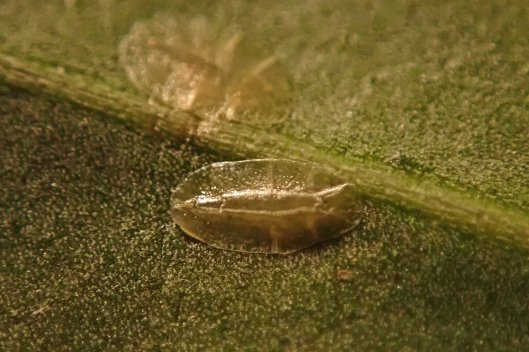
A couple of days ago I brought home two Ivy leaves I’d plucked off a plant on my way home (I’m trying to improve my sketching skills this year and figured these might be an easy leaf to start with). It was only when I got home and was looking more closely at them that I discovered one leaf had some tiny attachments on the underside.

240104 Lichtensia viburni (1)

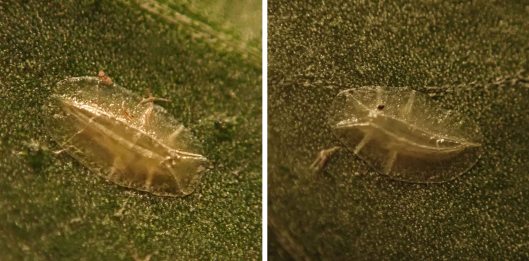
These are Viburnum cushion scale insects (Lichtensia viburni), which, in southern Europe, are recognised as pests on Olive trees, while, in northern Europe, they are mostly found on Ivy. From looking at photos on the Bladmineerders website, the scale insects I found are male. Beneath their outer shield, they will eventually moult into two-winged adults and fly off to find females to mate with.

240104 Lichtensia viburni (2)

The female scales are the ones some of you may have noticed on your plants – once fertilised in the springtime, their bodies swell with eggs and produce a white woolly covering, which is actually the egg sac. You can read more and see further images on the Bladmineerders website.