Yellow wags

Tags

, , , ,

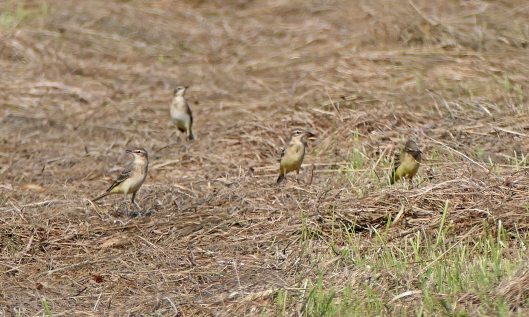
This week, for five days running, Cosmeston Lakes Country Park played host to the biggest flock of Yellow wagtails seen in the 20-odd years of local birding memory.
230907 yellow wags (1)

Although the park authority installed fencing, cattle yards and signage for conservation grazing a couple of years ago, no cattle have yet materialised, and the outer paddocks were once again cut, at the end of last week, so the Council can make some money selling the hay to a local farmer.

230907 yellow wags (2)

While conservation grazing would be much better for enhancing local biodiversity, this year’s hay cut coincided exactly with the time many birds were beginning their autumn migration. The field obviously had an abundance of insects and this proved perfect for the Yellow wagtails to feed up before heading south to overwinter in sub-Saharan Africa.

230907 yellow wags (3)

Usually, only one or two of these lovely little birds are seen at Cosmeston during spring and autumn migration so to have at least 36 birds counted by one local birder during his Tuesday morning visit is particularly special, as is the fact that the birds stayed around for several days.

230907 yellow wags (4)

If you’re not familiar with Yellow wagtails, the males are the bright yellow birds, the females and juveniles those with more subdued colouring. They’re very active tail-waggers, and were a joy to watch as they searched for food amongst the drying grasses.

Spider survivors

Tags

, , ,

I was entranced, and relieved, to spot these two Wasp spiders during a recent meander around Cardiff’s Grangemoor Park. The park, which was once a landfill site, was closed for a long time while repairs were done to its infrastructure, to stop contaminated water seeping from its interior rubbish. The repair process was conducted without any regard for the local flora and fauna and, during previous recent visits, I’d not managed to find any of these stunning spiders, first discovered at the park in August 2021. It’s good to know they’ve survived the upheaval.

230904 wasp spider

Stinking Roger

Tags

,

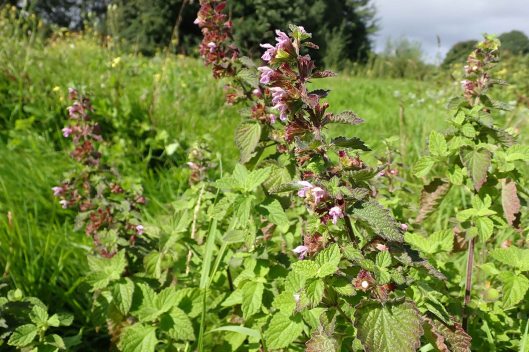
This new wildflower comes courtesy of a local birding pal who also likes to botanise. This is Black horehound (Ballota nigra), which my Flora Britannica says is also known as Stinking Roger. It doesn’t explain where the name Roger comes from but I can understand the ‘stinking’ – I rubbed the leaves and was left with a nasty pong on my fingers.

230903 black horehound (1)

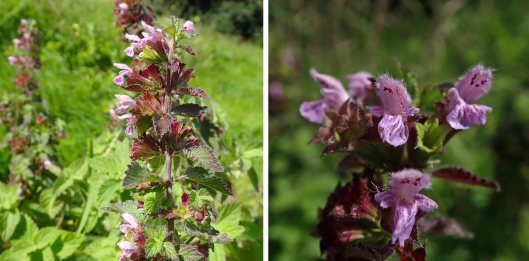
Interestingly, when I googled ‘Stinking Roger’, I found that name applied to several different plants all around the world. Roger obviously has a reputation! Also, an entry in the Merriam-Webster online dictionary gave three other vernacular names: Black archangel, Fetid horehound, and Stinking horehound.

230903 black horehound (2)

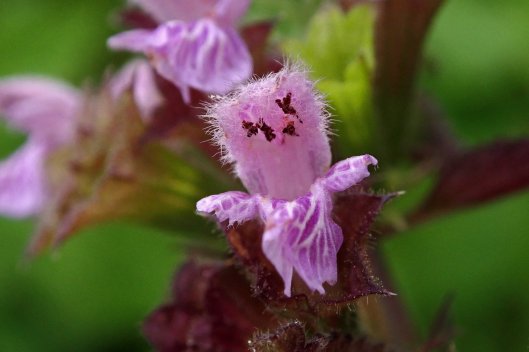
Despite its smell, Black horehound is a pretty enough perennial, a frequenter of path edges and waste ground, with lovely pinkish flowers arranged in whorls around the stem.

230903 black horehound (3)

Great crested grebe, great parent

Tags

, , , , , ,

These two Great crested grebe humbugs (chicks – the humbug name comes from their markings resembling a popular boiled sweet) looked too big still to be hitching a ride on their parent’s back and I think the parent thought so too, unceremoniously dumping them in the water to scratch an itch. But they soon climbed back on again. Great crested grebe parents are very tolerant!

Flea beetle

Tags

, , ,

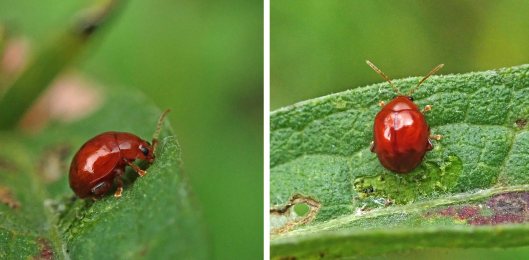
This ruddy creature is my first ever Flea beetle but, just as with my recent new leafhopper, I haven’t been able to put a specific name to it. There are two very similar species, Sphaeroderma rubidum and Sphaeroderma testaceum, and, though the UK Beetles website maintains that ‘they are easily distinguished, with a little experience, by sight; the colour and shape being unique’, I don’t have the necessary experience.

230901 flea beetle (1)

The website explains:

Body strongly rounded, often almost circular, pronotum very strongly narrowed from the base and very finely punctured. 2.3-3.5 mm.  –  S. rubidum
Body less strongly rounded, slightly but distinctly elongate, the pronotum less strongly narrowed from the base and more strongly punctured, especially towards the basal margin. 2.5-4.2 mm.  –  S. testaceum

230901 flea beetle (2)

Without seeing the two beetles side by side or, perhaps, knowing in advance specifically what to look for, I find myself unable to identify the beetle I found.

Tufted ducklings and their heroic mama

Tags

, , , , ,

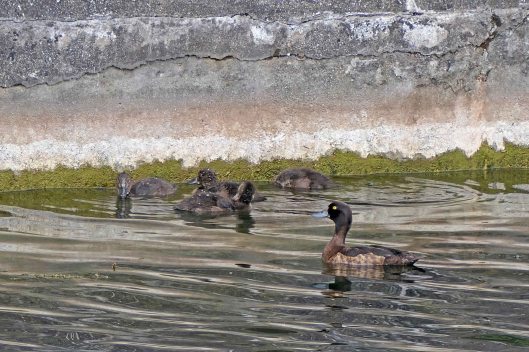
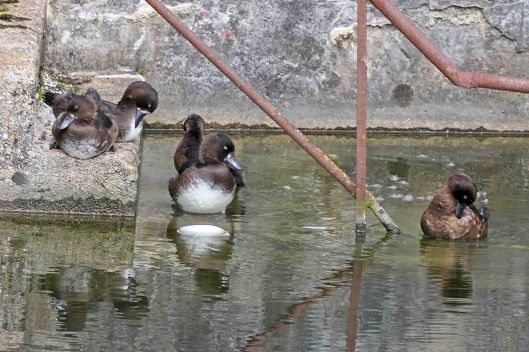
Every time I walk a circuit of Cardiff Bay I take a moment to check on these Tufted ducklings. Despite being confined in the now-flooded former Channel Dry Dock and living amongst human detritus, they have thrived, thanks to the parental care and constant vigilance of their mama. They should soon be able to fly and will then be able to escape their watery prison.

230831 tufted ducklings (1) 230807

~  7 August

230831 tufted ducklings (2) 230820

~ 20 August

230831 tufted ducklings (3) 230824

~ 24 August

Fossilised ripples

Tags

, , , ,

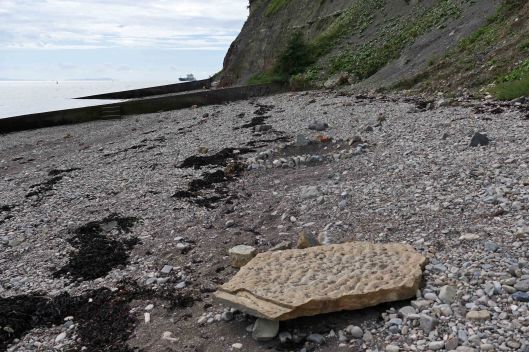
Geology fascinates me, and I am privileged to live in a geologically rich area, but it’s not a subject I know anything about so my geological blog posts on here are very few and far between. However, when a local birder posted on social media about a slab of rock he’d found on a local beach, and a local geologist later confirmed the find and shared a link explaining the rock’s origins, I just had to investigate.

230830 fossilised ripples (1)

The slab of rock was lying beneath the cliff at Penarth Head on the beach shown in the photo above. And, in fact, when I went and looked, I found several similar slabs. They had fallen from the top section of the cliff, which is known as the Lilstock Formation. Rather than attempt to explain the geology of these cliffs, it seems easiest if I refer you to the blog my geologist friend showed me: ‘Geological Walk at Penarth Head‘, published on the Geologists’ Association – South Wales Group website on 27 June 2021.

230830 fossilised ripples (2)

It wasn’t easy to capture in photographs but I hope you can see the ripple effect on the surface of these slabs. This is basically an ancient fossilised beach, the ripples caused by the action of water and tides on a muddy surface millions of years ago. The fact that I could touch a surface formed so long ago is something I find quite mind-boggling.

230830 fossilised ripples (3)