Late brood

Tags

, , , ,

The House martins that nest under the eaves of some of the houses and apartments around Penarth Marina are still busy feeding their young. These could be second broods, or possibly even third broods if the adults arrived back early enough. The RSPB website notes that the ‘fledged young from first broods often help their parents feed a second brood’. Good practice for their future breeding, I’m sure.

230829 house martins

Leafhopper: Populicerus sp.

Tags

, , , , ,

I found a new leafhopper species last week but, despite it having quite distinctive markings, I have not been able to identify it exactly. This is because there are several that look very similar and, even knowing the tree or plant they are on (in this case, Poplar), doesn’t help. One needs to examine their genitals to figure these little leafhoppers out.

230828 Populicerus sp (1)

There are five species of Populicerus showing in the Welsh database (Populicerus confusus, P. populi, P. albicans, P. nitidissimus, and P. laminatus), only four of which have been recorded in Wales (the first four in my list) and, of those, the numbers, except for P. confusus (64) are in single digits. That is likely to be a reflection of the difficulty of identifying the species rather than the populations of these leafhoppers.

230828 Populicerus sp (2)

All five species have similar markings but three have different colouring. However, Populicerus populi and P. laminatus are so similar that they require more intimate examination – the creature I found, the leafhopper shown here, is one of these two.

Common calamint

Tags

, ,

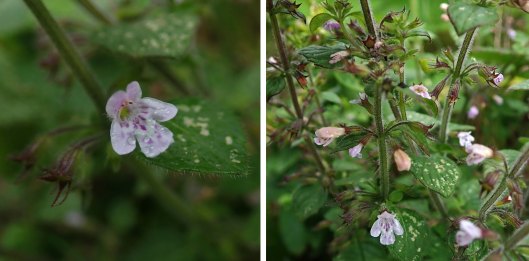
This is a new plant for me, and I freely admit to having walked past it several times before finally noticing it, perhaps because it only flowers from July to September. It’s Common calamint (Clinopodium ascendens), a member of the mint family, the Lamiaceae, and, not surprisingly, its leaves when crushed smell deliciously of mint.

230827 common calamint (1)

The plant in question, in the photo above, is the one with small greyish-looking leaves (though they’re actually green with white speckles) and even smaller pink flowers. My wildflower book says it can be found in a variety of habitats, from hedge banks and bushy areas to dry grassy scrubland and roadside verges. The plants I found were growing alongside an under-cliff path that leads to a local beach, so it seems this mint is very adaptable. Despite that, there are only 199 records in the Welsh biodiversity database, so perhaps I’m not the only person to walk past these plants without noticing them.

230827 common calamint (2)

My first autumn Wheatear

Tags

, , , , ,

I went looking and hoping for a Yellow wagtail – found none – but, all of a sudden, a bird flitted up from the grass not far ahead, disturbed by a passing dog, and my eye picked out a flash of white at its rear end. I had my binoculars to my eyes in seconds, scanned all around, but couldn’t relocate the bird. I walked on, keeping a careful eye out, noting the prospecting Pied wagtails and browsing Linnets, but no sign of that white bottom. I was about to turn around and head home when another roaming dog put all the birds up and she of the white rear end, this beautiful Wheatear, popped down quite close to me. My first of the autumn!

230826 wheatear

Urban Fox

Tags

, , ,

A chance glance over the edge of the bridge as I was walking home yesterday turned up this urban Fox, running down hill towards the bridge. It stopped, turning to face backwards to watch the approaching train, but it wasn’t at all phased by the noisy engine bearing down it, waiting till the last minute to leap into the bushes at the side of the tracks. And, as soon as the last carriage had passed, it hopped back on to the tracks again to continue its journey. Sadly, it didn’t look in the best of health, its hindquarters seemingly affected by mange.

230825 fox

Midweek treat

Tags

, , , , ,

Think of them as a palate cleanser; a floral pick-me-up; a Thursday tonic; a spiralling shot in the arm – the cheerful sight of Autumn lady’s tresses (Spiranthes spiralis) in full bloom amongst the lush grasses and wildflowers at my local country park. I hope you have some growing near you to help brighten your day!

Nematus septentrionalis

Tags

, , , , , ,

The sawfly larvae are back!

You may remember my post last summer (Sawfly larvae on Birch, July 2022) about the black-spotted yellow-and-green larvae of the sawfly Nematus septentrionalis that were munching through the leaves of a local Birch sapling. Well, luckily, the sapling survived but it’s now providing a feast for this year’s brood of the same sawflies.

This time around I’ve found the larvae at a much earlier stage of development. And, destructive though they may be, they do look rather cute curled up in their individual holes in the leaves, and quite different in colour at this young age.

Plus, this time I spotted the eggs they emerged from – and some eggs yet to hatch, laid by the adult sawfly along the veins of the leaves.

I may sound a trifle over-enthusiastic about creatures that are basically eating a tree. But, last year, something ate most of the larvae before they consumed too many leaves and, as there are a good number of hungry Stonechats, Whitethroats, Green- and Goldfinches currently in this field, I think the sawfly larvae’s days are probably numbered.

The crab catcher

Tags

, , , , , ,

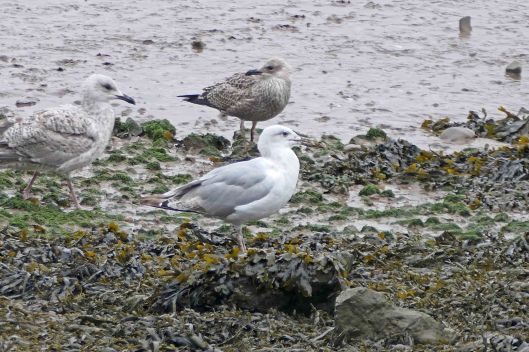
I was searching through the gull flock that was poking around on the mud flats, looking for any unusual birds, when this third-summer Herring gull suddenly lurched forward, splashing through the mud and almost falling into a watery hole. When it stood erect I saw why – it had caught itself a crab.

230823 herring gull and crab (1)

Of course, all the other gulls then wanted a piece, and the crab catcher was forced to fly around the small bay a few times to get them off its tail. Luckily, most of the other gulls were younger and less experienced than it was, so it was able to settle and pull its catch in to bite-sized chunks – though not without very close scrutiny from the hopeful and hungry!

230823 herring gull and crab (2)

The last dragon

Tags

, , , ,

Though I’m still hoping to spot another damselfly species, the Migrant hawker (Aeshna mixta) is probably the last of the larger dragonfly species I’ll see this year. I’ve spent many an enjoyable minute or ten watching these beauties flying back and forth along the edges of woodland rides and local pathways, waiting hopefully for them to perch, only to have them fly above the trees and disappear, or stop in a place too distant for photographs. So, I was especially grateful when this hawker proved to be much more cooperative.

230821 migrant hawker

By the sea

Tags

, , , , , , , , , ,

This week’s challenge for #WildflowerHour was ‘What can you find blooming along the coast?’. I’ve had a couple of walks around parts of Cardiff Bay this week and could’ve included a lot of plants but have selected just four.

230820 vipers-bugloss

As Cardiff Council has (amazingly!) refrained from cutting the Barrage grass in recent months, the few Viper’s-bugloss (Echium vulgare) plants that were previously growing there have increased markedly. There must be over 50 plants now spread across the expanse of the Barrage, and the blue flowers make a lovely contrast against the grass green.

230820 tansy

I rarely see Tansy (Tanacetum vulgare), so this single plant, thriving on the sandy slope below the children’s playground on the Barrage, was a delightful surprise.

230820 white campion

Growing just along from that Tansy plant, was this lone White campion (Silene latifolia) plant. It wasn’t looking as healthy as the Tansy but was covered in seed heads so I think it was just past its best.

230820 wood sage

This Wood sage (Teucrium scorodonia) was a total surprise as you wouldn’t necessarily expect a plant with ‘wood’ in its name to be growing alongside a seaside path. My book says it prefers acid soils but, when I googled, I found many examples of Wood sage growing on scree slopes, amongst limestone, and close to sand dunes, so I guess it’s very adaptable.