• ABOUT
  • BIRDING 2018
  • Birding 2019
  • BLOG POSTS
  • Butterflies 2018
  • Resources

earthstar

~ a celebration of nature

earthstar

Tag Archives: bees

An Ivy bee mating ball

24 Sunday Sep 2017

Posted by sconzani in insects, nature, plants

≈ 5 Comments

Tags

bee mating frenzy, bees, bees on ivy, British bees, Colletes hederae, Ivy bee, Ivy bee mating ball, ivy flowers

Some days are just magical! I went out looking for birds – instead I got mobbed by Red admiral butterflies while walking along the coastal path, which made me grin like a Cheshire cat, and then I found these little buzzers.

170924 Ivy bees Colletes hederae (4)
170924 Ivy bees Colletes hederae (5)

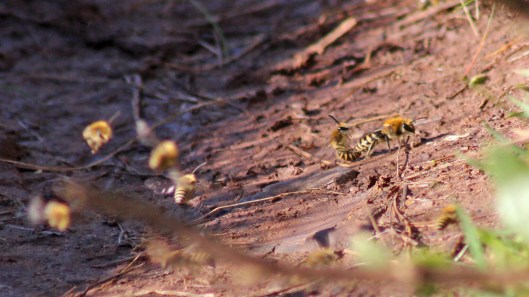
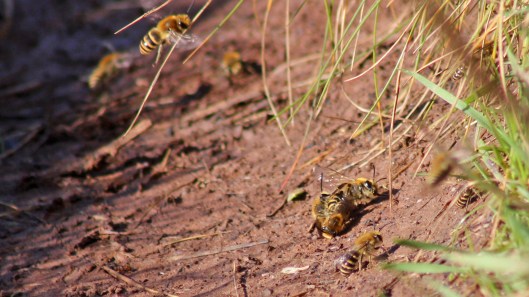
They’re Ivy bees (Colletes hederae) and, as their name suggests, they feed on ivy flowers so they don’t appear until early autumn, when most other bees are winding down activities for the year. With an orange woolly thorax and orange-and-black striped abdomen, these bees are easy to identify, though Colletes hederae was only described as a separate species back in 1993 (before that it was confused with two other species of Colletes). Ivy bees only arrived in Britain from Europe in 2001 but have since gradually spread across southern England and in to south Wales: the extent of their spread is being tracked by BWARS, the Bees, Wasps and Ants Recording Society, so please do log your sightings, either on their website here or with your local records centre.

170924 Ivy bees Colletes hederae (6)
170924 Ivy bees Colletes hederae (7)

I had seen my first Ivy bees for the year the previous week but this new sighting was more special because it was a colony. Though the Ivy bee is a solitary bee (it doesn’t form a hive), a group of females will often excavate their individual burrows and underground chambers together in a sandy bank or similar area of loose earth. And, as the BWARS website explains, male bees often wait by the burrows for females to return and then pounce on them. When the other males spot what’s happening, they also want a piece of the action, jumping on the mating couple to form a writhing mass or mating ball. I was lucky enough to see one of these happen, as shown below.
170924 Ivy bees Colletes hederae (1)170924 Ivy bees Colletes hederae (2)170924 Ivy bees Colletes hederae (3)

Like Loading...

What’s on the teasel, 2

30 Wednesday Aug 2017

Posted by sconzani in flowers, insects, nature, wildflowers

≈ 1 Comment

Tags

6-spot Burnet moth, bees, British wildflowers, bumblebees, Six-spot burnet, Teasel

The pretty lilac of teasel flower is beginning to fade now but the mini beasts have certainly been enjoying its nectar. In my local parks and reserves it’s a favourite with the 6-spot Burnet moths and with bees of all species. And not long after those pretty little flowers fade away, the seeds will begin to form and grow, and provide food for the birds, particular the dapper little goldfinch, during the winter months. I’ll try to catch photos of them on the teasels in a couple of months’ time.

170830 whats on the teasel 6spot burnet (1)
170830 whats on the teasel 6spot burnet (2)
170830 whats on the teasel bees (1)
170830 whats on the teasel bees (2)
170830 whats on the teasel bees (3)
Like Loading...

The Cuckoos of the bee world

15 Monday May 2017

Posted by sconzani in insects, nature

≈ Leave a comment

Tags

bees, Cuckoo, Cuckoo bees, Nomada bees, Nomada species

You’ve no doubt heard of the Cuckoo bird that lays its eggs in the nests of other birds to get them to do all the hard work of feeding and raising their chicks but have you heard of the Cuckoo bees? These are the Nomada species, a huge group of bees with over 850 species worldwide, though only about 30 of these can be found in Britain. Even so, it is extremely difficult to tell those 30 species apart so I’m not even going to attempt to identify those in my photos.

170509 Nomada sp Cuckoo bees (3)

As you may have guessed, these bees lay their eggs in the nests of other bee species, primarily the Andrena species. When they hatch, the Cuckoo bee larvae eat the eggs of their host and then consume the food the Andrena had gathered for their own young. It’s very cunning if rather nasty behaviour.

170509 Nomada sp Cuckoo bees (1)
170509 Nomada sp Cuckoo bees (5)
170509 Nomada sp Cuckoo bees (2)
170509 Nomada sp Cuckoo bees (4)
Like Loading...

Signs of Spring, 3

25 Saturday Mar 2017

Posted by sconzani in insects, ladybird, nature, spring, wildflowers

≈ 7 Comments

Tags

bees, butterflies, flies, hoverflies, insects, insects in springtime, ladybird, shieldbugs, Spring has sprung

You know Spring has well and truly arrived when the insects start appearing in reasonable quantities so, judging by the numbers of insects I’ve seen on my walks over the past two days, I would say Spring has most definitely sprung, wouldn’t you?

170325 Spring insects (1)
170325 Spring insects (2)
170325 Spring insects (3)
170325 Spring insects (4)
170325 Spring insects (5)
170325 Spring insects (6)
170325 Spring insects (7)
170325 Spring insects (8)
170325 Spring insects (9)
170325 Spring insects (10)
170325 Spring insects (11)
170325 Spring insects (12)
Like Loading...

The pleasure of the bee

10 Saturday Sep 2016

Posted by sconzani in flowers, insects, nature

≈ 4 Comments

Tags

bees, bumblebee, Kahlil Gibran, Megachile sp, the pleasure of the bee, The Prophet

160910-bees-flowers-2

Go to your fields and your gardens, and you shall learn that
it is the pleasure of the bee to gather honey of the flower,
But it is also the pleasure of the flower to yield its honey to the bee.
For to the bee a flower is a fountain of life,
And to the flower a bee is a messenger of love,
And to both, bee and flower, the giving and the receiving of pleasure
is a need and an ecstasy.

from Kahlil Gibran, The Prophet

160910-bees-flowers-1

Like Loading...
Newer posts →

About me

sconzani

sconzani

I'm a writer and photographer; researcher and blogger; birder and nature lover; countryside rambler and city strider; volunteer and biodiversity recorder.

View Full Profile →

Follow earthstar on WordPress.com

Enter your email address to follow this blog and receive notifications of new posts by email.

Recent blog posts

  • N is for nest December 19, 2025
  • M is for mite December 18, 2025
  • L is for lepidopteran lifers December 17, 2025
  • K is for Keeled skimmers December 16, 2025
  • J is for Jersey tiger December 15, 2025

From the archives

COPYRIGHT

Unless otherwise acknowledged, the text and photographs on this blog are my own and are subject to international copyright. Nothing may be downloaded or copied without my permission.

Fellow Earth Stars!

  • Unknown's avatar
  • Unknown's avatar
  • Unknown's avatar
  • Unknown's avatar
  • Unknown's avatar
  • Unknown's avatar
  • Unknown's avatar
  • Unknown's avatar
  • Unknown's avatar
  • Unknown's avatar
  • Unknown's avatar
  • Unknown's avatar
  • Unknown's avatar
  • Unknown's avatar
  • Unknown's avatar
  • Unknown's avatar
  • Unknown's avatar
  • Unknown's avatar
  • Unknown's avatar
  • Unknown's avatar
  • Unknown's avatar
  • Unknown's avatar
  • Unknown's avatar
  • Unknown's avatar
  • Unknown's avatar
  • Unknown's avatar
  • Unknown's avatar
  • Unknown's avatar
  • Unknown's avatar
  • Unknown's avatar
  • Unknown's avatar
  • Unknown's avatar
  • Unknown's avatar
  • Unknown's avatar
  • Unknown's avatar
  • Unknown's avatar
  • Unknown's avatar
  • Unknown's avatar
  • Unknown's avatar
  • Unknown's avatar
  • Unknown's avatar
  • Unknown's avatar
  • Unknown's avatar
  • Unknown's avatar
  • Unknown's avatar
  • Unknown's avatar
  • Unknown's avatar
  • Unknown's avatar
  • Unknown's avatar
  • Unknown's avatar

Blog at WordPress.com.

Privacy & Cookies: This site uses cookies. By continuing to use this website, you agree to their use.
To find out more, including how to control cookies, see here: Cookie Policy
  • Subscribe Subscribed
    • earthstar
    • Join 667 other subscribers
    • Already have a WordPress.com account? Log in now.
    • earthstar
    • Subscribe Subscribed
    • Sign up
    • Log in
    • Report this content
    • View site in Reader
    • Manage subscriptions
    • Collapse this bar
 

Loading Comments...
 

You must be logged in to post a comment.

    %d