• ABOUT
  • BIRDING 2018
  • Birding 2019
  • BLOG POSTS
  • Butterflies 2018
  • Resources

earthstar

~ a celebration of nature

earthstar

Tag Archives: British galls

Galls: Phytoptus avellanae

20 Monday Feb 2023

Posted by sconzani in insects, trees

≈ 3 Comments

Tags

British galls, bud galls, gall mites, gall-causing mites, galls on Hazel, Hazel, mite galls, mites, Phytoptus avellanae

These are my latest gall finds, caused by the mite species Phytoptus avellanae, shown here on Hazel (Corylus avellana) though they can also affect the buds of Filbert (Corylus maxima). The feeding of the mites on the plant cells within the buds causes those buds to swell and multiply. You can see a comparison in my photo below, the mite-infected gall bud on the left, the normal bud on the right.

230220 gall Phytoptus avellanae (1)

The mites that cause these galls are tiny, so rarely seen, but the Dutch Bladmineerders website has some excellent photos showing them in minute detail. As with so many galls, they are thought to be widespread in Britain but are not well recorded. So, if you’re out and about enjoying a spring walk and spot some Hazel, do please cast an eye over the buds, and record any galls you see. Citizen scientists really do make a difference to our knowledge of the natural world around us.

230220 gall Phytoptus avellanae (2)

Like Loading...

Merry Mistletoe!

25 Sunday Dec 2022

Posted by sconzani in plants

≈ 2 Comments

Tags

British galls, British plants, Christmas plant, Mistletoe, white berries

Whatever today means to you – holy day or holiday, special times with your family, or just another day (that’s me), I hope you find time for a walk in Nature, for the peace and joy it can bring. Also, merry feasting!

221225 mistletoe

Like Loading...

Red, no danger

24 Friday Jun 2022

Posted by sconzani in insects, plants

≈ Leave a comment

Tags

Bedeguar gall wasp, Bedeguar wasp gall, British galls, Diplolepis rosae, gall, gall on rose

Bright red in the landscape always draws my eye (witness Wednesday’s beetles), so this burst of vibrant colour on a low-growing rose bush immediately attracted me. And the fact that the rose was ‘persuaded’ to create this object by the larvae of a tiny wasp is really quite mind-blowing. That wasp is a Bedeguar gall wasp (Diplolepis rosae), and you may remember my somewhat haphazard but ultimately successful attempts to see one of these wasps when I kept a gall in a jar to see what emerged (Bedeguar gall wasp, May 2020). This time I’m restricting myself to admiring the wasp’s astonishing creation.

220624 bedeguar gall

Like Loading...

Rose leaf galls

09 Thursday Jun 2022

Posted by sconzani in insects, leaves

≈ Leave a comment

Tags

Blennocampa phyllocolpa, British galls, British sawflies, galls caused by sawflies, galls on roses, insects on roses, leaf-rolling sawfly larvae, rolling leaves on roses, Rose galls

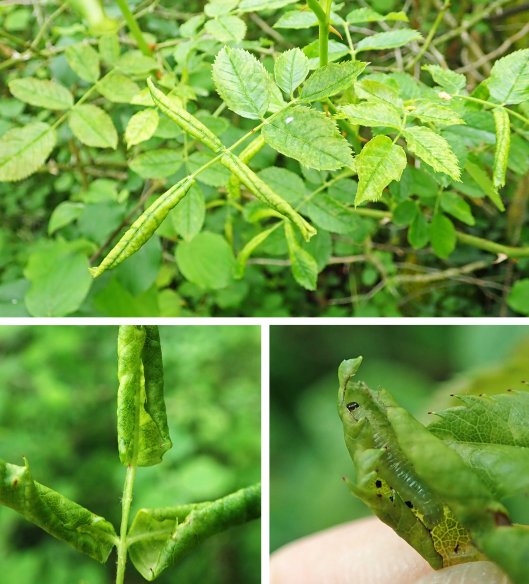
I was alerted to the possibility of finding these galls by a post I saw on Twitter – social media certainly is good for spreading the word about what to look for when and where.

220609 Blennocampa phyllocolpa

These galls, these downward rollings of the leaf edges on rose species, are due to the larvae of the sawfly Blennocampa phyllocolpa. Presumably, they cause the leaves to roll in order to create shelters for themselves, as the leaves seem otherwise unharmed, though, when I carefully unrolled perhaps 10 leaves, I only found a larva in one of them. The adult sawfly is a tiny black creature, photos of which you can see on The Sawflies (Symphata) of Britain and Ireland website. If you have roses in your garden, you may already be aware of this sawfly’s activities on your plants.

Like Loading...

Holm oak gall mites

09 Wednesday Feb 2022

Posted by sconzani in insects, trees

≈ Leave a comment

Tags

Aceria ilicis, British galls, gall mites, galls, galls on oak trees, Holm oak, mite galls, mite galls on Holm oak

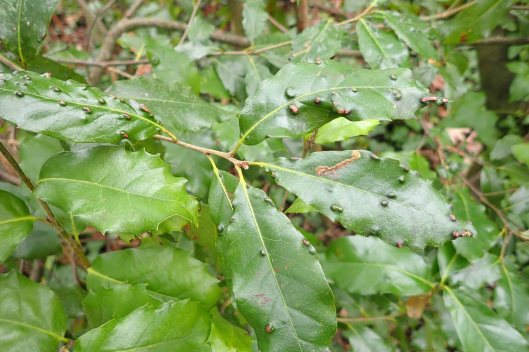
During yesterday’s walk, when checking for leaf mines on the leaves of Holm oak (large numbers of Ectoedemia heringella present – you can see one in the photo below), I noticed a huge abundance of small bumps covering many of the leaves.

220209 Aceria ilicis on holm oak (1)

These are the galls caused by the miniscule mite Aceria ilicis. On the underside (though sometimes also on top), the depression in the leaf is filled with tiny brown hairs (an erineum) where the mites make their home. The galls can be seen throughout the year, so next time you spot a Holm oak, check out its leaves.

220209 Aceria ilicis on holm oak (2)
220209 Aceria ilicis on holm oak (3)
Like Loading...

Oak: a new gall

25 Tuesday May 2021

Posted by sconzani in insects, leaves, spring, trees

≈ Leave a comment

Tags

Andricus curvator, British galls, galls on Oak leaves, galls on oak trees, Oak gall wasps, oak galls, oak tree

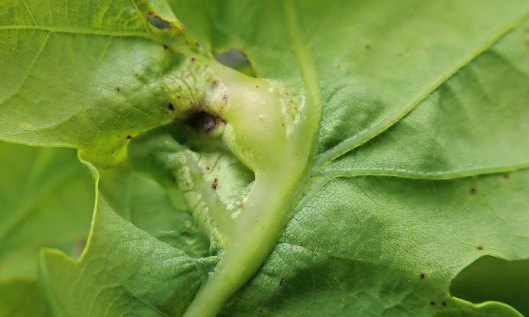
With heavy cloud and occasional rain, Sunday was not a day for finding butterflies in the woodland. So, I decided to look more closely at Oak leaves to see what I might find, and that strategy paid off in spades as the next few days’ blog posts will show. First up, I found a gall I hadn’t seen before, which turns out to be the sexual generation of the gall wasp Andricus curvator.

210525 Andricus curvator (1)

When the adult wasps emerge in the spring from the agamic (asexual) generation galls, which are formed on buds in the autumn and fall to the ground to over-winter, they lay their eggs mostly on Oak leaves but also, sometimes, on twigs or catkins, so these galls can take several forms. The ones I found (and they were numerous) were all on leaves, causing malformations and swellings, as you can see from the photos above and below.

210525 Andricus curvator (2)
210525 Andricus curvator (3)

I was tempted to split a gall open to see what was inside but it turns out I didn’t have to, as something had nibbled away at one gall, revealing a second round gall inside (see below). The larvae within this inner gall will emerge in the autumn to lay its eggs on Oak buds, and so the process will continue.

210525 Andricus curvator (4)

Like Loading...

238/366 Midge galls

25 Tuesday Aug 2020

Posted by sconzani in autumn, insects, nature, plants, wildflowers

≈ 2 Comments

Tags

British galls, British insects, British wildflowers, Cosmeston Lakes Country Park, galls on wild carrot, Kiefferia pericarpiicola, midge gall, Wild carrot

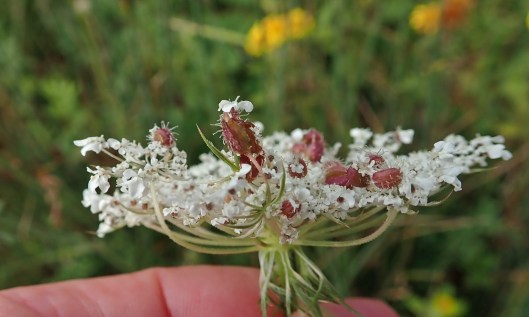
I was looking around at the various wildflowers yesterday at Cosmeston, seeing what insects might be about, when I noticed these odd growths on some of the Wild carrot flower heads. I split one open with my finger nail and a miniscule orange blob fell out; turns out that was the larva of a midge with the long-winded name of Kiefferia pericarpiicola.

200825 Kiefferia pericarpiicola (1)

The galls start off green (below left), before turning pinkish and eventually brown. According to the Nature Spot website, these galls can be seen from late summer through to autumn, after which the larvae will leave the gall and drop down to the soil to pupate. The midge only occurs in southern parts of Britain at the moment – and I only found two previous records in the Welsh biodiversity database – but perhaps that will change as our climate continues to warm and the midge flies further afield. It’s also possible, of course, that this insect is under-recorded – it seems the midge itself is almost never seen, only its gall creations.

OLYMPUS DIGITAL CAMERA
Like Loading...

137/366 Bedeguar gall wasp

16 Saturday May 2020

Posted by sconzani in insects, nature

≈ 7 Comments

Tags

Bedeguar gall wasp, British galls, British wasps, Diplolepis rosae, gall on dog-rose, gall wasps, galls, Robin's pincushion

You might remember that, a few months ago, I posted about the (supposedly) empty galls of the Bedeguar gall wasp I’d found during a wet walk at Cosmeston Lakes Country Park (Empty pincushions, January 2020). A week or so after writing that post, I was back at Cosmeston and remembered to harvest one of the galls, which has ever since been sitting in a sealed jar on my kitchen windowsill.

200516 diplolepis rosae gall (1)
200516 diplolepis rosae gall (2)
200516 diplolepis rosae gall (3)

Although the many holes in the gall made me think that all of its inhabitants had already hatched, I decided to wait and see if anything else appeared. Two days ago I noticed movement in the jar and, taking a closer look, found two different species of wasp had emerged.

200516 diplolepis rosae (1)

This is one of them, and I’m 99% certain this is the gall causer itself, the Bedeguar gall wasp, Diplolepis rosae, the offspring of the wasp that caused the gall to form in the first place. These wasps are so tiny – just 3-4 mm long – that most of us don’t usually see them so I was very pleased to have this one emerge from its gall.

200516 diplolepis rosae (2)

There is a bit of a story attached to the second wasp that emerged, and I am currently awaiting confirmation of its identity. As soon as I know more, I’ll write it up in a further post.

Like Loading...

120/366 What’s in a gall?

29 Wednesday Apr 2020

Posted by sconzani in insects, nature

≈ 3 Comments

Tags

British galls, British wasps, parasite of Urophora cardui, parasitic wasp, Thistle gall fly, Thistle gall fly gall, Urophora cardui

Back in October 2017, I blogged about a gall I’d found (More galls, part 2), the gall created by the Thistle gall fly (Urophora cardui). Here are two photos of those galls: on the left, the gall growing on the thistle (in fact, there are two galls – there’s a second one, still quite small, in the background to the left) and, on the right, a dried version, which I harvested from a thistle plant at the end of last year and which I’ve since been keeping at home in a jar.

200429 1 thistle gall fly gall
200429 2 thistle gall fly gall

According to my research, the Thistle gall flies don’t usually emerge until June but last week flying creatures began emerging from the gall. On closer examination, I found the empty pupae case (pictured below right) poking out of one of several holes in the gall.

200429 3 thistle gall fly gall
200429 4 thistle gall fly gall parasite

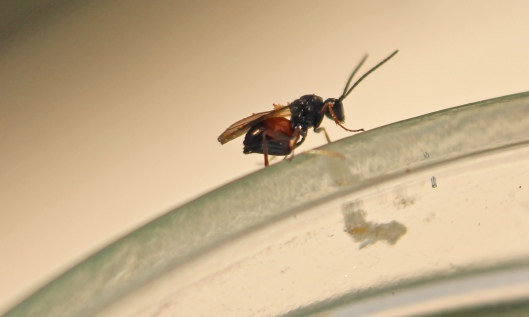
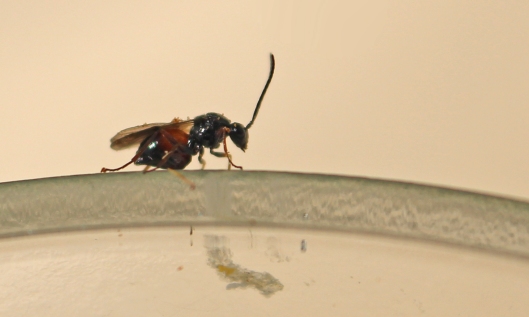
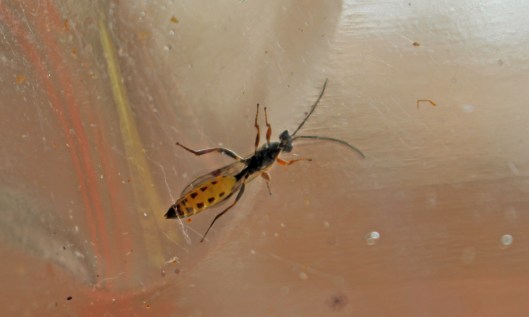
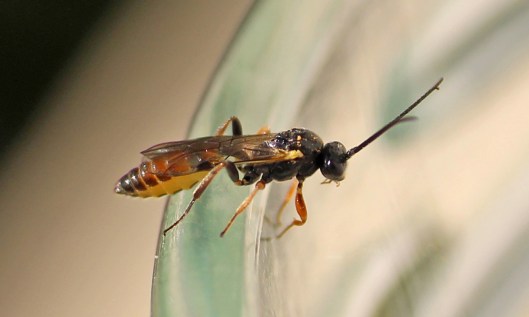
So far, five little critters have hatched but these are not Thistle gall flies. They appear to be some kind of parasitic wasp, which I have not yet managed to identify – there are thousands of species of parasitic wasp and these are not the species that is normally considered the primary parasite of the Urophora cardui (which is a wasp called Eurytoma robusta).

200429 5 thistle gall fly gall parasite

Underside of wasp, photographed through glass of jar

I don’t know whether any Thistle gall fly larvae or pupae still survive within the gall or, indeed, whether anything else will yet emerge. So, for now, the gall remains in its jar, and I’ll post again if any other aliens appear.

This story has a sequel as all in this gall was not as it seemed – here’s a link to part 2, A Tale of two galls, May 2020.

200429 6 thistle gall fly gall parasite

One of the mystery wasps, sitting on the edge of the jar, as it was being released

Like Loading...

31/366 Empty pincushions

31 Friday Jan 2020

Posted by sconzani in insects, nature, plants

≈ 5 Comments

Tags

Bedeguar gall wasp, British galls, Diplolepis rosae, gall on dog-rose, gall wasps, galls, Robin's pincushion

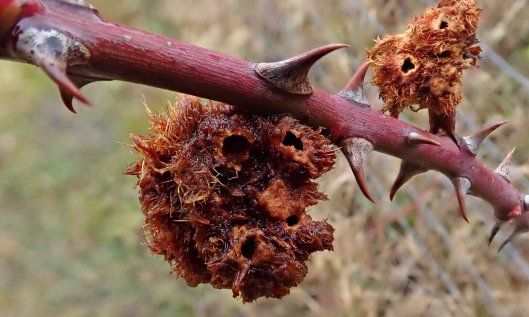
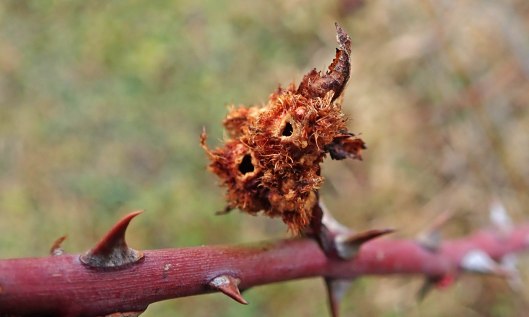
Robin’s pincushions are the amazing gall structures created on Dog roses by the larvae of Diplolepis rosae, the Bedeguar gall wasp.

200131 Robins pincushions (1)

I’ve seen the bright red galls many times during the summer months but I’ve not looked for them in the winter, so it was interesting today to find these and to see the very obvious holes where the adult wasps have hatched out. If it hadn’t been raining, I would have broken one off and brought it home for a closer look inside … maybe next week.

200131 Robins pincushions (2)

Like Loading...
← Older posts
Newer posts →

About me

sconzani

sconzani

I'm a writer and photographer; researcher and blogger; birder and nature lover; countryside rambler and city strider; volunteer and biodiversity recorder.

View Full Profile →

Follow earthstar on WordPress.com

Enter your email address to follow this blog and receive notifications of new posts by email.

Recent blog posts

  • M is for mite December 18, 2025
  • L is for lepidopteran lifers December 17, 2025
  • K is for Keeled skimmers December 16, 2025
  • J is for Jersey tiger December 15, 2025
  • I is for Ichneumon December 14, 2025

From the archives

COPYRIGHT

Unless otherwise acknowledged, the text and photographs on this blog are my own and are subject to international copyright. Nothing may be downloaded or copied without my permission.

Fellow Earth Stars!

  • Unknown's avatar
  • Unknown's avatar
  • Unknown's avatar
  • Unknown's avatar
  • Unknown's avatar
  • Unknown's avatar
  • Unknown's avatar
  • Unknown's avatar
  • Unknown's avatar
  • Unknown's avatar
  • Unknown's avatar
  • Unknown's avatar
  • Unknown's avatar
  • Unknown's avatar
  • Unknown's avatar
  • Unknown's avatar
  • Unknown's avatar
  • Unknown's avatar
  • Unknown's avatar
  • Unknown's avatar
  • Unknown's avatar
  • Unknown's avatar
  • Unknown's avatar
  • Unknown's avatar
  • Unknown's avatar
  • Unknown's avatar
  • Unknown's avatar
  • Unknown's avatar
  • Unknown's avatar
  • Unknown's avatar
  • Unknown's avatar
  • Unknown's avatar
  • Unknown's avatar
  • Unknown's avatar
  • Unknown's avatar
  • Unknown's avatar
  • Unknown's avatar
  • Unknown's avatar
  • Unknown's avatar
  • Unknown's avatar
  • Unknown's avatar
  • Unknown's avatar
  • Unknown's avatar
  • Unknown's avatar
  • Unknown's avatar
  • Unknown's avatar
  • Unknown's avatar
  • Unknown's avatar
  • Unknown's avatar
  • Unknown's avatar

Blog at WordPress.com.

Privacy & Cookies: This site uses cookies. By continuing to use this website, you agree to their use.
To find out more, including how to control cookies, see here: Cookie Policy
  • Subscribe Subscribed
    • earthstar
    • Join 667 other subscribers
    • Already have a WordPress.com account? Log in now.
    • earthstar
    • Subscribe Subscribed
    • Sign up
    • Log in
    • Report this content
    • View site in Reader
    • Manage subscriptions
    • Collapse this bar
 

Loading Comments...
 

You must be logged in to post a comment.

    %d