• ABOUT
  • BIRDING 2018
  • Birding 2019
  • BLOG POSTS
  • Butterflies 2018
  • Resources

earthstar

~ a celebration of nature

earthstar

Tag Archives: British moths

Some recent moths

16 Monday Jul 2018

Posted by sconzani in insects, nature

≈ 2 Comments

Tags

Blood-vein, British moths, Burnet companion, Common purple & gold, Glyphipterix thrasonella, moths, Orange-spot piercer, Riband wave, Riband wave banded form, Scarlet tiger

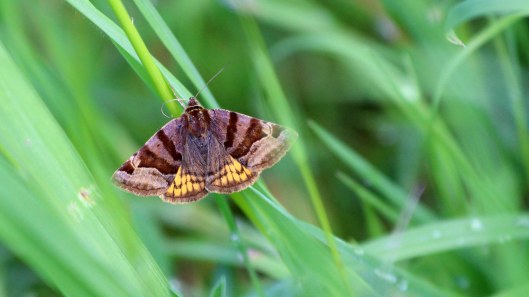
Though they seem to have disappeared now, the Burnet companions (Euclidia glyphica) were out in force at Cosmeston for about six weeks, from the last day of May until early July.

180716 1 Burnet companion

The Common purple & gold (Pyrausta purpuralis) is a tiny but very colourful moth – a rich maroon-purple base with pretty gold markings.
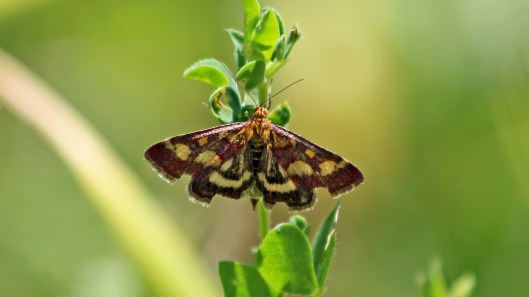
180716 2 Pyrausta purpuralis

With a thin red line running horizontally from one wing tip to the other, it’s easy to see how the Blood-vein (Timandra comae) got its name.

180716 3 Blood-vein

Glyphipterix thrasonella (no common name) is another very small moth, as you can tell from its size relative to my fingers, and is another with attractive markings, this time bright light blue on a gold base.
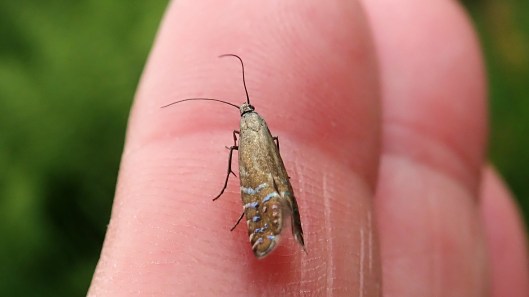
OLYMPUS DIGITAL CAMERA

In Bute Park recently I spotted two different species of moth. The first was this tiny micro on Hogweed, an Orange-spot piercer (Pammene aurana).

180716 5 Orange-spot piercer

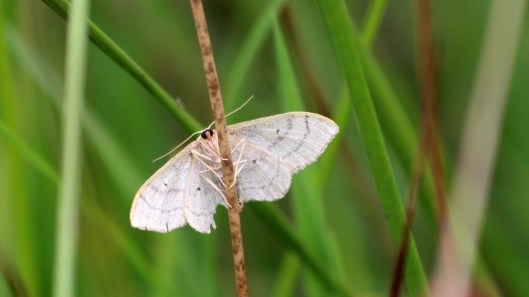
I didn’t have to try hard to see the second moth as it fluttered down from a tree on to the earth in front of me. This is a Riband wave (Idaea aversata).
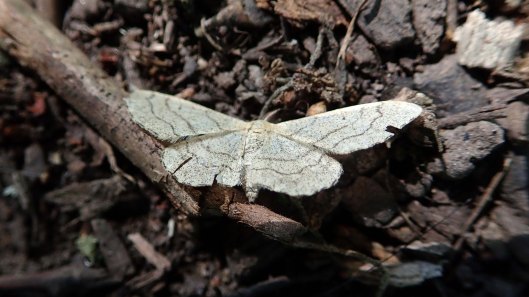
OLYMPUS DIGITAL CAMERA

And, while we’re on the subject of Riband waves, here’s another but this is the banded form – note how the area between the two lines on its wings has been ‘coloured in’.
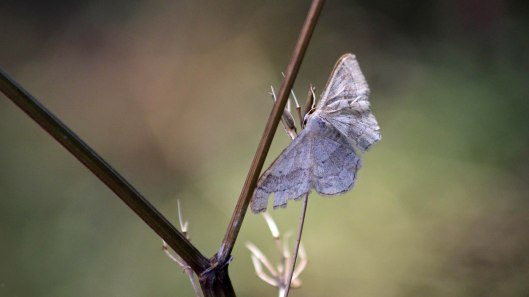
180716 7 Riband wave banded form

Last but certainly not least is this stunning Scarlet tiger (Callimorpha dominula), which was sitting on the grassy path in front of me during a recent meander around Lavernock Nature Reserve.
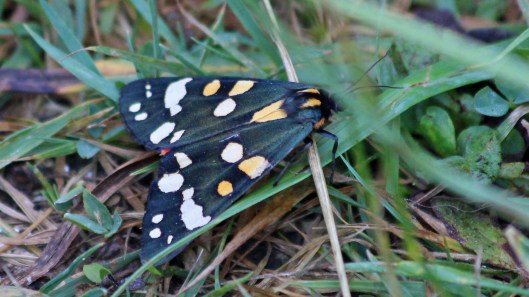
180716 8 Scarlet tiger

Like Loading...

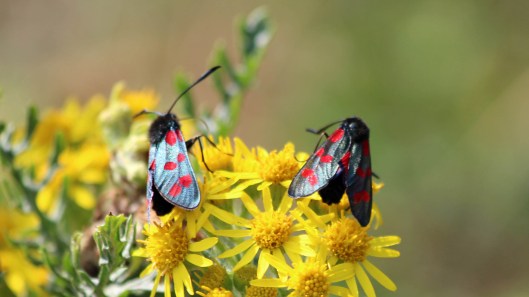
Six-spots love Ragwort

10 Tuesday Jul 2018

Posted by sconzani in flowers, insects, nature, wildflowers

≈ 4 Comments

Tags

British moths, Burnet moths, moths on ragwort, Ragwort, Six-spot burnet

Self-evident, really. Nom, nom, nom!

180712 Six-spot burnet moths on ragwort(2)

180712 Six-spot burnet moths on ragwort(1)
180712 Six-spot burnet moths on ragwort(3)
180712 Six-spot burnet moths on ragwort(5)
180712 Six-spot burnet moths on ragwort(6)

180712 Six-spot burnet moths on ragwort(4)

Like Loading...

Aberbargoed Grasslands revisited

06 Friday Jul 2018

Posted by sconzani in insects, nature

≈ 2 Comments

Tags

Aberbargoed Grasslands, British butterflies, British moths, Burnet companion, butterflies, Common purple & gold, Large skipper, moths, Riband wave, Ringlet, Silver Y, Small heath, Small skipper

On Wednesday I made my second visit to Aberbargoed Grasslands National Nature Reserve with my friend Sharon. Last time we dipped on seeing the Marsh fritillaries because it was too overcast; this time, we dipped again because the recent spell of hot dry weather has meant their season has finished for the year. Still, we have now walked most of the paths around the reserve so we’ll know exactly where to look next year. And, though we missed out the fritillaries, there were still plenty of other butterflies and moths to charm and delight us.

180705 1 small heath

Small heath (Coenonympha pamphilus)

180705 2 Ringlet

Ringlet (Aphantopus hyperantus)

180705 3 Small skipper

Small skipper (Lycaena phlaeas)

180705 4 Large skipper

Large skipper (Lycaena dispar)

180705 5 Burnet companion

Burnet companion (Euclidia glyphica)

180705 6 Pyrausta purpuralis

Common purple & gold (Pyraustra purpuralis)

180705 7 Riband wave

Riband wave (Idaea aversata)

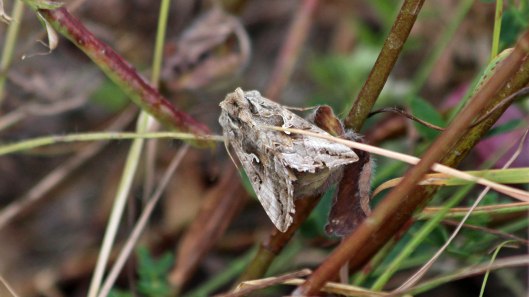
180705 8 Silver Y

Silver Y (Autographa gamma)


Like Loading...

A Common footman

04 Wednesday Jul 2018

Posted by sconzani in insects, nature

≈ 2 Comments

Tags

British moths, Common footman, Eilema lurideola, moth, moths

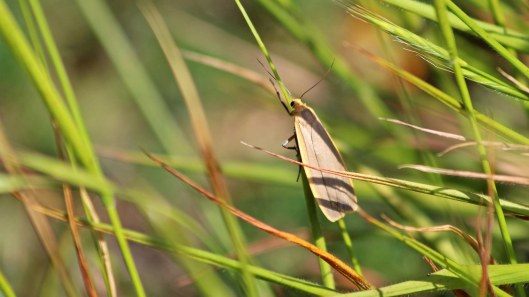
Moths have some wonderful names. I mean, you’ve got to wonder why one little group is named after a domestic servant. As well as this one, the Common footman, there are also Buff, Orange, Scarce, Dingy, Northern, Pigmy, and Hoary footmen, all members of the Eilema group of moths.

180703 common footman (1)

I spotted this little chap, Eilema lurideola, floundering around in the grass at Cosmeston recently. It might well be an elegant flier but it was having a great deal of trouble climbing up stalks of grass.

180703 common footman (2)
180703 common footman (3)
180703 common footman (4)
180703 common footman (5)
Like Loading...

Leptastic!

25 Monday Jun 2018

Posted by sconzani in insects, nature

≈ Leave a comment

Tags

#30DaysWild, 30 Days Wild, British butterflies, British moths, butterflies, Common blue, Large skipper, Meadow Brown, moths, Pyrausta purpuralis, Ringlet, Six-spot burnet, Small skipper, Small white, Speckled wood

Day 25 of #30DaysWild was hot – the hottest day of the year so far in Wales! I’m not a huge fan of the heat or the burning sun – one of the reasons I moved to Britain was to escape them, but the climate is a’changing. The only good thing about sunshine is that it brings out the Lepidoptera, the butterflies and moths, though even they looked a bit frantic, as if the heat was making them crazy. Still, on my Penarth – Lavernock – Cosmeston – Penarth circuit, I did manage to see my first Small skipper for the year and a host of other fantastic Leps as well.

180625 6-spot burnet

Six-spot burnet moth

180625 common blue

Common blue

180625 large skipper

Large skipper

180625 meadow brown

Meadow brown

180625 Pyrausta purpuralis

Pyrausta purpuralis moth

180625 ringlet

Ringlet

180625 small skipper

Small skipper

180625 small white

Small white

180625 speckled wood

Speckled wood

Like Loading...

Fritillaries!

22 Friday Jun 2018

Posted by sconzani in insects, nature

≈ Leave a comment

Tags

#30DaysWild, 30 Days Wild, British butterflies, British moths, Dark Green Fritillary, Large skipper, Six-spot burnet, Small heath butterfly, Small Pearl-bordered Fritillary

I had never seen any Fritillary butterflies until today, so, on day 22 of #30DaysWild, I’ve had a very exciting afternoon seeing my very first High Browns, Dark Greens and Small Pearl-bordereds. These butterflies were very fast fliers and didn’t settle long so I didn’t get many shots, and didn’t manage any of the High Browns. Below are three different Dark Green Fritillaries and one Small Pearl-bordered … plus a few other butterflies we saw.

180622 fritillary (1)180622 fritillary (2)180622 fritillary (3)

180622 fritillary (4)

Small pearl-bordered fritillary

I did manage to get reasonable images of some of the many lovely little Small heath butterflies, the one Six-spot burnet moth we saw, and, my favourite, this cute Large skipper. ‘Twas a grand day!

180622 Small heath180622 6-spot burnet180622 Large skipper

Like Loading...

Aberbargoed Grasslands

08 Friday Jun 2018

Posted by sconzani in insects, nature, parks

≈ 2 Comments

Tags

#30DaysWild, 30 Days Wild, Aberbargoed Grasslands, British butterflies, British moths, Common blue butterfly, Large white butterfly, Long-horn moth, Nemophora degeerella, Small copper

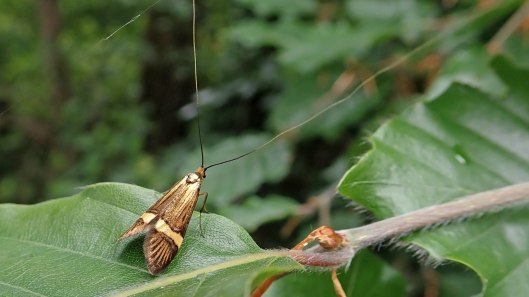
On day 8 of #30DaysWild I paid my first visit to the Aberbargoed Grasslands, with my friend Sharon. We were hoping to spot some of the Marsh fritillaries this National Nature Reserve is known for but, sadly, we didn’t even see one. Perhaps the overcast weather had sent them into hiding. The good news is that I saw my first Small copper butterfly for the year, we saw a small number of Common blue butterflies and a few whites. We also spotted several moths, the most spectacular of which was a group of five male long-horn moths, Nemophora degeerella. They were dazzling, even on a grey day, and just look at the length of those horns!

180608 1 Small copper

Small copper butterfly

180608 2 Common blue

A Common blue butterfly feeding on meadow thistles

180608 Large white

Large white butterfly

180608 4 Nemophora degeerella

A long-horn moth, Nemophora degeerella

180608 5 Nemophora degeerella

Look at the length of those horns!

Like Loading...

Random acts of wildness

01 Friday Jun 2018

Posted by sconzani in insects, nature

≈ 2 Comments

Tags

#30DaysWild, British butterflies, British moths, Burnet companion, butterflies, Cinnabar, Common blue, Latticed heath, moths, random acts of wildness, Silver Y, Small white

From today until the end of June, I’m taking part in 30 Days Wild, a month-long nature challenge run by the Wildlife Trusts. The idea is to do something wild every day for 30 days, whether ‘you take time out to simply smell a wildflower, listen to birdsong, explore a local wild place or leave a part of your garden to grow wild for a month’ and the aim is that by ‘making nature part of your life for 30 days’, you will feel ‘happier, healthier and more connected to nature’. This is pretty much what I do most days anyway but this month I’m going to ensure I go wild every single day! You can join in too, if you want – the info is here.

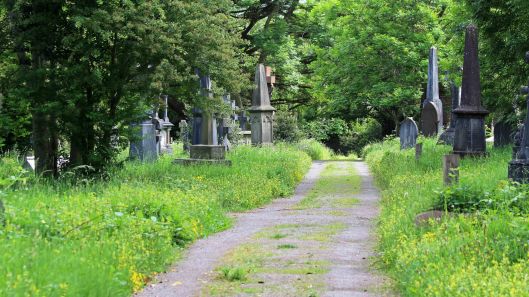
180601 (1) Cathays Cemetery

So, today, on day one, I went for a lovely long wander in Cathays Cemetery, Cardiff’s magnificent, huge, Victorian cemetery. Sadly, some parts of the cemetery are poorly managed – large areas without gravestones, which could be easily become wildflower meadows, are savagely mown, the clippings not removed. But there are a couple of areas where the grasses and wildflowers have been allowed to grow, and additional wildflowers – in particular, a lot of Yellow rattle – have been sewn. These two areas were alive with insects today: bees and hoverflies, bugs and beetles, and damselflies galore. My favourites, though, were all the lovely Lepidoptera: here are some I saw …

180601 (2) Latticed heath

Latticed heath moth

180601 (3) Common blue female

Common blue butterfly (female)

180601 (4) Common blue male

Common blue butterfly (male)

180601 (5) Silver Y

Silver Y moth

180601 (6) Burnet companion

Burnet companion moth

180601 (7) Small white

Small white butterfly

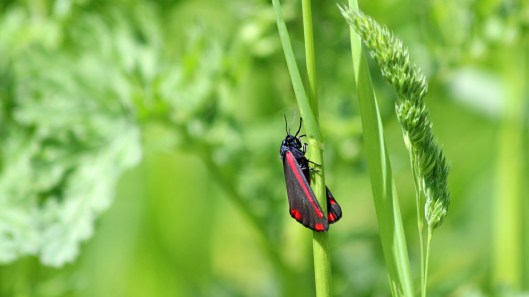
180601 (8) Cinnabar

Cinnabar moth

Like Loading...

A moth trap

17 Tuesday Apr 2018

Posted by sconzani in insects, nature

≈ 8 Comments

Tags

British moths, Early grey, Early thorn, moths, Selenia dentaria, Xylocampa areola

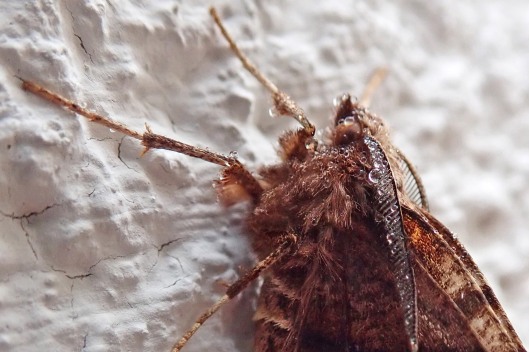
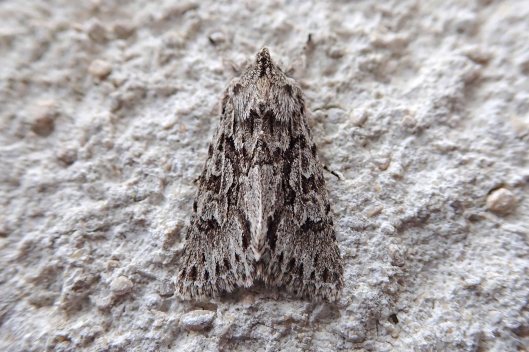
I don’t have a garden so I can’t have a moth trap, and I admit to getting the teensiest bit envious of friends who do have traps. But I get to see their finds on Facebook, and I will also readily admit that learning to identify the 2500 species of moth found in Britain might just do my head in, so perhaps not having a moth trap is really a good thing! And, anyway, I seem to have discovered a very convenient place to find the occasional moth, a tall alleyway between local houses that has its very own street lamp.

OLYMPUS DIGITAL CAMERA

I walk this way often but hadn’t noticed moths until the day before yesterday – perhaps it hasn’t been warm enough before. And, as you can see from the head of this first moth (photo below), it was a damp, foggy morning and the moth was still to warm up so couldn’t fly away. This is one of the first of two generations of Early thorn (Selenia dentaria) to breed throughout much of Britain each year. (To find out more about the Early thorn, click here).

OLYMPUS DIGITAL CAMERA

The second moth on the alley wall was this dapper delight, an Early grey (Xylocampa areola), another common and widespread moth, whose caterpillars feed on Honeysuckle. (More on the Early grey here.)

OLYMPUS DIGITAL CAMERA

Like Loading...

Leafminer on bramble

29 Monday Jan 2018

Posted by sconzani in insects, nature, plants

≈ 6 Comments

Tags

bramble, British micro moth, British moths, Golden pigmy moth, leaf mines, leafminer, moth larvae in leaf mines, Rubus fruticosus agg, Stigmella aurella

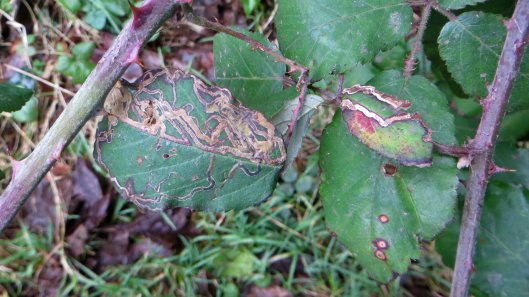
Following on from my Leafmines 101 post and the one about leafminers on Hart’s tongue fern, here’s another leaf mine I think I can identify (note the ‘I think’!).

180129 Stigmella aurella on bramble (1)

The reason I’m hesitant about positively IDing this one is because there are two species of micro moth whose larvae produce very similar mines on bramble (Rubus fruticosus agg.) leaves. One is the Glossy bramble pigmy moth (Stigmella splendidissimella) but the more likely in this case is the Golden pigmy moth (Stigmella aurella).

180129 Stigmella aurella on bramble (2)
180129 Stigmella aurella on bramble (3)

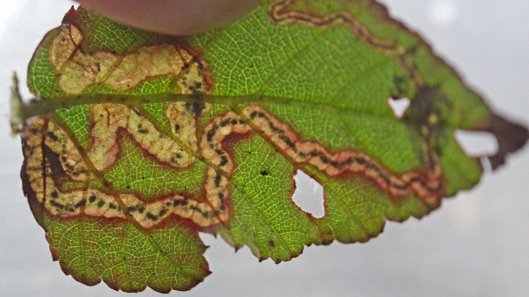
Though it’s very common and widespread in Britain, I’ve never seen this tiny moth (images on the UK moths website here) but the mines its larvae create on bramble leaves are everywhere I look. As you can see, the mine starts out small but, as the larva within chews and chews, so it widens its mine to accommodate its expanding girth.

You can see if the inhabitant is still at home by holding the leaf up to the light. Most of these seemed to be empty, as you can see from the images below (the central black lines are the frass). I’ve never actually opened a mine to have a look at the larva when it has been inside but, if I did, I would see an orangey-yellow grub with a brownish tinge to its head (there are images on the Bladmineerders website here).

180129 Stigmella aurella on bramble (4)180129 Stigmella aurella on bramble (5)

Like Loading...
← Older posts
Newer posts →

About me

sconzani

sconzani

I'm a writer and photographer; researcher and blogger; birder and nature lover; countryside rambler and city strider; volunteer and biodiversity recorder.

View Full Profile →

Follow earthstar on WordPress.com

Enter your email address to follow this blog and receive notifications of new posts by email.

Recent blog posts

  • Cormorants, young and old March 12, 2026
  • Bay bunnies March 11, 2026
  • Beating the gloom March 10, 2026
  • No booming Bittern but … March 9, 2026
  • Danish scurvygrass March 8, 2026

From the archives

COPYRIGHT

Unless otherwise acknowledged, the text and photographs on this blog are my own and are subject to international copyright. Nothing may be downloaded or copied without my permission.

Fellow Earth Stars!

  • Unknown's avatar
  • Unknown's avatar
  • Unknown's avatar
  • Unknown's avatar
  • Unknown's avatar
  • Unknown's avatar
  • Unknown's avatar
  • Unknown's avatar
  • Unknown's avatar
  • Unknown's avatar
  • Unknown's avatar
  • Unknown's avatar
  • Unknown's avatar
  • Unknown's avatar
  • Unknown's avatar
  • Unknown's avatar
  • Unknown's avatar
  • Unknown's avatar
  • Unknown's avatar
  • Unknown's avatar
  • Unknown's avatar
  • Unknown's avatar
  • Unknown's avatar
  • Unknown's avatar
  • Unknown's avatar
  • Unknown's avatar
  • Unknown's avatar
  • Unknown's avatar
  • Unknown's avatar
  • Unknown's avatar
  • Unknown's avatar
  • Unknown's avatar
  • Unknown's avatar
  • Unknown's avatar
  • Unknown's avatar
  • Unknown's avatar
  • Unknown's avatar
  • Unknown's avatar
  • Unknown's avatar
  • Unknown's avatar
  • Unknown's avatar
  • Unknown's avatar
  • Unknown's avatar
  • Unknown's avatar
  • Unknown's avatar
  • Unknown's avatar
  • Unknown's avatar
  • Unknown's avatar
  • Unknown's avatar
  • Unknown's avatar

Blog at WordPress.com.

Privacy & Cookies: This site uses cookies. By continuing to use this website, you agree to their use.
To find out more, including how to control cookies, see here: Cookie Policy
  • Subscribe Subscribed
    • earthstar
    • Join 668 other subscribers
    • Already have a WordPress.com account? Log in now.
    • earthstar
    • Subscribe Subscribed
    • Sign up
    • Log in
    • Report this content
    • View site in Reader
    • Manage subscriptions
    • Collapse this bar
 

Loading Comments...
 

You must be logged in to post a comment.

    %d