• ABOUT
  • BIRDING 2018
  • Birding 2019
  • BLOG POSTS
  • Butterflies 2018
  • Resources

earthstar

~ a celebration of nature

earthstar

Tag Archives: British wildflowers

A viperish plant

27 Sunday Jun 2021

Posted by sconzani in flowers, wildflowers

≈ 4 Comments

Tags

blue flowers, British wildflowers, Echium vulgare, Viper's-bugloss

Of Viper’s-bugloss (Echium vulgare), Richard Mabey writes in Flora Britannica:

[It] is a viperish plant in all its parts. The sprays of flowers that spiral up the stem are half-coiled; the long red stamens protrude from the mouths of the blue and purple flowers like tongues; the fruits resemble adders’ heads. Even the ‘speckled’ stem (it is hairy in fact) suggested snakes’ skins to early herbalists.

And like all members of the Echium family, this glorious plant is much loved and visited by insects, especially (from my own observations) bumblebees.

210627 viper's-bugloss (1)
210627 viper's-bugloss (2)
210627 viper's-bugloss (3)
Like Loading...

Variation

25 Friday Jun 2021

Posted by sconzani in flowers, wildflowers

≈ 4 Comments

Tags

British orchids, British wildflowers, Common spotted-orchid, Dactylorhiza fuchsia, native orchids

I mentioned recently how I sometimes find orchids difficult to identify. These photos illustrate why. As far as I can work out, as they all had spots on their leaves, and in spite of the variation in colours and patterns, these are all Common spotted-orchids (Dactylorhiza fuchsia).

210625 common spotted-orchid (1)
210625 common spotted-orchid (2)
210625 common spotted-orchid (3)
210625 common spotted-orchid (4)
210625 common spotted-orchid (5)
210625 common spotted-orchid (6)
210625 common spotted-orchid (7)
210625 common spotted-orchid (8)
210625 common spotted-orchid (9)
Like Loading...

Summer yellow

20 Sunday Jun 2021

Posted by sconzani in flowers, wildflowers

≈ Leave a comment

Tags

British wildflowers, summer colour, yellow flowers, yellow wildflowers

We’ve rain today, the gentle soft rain that I’ve come to associate with life in Wales, but I’m not complaining. It’s much needed, by the land, its plants and its beasties, after a couple of weeks of strong sunshine and baking heat. To counteract the dull grey I see out my window, I’m about to compile today’s post, a little video full of summer sunshine, with some of the yellow-flowered wildflowers currently in bloom. I know I’ve done this before, and quite recently, but I do so enjoy the bright cheeriness of yellow.

Pictured today are: Bird’s-foot trefoil, Creeping buttercup, Creeping cinquefoil, a Dandelion species, Dyer’s greenweed, Evening primrose, Meadow buttercup, a Melilotus species, Mouse-ear hawkweed, Nipplewort, Pineapple weed, Reflexed stonecrop, Silverweed, Smooth sow-thistle, Tormentil, Wood avens, Yellow iris, Yellow loosestrife, Yellow pimpernel, Yellow water-lily, and Yellow-wort.

Like Loading...

A select club

19 Saturday Jun 2021

Posted by sconzani in insects, wildflowers

≈ 4 Comments

Tags

British moths, British wildflowers, Dyer’s greenweed, Mirificarma lentiginosella, Mirificarma lentiginosella larvae, moth larvae on Dyer's greenweed

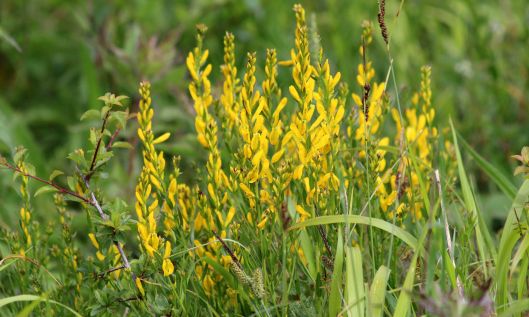
A couple of years ago, I discovered through chats to local Butterfly Conservation Senior moth ecologist George that three rare moths use Dyer’s greenweed (Genista tinctoria) as their larval food plant. (There’s a Butterfly Conservation factsheet about these here.)

210619 dyers greenweed

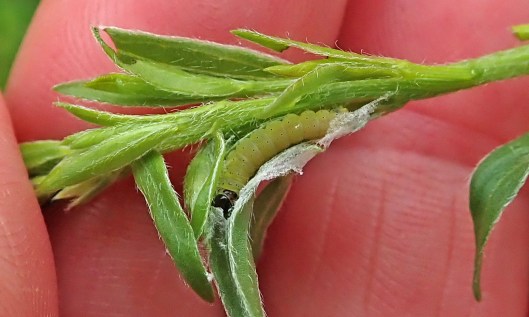
The larvae create little homes for themselves by spinning together the leaves at the tips of Dyer’s greenweed shoots, and, yesterday, after much careful searching, I finally found a ‘spinning’ that was occupied.

210619 Mirificarma lentiginosella (1)
210619 Mirificarma lentiginosella (2)

George has now confirmed for me that this little beauty is the larva of the nationally scarce moth Mirificarma lentiginosella. And he writes: ‘You now join the select club of people who have seen this species in Wales: you, me, and C.G. Barrett who recorded it in Pembrokeshire in the 1800s’. As you can imagine, I am extremely pleased to have joined this select club!

210619 Mirificarma lentiginosella (3)

Like Loading...

Lovely Leguminosae

13 Sunday Jun 2021

Posted by sconzani in flowers, wildflowers

≈ 2 Comments

Tags

British wildflowers, Leguminosae, Pea family

There’s something about the Pea family, the Leguminosae. Maybe it’s because my Nana used to grow Sweet peas every year so I always associate their smell with good memories of time spent with her. Maybe it’s because my Dad always grew peas in his vegetable garden (though my brother and I often ate them straight off the vines before Dad could harvest them for a family meal) – also good memories of helping him planting and weeding. Maybe it’s just that their distinctive five-petalled flowers make the Pea family a little easier to identify than many other wildflower families. Maybe it’s just that they’re beautiful. Here are some that are blooming now here in south Wales.

These are Goat’s-rue (Galega officinalis), Hairy tare (Vicia hirsuta), Bitter vetch (Lathyrus linifolius), Bush vetch (Vicia sepium), Common vetch (Vicia sativa), Tufted vetch (Vicia cracca), Grass vetchling (Lathyrus nissolia), and Meadow vetchling (Lathyrus pratensis).

Like Loading...

Spatling Poppie

09 Wednesday Jun 2021

Posted by sconzani in flowers, wildflowers

≈ 2 Comments

Tags

Bladder campion, British wildflowers, Silene vulgaris, white wildflowers

According to Flora Britannica, this plant is ‘one of the favourite food-plants of the little insects known as froghoppers, notable for surrounding themselves with protective froth whilst feeding. John Gerard … called it “Spatling Poppie”, “in respect of that kindle of frothie spittle, or spume, which we call Cuckoo spittle, that more aboundeth in the bosomes of the leaues of these plants, then in any other”.’

210609 bladder campion (3)

Gerard’s ‘Spatling Poppie’ is today better known as Bladder campion (Silene vulgaris), and I think it’s fairly obvious where the name ‘bladder’ came from – the calyx of the flower head looks swollen, as if inflated with air or water. According to the Plantlife website, the plant’s other common names include Cowbell, Maiden’s tears, and Common Bladder Catchfly ‘even though it doesn’t technically catch flies’.

210609 bladder campion (2)

This is not a flower I see often locally, so I was delighted to find several clumps growing amongst wildflowers at the edge of a local road. A roadside verge is a typical location for Bladder campion, and these lovely wildflowers can also be found under hedgerows, in fields and meadows.

210609 bladder campion (1)

Like Loading...

A fiesta of Bee orchids

06 Sunday Jun 2021

Posted by sconzani in plants, wildflowers

≈ Leave a comment

Tags

#NoMowMay, Bee orchid, British wildflowers, Native British orchid, native orchids, urban orchids, wildflowers in road verges

If you live in or around or anywhere near Cardiff and you like orchids, then get yourself down to Ferry Road in Cardiff Bay, because there is a Bee orchid fiesta happening right now, and probably for the next few weeks.

210606 bee orchids (1)

It’s completely free. All you have to do is walk along the pavement on the west side of the road adjacent to the Cardiff Bay Retail Centre and look at the verge, because the good folks who manage the Retail Centre agreed to stop mowing said verge this spring, and the result is an explosion of Bee orchids.

I kid you not! One of the council’s community rangers did a count yesterday and reckons there are over 800 spikes, many of which are not yet in bloom. It is seriously amazing, and just shows what botanic marvels are in our road verges if the councils and corporations would just let them grow.

210606 bee orchids (3)

Like Loading...

Lousewort

30 Sunday May 2021

Posted by sconzani in flowers, wildflowers

≈ Leave a comment

Tags

Aberbargoed Grasslands, British wildflowers, Lousewort, Pedicularis sylvatica, semi-parasitic plants

One of the many good things about visiting a different location after having been restricted to my local patch for many months is getting the opportunity to see something new. So, when I went to Aberbargoed Grasslands for the Marsh fritillaries I blogged about yesterday, I also spotted other fauna and flora I don’t usually see.

210530 lousewort (1)

Acid-loving Lousewort (Pedicularis sylvatica) thrives in the boggy fields where the Marsh frits are found. It’s actually a semi-parasitic plant, tapping into the roots of adjacent grasses and other plants to obtain the nutrients it needs to grow.

This plant’s name is odd: the NBN Atlas website explains that people used to believe that livestock that ate Lousewort would then become infected with lice. Bizarre!

Like Loading...

New awakenings

23 Sunday May 2021

Posted by sconzani in flowers, spring, wildflowers

≈ Leave a comment

Tags

British wildflowers, Common comfrey, Field scabious, Flax, knapweed, Oxeye daisy, Ragged robin, Red campion, Red valerian, Spring colour, Yarrow

Despite our un-spring-like weather, more and more wildflowers are coming in to bloom. Here are some I’ve noticed during the past fortnight’s ramblings in my local countryside: Comfrey, Field scabious, Flax, Knapweed, Oxeye daisy, Ragged robin, Red campion and Red valerian, and Yarrow. Though my video shows a decidedly blue-pink range of hues, there are other-coloured species in bloom – it’s just that I intend doing some family- or species-specific blogs so will save those photographs for now.

Like Loading...

Buttercups and beasties

18 Tuesday May 2021

Posted by sconzani in insects, spring, wildflowers

≈ Leave a comment

Tags

British wildflowers, buttercups, buttercups and insects, insects in buttercups, yellow wildflowers

It seems I’m not the only one who likes buttercups, judging by the quantity and variety of mini-beasties I’ve spotted in them in recent days: bees and hoverflies, earwigs and micro-moths, and even a slug.

210518 buttercup bee nomada
210518 buttercup earwig
210518 buttercup hoverfly (1)
210518 buttercup hoverfly (2)
210518 buttercup moths
210518 buttercup slug
Like Loading...
← Older posts
Newer posts →

About me

sconzani

sconzani

I'm a writer and photographer; researcher and blogger; birder and nature lover; countryside rambler and city strider; volunteer and biodiversity recorder.

View Full Profile →

Follow earthstar on WordPress.com

Enter your email address to follow this blog and receive notifications of new posts by email.

Recent blog posts

  • Avocet February 21, 2026
  • First large spider February 20, 2026
  • Our celebrity Redshank February 19, 2026
  • My first moth of the year February 18, 2026
  • Three Common sandpipers February 17, 2026

From the archives

COPYRIGHT

Unless otherwise acknowledged, the text and photographs on this blog are my own and are subject to international copyright. Nothing may be downloaded or copied without my permission.

Fellow Earth Stars!

  • Unknown's avatar
  • Unknown's avatar
  • Unknown's avatar
  • Unknown's avatar
  • Unknown's avatar
  • Unknown's avatar
  • Unknown's avatar
  • Unknown's avatar
  • Unknown's avatar
  • Unknown's avatar
  • Unknown's avatar
  • Unknown's avatar
  • Unknown's avatar
  • Unknown's avatar
  • Unknown's avatar
  • Unknown's avatar
  • Unknown's avatar
  • Unknown's avatar
  • Unknown's avatar
  • Unknown's avatar
  • Unknown's avatar
  • Unknown's avatar
  • Unknown's avatar
  • Unknown's avatar
  • Unknown's avatar
  • Unknown's avatar
  • Unknown's avatar
  • Unknown's avatar
  • Unknown's avatar
  • Unknown's avatar
  • Unknown's avatar
  • Unknown's avatar
  • Unknown's avatar
  • Unknown's avatar
  • Unknown's avatar
  • Unknown's avatar
  • Unknown's avatar
  • Unknown's avatar
  • Unknown's avatar
  • Unknown's avatar
  • Unknown's avatar
  • Unknown's avatar
  • Unknown's avatar
  • Unknown's avatar
  • Unknown's avatar
  • Unknown's avatar
  • Unknown's avatar
  • Unknown's avatar
  • Unknown's avatar
  • Unknown's avatar

Blog at WordPress.com.

Privacy & Cookies: This site uses cookies. By continuing to use this website, you agree to their use.
To find out more, including how to control cookies, see here: Cookie Policy
  • Subscribe Subscribed
    • earthstar
    • Join 670 other subscribers
    • Already have a WordPress.com account? Log in now.
    • earthstar
    • Subscribe Subscribed
    • Sign up
    • Log in
    • Report this content
    • View site in Reader
    • Manage subscriptions
    • Collapse this bar
 

Loading Comments...
 

You must be logged in to post a comment.

    %d