After dazzling you with 39 different wildflowers last Sunday, today I have just one offering, but I think it is equally dazzling. There’s just something about the blue of Sea holly that I simply adore.


01 Sunday Oct 2023
Posted in wildflowers
After dazzling you with 39 different wildflowers last Sunday, today I have just one offering, but I think it is equally dazzling. There’s just something about the blue of Sea holly that I simply adore.
24 Sunday Sep 2023
Posted in autumn, flowers, wildflowers
39. That’s the number of wildflowers I photographed as I wandered around Cosmeston Lakes Country Park yesterday. I was also on the look out for American birds (if you’re not local or a birder, you may not know that there’s been an unprecedented number of American birds found in western parts of Britain after the remnants of Hurricane Lee swept through last week), but the sheer numbers and varieties and colours of these wildflowers were very welcome compensation.

These beauties are in the order I found them as I walked: Oxeye daisy, Common ragwort, Common knapweed (with unusual contrasting petal colours), Eyebright, Bird’s-foot trefoil, Red clover, Black medick, Agrimony, Wild parsnip, Devil’s-bit scabious, Selfheal, Wild carrot.

Goat’s-beard, Yellow-wort, Meadow buttercup, Bramble, Creeping thistle, Large bindweed, Great willowherb, Common mouse-ear, Hogweed, White clover, Meadow vetchling, Daisy
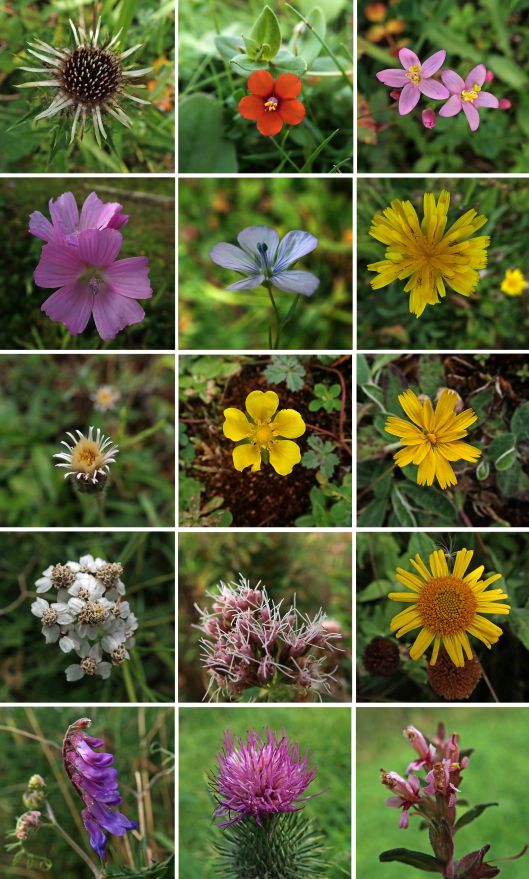
Carline thistle, Scarlet pimpernel, Common centaury, Musk mallow, Flax, Rough sow-thistle, Blue fleabane, Creeping cinquefoil, Mouse-ear-hawkweed, Yarrow, Hemp-agrimony, Common fleabane, Tufted vetch, Spear thistle, Red bartsia.
11 Monday Sep 2023
Posted in autumn, insects, wildflowers
Tags
British butterflies, British wildflowers, butterfly, butterfly on scabious, Devil's-bit scabious, Meadow Brown
Nothing says late summer/early autumn to me more than a Meadow brown butterfly on Devil’s-bit scabious. This is a typical sight now at my local country park.

10 Sunday Sep 2023
Posted in flowers, plants, wildflowers
As mentioned in yesterday’s post, the challenge for this evening’s #WildflowerHour on social media is #seedheads.
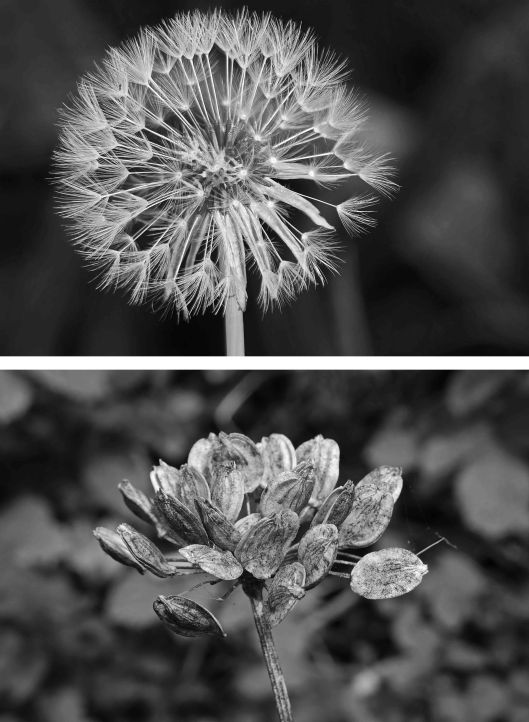
This is a topic I’ve posted about on here many times previously because I admire and enjoy photographing the sculptural aspects and diversity of floral seed heads.

Some seeds, those with silken, feathery or fluffy attachments, have obviously been designed to be caught and distributed by the wind; others, with tiny hooks or burrs, to be caught on the fur or fabric of passers-by and transported with them to new destinations.

This week I’ve pared back my photos, turning to black and white and trying to simplify the backgrounds in order to emphasise the shapes and designs of these remarkable seed heads.

27 Sunday Aug 2023
Posted in wildflowers
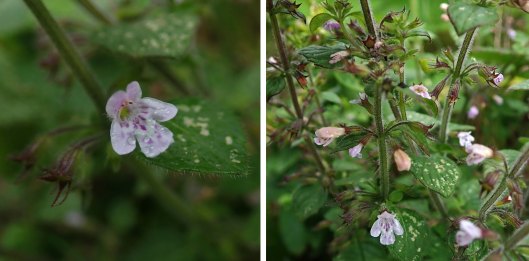
This is a new plant for me, and I freely admit to having walked past it several times before finally noticing it, perhaps because it only flowers from July to September. It’s Common calamint (Clinopodium ascendens), a member of the mint family, the Lamiaceae, and, not surprisingly, its leaves when crushed smell deliciously of mint.

The plant in question, in the photo above, is the one with small greyish-looking leaves (though they’re actually green with white speckles) and even smaller pink flowers. My wildflower book says it can be found in a variety of habitats, from hedge banks and bushy areas to dry grassy scrubland and roadside verges. The plants I found were growing alongside an under-cliff path that leads to a local beach, so it seems this mint is very adaptable. Despite that, there are only 199 records in the Welsh biodiversity database, so perhaps I’m not the only person to walk past these plants without noticing them.
20 Sunday Aug 2023
Posted in plants, seaside, wildflowers
Tags
#WildflowerHour, British wildflowers, Echium vulgare, seaside wildflowers, Silene latifolia, Tanacetum vulgare, Tansy, Teucrium scorodonia, Viper's-bugloss, White campion, Wood sage
This week’s challenge for #WildflowerHour was ‘What can you find blooming along the coast?’. I’ve had a couple of walks around parts of Cardiff Bay this week and could’ve included a lot of plants but have selected just four.

As Cardiff Council has (amazingly!) refrained from cutting the Barrage grass in recent months, the few Viper’s-bugloss (Echium vulgare) plants that were previously growing there have increased markedly. There must be over 50 plants now spread across the expanse of the Barrage, and the blue flowers make a lovely contrast against the grass green.

I rarely see Tansy (Tanacetum vulgare), so this single plant, thriving on the sandy slope below the children’s playground on the Barrage, was a delightful surprise.

Growing just along from that Tansy plant, was this lone White campion (Silene latifolia) plant. It wasn’t looking as healthy as the Tansy but was covered in seed heads so I think it was just past its best.

This Wood sage (Teucrium scorodonia) was a total surprise as you wouldn’t necessarily expect a plant with ‘wood’ in its name to be growing alongside a seaside path. My book says it prefers acid soils but, when I googled, I found many examples of Wood sage growing on scree slopes, amongst limestone, and close to sand dunes, so I guess it’s very adaptable.
13 Sunday Aug 2023
Posted in flowers, wildflowers
When I first spotted these Broad-leaved helleborines sprouting back in June, I despaired for their survival in the dry heat. But several weeks of intermittent rain have brought them back to life, and they look as beautiful as ever.

06 Sunday Aug 2023
Posted in wildflowers
During Friday’s walk I was vaguely hoping to see the Otter that’s been visiting Cardiff Bay wetlands during recent weeks (I didn’t – and I’m not one to stand around for hours on the off chance) but my secondary purpose was to look for pavement plants, those wildflowers that manage to colonise the cracks between bricks or slabs of tarmac and the subject of today’s Wildflower Hour on social media.
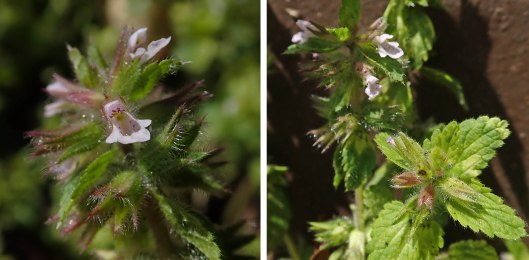
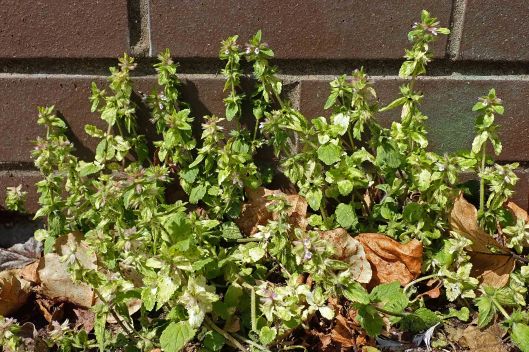
Fortunately, I bumped in to a local birding friend who is also a keen botanist and he was able to point me in the direction of this plant, a new one for me, Field woundwort (Stachys arvensis). Though its natural habitat is fields and hedge edges, especially on sandy soils and mostly in the southern parts of Britain, this plant has extended its range to include some urban locations, like allotments and, as shown here, the tiny cracks between a building and the pavement.
30 Sunday Jul 2023
Posted in plants, wildflowers
A year ago, one of my local birding acquaintances, who is also a keen botanist, discovered a small area of Jersey cudweed (Gnaphalium luteoalbum) growing along the edge of the Cardiff Bay walking and cycling trail. Though he quickly reported his find to Cardiff Council in an attempt to protect it, their contractors soon obliterated the plants in a typical ‘kill the weeds’ operation. So, I didn’t get to see this new plant then but I made myself a note to check back in a year’s time, which I did, last week, and was very pleased to see the plants have reappeared.
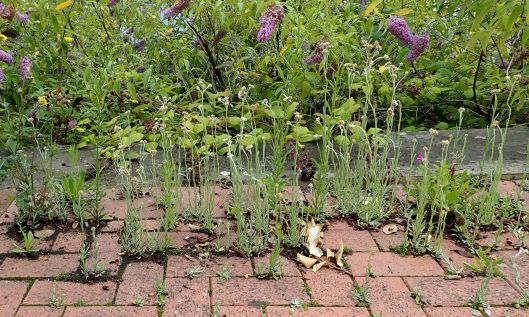
The NatureSpot website notes that Jersey cudweed is likely to have been ‘an ancient introduction’ to Britain that then ‘became almost extinct’ but is now bouncing back (despite the anti-weed brigade!). And, though traditionally a plant of sandy fields and dune slacks, it is now adapting to life as a pavement plant in our towns and cities.

23 Sunday Jul 2023
Posted in flowers, wildflowers
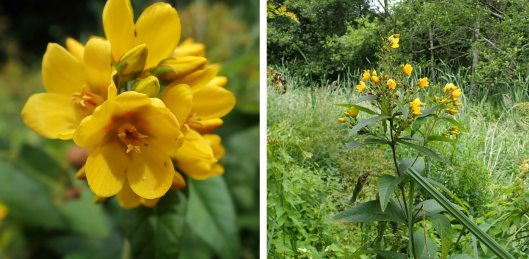
With their roots in the water along the edge of a local canal, these Yellow loosestrife (Lysimachia vulgaris) plants were so exuberant and lush I initially thought they were some other species. They had obviously found the damp niche that suited them best.

Though I would never advocate the use of herbal medicine (just being cautious about matters I don’t understand or have knowledge of), Yellow loosestrife did, apparently, have a large number of traditional uses as a medicinal plant, from treating diarrhoea and haemorrhaging to cleaning wounds and being used as a mouthwash. And the First Nature website reports on other common uses:
Yellow Loosestrife tied around the necks of oxen was reputed to keep irritating flies away from them. In the distant past these and several other kinds of ‘loosestrife’ plants were also used to get rid of infestations of flies in houses. The plants were dried and burned indoors, and toxins in the smoke drove out the flies (and no doubt also any human occupants).
 earthstar
You must be logged in to post a comment.