• ABOUT
  • BIRDING 2018
  • Birding 2019
  • BLOG POSTS
  • Butterflies 2018
  • Resources

earthstar

~ a celebration of nature

earthstar

Tag Archives: butterfly

133/366 First Common blue

12 Tuesday May 2020

Posted by sconzani in insects, nature, wildflowers

≈ 6 Comments

Tags

British butterflies, British wildflowers, butterfly, Common blue butterfly, wildflowers on road verges, wildflowers on roadsides

One of the benefits of some local councils not mowing all the road verges at the moment is that wildflowers that would normally be strimmed to death are now being allowed to grow and bloom.

200512 Common blue butterfly (1)

Not only does this mean we get to enjoy their glorious rainbow of colours but the wildflowers’ pollen and nectar also provide a nutritious feast for all the newly emerging insects.

200512 Common blue butterfly (2)

And it was on one such uncut verge that I spotted my first Common blue butterfly of the year today, this stunning, pristine, little male.

200512 Common blue butterfly (3)

If only the councils would mow less all the time, then we’d be able to enjoy both the flowers and the insects all through spring and summer, and it would also go a little way to reversing the huge decline in insect life that’s happening all over the world.

200512 Common blue butterfly (4)

Like Loading...

128/366 Dingy skippers

07 Thursday May 2020

Posted by sconzani in insects, nature

≈ 2 Comments

Tags

British butterflies, butterfly, Dingy Skipper, Erynnis tages, Lavernock Nature Reserve

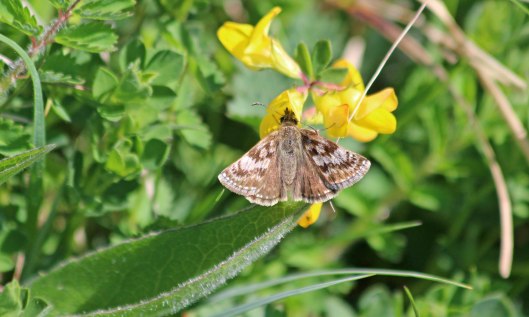
Not only did I see my first dragonflies of the year yesterday at Lavernock Nature Reserve but I also spotted my first Dingy skippers (Erynnis tages).

200507 dingy skipper (1)

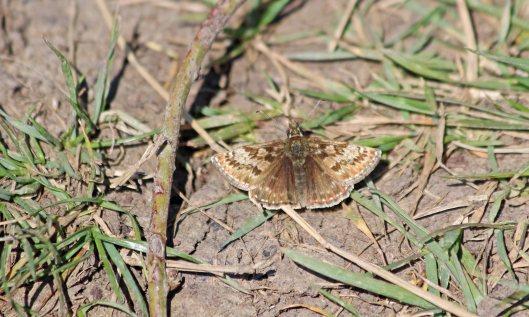
At least four of these inconspicuous little butterflies were feeding on their favourite food plant, Common bird’s-foot trefoil, or basking on the compacted earth of the tracks through the reserve, as is their wont.

200507 dingy skipper (2)

Their preferences for bird’s-foot trefoil and patches of bare ground are why these butterflies are often found on chalk and limestone grasslands, on brownfield sites and in disused quarries, amongst sand dunes and along open pathways adjacent to woodland.

200507 dingy skipper (3)

Sun, shelter and good food – it’s not much to ask for. But, sadly, the Dingy skipper is one of many declining species of butterfly in Britain, probably due to the way land is managed and to the intensification of agriculture. So, I feel very privileged to be able to observe and enjoy these lovely little skippers so close to home.

200507 dingy skipper (4)

Like Loading...

126/366 The Lady of the Woods

05 Tuesday May 2020

Posted by sconzani in insects, nature, spring

≈ 6 Comments

Tags

British butterflies, butterfly, Orange-tip 2nd instar, Orange-tip butterfly, Orange-tip egg

I know I already posted about seeing my first Orange-tip butterfly of the year (The ostentatious Orange-tip, 15 April) but, for those not familiar with this lovely springtime butterfly, I thought it might be useful to see a bit more detail. So, here is a typical male Orange-tip, from the top and the side. The speckling on the lower wings looks green but that’s an optical illusion – the colours are actually yellow and black.

200505 orange-tip male (1)
200505 orange-tip male (2)

And here’s a female from both angles. If you only see her from the top, you might confuse her with one of the other white butterflies, though the dark patches are different in all the whites, and the Orange-tip also has a distinctive wing shape.

200505 orange-tip female (1)
200505 orange-tip female (2)

I managed to find several eggs during a recent walk – the newly laid eggs are white but turn orange very quickly. You’ll find them on the caterpillar food plants: Cuckooflower, Garlic mustard and Honesty are three wildflowers this butterfly favours. And, for the first time ever, I found a caterpillar. This is a 2nd instar (i.e. stage) – the larvae proceed through 5 instars, progressively growing larger, until they are ready to pupate.

200505 orange-tip egg
200505 orange-tip larva 2nd instar

You might be wondering why I gave this post the title of ‘the Lady of the Woods’. Well, according to Peter Eeles’s superb publication Life Cycles of British & Irish Butterflies (every home should have one!), this is the name given to the Orange-tip by Benjamin Wilkes in his Twelve New Designs of English Butterflies, published in 1742.

Like Loading...

122/366 Species 10

01 Friday May 2020

Posted by sconzani in insects, nature

≈ 4 Comments

Tags

British butterflies, butterfly, Grangemoor Park, Green-veined white, Pieris napi

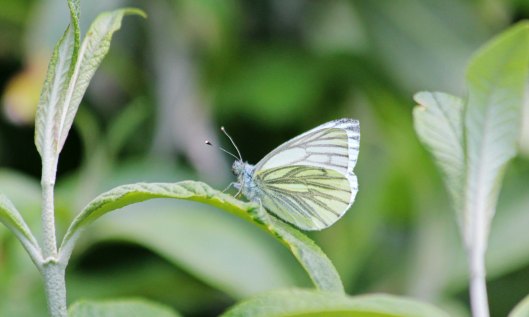
With the current restrictions on movement, my butterflying has got off to a slower start than usual but today I spotted my first Green-veined white butterfly of 2020, my tenth species for the year, during my walk around Cardiff’s Grangemoor Park.

200501 Green-veined white (1)

This pristine male only appeared briefly, before disappearing amongst the leafy trees, but it was a joy to see him. These spring-brood Green-veined whites are often very pale – I can’t even see the small dark spots on his upper wings and he has only a hint of yellow colouring on his undersides. The summer brood, when they emerge in July and August, usually show darker markings – I’ll try and do a comparison post later in the year to show the differences.

200501 Green-veined white (2)

Like Loading...

114/366 Little and large

23 Thursday Apr 2020

Posted by sconzani in insects, nature

≈ Leave a comment

Tags

Adela reaumurella, British butterflies, British moths, butterfly, Green long-horn, Large white, Long-horn moth, moth, Pieris brassicae

During yesterday’s exercise meander around Penarth, I found two lovely Lepidoptera in one of the few local parks that’s still open.

200423 green long-horn moth

The first was this amazing day-flying moth, the Green long-horn (Adela reaumurella). It may have a wingspan of only 14-18mm, but just look at those antennae (hence, the name ‘long-horn’). This is a male; the females have shorter antennae, which are half black, half white.

200423 large white butterfly

Then, to my delight, soon after seeing that stunning little moth, I spotted my first Large white butterfly (Pieris brassicae) for 2020. And, compared to the moth, it really is large, with a wingspan between 63 and 70mm. This is also a male; the females have two grey-black spots on their upper wings.

Like Loading...

109/366 Speckled Spring

18 Saturday Apr 2020

Posted by sconzani in insects, nature, spring

≈ Leave a comment

Tags

British butterflies, butterfly, Pararge aegeria, Speckled wood, spring butterflies

We’ve had much-needed rain and low-cloud gloom for the past two days but, earlier in the week, when the sun was warm and glorious and my walk took me along the coastal path, it felt like proper Spring. The bird song was almost deafening and – what clinched the Spring-ness for me – I counted 12 Speckled wood butterflies along the path, either perched sun-basking or patrolling their patch of scrub or – the males – engaged in spiralling dogfights over territory. Springtime magic!

200418 speckled woods (1)
200418 speckled woods (2)
200418 speckled woods (3)
200418 speckled woods (4)
200418 speckled woods (5)
200418 speckled woods (6)
200418 speckled woods (7)
200418 speckled woods (8)
200418 speckled woods (9)
Like Loading...

106/366 The ostentatious Orange-tip

15 Wednesday Apr 2020

Posted by sconzani in insects, nature, spring

≈ 5 Comments

Tags

Anthocharis cardamines, British butterflies, butterfly, Orange-tip, Orange-tip butterfly, spring butterflies

If there is one butterfly whose male makes a truly conspicuous effort to impress the female of the species, then it must surely be the Orange-tip (Anthocharis cardamines). Those vivid orange wing tips are hard to miss, even when the males are speeding past at a hundred miles an hour. Today, at last, I saw my first Orange-tip for 2020 – in fact, I spotted four of these handsome chaps and, after following a couple back and forth along their chosen territories, I finally managed a single photo of one as it was refuelling.

200415 orange-tip

Like Loading...

102/366 Holly blue

11 Saturday Apr 2020

Posted by sconzani in insects, nature, spring

≈ 8 Comments

Tags

British butterflies, butterfly, Holly blue, Holly blue butterfly

Another new butterfly species for the year, the Holly blue!

200411 holly blue (1)

This individual is actually the second one I’ve seen – the first was up and over the bushes and trees too quickly for me to grab a photo but this little lovely was flying slowly from spot to spot along a grassy slope so I was able to enjoy its beauty and get a couple of images. There’s just something very special about blue butterflies and the Holly blue is usually the first of the year to emerge.

200411 holly blue (2)

Like Loading...

99/366 Small whites and Speckled woods

08 Wednesday Apr 2020

Posted by sconzani in insects, nature, spring

≈ 6 Comments

Tags

British butterflies, butterfly, Pararge aegeria, Pieris rapae, Small white butterfly, Speckled wood, spring butterflies

Actually, that title should really be three Small whites and a single Speckled wood but it’s a bit long-winded for a blog title. Suffice to say, my butterfly list for the year has grown by these two new species in the past two days.

200407 speckled wood

I think this Speckled wood (Pararge aegeria) is a female – their markings are, apparently, larger and more distinct – but I’m not entirely sure. Working out details like this is something I’m aiming to improve this year.

200407 small white (3)

The Small whites (Pieris rapae) here are two females and a male (below, right). The males only have one spot on their wings and, in this first brood of the year, the wing markings of both sexes are lighter than they will be in the later, summer broods.

200407 small white (1)
200407 small white (2)

I am dizzyingly delighted to be seeing more butterflies flying now. They bring me comfort and joy, something I’m sure we could all do with at the moment. I hope you are all managing to find small moments of comfort and joy in your daily lives as well.

Like Loading...

92/366 The Devil’s butterfly?

01 Wednesday Apr 2020

Posted by sconzani in insects, nature, spring

≈ 1 Comment

Tags

British butterflies, butterfly, Grangemoor Park, Nettle tortoiseshell, Small tortoiseshell, spring butterflies

Today’s fascinating information on the once common, now less so Small tortoiseshell (Aglais urticae) is taken from Peter Eeles’s magnificent publication Life Cycles of British and Irish Butterflies (Pisces Publications, 2019). If you like butterflies and don’t have this book, you really should get it, as it’s jam-packed with amazing detail and fabulous photos.

200401 small tortoiseshell (1)

In the section on the Small tortoiseshell, Eeles reports on the variety of names it has had over the centuries: the Lesser Tortoise-shell Butterfly (James Petiver, Musei Petiveriani, 1699); Small Tortoiseshell (Benjamin Wilkes, Twelve New Designs of English Butterflies, 1742); and Nettle tortoiseshell (William Lewin, Twelve Papilios of Great Britain, 1795).

200401 small tortoiseshell (2)

Eeles also notes that, in Scotland, in the past, this lovely creature was called the Devil’s butterfly and the Witch’s butterfly, though he doesn’t explain how it got those unfortunate names.

200401 small tortoiseshell (3)

This particular Small tortoiseshell was the highlight of yesterday’s exercise walk around Grangemoor Park (luckily, Cardiff’s parks are still open, though this is the only one in walking distance for me). It was a joy to see, as we don’t get a lot of these butterflies in my local area, and I was delighted when it settled in a couple of places so I could get some photos.

200401 small tortoiseshell (4)

Like Loading...
← Older posts
Newer posts →

About me

sconzani

sconzani

I'm a writer and photographer; researcher and blogger; birder and nature lover; countryside rambler and city strider; volunteer and biodiversity recorder.

View Full Profile →

Follow earthstar on WordPress.com

Enter your email address to follow this blog and receive notifications of new posts by email.

Recent blog posts

  • My first moth of the year February 18, 2026
  • Three Common sandpipers February 17, 2026
  • Beetle: Athous bicolor February 16, 2026
  • Crocus flower power February 15, 2026
  • Delightful doves February 14, 2026

From the archives

COPYRIGHT

Unless otherwise acknowledged, the text and photographs on this blog are my own and are subject to international copyright. Nothing may be downloaded or copied without my permission.

Fellow Earth Stars!

  • Unknown's avatar
  • Unknown's avatar
  • Unknown's avatar
  • Unknown's avatar
  • Unknown's avatar
  • Unknown's avatar
  • Unknown's avatar
  • Unknown's avatar
  • Unknown's avatar
  • Unknown's avatar
  • Unknown's avatar
  • Unknown's avatar
  • Unknown's avatar
  • Unknown's avatar
  • Unknown's avatar
  • Unknown's avatar
  • Unknown's avatar
  • Unknown's avatar
  • Unknown's avatar
  • Unknown's avatar
  • Unknown's avatar
  • Unknown's avatar
  • Unknown's avatar
  • Unknown's avatar
  • Unknown's avatar
  • Unknown's avatar
  • Unknown's avatar
  • Unknown's avatar
  • Unknown's avatar
  • Unknown's avatar
  • Unknown's avatar
  • Unknown's avatar
  • Unknown's avatar
  • Unknown's avatar
  • Unknown's avatar
  • Unknown's avatar
  • Unknown's avatar
  • Unknown's avatar
  • Unknown's avatar
  • Unknown's avatar
  • Unknown's avatar
  • Unknown's avatar
  • Unknown's avatar
  • Unknown's avatar
  • Unknown's avatar
  • Unknown's avatar
  • Unknown's avatar
  • Unknown's avatar
  • Unknown's avatar
  • Unknown's avatar

Blog at WordPress.com.

Privacy & Cookies: This site uses cookies. By continuing to use this website, you agree to their use.
To find out more, including how to control cookies, see here: Cookie Policy
  • Subscribe Subscribed
    • earthstar
    • Join 670 other subscribers
    • Already have a WordPress.com account? Log in now.
    • earthstar
    • Subscribe Subscribed
    • Sign up
    • Log in
    • Report this content
    • View site in Reader
    • Manage subscriptions
    • Collapse this bar
 

Loading Comments...
 

You must be logged in to post a comment.

    %d