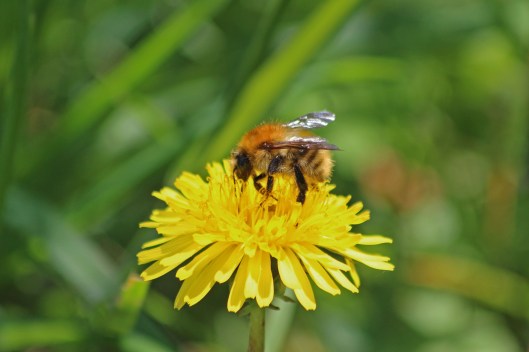
Keeping it simple today – just me enjoying a bee (a Common Carder bee) enjoying a dandelion.

18 Saturday May 2019
Posted in 365DaysWildin2019, insects, nature, wildflowers
Keeping it simple today – just me enjoying a bee (a Common Carder bee) enjoying a dandelion.
23 Saturday Feb 2019
Posted in 365DaysWildin2019, flowers, nature, plants, wildflowers
The French dent-de-lion, lion’s tooth (from the shape of its leaves), became, in English, Dandelion, that wonderful burst of wildflower yellow that lights up grassy meadows and roadside verges, and provides an important early source of pollen to emerging insects. I couldn’t go past this particularly lush flower as I stomped down the zigzag path this afternoon.

15 Thursday Nov 2018
Posted in autumn, nature, wildflowers
Tags
dandelion, dandelion seedhead, plant seeds, round seedheads, seed dispersal methods, seed dissemination, seeds
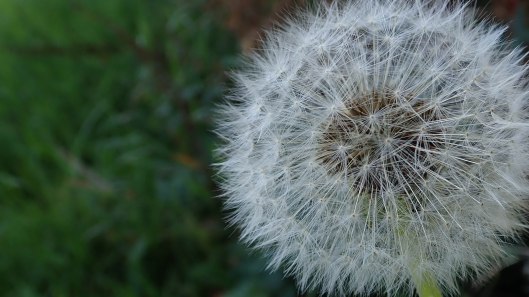
With its seeds attached to tiny botanical parachutes that can be distributed far and wide by the wind, the Dandelion (Taraxacum officinale agg.) has evolved an extremely efficient method of disseminating its seed. It’s not surprising, then, that many other species use a very similar method to disperse their seeds.


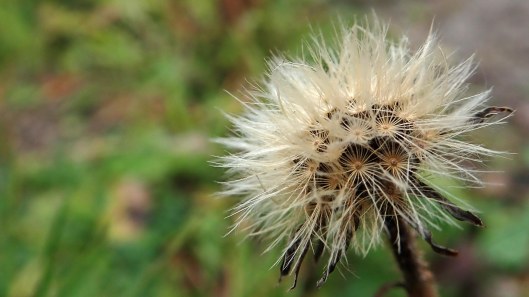

I don’t think I’m getting my wish this time around!

23 Friday Mar 2018
Posted in flowers, nature, spring, wildflowers
Tags
#FloralFriday, British flora, British wildflowers, Colt's-foot, Daisy, dandelion, gorse, Groundsel, Lesser Celandine, Red dead-nettle, Speedwell, Three-cornered garlic, wildflowers
What a week it’s been weather wise! We’ve gone from a generous dumping of snow and temperatures hovering around -5°C last Sunday through occasional rain, sunny periods, UV factors up and down, zephyr winds and mustang gales. Is it spring or isn’t it? Well, I’m seeing increasingly more wildflowers so I guess it must be. Here’s a selection from this week’s wanders.

Colt’s-foot (Tussilago farfara)

Daisy (Bellis perennis)

a type of Dandelion (Taraxacum sp.)

a type of Gorse (Ulex sp.)

Groundsel (Senecio vulgaris)
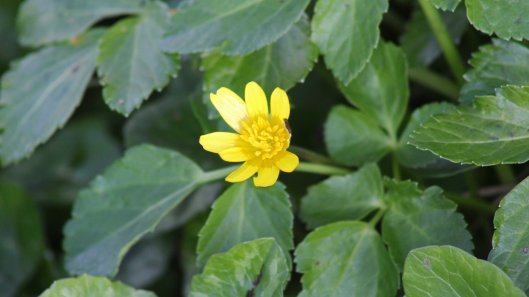
Lesser celandine (Ficaria verna)

Red dead-nettle (Lamium purpureum)

a species of Speedwell (probably Germander) (Veronica sp.)
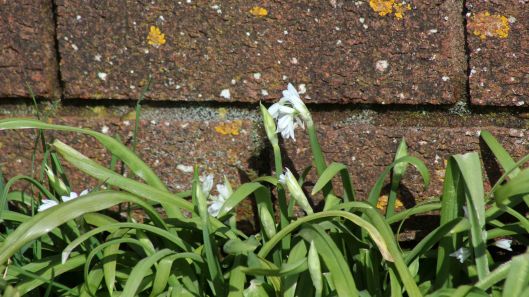
Three-cornered leek (Allium triquetrum)
08 Thursday Jun 2017
Posted in flowers, nature, wildflowers
I made a wish, I cast my vote … but will my wish come true?

02 Wednesday Nov 2016
Posted in nature, wildflowers
… and blow!

14 Friday Oct 2016

It’s a rather grey and gloomy Friday evening here in Cardiff so I think we need some brightening up. There aren’t a lot of flowers around now that autumn is well and truly here but the dandelions and their lookalikes continue to provide little bursts of sunshine on grassy swards, the rudbeckias (at least, I think that’s what they were) have just finished a magnificent show at my local park and, at the cemetery, the Fox and cubs blooms are adding wonderful spots of orange to the autumnal landscape. Happy weekend, everyone!


17 Sunday Apr 2016
Posted in nature, spring, wildflowers
Tags
Bluebell, Bute Park, Common dog-violet, Daisy, dandelion, Germander speedwell, Golden saxifrage, gorse, Greater stitchwort, Green alkanet, Herb Robert, Lesser Celandine, primrose, Red campion, Sweet violet, White deadnettle, Wild garlic, Wild strawberry, Wood anemone
This weekend I could have paid £12 to see what I’m sure would have been gorgeous flowers and inspirational displays at the Royal Horticultural Society’s Flower Show being held here in Cardiff’s Bute Park but, as I don’t have that kind of cash to splash at the moment, I decided to see what flowers I could find in Bute Park for nothing. With 18 different types of wildflowers currently in bloom I certainly wasn’t disappointed. Enjoy!


There were: Bluebell (mostly Spanish but I found a few natives) (Hyacinthoides non-scripta); Daisy (Bellis perennis); Dandelion (Taraxacum officinale); White deadnettle (Lamium album); Herb Robert (Geranium robertianum); Germander speedwell (Veronica Chamaedrys); Gorse (Ulex europaeus); Greater stitchwort (Stellaria holostea); Green alkanet (Pentaglottis sempervirens); Lesser celandine (Ranunculus ficaria); Opposite-leaved golden saxifrage (Chrysosplenium oppositifolium); Primrose (Primula vulgaris); Red campion (Silene dioica); Common dog-violet (Viola riviniana) and Sweet violet (Viola odorata); Wild garlic (Allium ursinum); Wild strawberry (Fragaria vesca); and Wood anemone (Anemone nemorosa).
25 Friday Dec 2015
Posted in nature, nature photography, wildflowers
One of my favourite wildflowers is the humble dandelion. On grey winter days it provides a welcome burst of cheery yellow, and seeing the fluffy seed heads brings me fond childhood memories, of dandelion clocks to tell the time from the number of blows it takes to remove the seeds, and of making a wish when the last of the seeds blows away.

Officially labelled Taraxacum officinale agg., the common name dandelion comes from the French dent de lion, lion’s tooth, a reference to its deeply toothed leaves. In England, it is also commonly called ‘wet-the-bed’ and ‘pissy-beds’, from the idea that just touching a dandelion causes bed-wetting. Luckily, that’s not true, though the dandelion is a scientifically proven diuretic.

In fact, the dandelion is an extremely useful plant. It’s a good source of beta-carotene, is rich in Vitamin C and the B-complex vitamins and also high in protein, so has been used for thousands of years to improve the functioning of the liver, gallbladder, and urinary and digestive systems. And, though I’ve never tried it, dandelion is also widely used to make wine. So, the next time you’re tempted to eradicate these ‘weeds’ from your garden, think again and, instead, make use of Nature’s bounty.
 earthstar
You must be logged in to post a comment.