• ABOUT
  • BIRDING 2018
  • Birding 2019
  • BLOG POSTS
  • Butterflies 2018
  • Resources

earthstar

~ a celebration of nature

earthstar

Tag Archives: Spring colour

Wild and flowering

16 Friday Apr 2021

Posted by sconzani in flowers, spring, wildflowers

≈ Leave a comment

Tags

British wildflowers, Bush vetch, Garlic mustard, Herb Robert, Honesty, Red campion, Shining crane's-bill, Spring colour, spring wildflowers

These gorgeous wildflowers are now blooming in the sunnier, more sheltered spots I pass on my daily walks:

210416 bush vetch

Bush vetch (Vicia sepium), the first of the vetches I’ve seen this year.

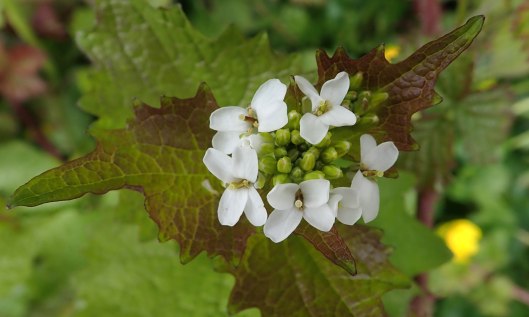
210416 garlic mustard

Garlic mustard (Alliaria petiolata), also known as Jack-by-the-hedge

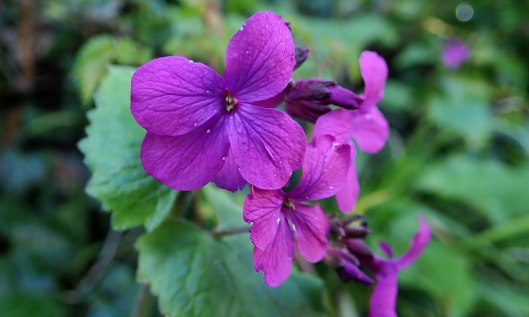
210416 honesty

Honesty (Lunaria annua), originally a garden escapee but now naturalised in the local countryside

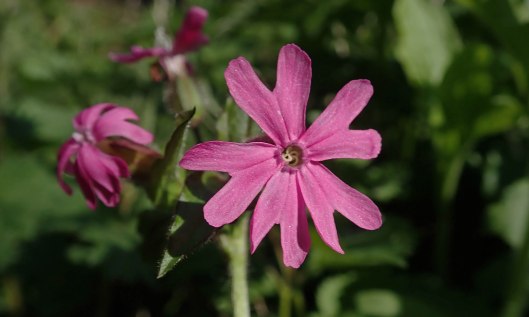
210416 red campion

Red campion (Silene dioica)

210416 herb robert

Herb Robert (Geranium robertianum) and, below, its cousin, Shining crane’s-bill (Geranium lucidum). As you can see, the flowers of these two are very similar but the leaves are quite different.

210416 Shining crane's-bill

Like Loading...

The Yellow challenge

11 Sunday Apr 2021

Posted by sconzani in flowers, spring, wildflowers

≈ Leave a comment

Tags

#WildflowerHour, British wildflowers, Spring colour, yellow flowers, yellow wildflowers

This week’s Wildflower Hour challenge was to find yellow-flowered wildflowers currently in bloom. Here are my finds – a blast of spring sunshine to enjoy this Sunday evening:

210411 yellow (1)

Colt’s-foot, Dandelion, Gorse

210411 yellow (2)

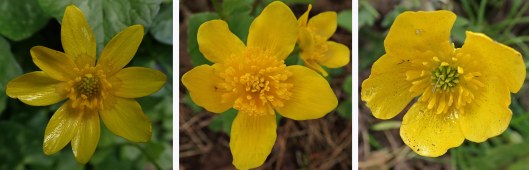
Lesser celandine, Marsh marigold, Meadow buttercup

210411 yellow (3)

Groundsel, Opposite-leaved golden saxifrage (perhaps a bit of a stretch to say this is yellow, but it does have ‘golden’ in its name), Yellow archangel

210411 yellow (4)

Prickly sow-thistle, Cowslips, Ragwort

210411 yellow (5)

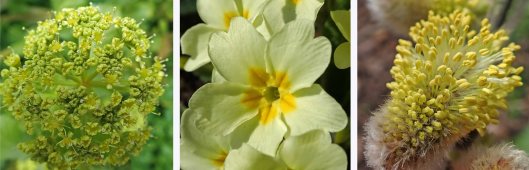
Pushing the envelope on these ones but … Alexanders (greenish-yellow), Primrose (buttery yellow), Pussy willow (not strictly a wildflower, but I’m having it)

Like Loading...

Shades of pink and blue

04 Sunday Apr 2021

Posted by sconzani in nature

≈ 2 Comments

Tags

Bluebells, British wildflowers, Cornsalad, Cuckooflower, Doves-foot cranes-bill, Ground ivy, Lords-and-ladies, Lungwort, Red dead-nettle, Spring colour

All of a sudden, the countryside has been splashed and daubed and sprinkled with these pretty shades of pink and blue.

210404 bluebells

Bluebell (Hyacinthoides sp.), not the native species but still pretty

210404 corn salad

Common Cornsalad (Valerianella locusta), also known as Lamb’s lettuce

210404 cuckooflower

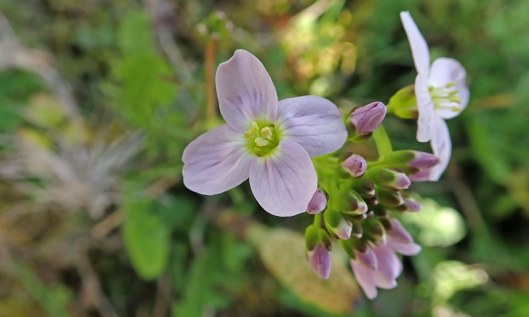
Cuckooflower (Cardamine pratensis), which you might know as Milkmaids or Lady’s smock

210404 ground ivy

Ground ivy (Glechoma hederacea), this little beauty has some wonderful vernacular names, including Gill-over-the-ground and Run-away Robin

210404 lords and ladies

Lords-and-ladies (Arum maculatum), another wildflower named for a bird: Cuckoopint

210404 lungwort

Lungwort (Pulmonaria officinalis), also known as Our Lady’s milk and Mary’s tears

210404 red dead-nettle

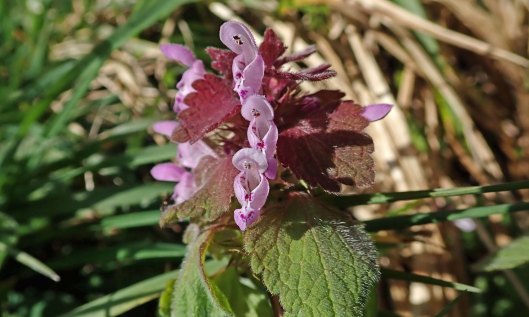
Red dead-nettle (Lamium purpureum), which seems to be under every hedge, along every woodland edge right now

210404 Round-leaved crane's-bill

Dove’s-foot crane’s-bill (Geranium molle), found growing around the base of a local power pole yesterday

Like Loading...

Good Friday plant

02 Friday Apr 2021

Posted by sconzani in plants, spring, wildflowers

≈ 2 Comments

Tags

Adoxa moschatellina, British wildflowers, Good Friday plant, Moschatel, Spring colour, Town Hall clock

This couldn’t have been more appropriate if I’d planned it, which I assure you I didn’t. Until yesterday’s wander through a local woodland, I’d never seen Moschatel before. Its scientific name is Adoxa moschatellina but one of its vernacular names is Good Friday plant, because it usually begins flowering at the beginning of April and is often first seen in bloom at Easter.

Another of its common names is Townhall clock, which Richard Mabey explains in Flora Britannica is because the small flowers ‘are arranged in a remarkable fashion, at right angles to one another, like the faces of a town clock – except that there is a fifth on top, pointing towards the sky’. My photos don’t show this very well so I might have to revisit to get more.

210402 moschatel (2)

Like Loading...

The Violet challenge

21 Sunday Mar 2021

Posted by sconzani in flowers, spring, wildflowers

≈ Leave a comment

Tags

British wildflowers, Common dog-violet, dog violets, Early dog-violet, Spring colour, Sweet violet, Viola odorata, Viola odorata var. dumetorum, Viola reichenbachiana, Viola riviniana, violets, white Sweet violet

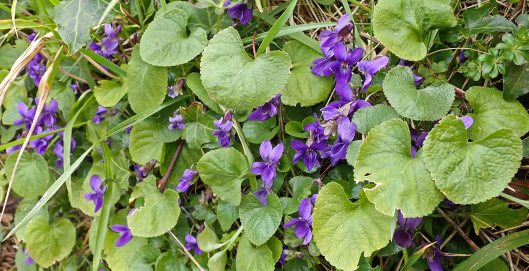
The wildflower hour challenge this week was to ‘find a violet in bloom and work out which one it is’. Now, you might think that’s an easy task but, once you learn – as I did – that there are five subspecies of Sweet violet alone, you could easily decide – as I almost did – that this was a challenge too far. But I persevered, and found three different species (and two subspecies of one).
210321 Viola odorata var odorata (1)

Let’s start with Sweet violet, and the two subspecies I Iocated, the standard purple violet with the glorious scent, Viola odorata var. odorata, and one of the two white subspecies, Viola odorata var. dumetorum. As well as its glorious smell, the Sweet violet can most easily be identified by the rounded sepals that lay flat against the flower (if the sepals were angled back towards the stem, you’d have a Hairy violet – I didn’t find any of those this week). And I’ve not yet seen the second variation of the white violet, Viola odorata var. imberbis (which doesn’t have a ‘beard’, the hairs inside the flower).

210321 Viola odorata var odorata (2)
210321 Viola odorata var dumetorum (2)

210321 Viola odorata var dumetorum (1)

I managed to find both the dog-violets (the word ‘dog’ in this case indicating there is no scent; nothing to do with the domestic pet!). These are Common dog-violet (Viola riviniana) (photos on the left below) and Early dog-violet (Viola reichenbachiana) (photos on the right). These two can be difficult to tell apart sometimes but, though both dog-violets have pointy sepals, the Common dog’s sepals are usually bigger, with tops (the sepal appendages) that are more square, and often notched or scalloped. Also, the spurs at the back of the flowers are mostly stouter and notched at the end on the Common dog, and the veins inside its flowers are longer and multi-branching.

210321 Viola riviniana common dog (1)
210321 Viola reichenbachiana early dog (1)
210321 Viola riviniana common dog (2)
210321 Viola reichenbachiana early dog (2)

You can find Wildflower hour on Twitter by clicking this link, and their website is here. They’re probably on Facebook too but I no longer use FB. If you’re on Twitter, there are many excellent botanists’ accounts to follow but one I definitely recommend is Moira O’Donnell (@nervousbotanist), who often shares easy-to-follow species crib sheets, one of which I have drawn on for this post.

Like Loading...

Red spots

18 Thursday Mar 2021

Posted by sconzani in insects, ladybird, spring

≈ Leave a comment

Tags

7-spot ladybird, British ladybirds, Coccinella septempunctata, Seven-spot ladybird, Spring colour

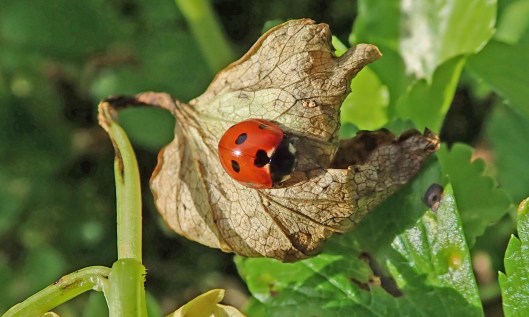
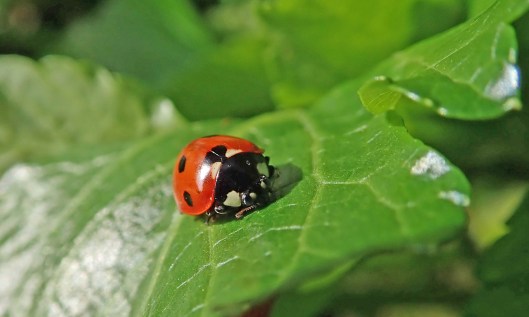
A tiny spot of red caught my eye, and then, close by, another – my first ladybirds of the year, both Seven-spot ladybirds (Coccinella septempunctata).

210318 ladybird (1)

If you’re lucky, you may have had these little beauties hibernating in your garden shed but, in this case, these two are countryside dwellers so have probably spent the winter inside a plant stem, or perhaps tucked securely within the dense branches of ivy, or maybe in a deep crack in tree bark. A few sunny days and warmer overnight temperatures will have triggered their emergence from hibernation, and produced another spring treat for me to enjoy!

210318 ladybird (2)

Like Loading...

Blooming most recklessly

16 Tuesday Mar 2021

Posted by sconzani in flowers, wildflowers

≈ 4 Comments

Tags

British wildflowers, Spring colour, spring flowers

‘Everything is blooming most recklessly; if it were voices instead of colors, there would be an unbelievable shrieking into the heart of the night.’ ~Rainer Maria Rilke, Letters of Rainer Maria Rilke

210316 colt's-foot
210316 creeping buttercup
210316 crocus
210316 daisy
210316 dandelion
210316 lesser celandine
210316 primrose lilac
210316 primrose yellow
210316 smooth cat's-ear
Like Loading...

Youth and cheerfulness

14 Sunday Feb 2021

Posted by sconzani in flowers, winter

≈ 2 Comments

Tags

British wildflowers, crocus, Crocuses, Spring colour, spring flowers

As I’m sure most of you know, in Victorian Britain flowers had special meanings, and many people could understand the language of flowers, could even send coded messages by choosing carefully the flowers they included in a floral gift to a friend or potential lover.

Crocuses, apparently, symbolised youth and cheerfulness. Sadly, my youth is long gone but seeing these beauties on a recent walk certainly made me feel cheery.

Like Loading...

131/366 New bloomers

10 Sunday May 2020

Posted by sconzani in nature, spring, wildflowers

≈ 5 Comments

Tags

Bittersweet nightshade, British wildflowers, Common milkwort, Cut-Leaved crane’s-bill, Flax, Goat's-beard, Spring colour, Wood avens

Here are this week’s newly flowering wildflowers …

200510 bittersweet nightshade

Bittersweet nightshade (Solanum dulcamara), also known as Woody nightshade and Deadly nightshade, though my Flora Britannica assures me this is actually one of the less poisonous members of the nightshade family.

200510 cut-leaved crane's-bill

Cut-leaved crane’s-bill (Geranium dissectum), one of the many lovely members of the extended Geranium family.

200510 flax

Flax (Linum usitatissimum), a small delicate plant, with beautiful pale blue flowers. This is rather different from the plant I, as a New Zealander, usually associate with this name – see my September 2018 post Flax.

200510 goat's-beard

Goat’s-beard (Tragopogon pratensis). As well as producing these glorious large sunny flowers, this wildflower, also known as Jack-go-to-bed-at-noon, has the most wonderful seedheads.

200510 wood avens

Wood avens (Geum urbanum) – you may know this wildflower by its alternate name of Herb Bennet.
200510 milkwort

Common milkwort (Polygala vulgaris). Discovered during my walk to Lavernock Nature Reserve earlier this week, this was the first time I’d seen this pretty little plant, though it’s very small and was almost hidden amongst the other wildflowers and grasses so it may be that I had simply overlooked it on previous visits.

One theory behind its common name is that the flowers of milkwort are shaped like udders and so medieval herbalists, following the ‘signature’ belief (that body parts can be treated by plants that resemble them), used to prescribe this plant to nursing mothers to increase their milk flow.

Like Loading...

124/366 Ragged robin

03 Sunday May 2020

Posted by sconzani in nature, spring, wildflowers

≈ 7 Comments

Tags

Bee-fly, British wildflowers, Grangemoor Park, Lychnis flos-cuculi, Ragged robin, Silene flos-cuculi, Spring colour, spring flowers

At Grangemoor Park on Friday, I spotted my first flowering Ragged robin for the year.

200503 ragged robin (1)

This gorgeous wildflower was formerly known as Lychnis flos-cuculi, but is now Silene flos-cuculi – from a scientific article I browsed, this seems a complicated story of almost constant reclassification of the species! You will still see both names used in books and on line, which is why I’ve mentioned both here.

200503 ragged robin (2)

According to a couple of books I discovered on the ‘language of flowers’, Ragged robin’s symbolic meaning is ‘wit’, and it is dedicated to Saint Barnabas. The ever-informative First Nature website says:

Lychnis, the genus name, comes from the Greek noun lychnos, meaning lamp; it refers to the use of a plant in this genus as the wick of an oil lamp. The specific epithet flos-cuculi means ‘flower of the cuckoo’ and was probably chosen because the first flowers of Ragged Robin appear just as the first cuckoos are being heard (in Britain and Ireland at least) in May.

200503 ragged robin (3)

A special moment: to try to stop it swaying in the breeze so I could get a sharp photo, I was holding one of the blooms when a bee-fly decided to zoom in for a feed of nectar. That super long proboscis comes in handy for long narrow flowers like these.

200503 ragged robin (4)

Like Loading...
← Older posts
Newer posts →

About me

sconzani

sconzani

I'm a writer and photographer; researcher and blogger; birder and nature lover; countryside rambler and city strider; volunteer and biodiversity recorder.

View Full Profile →

Follow earthstar on WordPress.com

Enter your email address to follow this blog and receive notifications of new posts by email.

Recent blog posts

  • O is for Odonata December 20, 2025
  • N is for nest December 19, 2025
  • M is for mite December 18, 2025
  • L is for lepidopteran lifers December 17, 2025
  • K is for Keeled skimmers December 16, 2025

From the archives

COPYRIGHT

Unless otherwise acknowledged, the text and photographs on this blog are my own and are subject to international copyright. Nothing may be downloaded or copied without my permission.

Fellow Earth Stars!

  • Unknown's avatar
  • Unknown's avatar
  • Unknown's avatar
  • Unknown's avatar
  • Unknown's avatar
  • Unknown's avatar
  • Unknown's avatar
  • Unknown's avatar
  • Unknown's avatar
  • Unknown's avatar
  • Unknown's avatar
  • Unknown's avatar
  • Unknown's avatar
  • Unknown's avatar
  • Unknown's avatar
  • Unknown's avatar
  • Unknown's avatar
  • Unknown's avatar
  • Unknown's avatar
  • Unknown's avatar
  • Unknown's avatar
  • Unknown's avatar
  • Unknown's avatar
  • Unknown's avatar
  • Unknown's avatar
  • Unknown's avatar
  • Unknown's avatar
  • Unknown's avatar
  • Unknown's avatar
  • Unknown's avatar
  • Unknown's avatar
  • Unknown's avatar
  • Unknown's avatar
  • Unknown's avatar
  • Unknown's avatar
  • Unknown's avatar
  • Unknown's avatar
  • Unknown's avatar
  • Unknown's avatar
  • Unknown's avatar
  • Unknown's avatar
  • Unknown's avatar
  • Unknown's avatar
  • Unknown's avatar
  • Unknown's avatar
  • Unknown's avatar
  • Unknown's avatar
  • Unknown's avatar
  • Unknown's avatar
  • Unknown's avatar

Blog at WordPress.com.

Privacy & Cookies: This site uses cookies. By continuing to use this website, you agree to their use.
To find out more, including how to control cookies, see here: Cookie Policy
  • Subscribe Subscribed
    • earthstar
    • Join 667 other subscribers
    • Already have a WordPress.com account? Log in now.
    • earthstar
    • Subscribe Subscribed
    • Sign up
    • Log in
    • Report this content
    • View site in Reader
    • Manage subscriptions
    • Collapse this bar
 

Loading Comments...
 

You must be logged in to post a comment.

    %d