• ABOUT
  • BIRDING 2018
  • Birding 2019
  • BLOG POSTS
  • Butterflies 2018
  • Resources

earthstar

~ a celebration of nature

earthstar

Monthly Archives: March 2016

Itsy bitsy, teenie weenie

11 Friday Mar 2016

Posted by sconzani in insects, nature

≈ 3 Comments

Tags

Halyzia secedimguttata, ladybird, Orange ladybird

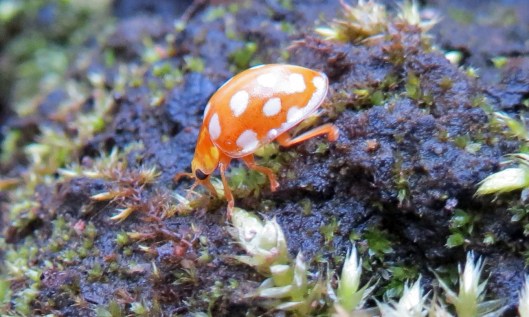
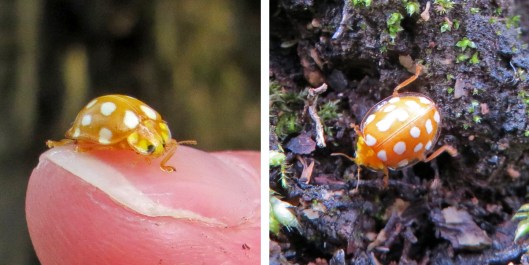
It seems you never know what you might find inside an old rubbery Jelly ear fungus. I certainly didn’t expect to find this delightful little creature, an Orange ladybird (Halyzia secedimguttata). They usually overwinter in a cosy spot amongst the leaf litter or tucked away in a crack in tree bark but the Jelly ear was on a fallen branch and I guess it looked like a snug cave to an insect that’s only 4-6mm long.

160311 orange ladybird (1)

Until 1987 the orange ladybird was thought to live only in ancient woodland but then it discovered it rather liked living on sycamore trees and later developed a liking for ash trees as well, so now you can find it in any woodland, park or garden in Wales and England where these trees grow. It is less common in Scotland apparently – perhaps too cold?

160311 orange ladybird (2)

The Orange ladybird feeds on the powdery mildew fungi that grows on trees and has an interesting lifecycle, laying batches of up to 40 eggs at a time, which hatch as larvae, which eventually pupate while the adult ladybird develops. Fascinating!

Like Loading...

Meet the Mallards

10 Thursday Mar 2016

Posted by sconzani in birds, nature, nature photography

≈ 5 Comments

Tags

birding, birds, birdwatching, British birds, duck, Mallard, weather folklore

160306 mallard 3

Though male and female Mallard (Anas platyrhynchos) are so different they were originally thought to be two different species, today they are what almost everyone imagines when they hear or read the word ‘duck’, and they are the bird people most love to feed with old scraps of bread. Please don’t! As Britain’s Canal and River Trust has often warned, with 6 million loaves being thrown into canals, lakes and waterways every year, bread is a serious problem. Not only is it bad for the ducks’ environment, it’s not very healthy for the ducks either. Click on this link to read about the more natural alternatives.

160306 mallard 1

British folklore has many charming references to mallards and weather forecasting, like this: ‘If ducks fly backwards and forwards, and continually plunge in water and wash themselves incessantly, wet weather will ensure.’ In Scotland, there’s a similar saying: ‘When ducks are driving through the burn [darting through the stream], / that night the weather takes a turn.’ And here’s one from Sussex: ‘If there’s ice at Martinmas will bear a duck / There’ll be nothing after but sludge and muck.’ Obviously, the nation’s weather forecasters should be watching the mallards, not their charts and satellite maps!

160306 mallard 2

Like Loading...

The horse in striped pyjamas

09 Wednesday Mar 2016

Posted by sconzani in animals, nature, nature photography

≈ 6 Comments

Tags

horse in striped pyjamas, Ngorongoro Crater, Serengeti National Park, Tanzania, zebra

Eight things you might not have known about zebras, until now:

zebras (1)

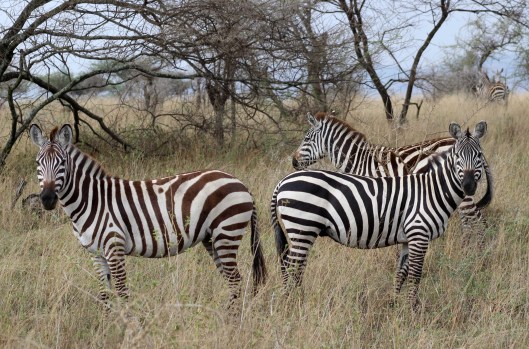
1 Zebras can move fast, up to 65mph in fact, which, when combined with superb stamina and some cunning zigzagging moves, means they can outrun most of the creatures that might want to eat them.
zebras (2)

2 Zebras are relatively long-lived animals, clocking up between 20 and 30 years in the wild, and up to 40 in zoos.

zebras (3)

3 Though never domesticated, zebras were once trained to pull chariots around the hippodromes of Ancient Rome.

zebras (4)

4 Zebras are clever communicators. As well as oral expression (barks, whinnies and sniffing sounds), they also use facial expressions and the position of their ears and tails to convey how they feel. Beware the zebra with wide-open eyes, bared teeth and ears pulled backwards – he’s mad!

zebras (5)

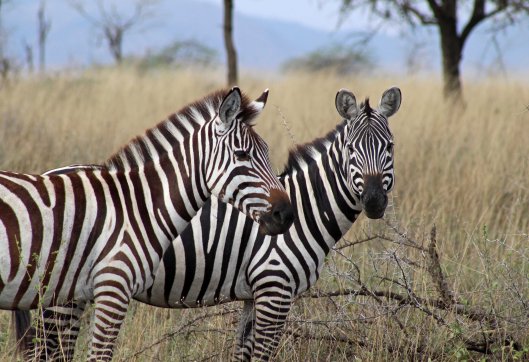
5 As the old Eddie Arnold song goes, a zebra looks like a horse in striped pyjamas. Turns out, zebras sleep like horses too, standing up and only when safe amongst the herd.
zebras (6)

6 The herd means protection for a zebra, and the larger the herd the better, as then more ears and eyes are keeping watch. Other grazing animals like antelope and wildebeest are also welcome.

zebras (7)

7 Talking of herds – what about that incredible spectacle, the annual 1800-mile migration of zebras, antelopes and wildebeest between Kenya’s Maasai Mara and Tanzania’s mighty Serengeti Plains?

zebras (8)

8 And, finally, about those striped pyjamas – it seems zebras evolved stripes for a multitude of reasons:  en masse in a herd, their stripes visually merge so predators have a tough job focusing on individual animals; stripes also distort distance in low light (i.e. at dawn and dusk); they’re a unique visual fingerprint helping zebras recognise each other; they’re a form of temperature control as stripes are believed to disperse around 70% of the sun’s heat; and new research has shown that their monochrome pattern confuses the visual systems of flies, thus helping to keep those annoying critters at bay.

My photographs of zebras were taken on the Serengeti Plains and in the Ngorongoro Crater in Tanzania in 2014, at the end of a week-long trip with The Giving Lens, an organisation that combines photography workshops with mentoring, media and financial support for local NGOs.

Like Loading...

I’m following a tree: month 2

08 Tuesday Mar 2016

Posted by sconzani in nature, spring, trees

≈ 10 Comments

Tags

Bute Park, Cardiff, Dawn redwood, I'm following a tree, tree following

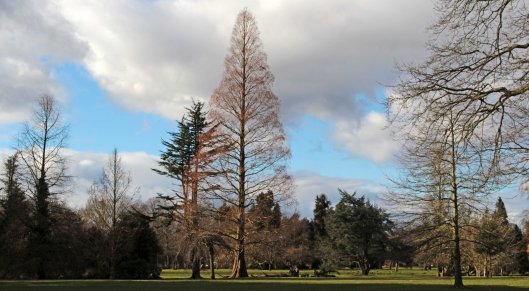
160308 dawn redwood (4)

Though I have strolled past Dawn Redwood a couple of times this month, I hadn’t really noticed any change in her, until today – and then it was only when I was reviewing this afternoon’s photos and zoomed in on one or two. Note to self: next time, choose a shorter tree to follow, the better to see what’s happening up top – because it’s at the top of the tree that all the action is happening.

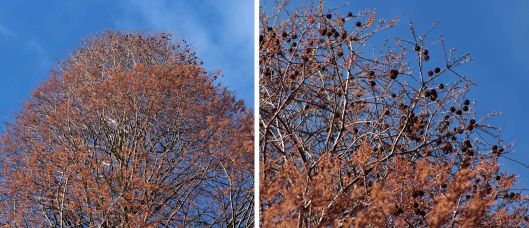
160308 dawn redwood (2)160308 dawn redwood (1)

Not only is Dawn still carrying last season’s cones up there, she also still has more of a flush of this spring’s flowers higher up and, at the very top, the green of this year’s foliage is just beginning to burst out. I find each of these things surprising – the cones and the flowers because the top of the tree must be the most windblown so I’d have expected both to have been blown off more at the top than lower down the tree, and the budding foliage because I thought the tree would green from the bottom as the sap rose upwards with the warmer weather.

This is exactly why following a tree is so very interesting. The more closely you look, the more you see and learn.

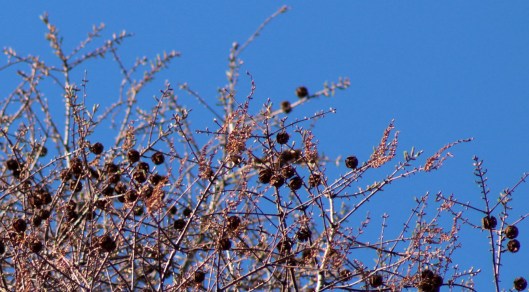
160308 dawn redwood (3)

small cones for such a large tree, and very tiny seeds (bottom of photo, left of centre)

Why not join the tree following community. You can find out more here.

Like Loading...

Great crested grebes: the nesting

07 Monday Mar 2016

Posted by sconzani in birds, nature, nature photography

≈ Leave a comment

Tags

birding, birdwatching, British birds, Great Crested Grebe, nesting

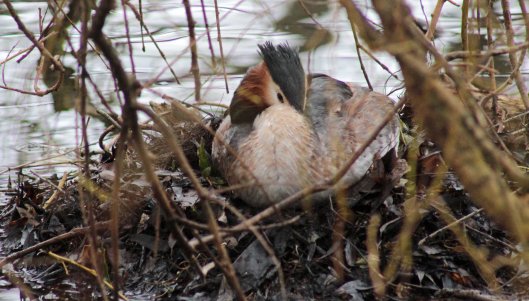
160307 great crested grebe nesting (1)

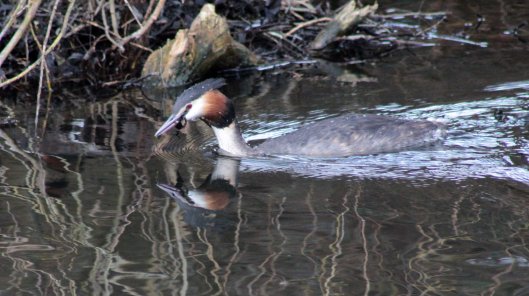
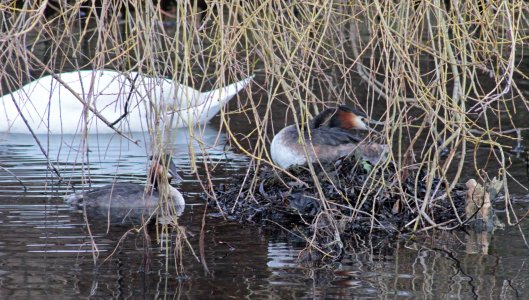
A week ago I mentioned that I had, quite by chance, found a pair of Great Crested Grebes nesting here in Cardiff. What a joy to see! I intend revisiting them once a week or so to see how they’re progressing.

160307 great crested grebe nesting (2)

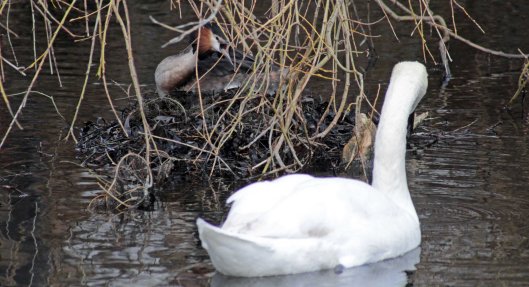
If you think sitting on a nest all day is an easy job, think again! Firstly, it seems that, just like home decorating, the nest-building process is never finished. As I watch Mr Grebe brings home some bits of weed, shows the missus, then places them carefully around the edges of the nest.

160307 great crested grebe nesting (3)

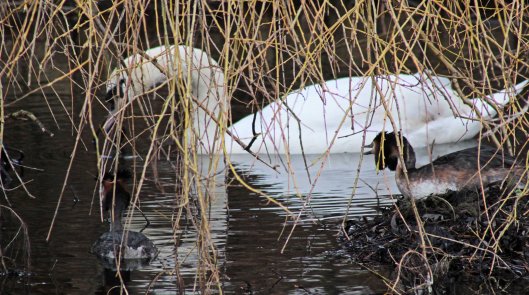
While he is off collecting more, the mate of the swan that is nesting just a few metres away comes gliding by, looking for food, perhaps with his eye on the fresh weed Mr Grebe keeps collecting. Mrs Grebe is having none of it! Feeling threatened and upset, she opens her mouth wide and starts protesting loudly at the swan.

160307 great crested grebe nesting (4)

Mr Grebe rushes home to see what’s upsetting wifey and also tells the swan in no uncertain terms to back off.

160307 great crested grebe nesting (5)

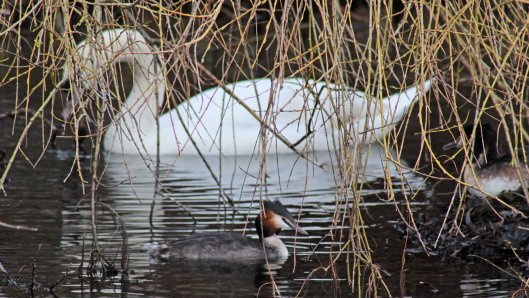
Though the swan is still quite close, the grebes calm down and hubby is about to head off for more weed.

160307 great crested grebe nesting (6)

But then another intruder gets too close: a coot comes paddling over, and Mrs Grebe gets upset all over again.

This all happened in the space of about 5 minutes. My photos are not the best but I don’t want to get too close and I don’t want to stay too long, though I don’t think the grebes even noticed my presence with all the other dramas happening.

Like Loading...

Fungi finger prints

06 Sunday Mar 2016

Posted by sconzani in fungi, nature, nature photography, trees

≈ Leave a comment

Tags

fungus, Rhytisma acerinum, sulphur dioxide air pollution, sycamore, Tar spot

Well, they look a bit like finger prints to me – or, perhaps, the wax seals people used to stamp on their communications and documents. But no! These are, in fact, the signs of Tar spot, a disease that most often affects sycamore trees but can also occur in other species of acer, and is caused by the fungus Rhytisma acerinum.

Rhytisma acerinum Sycamore Tarspot (1)

The spots start out yellow in the springtime, then eventually morph into the slightly raised bumpy black spots you can see in my photos. Although they look a little ugly, the spots don’t affect the health of the trees – they merely cause the leaves to drop a little earlier than normal in the autumn.

Rhytisma acerinum Sycamore Tarspot (2)
Rhytisma acerinum Sycamore Tarspot (3)

Though you might not like the look of them, there is one big benefit to seeing these spots on your sycamore tree: as the fungus is particularly sensitive to sulphur dioxide air pollution, its presence indicates your air is relatively clean and healthy.

Rhytisma acerinum Sycamore Tarspot (4)

Like Loading...

My favourite avians

05 Saturday Mar 2016

Posted by sconzani in birds, nature, nature photography

≈ 2 Comments

Tags

birding, birds, birdwatching, blackbird, Blue tit, British birds, bullfinch, dunnock, Forest Farm Nature Reserve, Great tit, robin, thrush

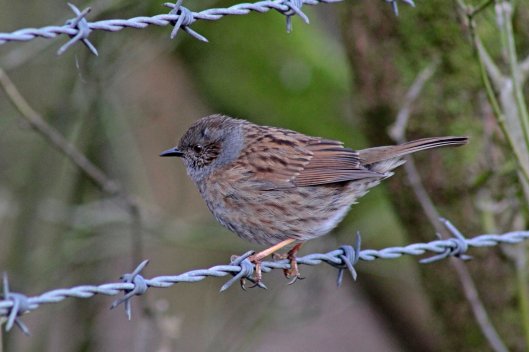
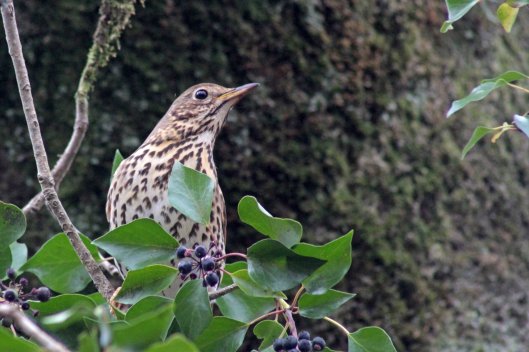
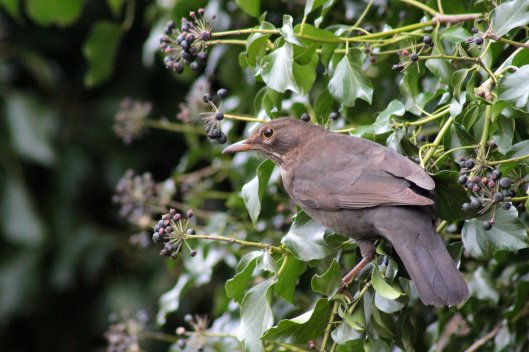
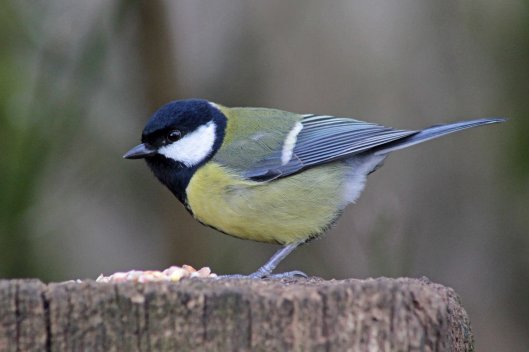
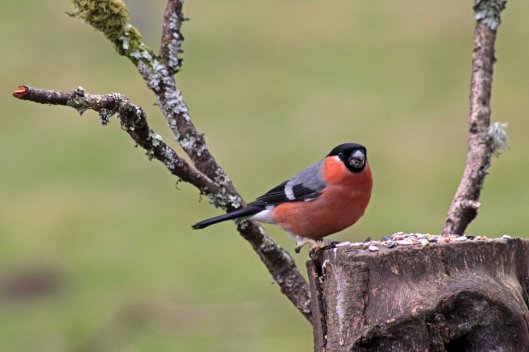
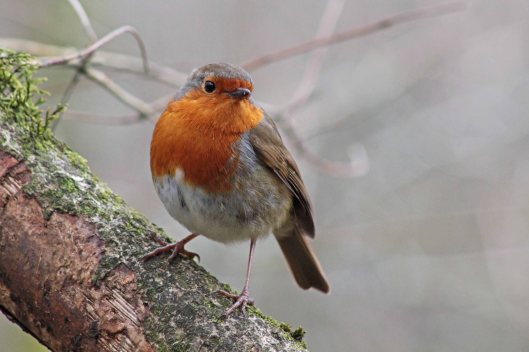
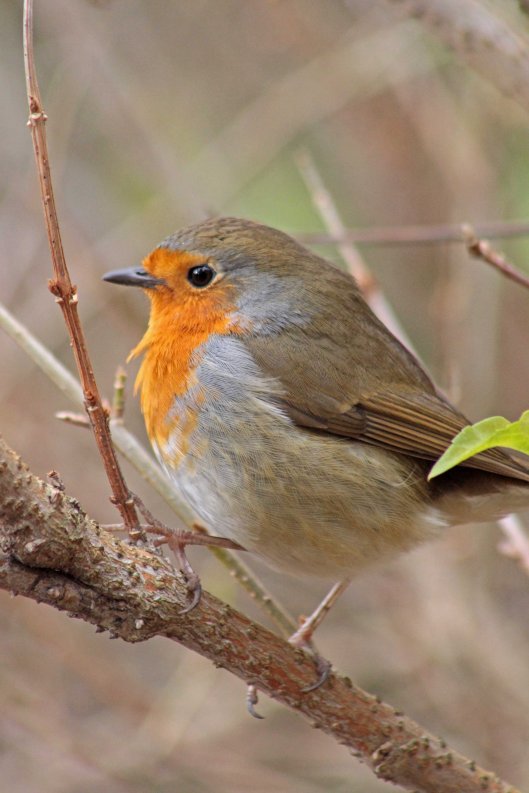
In spite of occasional hail showers and a biting cold wind, yesterday was another magical day at Forest Farm Nature Reserve. I was serenaded by robins, I laughed at the antics of the cute little blue tits, was entertained by the thrushes and blackbirds performing acrobatic stunts in search of the tastiest ivy berries, and enjoyed the most wonderful privilege of a great tit perching on my hand to eat the seeds I was offering. Here are a few of my photos.

160305 ff1 dunnock

A little timid, often overlooked, but very lovely dunnock

160305 ff2 thrush

Both the thrush (above) and blackbird (below) were feasting on ivy berries

160305 ff3 blackbird

160305 ff4 great tit

A great tit

160305 ff5 blue tit

Always so cute, a little blue tit

160305 ff6 bullfinch

A male bullfinch – such stunning colours

160305 ff7 robin

No visit to Forest Farm is complete without a robin or twenty!

Like Loading...

Conversation with robins: 4

04 Friday Mar 2016

Posted by sconzani in birds, nature, nature photography

≈ 8 Comments

Tags

birding, birds, birdwatching, British birds, conversations with robins, robin, singing robins

Forest Farm Nature Reserve, one fine February day …

160301 robin hood (1)

Me: ‘Hello, dear little robin. Got a song for me today?’
Robin: ‘Sure, lady. You know us robins love to sing. I’ve been learning a new one about an outlaw.’

160301 robin hood (2)

Me: ‘Really? Okay, let’s hear it.’
Robin: ‘Robin Hood, Robin Hood, riding through the glen.’

160301 robin hood (3)

Robin: ‘Robin Hood, Robin Hood, with his band of men.’

160301 robin hood (4)

Robin: ‘Feared by the bad, loved by the good.’

160301 robin hood (5)

Robin: ‘Robin Hood, Robin Hood, Robin Hood.’

160301 robin hood (6)

Robin: ‘Well, what d’ya think? I’d like to be an outlaw like Robin Hood. He’s my hero.’
Me: ‘You sang brilliantly. Well done! And, as a reward, here’s some birdseed you might like.’

Like Loading...

In honour of elephants

03 Thursday Mar 2016

Posted by sconzani in animals, nature, nature photography

≈ 2 Comments

Tags

#WorldWildlifeDay, elephants, Ngorongoro Crater, Serengeti National Park, Tanzania

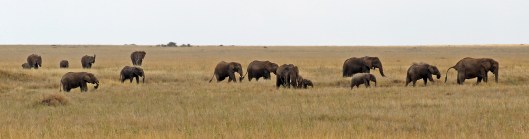
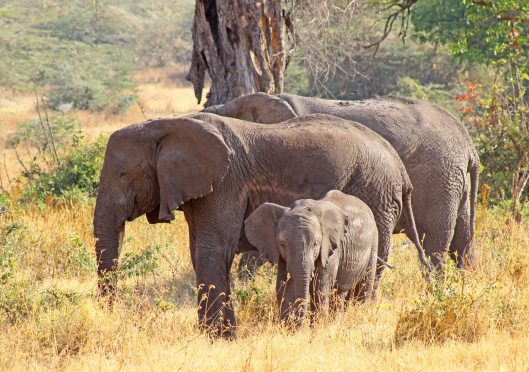
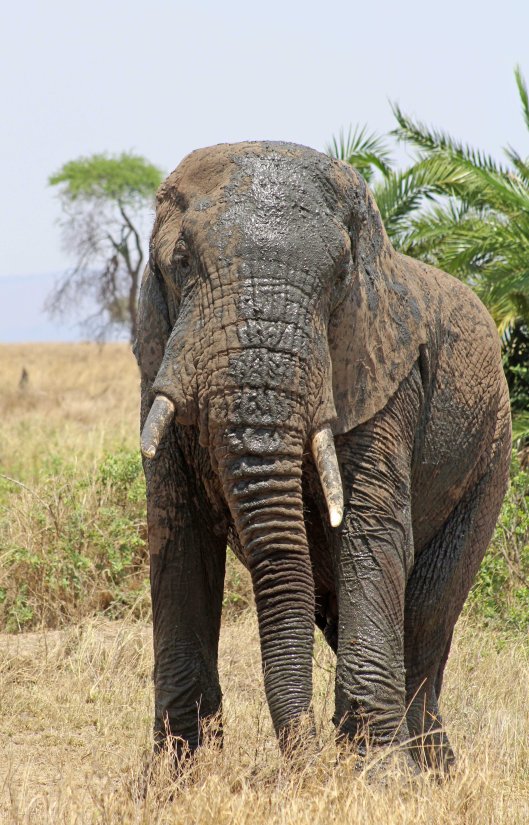
For World Wildlife Day …

elephants 1

‘Nature’s great masterpiece, an elephant; the only harmless great thing.’ ~ John Donne

elephants 2

‘If an elephant has its foot on the tail of a mouse and you say that you are neutral, the mouse will not appreciate your neutrality.’ ~ Desmond Tutu

elephants 3

‘Of all African animals, the elephant is the most difficult for man to live with, yet its passing – if this must come – seems the most tragic of all. I can watch elephants (and elephants alone) for hours at a time, for sooner or later the elephant will do something very strange such as mow grass with its toenails or draw the tusks from the rotted carcass of another elephant and carry them off into the bush. There is mystery behind that masked gray visage, and ancient life force, delicate and mighty, awesome and enchanted, commanding the silence ordinarily reserved for mountain peaks, great fires, and the sea.’ ~ Peter Matthiessen, The Tree Where Man Was Born

elephants 4

‘I have a memory like an elephant. I remember every elephant I’ve ever met.’ ~ Herb Caen

elephants 5

‘I have a memory like an elephant. In fact, elephants often consult me.’ ~ Noel Coward

elephants 6

‘Elephants love reunions. They recognize one another after years and years of separation and greet each other with wild, boisterous joy. There’s bellowing and trumpeting, ear flapping and rubbing. Trunks entwine.’ ~ Jennifer Richard Jacobson, Small as an Elephant

elephants 7

‘They say that somewhere in Africa the elephants have a secret grave where they go to lie down, unburden their wrinkled gray bodies, and soar away, light spirits at the end.’ ~ Robert McCammon, Boy’s Life

elephants 8

‘The question is, are we happy to suppose that our grandchildren may never be able to see an elephant except in a picture book?’ ~ David Attenborough

elephants 9

My photographs of elephants were taken on the Serengeti Plains and in the Ngorongoro Crater in Tanzania in 2014, at the end of a week-long trip with The Giving Lens, an organisation that combines photography workshops with mentoring, media and financial support for local NGOs.
Like Loading...

The far too Common gorse

02 Wednesday Mar 2016

Posted by sconzani in nature, plants

≈ 7 Comments

Tags

Common gorse, gorse, invasive weed, spring flowers

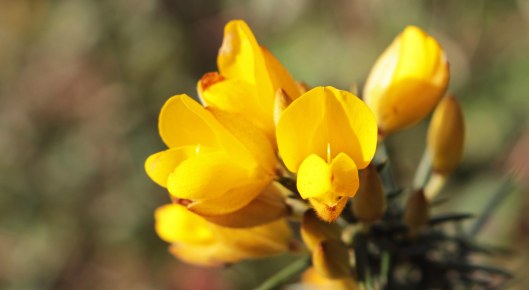
Mention gorse to a farmer in New Zealand and he’ll curse and swear and grab the nearest strong weed-killer. It’s considered the country’s worst agricultural weed, and millions of dollars have been spent trying to eradicate it. Obviously, then, it is not a New Zealand native but was introduced in the very early days of colonial settlement for use as hedges and windbreaks. Little did those early settlers realise how invasive the plant would become in New Zealand’s temperate climate or how much angst they would cause their descendants.

160302 gorse (1)

So, you will, I hope, forgive me for not waxing lyrical about the joys of gorse in my newly adopted country of Wales. Yes, I recognise it has a very pretty flower, and I also acknowledge that it is a useful source of pollen when very few other plants are flowering. Apparently, the scent of its flowers reminds people of the smell of coconut – I admit I haven’t given them the sniff test. And I have read that gorse provides shelter and a good nesting habitat for a range of birds, including the stonechat, yellowhammer and linnet. But, in this instance, I just can’t set my heritage aside – to my eye, it’s a weed, and always will be!

160302 gorse (3)
160302 gorse (2)
160302 gorse (4)
Like Loading...
← Older posts
Newer posts →

About me

sconzani

sconzani

I'm a writer and photographer; researcher and blogger; birder and nature lover; countryside rambler and city strider; volunteer and biodiversity recorder.

View Full Profile →

Follow earthstar on WordPress.com

Enter your email address to follow this blog and receive notifications of new posts by email.

Recent blog posts

  • Bloody-nosed beetle April 6, 2026
  • Gorse and its weevil April 5, 2026
  • Chiffchaffs chiffchaffing April 4, 2026
  • Bearded tit!!! April 3, 2026
  • A Portland Bill Kestrel April 2, 2026

From the archives

COPYRIGHT

Unless otherwise acknowledged, the text and photographs on this blog are my own and are subject to international copyright. Nothing may be downloaded or copied without my permission.

Fellow Earth Stars!

  • Unknown's avatar
  • Unknown's avatar
  • Unknown's avatar
  • Unknown's avatar
  • Unknown's avatar
  • Unknown's avatar
  • Unknown's avatar
  • Unknown's avatar
  • Unknown's avatar
  • Unknown's avatar
  • Unknown's avatar
  • Unknown's avatar
  • Unknown's avatar
  • Unknown's avatar
  • Unknown's avatar
  • Unknown's avatar
  • Unknown's avatar
  • Unknown's avatar
  • Unknown's avatar
  • Unknown's avatar
  • Unknown's avatar
  • Unknown's avatar
  • Unknown's avatar
  • Unknown's avatar
  • Unknown's avatar
  • Unknown's avatar
  • Unknown's avatar
  • Unknown's avatar
  • Unknown's avatar
  • Unknown's avatar
  • Unknown's avatar
  • Unknown's avatar
  • Unknown's avatar
  • Unknown's avatar
  • Unknown's avatar
  • Unknown's avatar
  • Unknown's avatar
  • Unknown's avatar
  • Unknown's avatar
  • Unknown's avatar
  • Unknown's avatar
  • Unknown's avatar
  • Unknown's avatar
  • Unknown's avatar
  • Unknown's avatar
  • Unknown's avatar
  • Unknown's avatar
  • Unknown's avatar
  • Unknown's avatar
  • Unknown's avatar

Blog at WordPress.com.

Privacy & Cookies: This site uses cookies. By continuing to use this website, you agree to their use.
To find out more, including how to control cookies, see here: Cookie Policy
  • Subscribe Subscribed
    • earthstar
    • Join 642 other subscribers
    • Already have a WordPress.com account? Log in now.
    • earthstar
    • Subscribe Subscribed
    • Sign up
    • Log in
    • Report this content
    • View site in Reader
    • Manage subscriptions
    • Collapse this bar
 

Loading Comments...
 

You must be logged in to post a comment.

    %d