• ABOUT
  • BIRDING 2018
  • Birding 2019
  • BLOG POSTS
  • Butterflies 2018
  • Resources

earthstar

~ a celebration of nature

earthstar

Monthly Archives: April 2018

Grandmother’s nightcap

20 Friday Apr 2018

Posted by sconzani in flowers, nature, spring, wildflowers

≈ 2 Comments

Tags

Anemone nemorosa, British wildflowers, Grandmother's nightcap, Moggie nightgown, Smell foxes, spring flowers, Windflower, Wood anemone

180420 wood anemone (4)

I’m not sure my grandmother ever wore a nightcap quite like this but Grandmother’s nightcap is just one of the vernacular names for the luminous Wood anemone (Anemone nemorosa). Others include Windflower, and, in parts of Deryshire, where a moggie is a mouse not a cat, Moggie nightgown, as well as Smell foxes, due to the musky smell a large colony of Wood anemones will sometimes emit.

180420 wood anemone (1)180420 wood anemone (2)180420 wood anemone (3)

Like Loading...

Birding at Craig Cerrig Gleisiad and Garwnant

19 Thursday Apr 2018

Posted by sconzani in birds, nature, spring, walks

≈ 2 Comments

Tags

birding, birdwatching, Brecon Beacons, British birds, Craig Cerrig Gleisiad, Dipper, Glamorgan Bird Club, Grey wagtail, Pen-y-fan, Pied flycatcher, Stonechat, Willow tit

Derek the weatherman got the forecast absolutely right for our Glamorgan Bird Club trip yesterday: foggy and a bit mizzly until 10am, then the cloud lifted to leave clear blue skies and t-shirt weather – it almost felt like summer!
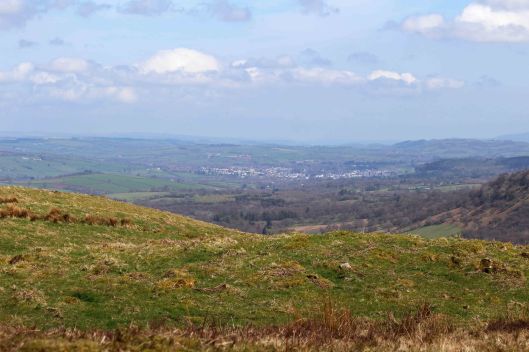
180419 Brecon in the distance

We twenty-two birding enthusiasts had headed north of Cardiff to the Brecon Beacons National Park – when the cloud lifted, we could see Pen-y-fan, at 2,907 feet (886m), Wales’s 10th highest mountain. The plan was to walk the lower slopes of Craig Cerrig Gleisiad National Nature Reserve, in the hope of seeing Ring Ouzels, Whinchats, Redstarts, Wheatears and possibly Pied Flycatcher, amongst other birds.
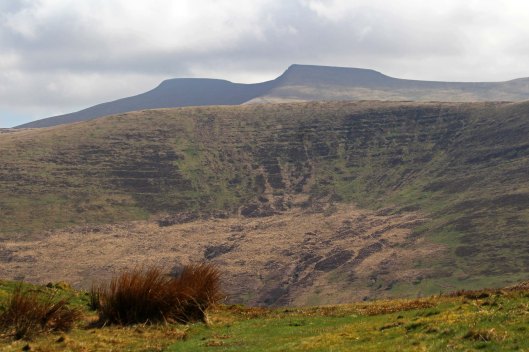
180419 Pen-y-Fan

Because of the damp weather and low cloud, we began the day by exploring the woodland around the Youth Hostel across the road from the reserve and immediately had superb views of Pied flycatchers, and not only male birds but also a female who was making a start on nest building. A Tree pipit sitting high on bushes in the neighbouring fields was also a year tick for me.

180419 Pied flycatcher female
180419 Pied flycatcher male

After a spot of early lunch back at the cars, we climbed the slopes into the dramatic landscape of Craig Cerrig Gleisiad, the southernmost glacial boulder field in Britain. Here we had Willow warblers singing all along the stream, and frequent views of Stonechats and Meadow pipits.

180419 stonechat female
180419 stonechat male

Some of the party went further up the track and were rewarded with views of distant Ring ouzels – I wasn’t one of the lucky ones, but it was great that others got on to them. Then, after regrouping back at the cars, some of us took a small detour on the way home for a quick visit to the Garwnant Forestry Centre, where we saw Grey wagtails and Dippers on the river and a Red kite and Sparrowhawk overhead. And we were very lucky that the resident Willow tit showed well for us near the Centre’s car parking area. It was another splendid day’s birding!

180419 Grey wagtail
180419 Dipper

My species list for the day was: Red Kite, Sparrowhawk, Buzzard, Peregrine, Lesser Black-backed Gull, Woodpigeon, Crow, Raven, Blue Tit, Great Tit, Coal Tit, Willow Tit, Willow Warbler, Blackcap, Wren, Nuthatch, Treecreeper, Dipper, Blackbird, Song Thrush, Robin, Pied Flycatcher, Redstart, Stonechat, Dunnock, Grey Wagtail, Pied Wagtail, Tree Pipit, Meadow Pipit, Chaffinch, and Siskin. And other birds seen (but not by me) were: Kestrel, Marsh Tit, Wheatear, Skylark, Swallow, Goldcrest, Ring Ouzel, and Linnet.
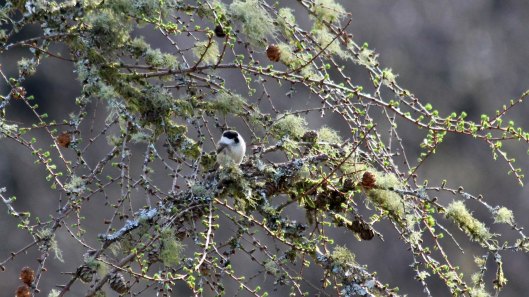

180419 Willow tit

Like Loading...

Wild words: bud burst

18 Wednesday Apr 2018

Posted by sconzani in leaves, nature, spring, trees

≈ Leave a comment

Tags

#WildWords, bud burst, bud scales, new leaves, Spring has sprung, springtime, wild words

I love this little miracle that happens every spring, and I couldn’t resist having ‘bud burst’ as this week’s words after seeing many beautiful examples when I was out walking on Monday.

OLYMPUS DIGITAL CAMERA

During winter, deciduous trees look so bare and barren, yet, safely enclosed within the protective cases of their ‘bud scales’, tiny leaves are beginning to grow. Then, once temperatures start to warm up, the trees’ roots absorb more water and the sap begins to rise. The leaf buds grow and swell to the point when their scales just can’t contain them any more and then, one day …

OLYMPUS DIGITAL CAMERA

Shazam! The buds burst out and begin to expand and soak up the spring sunshine!

OLYMPUS DIGITAL CAMERA

Like Loading...

A moth trap

17 Tuesday Apr 2018

Posted by sconzani in insects, nature

≈ 8 Comments

Tags

British moths, Early grey, Early thorn, moths, Selenia dentaria, Xylocampa areola

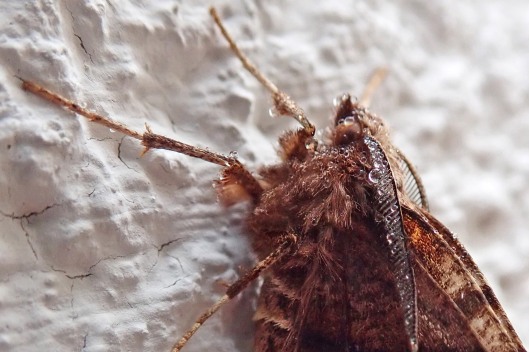
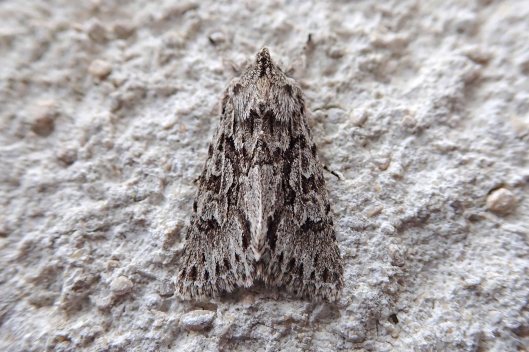
I don’t have a garden so I can’t have a moth trap, and I admit to getting the teensiest bit envious of friends who do have traps. But I get to see their finds on Facebook, and I will also readily admit that learning to identify the 2500 species of moth found in Britain might just do my head in, so perhaps not having a moth trap is really a good thing! And, anyway, I seem to have discovered a very convenient place to find the occasional moth, a tall alleyway between local houses that has its very own street lamp.

OLYMPUS DIGITAL CAMERA

I walk this way often but hadn’t noticed moths until the day before yesterday – perhaps it hasn’t been warm enough before. And, as you can see from the head of this first moth (photo below), it was a damp, foggy morning and the moth was still to warm up so couldn’t fly away. This is one of the first of two generations of Early thorn (Selenia dentaria) to breed throughout much of Britain each year. (To find out more about the Early thorn, click here).

OLYMPUS DIGITAL CAMERA

The second moth on the alley wall was this dapper delight, an Early grey (Xylocampa areola), another common and widespread moth, whose caterpillars feed on Honeysuckle. (More on the Early grey here.)

OLYMPUS DIGITAL CAMERA

Like Loading...

Getting the flutters

16 Monday Apr 2018

Posted by sconzani in insects, nature, spring

≈ 6 Comments

Tags

Bee-fly, British butterflies, butterflies, Comma, Comma butterfly, Peacock, Peacock butterfly, Speckled wood, Spring has sprung, springtime

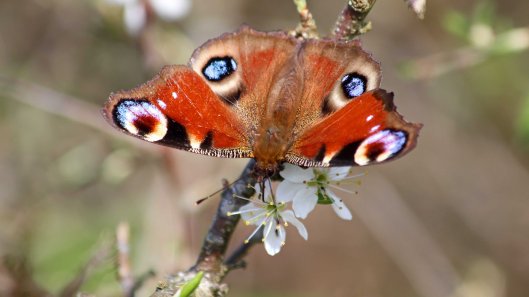
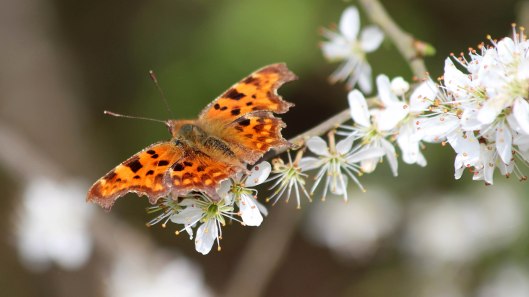
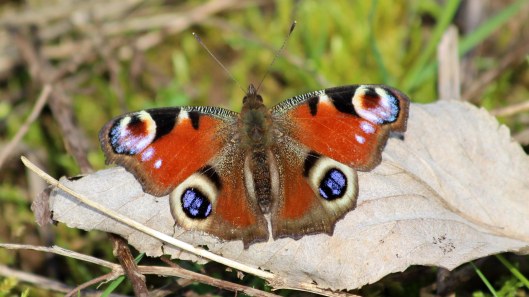
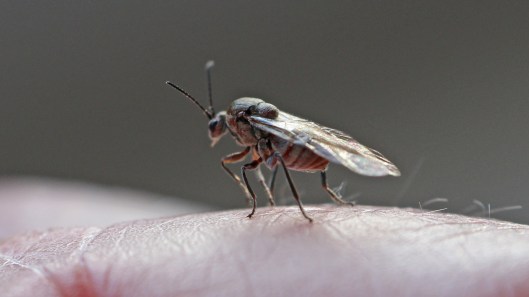
Spring came to south Wales on Saturday at approximately 3.30pm and lasted about 4 hours. (It’s supposed to return again next week and stay a few days but, in the constantly changing contemporary climate, it pays not to count your chickens – or, maybe that should be, your rays of sunshine!) Amazingly, as soon as the sun appeared, so too did the butterflies. It was like a door had been opened – where had they been hiding, I wonder? In the space of about 30 minutes, I saw Peacocks and Commas, several never-settling Brimstones, a distant large-or-small White, and my first Speckled wood of the year. Oh, and a couple of Bee-flies – not butterflies, obviously, but the cutest wee flying things you ever did see so I’ve included one here. It was delightful!

180416 1 Peacock180416 2 Comma180416 3 Peacock180416 4 Comma180416 5 Speckled wood180416 6 Bee fly

Like Loading...

On the verge

15 Sunday Apr 2018

Posted by sconzani in flowers, nature, plants, spring, wildflowers

≈ Leave a comment

Tags

#Ontheverge, #WildflowerHour, British wildflowers, spring flowers, wildflowers

Are you up for a challenge? Do you like wildflowers? Well, then get following Wildflowerhour on Twitter and / or Facebook, and join in the weekly wildflower challenge fun. Not only will your newsfeed be filled with glorious colour every Sunday night from 8 to 9pm (and throughout the week, as well) but I guarantee you will also learn something new each week.

180415 The verge

The verge

This week’s challenge was titled ‘On the verge’, and we were challenged to see what wildflowers we could discover on roadside verges. Rather than a busy highway, I chose a quiet local side road at Penarth Marina – I already get lots of odd looks for taking a close look at flowers and insects, so tried to avoid too much attention. The Marina area is a relatively new environment, my verge an area that had previously been a dock, where ocean-going ships brought goods from near and far to Cardiff, but this particular dock was filled with household rubbish and turned into a park back in the 1980s. So, I didn’t find anything particularly exciting on my verge but it was interesting to see what plants had become established.

180415 Common cornsalad Valerianella locusta

Common cornsalad (Valerianella locusta)

180415 Creeping buttercup Ranunculus repens

Creeping buttercup (Ranunculus repens)

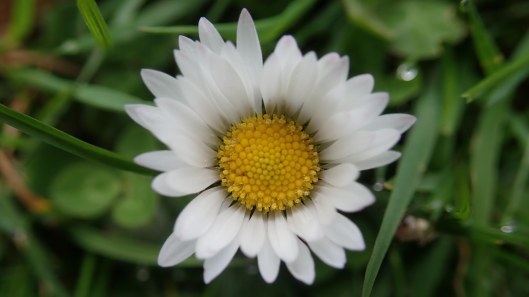
180415 Daisy Bellis perennis

The ever reliable Daisy (Bellis perennis)

180415 Dandelion Taraxacum sp and slug friend

Partly devoured Dandelion (Taraxacum sp.) and slug friend

180415 Field Wood-rush Luzula campestris

Field Wood-rush (Luzula campestris)

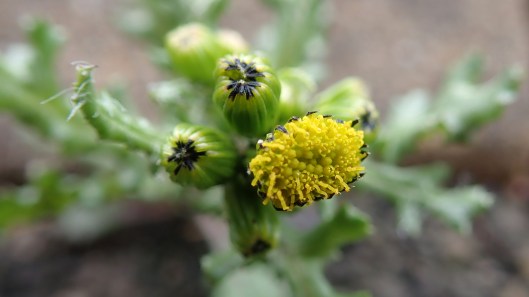
180415 Groundsel Senecio vulgaris

Groundsel (Senecio vulgaris)

180415 Ribwort plantain Plantago lanceolata

Not quite open yet, but close – Ribwort plantain (Plantago lanceolata)

180415 Wavy Bitter-cress Cardamine flexuosa

Wavy Bitter-cress (Cardamine flexuosa)

Like Loading...

Andricus kollari, maybe

14 Saturday Apr 2018

Posted by sconzani in insects, nature, trees

≈ 2 Comments

Tags

Andricus kollari, gall wasps, galls, galls on oak trees, Marble gall, oak galls, Oak Marble gall, oak tree

180414 Andricus kollari (3)

If you’re a regular around here, you may recall that in August 2017, I posted a mini-series of posts about some of the galls you can find on Oak trees, which included the Oak Marble gall (see the post here). You might also remember that in late October, I was excited to discover a creature had hatched out of one of my galls and I initially thought it was the gall causer, a minute wasp called Andricus kollari. It was not – turns out it was one of the 29 other species of hymenoptera (bees, wasp, ants and sawflies) that can also be found living in an Oak marble gall (more on that here) (and I never did identify it).

180414 Andricus kollari (1)
180414 Andricus kollari (5)

Well, this time, maybe, just maybe, I have seen the gall-causing wasp itself, A. kollari. A while ago, while out walking, I found a small Oak sapling that was absolutely covered in marble galls and, when I found one that had no holes in it, I couldn’t resist bringing it home. The tiny wasp you see in these photos recently hatched out of this gall and the size of the hole it made, plus comparisons with online photos, has led me to think that this time I may have seen the gall causer. I couldn’t be one hundred percent certain of my identification without killing the wasp and getting an expert to check it but I didn’t want to do that. And, of course, I could be totally wrong yet again. In the meantime, the wasp has been returned to the area where I found it so, weather permitting, it can continue its life cycle.

180414 Andricus kollari (2)
180414 Andricus kollari (4)
Like Loading...

My week in wildflowers

13 Friday Apr 2018

Posted by sconzani in flowers, nature, spring, wildflowers

≈ 2 Comments

Tags

Barren strawberry, Bluebell, British flora, British wildflowers, Common Stork's-bill, Cornsalad, Danish scurvygrass, gorse, Grape hyacinth, Petty spurge, Ragwort, Red dead-nettle, Three-cornered leek

Though the weather has been pretty miserable most of this week, I have been seeing more and more wildflowers when I’m out on my wanders.

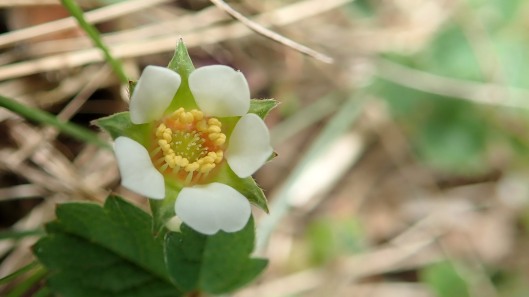
Barren strawberry

There will be no big fat juicy red berries from this little strawberry as this is a Barren strawberry (Potentilla sterilis) (it has fruit but they don’t become ‘fleshy and red’). I can tell which species it is from the top of the leaf that’s showing – the ‘terminal tooth’ is shorter than those on either side of it.

Bluebell

Last Sunday I saw my first Bluebells (Hyacinthoides sp.) of the year, almost certainly Spanish or hybrids rather than native Bluebells, but still beautiful to my eye.

Common stork's-bill

I think this is Common stork’s-bill (Erodium cicutarium), a nice surprise growing amongst the grass at Cardiff Bay Wetland Reserve.

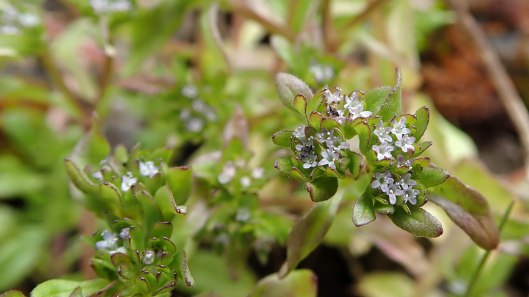
Cornsalad

Cornsalad is such a dainty little plant, with very delicate, pale blue flowers. I almost missed these growing by the path at Grangemoor Park and have since seen them in a couple of places. This is probably Common cornsalad (Valerianella locusta), but the only way to be sure it’s not one of the other four varieties is to check the fruit, which won’t be possible till later in the season.

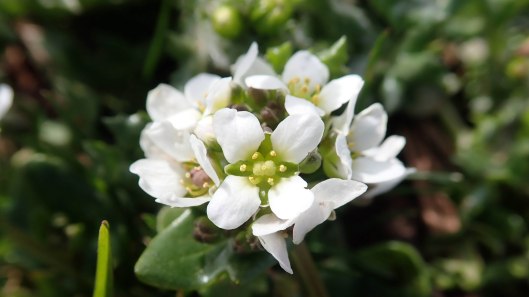
Danish scurvygrass

This is Danish scurvygrass (Cochlearia danica), originally a seaside plant that has now become widespread by following the road-salting trucks along the roads of Britain.

Gorse

Gorse (Ulex sp.) never seems to stop flowering, though the truth is that there are two Gorse species and, when one stops flowering, the other takes over.

Grape hyacinth

These Grape hyacinth (Muscari sp.) have become naturalised in my local cemetery, probably spreading from one or two deliberate grave-top plantings, or from nearby home gardens. I love their blue.

Petty spurge

Petty spurge (Euphorbia peplus) is a very common little wildflower that’s often overlooked.

Common ragwort

Spotting this flowering Ragwort by the roadside near Cardiff Bay was a bright surprise. It’s probably Common ragwort (Senecio jacobaea).

Red dead-nettle

Red dead-nettle (Lamium purpureum). I’m a big fan of all the dead-nettles – the ‘dead’ in their name refers to the fact that they aren’t covered in stinging hairs!

Three-cornered leek

Allium triquetrum, the Three-cornered leek, is a pretty, if somewhat smelly flower but considered an alien invasive plant species here in Britain.

Like Loading...

I’m following a tree: March 2018

12 Thursday Apr 2018

Posted by sconzani in autumn, nature, trees

≈ 7 Comments

Tags

#treefollowing, Acer mono, Acer pictum, autumn colour, Bute Park, I'm following a tree, tree following

I think, like much of Britain’s flora and fauna (and its human population), my tree is suffering from the late arrival of warmer spring weather as not much has changed with it during March: the leaf buds haven’t developed much further, no leaves have burst open, and it’s still looking very skeletal. Warmer temperatures are forecast for next week so, fingers crossed, that gives everything a kick-start.

In the meantime, I thought I would give you a little taste of the delights to come later in the year. While I don’t have any photos of my tree in summer green, I do have a photo, taken in October 2015, of this incredible Acer pictum (Acer mono) resplendent in its glorious autumn finery. Something to look forward to, for sure!

180412 Acer pictum in autumn

Like Loading...

Wild words: nuptial plumage

11 Wednesday Apr 2018

Posted by sconzani in birds, nature

≈ 1 Comment

Tags

#WildWords, alternate plumage, birding, birdwatching, breeding plumage, British birds, nuptial plumage, Turnstone, wild words

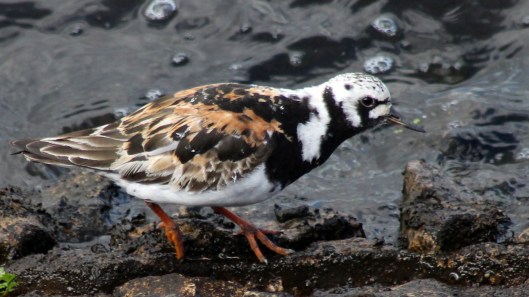
Nuptial plumage, also known as breeding plumage and alternate plumage, is the plumage assumed by adult birds prior to their annual breeding season. This plumage is generally more colourful than the bird’s usual plumage, presumably in order to attract the opposite sex. Birds achieve this change by moulting their feathers, before breeding into their nuptial ‘glad-rags’, and then afterwards, returning to their usual ‘day wear’.

180411a Turnstone in January

My photos show the change happening in the Turnstones I see so often in my local patch. The first photo (above), taken in January, shows the bird’s winter plumage. The following two photos, taken in March and April, show the moult in progress, and the final photo, taken in August, is after breeding has finished, when the bird is moulting from its nuptial plumage back to its winter, non-breeding plumage. To see these birds in their full nuptial plumage, I would have to head to their breeding grounds in Canada or Greenland, a tempting proposition but not affordable at this time!

180411b Turnstone in March180411c Turnstone in April180411d Turnstone in August

Like Loading...
← Older posts
Newer posts →

About me

sconzani

sconzani

I'm a writer and photographer; researcher and blogger; birder and nature lover; countryside rambler and city strider; volunteer and biodiversity recorder.

View Full Profile →

Follow earthstar on WordPress.com

Enter your email address to follow this blog and receive notifications of new posts by email.

Recent blog posts

  • Chiffchaffs chiffchaffing April 4, 2026
  • Bearded tit!!! April 3, 2026
  • A Portland Bill Kestrel April 2, 2026
  • A proliferation of Peacocks April 1, 2026
  • Little owl March 31, 2026

From the archives

COPYRIGHT

Unless otherwise acknowledged, the text and photographs on this blog are my own and are subject to international copyright. Nothing may be downloaded or copied without my permission.

Fellow Earth Stars!

  • Unknown's avatar
  • Unknown's avatar
  • Unknown's avatar
  • Unknown's avatar
  • Unknown's avatar
  • Unknown's avatar
  • Unknown's avatar
  • Unknown's avatar
  • Unknown's avatar
  • Unknown's avatar
  • Unknown's avatar
  • Unknown's avatar
  • Unknown's avatar
  • Unknown's avatar
  • Unknown's avatar
  • Unknown's avatar
  • Unknown's avatar
  • Unknown's avatar
  • Unknown's avatar
  • Unknown's avatar
  • Unknown's avatar
  • Unknown's avatar
  • Unknown's avatar
  • Unknown's avatar
  • Unknown's avatar
  • Unknown's avatar
  • Unknown's avatar
  • Unknown's avatar
  • Unknown's avatar
  • Unknown's avatar
  • Unknown's avatar
  • Unknown's avatar
  • Unknown's avatar
  • Unknown's avatar
  • Unknown's avatar
  • Unknown's avatar
  • Unknown's avatar
  • Unknown's avatar
  • Unknown's avatar
  • Unknown's avatar
  • Unknown's avatar
  • Unknown's avatar
  • Unknown's avatar
  • Unknown's avatar
  • Unknown's avatar
  • Unknown's avatar
  • Unknown's avatar
  • Unknown's avatar
  • Unknown's avatar
  • Unknown's avatar

Blog at WordPress.com.

Privacy & Cookies: This site uses cookies. By continuing to use this website, you agree to their use.
To find out more, including how to control cookies, see here: Cookie Policy
  • Subscribe Subscribed
    • earthstar
    • Join 642 other subscribers
    • Already have a WordPress.com account? Log in now.
    • earthstar
    • Subscribe Subscribed
    • Sign up
    • Log in
    • Report this content
    • View site in Reader
    • Manage subscriptions
    • Collapse this bar
 

Loading Comments...
 

You must be logged in to post a comment.

    %d