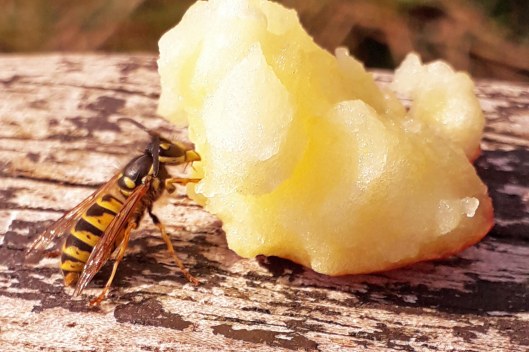
As I sat enjoying the coastal view, sipping my water, eating my apple, this wasp came a’visiting, buzzing annoyingly around the hand holding the apple, seeking sweet food, as they do on the fine days of late summer and early autumn. And, until I read this article on The Conversation website, I had no idea why. Take a look – it’s really interesting and well written. Oh, and my solution? I broke off a small piece of the apple and put it on the bench arm rest, so the wasp could help itself. As you can see, that worked a treat.
If you happen to see a Comma butterfly on one of our fine autumnal days, have a good look at the colour of its wings. You may notice that both the upper and the undersides of its wings are quite dark, particularly when compared to some of the Commas you saw in the summer months. Why is that?
The Comma is known for a particular form named hutchinsoni that is much paler in appearance on both upperside and underside that the nominate form. This form is found throughout the butterfly’s range and is normally attributed to individuals that go on to produce a second brood in the same year. Its name is a tribute to Emma Hutchinson, a renowned Victorian entomologist … who ultimately discovered its double-brooded nature and the corresponding variation between broods. The name was announced by J.E. Robson in 1881 in The Young Naturalist: ‘The Summer form is so different, and so constant in its appearance, that it ought to have a distinctive name, and we suggest it be called var. Hutchinsoni, in compliment to the lady … whose knowledge of the species is not exceeded by that of any one living.’
In my photos, the Comma on the left, Polygonia c-album var. hutchinsoni, was photographed on 24 June, the Comma on the right on 17 September, both in the same location and on fine, sunny days. I think you can see how marked the difference in their colouring is.
‘The vegetable life does not content itself with casting from the flower or the tree a single seed, but it fills the air and earth with a prodigality of seeds, that, if thousands perish, thousands may plant themselves, that hundreds may come up, that tens may live to maturity; that, at least one may replace the parent.’
~ Ralph Waldo Emerson, Chapter 6: Nature, Essays, Second Series, 1844.
One of the highlights for me at this time of year is finding Ivy bees feasting, as you might expect, on the newly opened flowers of Ivy. I blog about these little beauties every year so I won’t go in to their details again, just share my latest photos.
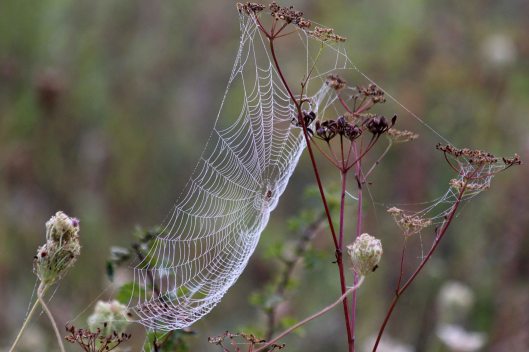
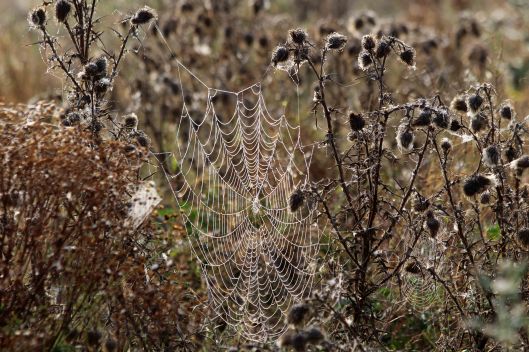
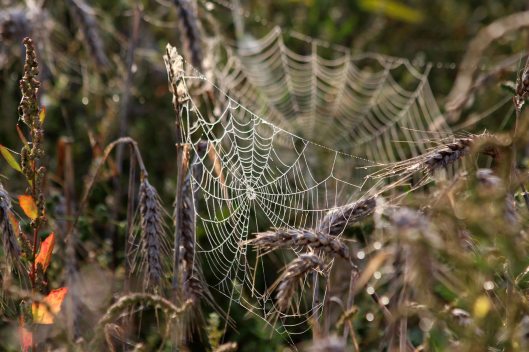
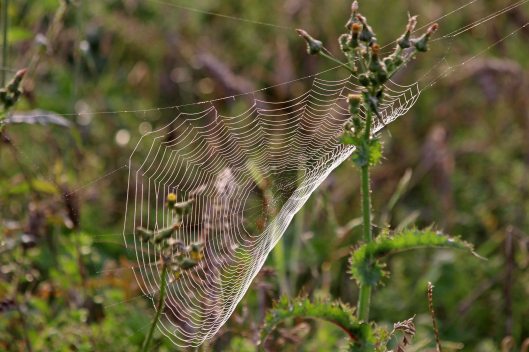
It was early Tuesday morning and the landscape was muffled by a dense layer of fog but there was magic happening in the fields, amongst the plants, as the power of fog droplets illuminated the industrious efforts of the spider kingdom.
One of the side benefits of searching the scabious for rare bees (see yesterday’s piece, Searching the scabious, 1) is that my search also revealed how many other insects were enjoying the essential late summer-early autumn food supply provided by the beautiful wildflower, Devil’s-bit scabious. Amongst them were these five butterflies and a moth: Large white, Red admiral, Small copper, Small tortoiseshell, Small white and a Silver Y.
And also these five hoverflies: Eristalis intricarius, Helophilus trivittatus, Sericomyia silentis, Volucella pellucens and Volucella zonaria.
In recent weeks, when the weather has been fine and the air relatively still, I’ve been spending time searching the Devil’s-bit scabious for bees. Not just any bees, but four scarce and endangered bees. This is part of Buglife’s ‘Searching for Scabious’ project, which
aims to improve our understanding of the distribution and conservation status of some of Wales’ rarest and most threatened solitary bees – the Large Scabious Mining Bee (Andrena hattorfiana) and its associated cuckoo, the Armed nomad bee (Nomada armata), and Small Scabious Mining Bee (Andrena marginata) and its cuckoo, the Silver-sided nomad bee (Nomada argentata).
I wasn’t familiar with these bees and am not very good at bee identification in general but Liam Olds, Buglife’s local conservation officer, has put together an excellent explainer video, which can be accessed on YouTube, so I thought I’d join the search.
Unfortunately, I haven’t managed to find any of the scarce bees at the two local sites where Devil’s-bit scabious grows in abundance (and neither has Liam, which was reassuring for me re my search skills but bad news for the bees). The bees I did find most commonly were the appropriately named Common carder (Bombus pascuorum) (below, left) and the Buff-tailed bumblebee (Bombus terrestris) (below, right).
Liam very kindly helped to identify the other small bees I found. These lovely little furrow bees are either the White-zoned furrow bee (Lasioglossum leucozonium) or the Bull-headed furrow bee (Lasioglossum zonulum) – the two species are too similar to tell them apart without closer examination.
I also found several of these more distinctive individuals, the Wood-carving leafcutter bee (Megachile ligniseca). You can find out more about them, and watch a little video of their nest-building skills, on the BWARS website. Meantime, I’m heading back to the scabious for another look.
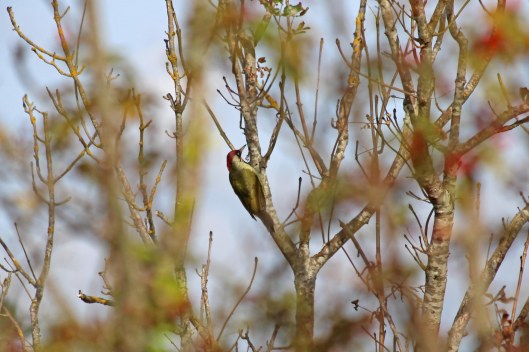
Green woodpeckers are very skittish birds I find. Any sudden movement and, with a loud yaffle, they’re off. Luckily, with this bird, I was partially hidden by trees. Although it heard me coming and flitted up from the ground where it had been poking about for ants, at least it didn’t fly far so I was able to focus my shot between the branches and twigs.
My title says ‘inspection’ but I was tempted to invent a new word and write ‘insection’, as my inspection was really a personal challenge to see how many different insects I could find on the copious number of Common ragwort plants currently in bloom at Cosmeston Lakes Country Park. All except three of these photos were taken during one 45-minute period on Wednesday – the Small copper and two flies were seen the following day. The broad diversity of species just shows how important Ragwort is as a late summer food plant for insects.










 earthstar
You must be logged in to post a comment.