• ABOUT
  • BIRDING 2018
  • Birding 2019
  • BLOG POSTS
  • Butterflies 2018
  • Resources

earthstar

~ a celebration of nature

earthstar

Monthly Archives: July 2021

A summer selection

11 Sunday Jul 2021

Posted by sconzani in flowers, wildflowers

≈ 2 Comments

Tags

British wildflowers, summer colour, summer wildflowers

This week’s floral display is a selection of the latest summer wildflowers in bloom: Agrimony, Chicory, Everlasting pea, Field bindweed, Field madder, Field scabious, Honeysuckle, Mignonette, Milkwort, Restharrow, Scarlet pimpernel, Stinking iris, Woody nightshade, and Yellow rattle.

Like Loading...

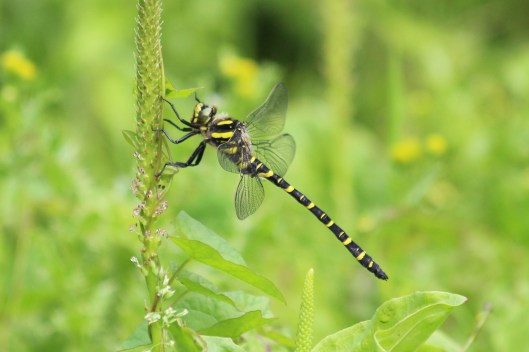
Golden-ringed dragon

10 Saturday Jul 2021

Posted by sconzani in insects

≈ 2 Comments

Tags

British dragonflies, British odonata, Cordulegaster boltonii, Golden-ringed dragonfly

It may have been only my second ever sighting of this gorgeous dragonfly species but, with its distinctive markings perfectly matching its name, I was certain of my ID – this is a Golden-ringed dragonfly (Cordulegaster boltonii). These beauties can be found in upland areas, heathlands and woodlands that have the flowing water they favour for breeding. The Golden-ringed I saw was close to a small river in a woodland setting, no more than 100 metres from where I spotted the White-letter hairstreak I posted about yesterday. That was a memorable walk indeed!

210710 golden-ringed dragonfly

You can read more about this dragonfly, and see lots of stunning images, on the British Dragonfly Society website.

Like Loading...

A white-letter day

09 Friday Jul 2021

Posted by sconzani in trees

≈ 6 Comments

Tags

British butterflies, butterfly on Wych elm, hairstreaks, Satyrium w-album, White-letter hairstreak, Wych elm

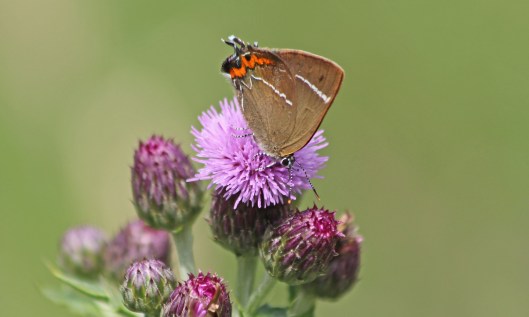
I’m sure you’ve all heard of red-letter days, those days that are of special significance or particularly memorable. Well, for me, yesterday was a red-letter white-letter day – the day when I had my best ever views of the elusive White-letter hairstreak butterfly (Satyrium w-album).

210709 white-letter hairstreak (1)

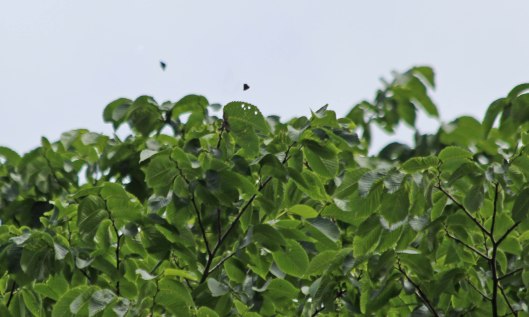
These beautiful creatures spend most of their time in the tops of Wych elm trees (now that most English elms have died from Dutch elm disease) so my first sighting of them this year was typical – they were flitting around the top of a tree in a local park, far too distant for good views, let alone photos (see above).

210709 white-letter hairstreak (2)

Then, yesterday, I was walking in meadows adjacent to a local woodland, when I spotted this gorgeous White-letter hairstreak nectaring on a thistle right next to the path in front of me. I was able to photograph and watch it for at least 15 minutes before it flew back towards the nearby Wych elm. A white-letter day to treasure!

210709 white-letter hairstreak (3)

Like Loading...

Rookie Robin

08 Thursday Jul 2021

Posted by sconzani in birds

≈ 2 Comments

Tags

birding, birdwatching, British birds, fledgling robin, robin

One of the things that makes this time of year special is all the young birds that are about, newly fledged but still clad in their teenage threads; learning to fend for themselves but still squawking at their parents for handouts; finding their way in the world, as this young Robin was yesterday.

210708 robin

Like Loading...

Marsh helleborines

07 Wednesday Jul 2021

Posted by sconzani in flowers, plants, wildflowers

≈ 4 Comments

Tags

British orchids, Epipactis palustris, Marsh helleborine, native orchids

As their current conservation status in Britain is rated amber, meaning they are vulnerable and near-threatened, I feel privileged to have within easy travelling distance a large colony of Marsh helleborines (Epipactis palustris).

210707 marsh helleborine (1)

And, as our rainfall levels in Wales during May were the highest recorded since records began in 1862, this has been a very good year for a plant that thrives in the wet – hence, the ‘Marsh’ in its name.

210707 marsh helleborine (2)
210707 marsh helleborine (3)

These are low-growing orchids, no more than a foot in height, but it is well worth getting down to their level to appreciate more fully the elegant and delicate beauty of their flowers. To my fanciful eye, they sometimes resemble a woman dancing, her frilly white petticoats swirling about her. At other times, I see a white blouse, with an extravagant ruffle down the front, like the jabot worn by some judges. What do you see?

210707 marsh helleborine (4)

Like Loading...

A future butterfly

06 Tuesday Jul 2021

Posted by sconzani in insects

≈ Leave a comment

Tags

British butterflies, butterfly, butterfly egg, Large skipper, Large skipper egg

Golden Large skippers have been flitting through the tall grasses of my local meadows for about a month now and soon, too soon, they will disappear for another year.

210706 large skipper

But, if they manage to escape the cutting blades of mowers and survive through whatever weather the winter throws at us this year, then the larvae that emerge from their miniscule eggs, like the one below, will guarantee we see these handsome creatures again next year.

210706 large skipper egg

Like Loading...

The 7-spot cycle

05 Monday Jul 2021

Posted by sconzani in insects, ladybird

≈ 3 Comments

Tags

7-spot ladybird, 7-spot ladybird lifecycle, British ladybirds, Coccinella septempunctata, ladybird life cycle

A few weeks ago I wrote about going insecting and showed a few of my recent finds, including what I suspected was a photo of ladybird eggs. Sure enough, when I revisited that particular spot last week, I found ladybirds in various stages of development. When I add in a photo, taken in a previous year, of ladybirds about to mate on a gorse bush, we have the full lifecycle: mating, eggs, larva, larva beginning to pupate, pupa and recently emerged adult (they often emerge quite pale), all of the 7-spot ladybird (Coccinella septempunctata).

210705 7spot (1)
210705 7spot (2)
210705 7spot (3)
210705 7spot (4)
210705 7spot (5)
210705 7spot (6)
Like Loading...

Heath spotted-orchids

04 Sunday Jul 2021

Posted by sconzani in flowers, wildflowers

≈ 2 Comments

Tags

Aberbargoed Grasslands, British orchids, British wildflowers, Dactylorhiza maculata, Heath spotted-orchid, native orchids

From the often-boggy, mostly acid grasslands at Aberbargoed direct to your screens, this week’s native British orchid is the appropriately named Heath spotted-orchid (remember, the spotted part of that name refers to the marks on its leaves, not its petals). Its scientific name is Dactylorhiza maculata, which the Plantlife website explains as follows: ‘The genus name Dactylorhiza is formed from the Greek words daktylos meaning finger and rhiza meaning root’ – so, this orchid has a multi-fingered root, rather than a single tuber. And maculata means spotted – those leaves.

210704 Heath spotted-orchid (1)

As you can see from the flower spikes below, this is another orchid with some variation in both its colours, which range from white through pink to pale purple, and its markings, which, though they look spotted from a distance, actually have various combinations of streaks and little loops. The shape of the petals is also distinctive, the lower one in particular is less deeply lobed than, for example, the Common spotted-orchid, which the Heath spotted does superficially resemble.

210704 Heath spotted-orchid (2)
210704 Heath spotted-orchid (3)
210704 Heath spotted-orchid (4)
Like Loading...

Leafmines: Enchanter’s nightshade

03 Saturday Jul 2021

Posted by sconzani in insects, plants

≈ Leave a comment

Tags

British leaf mines, British moths, Enchanter's nightshade, Larval mines of Mompha langiella, leafmines on Enchanter's nightshade, Mompha langiella, moth leafmines

I’ve been lingering over leafmines again and have a new one to show you, this time on the lovely little plant that carpets the woodland floor at this time of year, Enchanter’s nightshade (Circaea lutetiana).

210703 Mompha langiella on Enchanters nightshade (1)
210703 Mompha langiella on Enchanters nightshade (2)

The mines, which start off as galleries but are often subsumed into the later blotches, are made during June and July by the larvae of Mompha langiella, a rather nondescript little brown moth. The larvae, as described on the British leafminers website, are ‘light yellow, with darker thoracic legs’ (see photo left below), and, most fortunately, I also found a pupa (below right), which are located ‘occasionally in a mined leaf or in a cocoon between the leaves or on the leaves’.

210703 Mompha langiella on Enchanters nightshade (3)
210703 Mompha langiella on Enchanters nightshade (4)

Though Enchanter’s nightshade is widespread in the places where I walk, I’ve only found one site with these leafmines so far. Can you spot them in your local woodland?

Like Loading...

Wolf’s milk update

02 Friday Jul 2021

Posted by sconzani in fungi

≈ 4 Comments

Tags

British slime moulds, Lycogala slime mould, Lycogala terrestre, slime mould

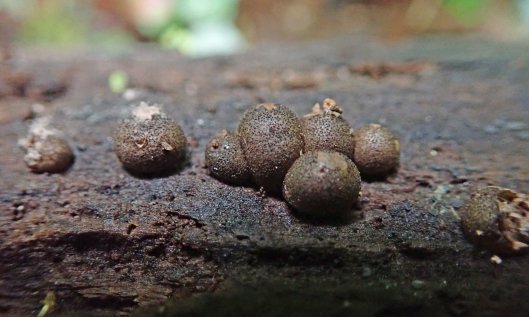
You might remember that on 18 June I blogged about Wolf’s milk, one of the Lycogala species of slime moulds, and noted that I couldn’t positively identify it until I saw the colour of its spores. Well, I’ve been back to recheck these slime balls. They took a bit of finding, as the dense tree canopy of the woodland makes the area quite dark and their change of colour as the slime balls have matured made them blend in with the log they were growing on, as you can see below.

210702 Lycogala terrestre (1)

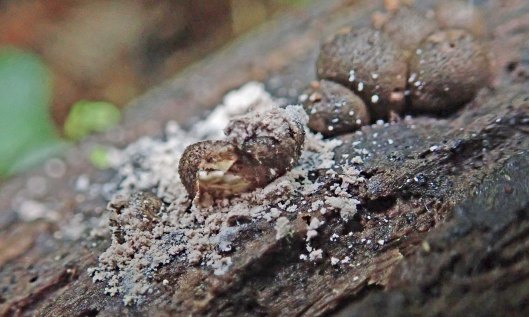
The good news is that I have been able to identify them. I ‘popped’ one – not a bad thing for the slime as this released its spores for distribution – and found the spore colour to have a pinkish hue, which confirmed the species as Lycogala terrestre.

210702 Lycogala terrestre (2)

Like Loading...
← Older posts
Newer posts →

About me

sconzani

sconzani

I'm a writer and photographer; researcher and blogger; birder and nature lover; countryside rambler and city strider; volunteer and biodiversity recorder.

View Full Profile →

Follow earthstar on WordPress.com

Enter your email address to follow this blog and receive notifications of new posts by email.

Recent blog posts

  • Bearded tit!!! April 3, 2026
  • A Portland Bill Kestrel April 2, 2026
  • A proliferation of Peacocks April 1, 2026
  • Little owl March 31, 2026
  • Distant seabirds March 30, 2026

From the archives

COPYRIGHT

Unless otherwise acknowledged, the text and photographs on this blog are my own and are subject to international copyright. Nothing may be downloaded or copied without my permission.

Fellow Earth Stars!

  • Unknown's avatar
  • Unknown's avatar
  • Unknown's avatar
  • Unknown's avatar
  • Unknown's avatar
  • Unknown's avatar
  • Unknown's avatar
  • Unknown's avatar
  • Unknown's avatar
  • Unknown's avatar
  • Unknown's avatar
  • Unknown's avatar
  • Unknown's avatar
  • Unknown's avatar
  • Unknown's avatar
  • Unknown's avatar
  • Unknown's avatar
  • Unknown's avatar
  • Unknown's avatar
  • Unknown's avatar
  • Unknown's avatar
  • Unknown's avatar
  • Unknown's avatar
  • Unknown's avatar
  • Unknown's avatar
  • Unknown's avatar
  • Unknown's avatar
  • Unknown's avatar
  • Unknown's avatar
  • Unknown's avatar
  • Unknown's avatar
  • Unknown's avatar
  • Unknown's avatar
  • Unknown's avatar
  • Unknown's avatar
  • Unknown's avatar
  • Unknown's avatar
  • Unknown's avatar
  • Unknown's avatar
  • Unknown's avatar
  • Unknown's avatar
  • Unknown's avatar
  • Unknown's avatar
  • Unknown's avatar
  • Unknown's avatar
  • Unknown's avatar
  • Unknown's avatar
  • Unknown's avatar
  • Unknown's avatar
  • Unknown's avatar

Blog at WordPress.com.

Privacy & Cookies: This site uses cookies. By continuing to use this website, you agree to their use.
To find out more, including how to control cookies, see here: Cookie Policy
  • Subscribe Subscribed
    • earthstar
    • Join 642 other subscribers
    • Already have a WordPress.com account? Log in now.
    • earthstar
    • Subscribe Subscribed
    • Sign up
    • Log in
    • Report this content
    • View site in Reader
    • Manage subscriptions
    • Collapse this bar
 

Loading Comments...
 

You must be logged in to post a comment.

    %d