• ABOUT
  • BIRDING 2018
  • Birding 2019
  • BLOG POSTS
  • Butterflies 2018
  • Resources

earthstar

~ a celebration of nature

earthstar

Author Archives: sconzani

The gift

09 Tuesday May 2023

Posted by sconzani in insects

≈ Leave a comment

Tags

Dagger fly, Empis tessellata, male insect gift-giving, mating dagger flies

With its bristly body, brown-tinged wings, black femora, and red/brown tibia and tarsi, I think this may be the dagger fly Empis tessellata, but these are tricky flies to identify so don’t take my word on that.

230509 empis tessellata (1)

And, to be honest, I’m not too concerned about identifying the exact species because what fascinates me more is their mating behaviour, which I was fortunate to witness during Sunday’s walk. According to the Naturespot website

Though it feeds on nectar it is also a predator and catches other insects using its long pointed proboscis to pierce their bodies. Males of Empis opaca and E. tessellata present a ‘gift’ to the female, in the form of a dead insect, before mating takes place. Females will not mate with males who do not present a gift.

230509 empis tessellata (2)

Like Loading...

Pieris napi

08 Monday May 2023

Posted by sconzani in insects

≈ 2 Comments

Tags

British butterflies, butterfly, Green-veined white, Pieris napi

My first confirmed sighting of a Green-veined white of 2023 came later than usual, last Thursday, 4 May, but it more than made up for its tardiness by posing beautifully on some not-quite-opened Hawthorn blossom. I love its scientific name Pieris napi, the Latin Pieris coming from the Ancient Greek Πιερίς meaning a muse and its specific name napi being a reference to one of its larval foodplants, Oil-seed rape (Brassica napus).

230508 green-veined white

Like Loading...

Field madder

07 Sunday May 2023

Posted by sconzani in flowers, wildflowers

≈ 2 Comments

Tags

British wildflowers, Field madder, Sherardia arvensis

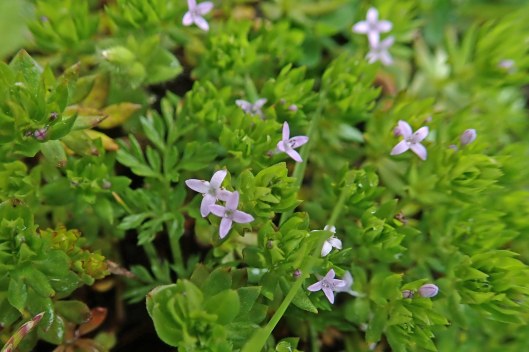
A member of the Bedstraw family, Field madder (Sherardia arvensis) is a low-growing annual that supposedly grows in both disturbed and cultivated ground on chalky soils. I write ‘supposedly’ because the Field madder pictured here grows along a sheltered damp and mossy road verge next to blocks of flats. Also, I’ve read – and my wildflower book states – that Field madder can grow up to 30cm tall but the plants I’ve seen have been tiny, only 5-10 cm. I guess wildflowers don’t read what’s written about them!

230507 field madder (2)

Popping out like stars against a dense background of bristly whorls of leaves, the clusters of four-petalled tiny flowers range in colour from pale pink to mauve. And, as you may have guessed from the name, the roots of Field madder can be used to make a red dye, though it is described as ‘an inferior source’ on the Oxford University Herbaria website. If you’re interested in learning more, the website also explains the source of the Sherardia name.

230507 field madder (1)

Like Loading...

A maniacal Magpie

06 Saturday May 2023

Posted by sconzani in birds

≈ 5 Comments

Tags

bird attacks bird, birding, birdwatching, British birds, Green woodpecker, Magpie, Magpie attacks Green woodpecker, vicious Magpie

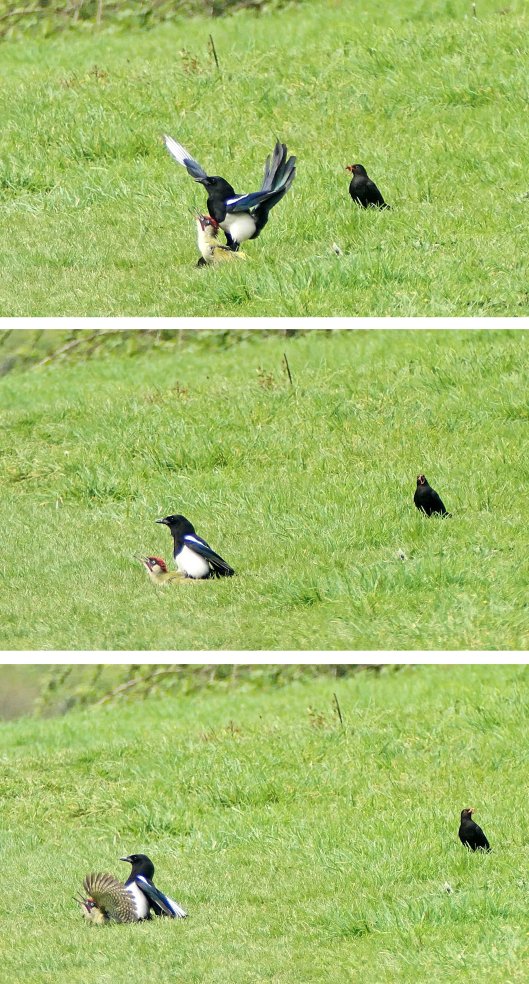
Green woodpecker: I was just minding my own business, hoovering up ants.

230506 magpie and green woodpecker (1)

Magpie: You’re gonna die for stealing MY ants!

230506 magpie and green woodpecker (2)

Blackbird: Wtf?!

230506 magpie and green woodpecker (3)

Good news, the woodpecker escaped. That Magpie was maniacal!

Like Loading...

White not pink

05 Friday May 2023

Posted by sconzani in flowers, nature, wildflowers

≈ Leave a comment

Tags

British wildflowers, Cosmeston Lakes Country Park, Dove's-foot crane's-bill, Geranium molle, white flowers, white-flowered Dove's-foot crane's-bill

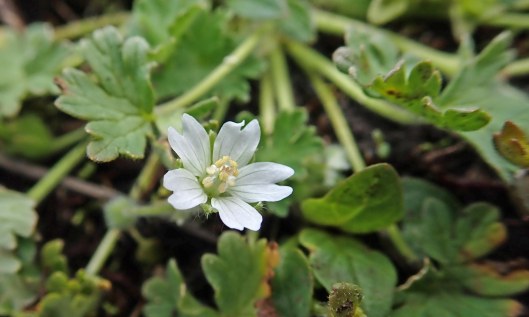
The flowers of Dove’s-foot crane’s-bill (Geranium molle) are usually described as pinkish-purple, and certainly all the plants I’ve seen previously have had tiny pink flowers, as shown in the comparison photos below. But I’ve discovered a small area at the Cosmeston Lakes Country Park where the flowers are a true white.

230505 Geranium molle (2)

I’m not sure what has caused this colour variation but it’s probably something in the soil. Before it became a country park, parts of Cosmeston were quarries, spoil tips and rubbish tips. If you follow this link to the Mary Gillham Archive website (a project I volunteered on, as my older followers will recall), you can see details – including maps and photographs – of Cosmeston during its transformation into a country park.

230505 Geranium molle (3)

One legacy of its former use is undoubtedly the presence of toxic chemicals in some areas. Indeed, the top portion of the east paddock is fenced off, not for conservation purposes but, I am reliably informed, to protect park users from whatever is buried there. Residues in the soil may well account for unusual qualities in the park’s flora and fauna.

230505 Geranium molle (1)

Like Loading...

The first skipper

04 Thursday May 2023

Posted by sconzani in insects

≈ Leave a comment

Tags

British butterflies, butterfly, Dingy Skipper, skipper butterflies, Skippers

I tend to avoid the local country park on bank holidays, as it can be difficult to find the peace and solitude I prefer during my walks but, luckily, on the May Day holiday, most people were sticking to the walks around the lakes, the children’s playground and those places where they could buy food and drinks. So, a circuitous walk around the various paddocks and through a sheltered woodland clearing turned up my first Small tortoiseshell butterfly of the year and this beauty, my first Dingy skipper. Bank holiday bonuses both!

230504 dingy skipper

Like Loading...

Wild words : extrafloral nectary

03 Wednesday May 2023

Posted by sconzani in insects, plants

≈ Leave a comment

Tags

Bracken, extrafloral nectaries, nectaries on Bracken, nectary, Pteridium aquilinum

Nectary: noun, biology; ‘a nectar-secreting glandular organ in a flower (floral) or on a leaf or stem (extrafloral)’ (Oxford Dictionary).

230503 extrafloral nectaries (1)

Like most people, I knew that most flowers produce nectar as a reward to attract pollinators but I’ve only recently learned that many plants produce nectar through extrafloral nectaries, as the definition explains, on their leaves or stems. I read that these particular nectaries can be found on many species of fern, and I’ve finally found some examples on the stems of Bracken (Pteridium aquilinum) that has just begun to sprout locally. The nectaries are the small smooth pale lumps on the back of the stipe, and, in Bracken, their purpose is apparently to attract ants that will then defend the fern against the insects that might eat it, like some species of bug and fly, and the larvae of various moths, amongst others.

230503 bracken and ant

ant leaving nectary on Bracken

However, I also found a journal article, referenced below, which reported that the ants actually had ‘no significant effect on bracken-specific herbivores’ so, in this case, the plant may be producing nectar for nothing.

Reference: ‘Bracken, Ants and Extrafloral Nectaries. I. the Components of the System’, J. H. Lawton and P. A. Heads, Journal of Animal Ecology, vol. 53, no. 3, October 1984, pp. 995-1014. I do not have access to Jstor so was only able to read the information contained in the article summary.

230503 common froghopper nymphs

Common froghopper nymphs on Bracken

Like Loading...

A damsel dropped in

02 Tuesday May 2023

Posted by sconzani in insects

≈ Leave a comment

Tags

British damselflies, British dragonflies, damselfly, Large Red damselfly

I was scanning an area of low plants and exposed stones on a site that was once a quarry, then rubbish tip, hoping to find my first Dingy skipper butterfly of the year when down dropped this gorgeous beastie, I don’t know from where. This, a week later than last year, was my first dragonfly of the year, at Cosmeston Lakes Country Park last Friday morning, a lovely Large red damselfly.

230502 large red damselfly

Like Loading...

Leafmines: Coleophora lutipennella

01 Monday May 2023

Posted by sconzani in insects, trees

≈ Leave a comment

Tags

British moths, case-bearing larvae, Case-bearing moth, Coleophora, Coleophora lutipennella, Common oak case-bearer, moth larvae on Oak

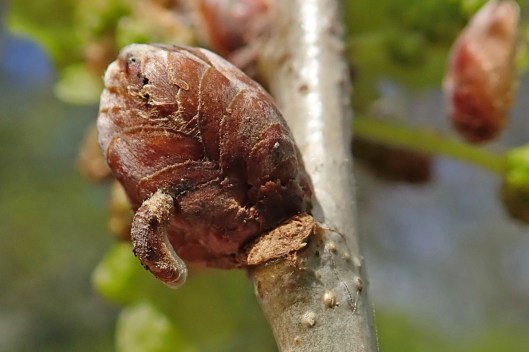
It’s often the way that, while looking for one thing, I find another. In this case, I was checking for eggs or larvae on the newly opening buds and flowers of an Oak tree where I’ve previously seen Purple hairstreak butterflies. No luck with those but I did find this …

230501 Coleophora lutipennella (1)

It’s the larva of the Common oak case-bearer moth (Coleophora lutipennella) – you can see the pretty little adult moth on the UK Moths website here. These case-bearing moths remind me a bit of snails, spending their larval stage in a home they carry around with them, though the moths don’t grow their own – they weave theirs from bits of vegetation and silk. In the photo below, you can see the larva poking its head out from the bottom of its case.

230501 Coleophora lutipennella (2)

It can be difficult to distinguish between the larvae of two very similar case-bearing moths, this one and Coleophora flavipennella. I had my find confirmed by expert Rob Edmunds, who manages the British Leafminers website. The difference between the two cases is minor but fascinating, the presence or not of a small hump of leaf tissue built in to the case – there’s an explanation and some excellent photos on the website’s June 2004 newsletter.

Like Loading...

International Day of the Dandelion

30 Sunday Apr 2023

Posted by sconzani in wildflowers

≈ Leave a comment

Tags

#InternationalDayOfTheDandelion, dandelion, insects on dandelions

We’ve had National Dandelion Day (on 5 April), but today’s flower festivities have gone global. So, happy International Day of the Dandelion (#InternationalDayOfTheDandelion on social media)! I am always happy to celebrate the sunshine cheerfulness and undeniable bounty of the dandelion so here are a few recent flowers and friends finds.

230430 dandelions and critters

Like Loading...
← Older posts
Newer posts →

About me

sconzani

sconzani

I'm a writer and photographer; researcher and blogger; birder and nature lover; countryside rambler and city strider; volunteer and biodiversity recorder.

View Full Profile →

Follow earthstar on WordPress.com

Enter your email address to follow this blog and receive notifications of new posts by email.

Recent blog posts

  • The Fox and the crow May 2, 2026
  • More Green tigers May 1, 2026
  • Cute cootlet April 30, 2026
  • Blood bees April 29, 2026
  • Nesting material April 28, 2026

From the archives

COPYRIGHT

Unless otherwise acknowledged, the text and photographs on this blog are my own and are subject to international copyright. Nothing may be downloaded or copied without my permission.

Fellow Earth Stars!

  • Unknown's avatar
  • Unknown's avatar
  • Unknown's avatar
  • Unknown's avatar
  • Unknown's avatar
  • Unknown's avatar
  • Unknown's avatar
  • Unknown's avatar
  • Unknown's avatar
  • Unknown's avatar
  • Unknown's avatar
  • Unknown's avatar
  • Unknown's avatar
  • Unknown's avatar
  • Unknown's avatar
  • Unknown's avatar
  • Unknown's avatar
  • Unknown's avatar
  • Unknown's avatar
  • Unknown's avatar
  • Unknown's avatar
  • Unknown's avatar
  • Unknown's avatar
  • Unknown's avatar
  • Unknown's avatar
  • Unknown's avatar
  • Unknown's avatar
  • Unknown's avatar
  • Unknown's avatar
  • Unknown's avatar
  • Unknown's avatar
  • Unknown's avatar
  • Unknown's avatar
  • Unknown's avatar
  • Unknown's avatar
  • Unknown's avatar
  • Unknown's avatar
  • Unknown's avatar
  • Unknown's avatar
  • Unknown's avatar
  • Unknown's avatar
  • Unknown's avatar
  • Unknown's avatar
  • Unknown's avatar
  • Unknown's avatar
  • Unknown's avatar
  • Unknown's avatar
  • Unknown's avatar
  • Unknown's avatar
  • Unknown's avatar

Blog at WordPress.com.

Privacy & Cookies: This site uses cookies. By continuing to use this website, you agree to their use.
To find out more, including how to control cookies, see here: Cookie Policy
  • Subscribe Subscribed
    • earthstar
    • Join 643 other subscribers
    • Already have a WordPress.com account? Log in now.
    • earthstar
    • Subscribe Subscribed
    • Sign up
    • Log in
    • Report this content
    • View site in Reader
    • Manage subscriptions
    • Collapse this bar

Loading Comments...

You must be logged in to post a comment.

    %d