• ABOUT
  • BIRDING 2018
  • Birding 2019
  • BLOG POSTS
  • Butterflies 2018
  • Resources

earthstar

~ a celebration of nature

earthstar

Author Archives: sconzani

Rhopalus subrufus

06 Friday Jun 2025

Posted by sconzani in insects

≈ Leave a comment

Tags

British bugs, bugs, mating bugs, Rhopalus subrufus

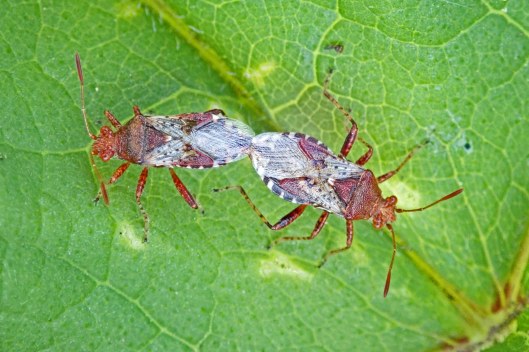
I felt a bit like a voyeur watching these handsome bugs doing their private business but I’d never seen their species before and, with them being preoccupied, it was the perfect opportunity to take a closer look and get some photographs. Rhopalus subrufus is one of four species in the genus Rhopalidae but, fortunately, R. subrufus is relatively easy to identify by the light and dark banding around the edge of its body (that flange is called the connexivum). The location where I found these two is typical of the habitat they favour: on low scrubby vegetation near trees or woodland.

Like Loading...

Cool cats, 2

05 Thursday Jun 2025

Posted by sconzani in insects

≈ Leave a comment

Tags

British moth caterpillars, caterpillars, Common quaker caterpillar, Lackey caterpillar, moth caterpillars, moth larvae, Mottled umber caterpillar, Ruby tiger caterpillar, Vapourer caterpillar

When I’m out walking at this time of year, I always keep a look out for leaf damage as that’s often the way to find invertebrates, whether they be weevils or beetle larvae or moth caterpillars or many other things. Today I thought I’d share some of the cool caterpillars I’ve been finding, most of which are relatively common and easy for everyone to identify. (I’ve linked each name to the relevant page on the UK Moths website so the curious amongst you can see what these cats will look like as moths; it always amazes me how different the adults are from their progeny.)
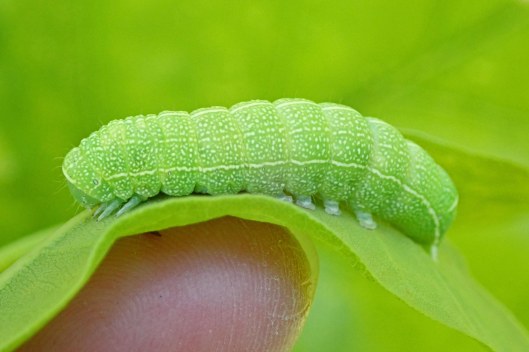
Having said that most of these are relatively common, I’d never actually seen a Common quaker (Orthosia cerasi) caterpillar before but found several recently on one Oak tree. Judging by how plump they were, all had been feeding well, and would be pupating quite soon after I saw them.

As you can perhaps see in my photo, this Lackey (Malacosoma neustria) caterpillar had just moulted (that’s the shed skin on the leaf next to it) and so was looking very vibrant. The Lackey is mostly found in southern parts of Britain and is a good example of how different the adult is – really quite drab.

Do these Mottled umber (Erannis defoliaria) caterpillars think their twig impression will deter hungry birds? Perhaps so. Judging by the fact that I spotted more than 20, of varying sizes and with slight colour variations, on a group of Lombardy poplar trees, their disguise was working.
I have to admit that I wasn’t the first to spot this lovely little Ruby tiger (Phragmatobia fuliginosa) heading purposefully across a local footpath. A young boy, who was out with his parents and their dog, had seen it and was trying, unsuccessfully, to feed it Dandelion leaves.

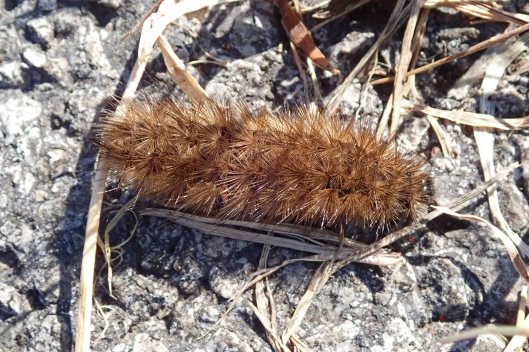
You may recall that, back in January, I blogged about finding a Vapourer cocoon and eggs. Well, though I found this particular caterpillar in a different place entirely, this is what would eventually have emerged from those eggs, the wonderfully flamboyant caterpillar of a Vapourer moth (Orgyia antiqua).

Like Loading...

Spider: Anyphaena accentuata

04 Wednesday Jun 2025

Posted by sconzani in spiders

≈ Leave a comment

Tags

Anyphaena accentuata, British spiders, buzzing spiders

When I read in my guide book that spiders of the genus Anyphaena, which my find definitely looked like (those dark markings on its abdomen are distinctive), required ‘microscopic examination of the genitalia … to distinguish between the species’, I thought to myself ‘Oh, no, not again!’ Fortunately, this time things were actually a little more straight forward than that statement implied, as the other two species are rare and currently confined to known areas in and around London. So, I submitted my record and it’s now been confirmed.

This handsome spider is Anyphaena accentuata, a buzzing spider. They’re called buzzing spiders because, during courtship, the male vibrates its abdomen against a leaf, which results in a high-pitched buzzing sound – a novel way to attract a female, to be sure. These spiders are mostly found in woodland and well-vegetated locations, where they live, hunt and mate amongst the leaves. Anyphaena accentuata is currently found mostly in the southern half of Britain, though it does appear to be expanding its range slowly northwards.

Like Loading...

Juniper shieldbug

03 Tuesday Jun 2025

Posted by sconzani in insects, trees

≈ Leave a comment

Tags

British shieldbugs, Cyphostethus tristriatus, Juniper shieldbug, shieldbug on Juniper, shieldbug on Lawson's cypress

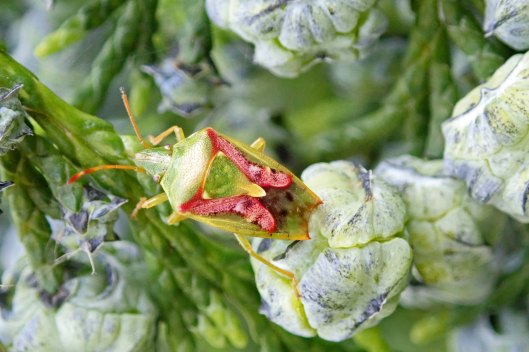
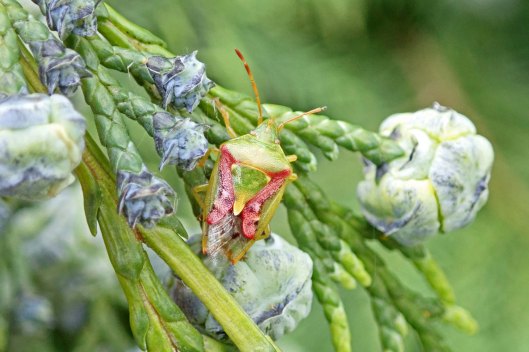
This is a bug I never thought I’d see locally as I don’t know any locations where Juniper trees grow. Fortunately for me, and as stated on the British Bugs website, the Juniper shieldbug (Cyphostethus tristriatus) has started living on Lawson’s cypress (Chamaecyparis lawsoniana) as well as its traditional host tree, the Juniper (Juniperus communis) for which it is named. And Lawson’s cypress is a popular planting in gardens and parks, which is where this tree was growing, alongside a path that runs around a local recreation ground.

British Bugs explains that adult Juniper shieldbugs, with the beautiful reddish-pink markings on their backs, can be seen all year round, though they tend not to be too active during the coldest winter months, like most of us. The nymphs that hatch from mid to late Spring feed on Juniper and Cypress berries and, like all shieldbugs, they go through a series of instars before reaching adulthood. The website has excellent, illustrated downloadable charts of the various stages of most shieldbug species for easy identification if you happen to spot a nymph and, now that I know where this Juniper shieldbug lives, I’ll have to go back and look for more, adults and nymphs.

Like Loading...

Galls: Macrodiplosis pustularis

02 Monday Jun 2025

Posted by sconzani in insects, trees

≈ Leave a comment

Tags

British galls, Cecidomyiidae, folded leaf lobes on Oak leaves, gall midges, galls on Oak leaves, insects on Oak, Macrodiplosis pustularis

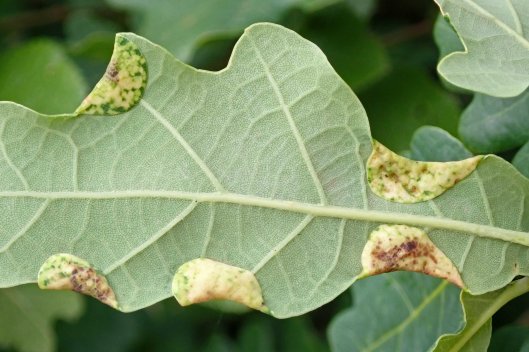
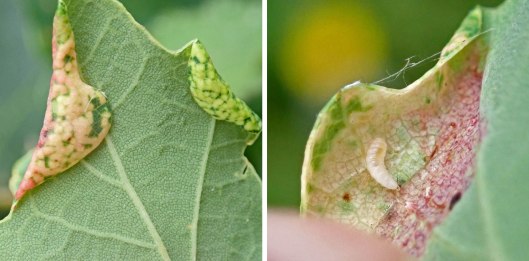
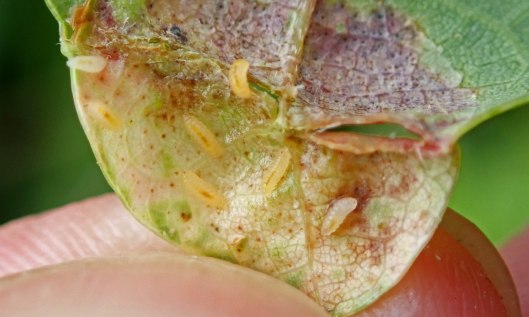
In my ignorance, when I first saw these folded-over leaf lobes on an Oak tree in a local park, I thought they had been created by leaf-mining moth larvae. Fortunately, there are much smarter people around than me and, when I posted some photos on social media, one of them popped up and told me what these really were: galls made by the larvae of the gall midge, Macrodiplosis pustularis.

Of course, once I knew that I had to return to the spot and pull up a couple of the folds to see the tiny larvae. The numbers inside can vary, apparently, from one to six or more. They are white when young but change to an orange colour as they develop.

The fold of the leaf is both a means of protection for the vulnerable larvae and also a food larder; they eat the leaf from the inside. Eventually, the larvae will drop from their leaf shelters, pupate and remain in the soil until the following Spring, when the whole process begins again.

Like Loading...

Smooth tare

01 Sunday Jun 2025

Posted by sconzani in wildflowers

≈ Leave a comment

Tags

British wildflowers, Ervum tetraspermum, Fabaceae, Pea family, Smooth tare, Vicia species, Vicia tetrasperma

Smooth tare (Vicia tetrasperma) (also known as Ervum tetraspermum) is a plant belonging to the pea (or bean or legume) family, the Fabaceae (or Leguminosae); so many names for one small plant.

As it grows in grassland and along road verges, it can often get lost amongst the larger, more dominant plant species – that’s certainly my excuse for having overlooked this lovely wildflower in previous years. But it is definitely worth searching for, if only to admire the ethereal beauty of its fine, delicate flowers. These are very pale, white with the merest hint of purple, with fine purple streaking on their upper petals. And now that Smooth tare has come to my attention, I am finding it in many of my favourite walking locations.

Like Loading...

Spider: Cheiracanthium erraticum

31 Saturday May 2025

Posted by sconzani in spiders

≈ Leave a comment

Tags

British spiders, Cheiracanthium erraticum, heathland spider, spider in low vegetation, spider in web

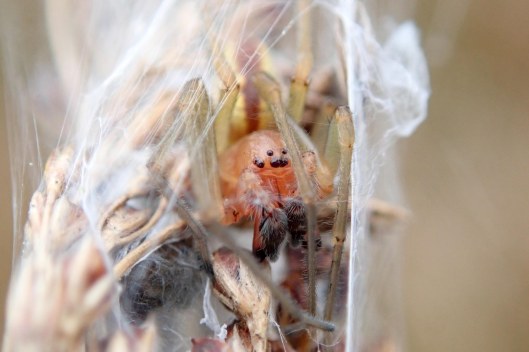
Having first been recorded here in 1861, this spider is a relative newcomer to Britain and, though it is still most frequently seen in southeastern England, it is slowly expanding its range north and west. I found this one at Cosmeston Lakes Country Park, not because I was looking for it, but simply because I noticed something had spun a web to bind two or three reed seedheads together and wondered what it was.

The adult spider was visible inside, and my photos were clear enough to see the distinctive red stripe that runs within a broader band of cream down the centre of its abdomen, which helped confirm this as Cheiracanthium erraticum. It favours grassland, more particularly areas of heathland, where it is typically found in low vegetation.

Like Loading...

Cygnet cuteness

30 Friday May 2025

Posted by sconzani in birds

≈ Leave a comment

Tags

birding, birdwatching, British birds, Cardiff's canals, cygnets, Mute swan, Mute swan cygnets

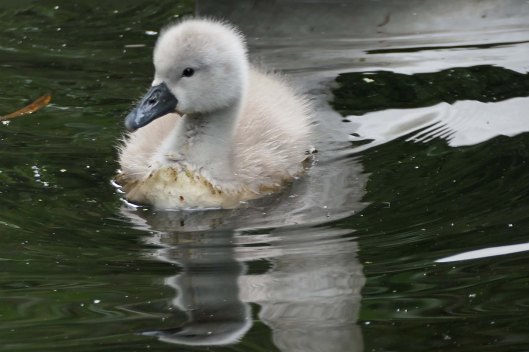
I had to go in to Cardiff today so I included a walk through ‘Little Venice’, the small network of canals south of the city centre. When I turned the first corner, this lovely family of Mute swans came immediately in to view – two adults and their six adorable cygnets.

Sometimes these canals are full of rubbish but, fortunately for the wildlife, it seemed much cleaner today – perhaps the local river-cleaning volunteer group have been busy.

As the canals have footpaths along both sides and are frequently used by pedestrians, the wildlife gets used to humans, and these adult swans were obviously used to people. They swam over to me, looking for food, and I was happy to oblige with some of the suet pellets I usually carry, though I was pleased to see that the cygnets remained wary and stuck to a vegetarian diet.

Like Loading...

Cacopsylla ambigua

29 Thursday May 2025

Posted by sconzani in insects

≈ 2 Comments

Tags

Cacopsylla ambigua, jumping plant lice, psyllidae, psyllids, psyllids on willow

Have you ever heard of jumping plant lice? No? Me neither, until very recently. But when a tiny insect that I initially thought was a barkfly leapt rather dramatically from its leaf into the vegetation a metre or so below rather than have its photograph taken, I thought ‘well, that’s odd’.

The family name for the jumping plant lice is Psyllidae and at least 77 species have been found living in Britain. Fortunately for me, the two Psyllids shown here stayed completely still, allowing me to get close enough for reasonable photos; they’re only 3-4mm long so getting very close is the only way for me to photograph them.

I haven’t yet had their identity confirmed but these have the characteristics of Cacopsylla (formerly Psylla) ambigua that I found listed on the British Bugs website, and they were found on Willow trees, which also fits; they are generally plant-specific, which certainly helps with their identification.

Like Loading...

Two dragons

28 Wednesday May 2025

Posted by sconzani in insects

≈ Leave a comment

Tags

British dragonflies, Broad-bodied Chaser, dragonfly, Four-spotted Chaser, Libellula depressa, Libellula quadrimaculata, Odonata

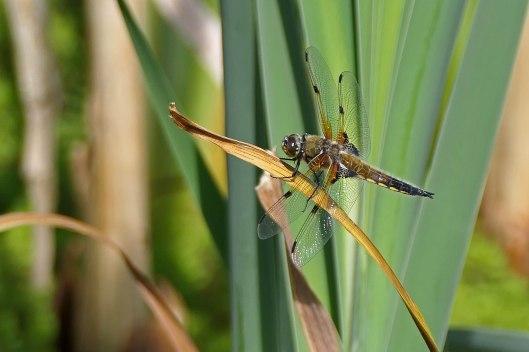
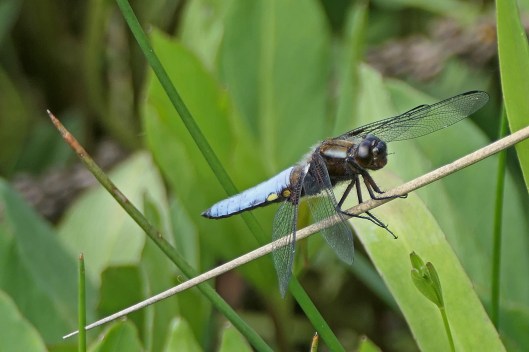
For me, the larger dragonflies have been few and far between this Spring. I’ve seen the odd one but fleetingly and its flown off before I could get a good view. Or I’ve heard one, that distinctive sound of the small wings rustling together as it takes flight. So, finally to have found two dragons that stayed still long enough for me to admire their colours and get some photographs has been very welcome indeed. Below are a Four-spotted chaser (Libellula quadrimaculata) and a Broad-bodied chaser (Libellula depressa). Fingers crossed for more sightings to come.

Like Loading...
← Older posts
Newer posts →

About me

sconzani

sconzani

I'm a writer and photographer; researcher and blogger; birder and nature lover; countryside rambler and city strider; volunteer and biodiversity recorder.

View Full Profile →

Follow earthstar on WordPress.com

Enter your email address to follow this blog and receive notifications of new posts by email.

Recent blog posts

  • Turtle bug March 23, 2026
  • Springtime invasives March 22, 2026
  • Singing Dunnocks March 21, 2026
  • New cat: Large yellow underwing March 20, 2026
  • Curious Coal tit March 19, 2026

From the archives

COPYRIGHT

Unless otherwise acknowledged, the text and photographs on this blog are my own and are subject to international copyright. Nothing may be downloaded or copied without my permission.

Fellow Earth Stars!

  • Unknown's avatar
  • Unknown's avatar
  • Unknown's avatar
  • Unknown's avatar
  • Unknown's avatar
  • Unknown's avatar
  • Unknown's avatar
  • Unknown's avatar
  • Unknown's avatar
  • Unknown's avatar
  • Unknown's avatar
  • Unknown's avatar
  • Unknown's avatar
  • Unknown's avatar
  • Unknown's avatar
  • Unknown's avatar
  • Unknown's avatar
  • Unknown's avatar
  • Unknown's avatar
  • Unknown's avatar
  • Unknown's avatar
  • Unknown's avatar
  • Unknown's avatar
  • Unknown's avatar
  • Unknown's avatar
  • Unknown's avatar
  • Unknown's avatar
  • Unknown's avatar
  • Unknown's avatar
  • Unknown's avatar
  • Unknown's avatar
  • Unknown's avatar
  • Unknown's avatar
  • Unknown's avatar
  • Unknown's avatar
  • Unknown's avatar
  • Unknown's avatar
  • Unknown's avatar
  • Unknown's avatar
  • Unknown's avatar
  • Unknown's avatar
  • Unknown's avatar
  • Unknown's avatar
  • Unknown's avatar
  • Unknown's avatar
  • Unknown's avatar
  • Unknown's avatar
  • Unknown's avatar
  • Unknown's avatar
  • Unknown's avatar

Blog at WordPress.com.

Privacy & Cookies: This site uses cookies. By continuing to use this website, you agree to their use.
To find out more, including how to control cookies, see here: Cookie Policy
  • Subscribe Subscribed
    • earthstar
    • Join 668 other subscribers
    • Already have a WordPress.com account? Log in now.
    • earthstar
    • Subscribe Subscribed
    • Sign up
    • Log in
    • Report this content
    • View site in Reader
    • Manage subscriptions
    • Collapse this bar
 

Loading Comments...
 

You must be logged in to post a comment.

    %d