• ABOUT
  • BIRDING 2018
  • Birding 2019
  • BLOG POSTS
  • Butterflies 2018
  • Resources

earthstar

~ a celebration of nature

earthstar

Author Archives: sconzani

Five big hovers

12 Thursday Jun 2025

Posted by sconzani in insects

≈ Leave a comment

Tags

British hoverflies, Chrysotoxum cautum, hoverfly, large hoverflies, Merodon equestris, Volucella bombylans, Volucella inflata, Volucella pellucens

I’ve come to the conclusion, rightly or wrongly, that large hoverflies are like buses: you don’t see any at all and then they all come along at once. At least that has been my recent experience (it’s probably more to do with the weather and the time of year, but I like my buses theory). The five big beasties shown here were all seen over just four days, between 29 May and 1 June.

With its black-and-yellow striping, it’s easy to see that Chrysotoxum cautum is one of the wasp-mimicking hoverflies. The eight British species of Chrysotoxum all have quite long antennae, and it is the relative lengths of the segments of those antennae that are used to differentiate between the five most similar species.

Merodon equestris comes in a variety of colour forms, each of which mimics bumblebees. The one pictured above is a rather worn specimen of form validus, which has a totally dark thorax and a grey-buff coloured bottom.
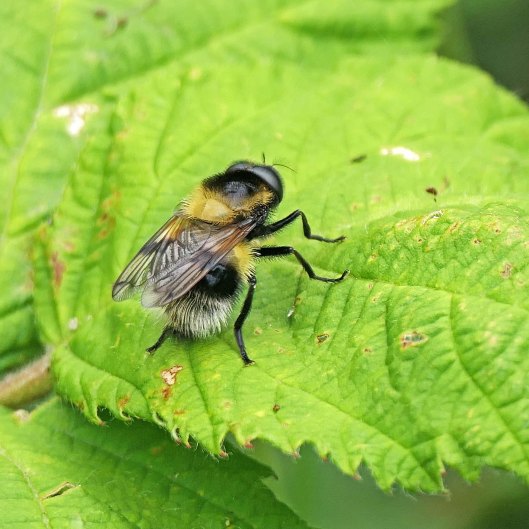
These final three are all members of the Volucellini, of which there are five British species. Like Merodon equestris, Volucella bombylans is a bumblebee mimic; which bumblebee it is attempting to mimic depends on which of the colour variations you see. This yellow-and-black form mimics Bombus lucorum, the White-tailed bumblebee, but there is also a mostly black, orange-bottomed variation of Volucella bombylans that mimics Bombus lapidarius, the Red-tailed bumblebee.
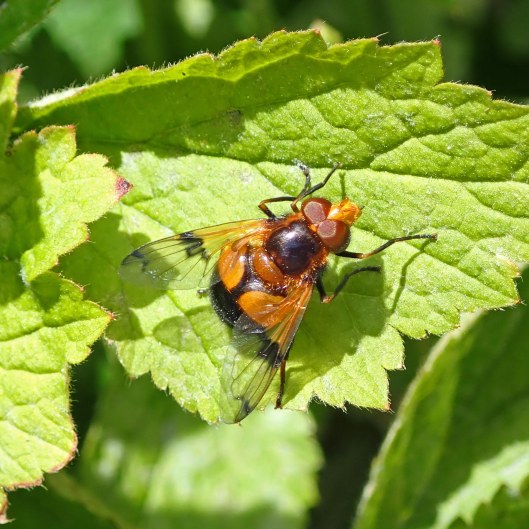
I was particularly pleased to see Volucella inflata as I’ve only found it once before. With its vivid and very distinctive markings, its round body, and protruding yellow snout, it’s a stunning hoverfly to encounter. Sadly for those of you in northern Britain, it’s mostly found in the southern counties and south Wales.
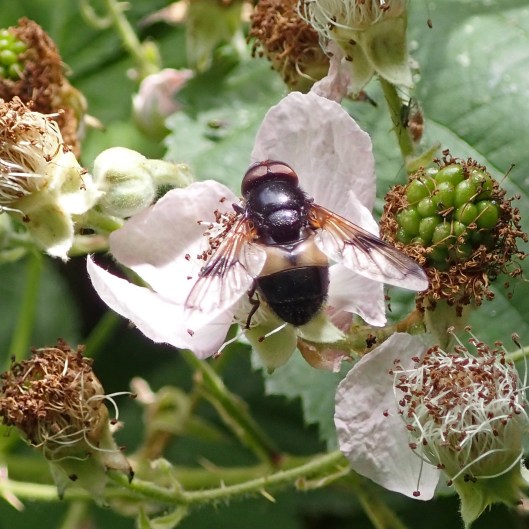
Volucella pellucens, on the other hand, is common and abundant throughout Britain, often seen hovering around head height along woodland rides and forest tracks. Due to its black-and-white colouring, it’s also known as the Great pied hoverfly.
Like Loading...

Spider: Pardosa species

11 Wednesday Jun 2025

Posted by sconzani in spiders

≈ Leave a comment

Tags

British spiders, Lycosidae, Pardosa female with egg sac, Pardosa species, wolf spiders

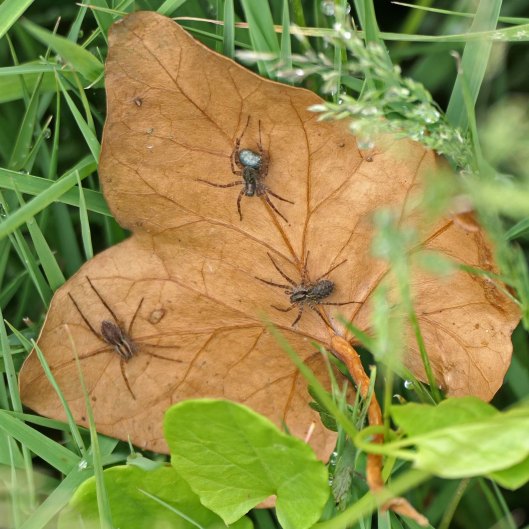
Does it look like a wolf? Then why is this one of the so-called wolf spiders? I presume it’s because the Lycosidae or wolf spiders don’t use webs to catch their prey, relying instead on their running speed and superb eyesight (they have 8 eyes lined up in 2 rows) to catch their food.

There are nine genera of wolf spiders, and the spiders shown here belong to one of 15 British species in the Pardosa genus. I cannot be more precise about the name because this is yet another family where identification is difficult; my guide book states that ‘even with the use of a microscope, identification can be extremely difficult’, so I’m just glad I managed to get the fact that these are Pardosa species verified.

All the Pardosa are brownish in colour, with similar markings on their abdomens in lighter and darker hues. As you can perhaps make out in my photos, even though these are all the same species, the markings are different in each spider. As you may also have gathered from looking at my photos, the females in this family carry their egg sacs around with them, presumably to protect them. Those sacs are usually a blue-green colour, with a paler seam down the centre.

If you want to see more of the spiders in this family, check out Steven Falk’s amazing album of photos on Flikr.

Like Loading...

Rhabdomiris striatellus

10 Tuesday Jun 2025

Posted by sconzani in insects, trees

≈ Leave a comment

Tags

British miridae, British plant bugs, bugs on Oak, insects on Oak trees, Miridae, oak tree, plant bug on Oak, Rhabdomiris striatellus

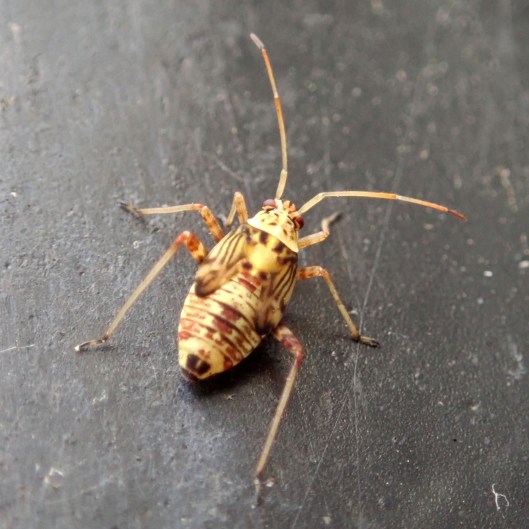
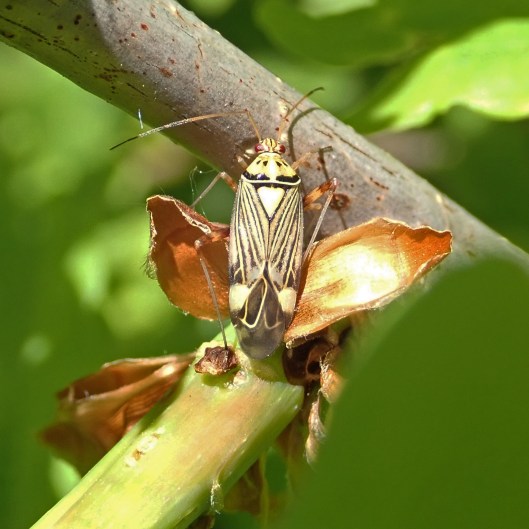
Here’s another bug that I’d never seen before this year and I’ve been lucky enough to find both a nymph and an adult. This is Rhabdomiris striatellus, one of the UK’s 200-plus species of plant bugs in the Miridae family. (I’ve probably only seen about a tenth of them so I’ve got plenty more discoveries yet to make.)

As this bug’s larvae feed on unripe catkins, it is usually found on or around Oak trees, and that’s certainly where I found the adult bug, shown below. The nymph above had probably fallen out of an Oak tree, or had decided to go walkabout to find a neighbouring Oak; I found it on the railings of my local park, where I’ve found so many invertebrates.

Rhabdomiris striatellus overwinters as an egg, hatches out in mid Spring, then passes through a series of instars until it reaches adulthood. The adults can then be seen from May through to July. Those timings certainly fit with my discoveries; I found the nymph on 25 April and the adult, in a different location, on 3 May.

Like Loading...

Leafmines: Coleophora paripennella

09 Monday Jun 2025

Posted by sconzani in insects, plants

≈ Leave a comment

Tags

British coleophora, British moths, case-bearing moth larva, case-bearing moth larva on Knapweed, Coleophora, Coleophora paripennella, leaf-mining moth larvae, moth larva on Knapweed

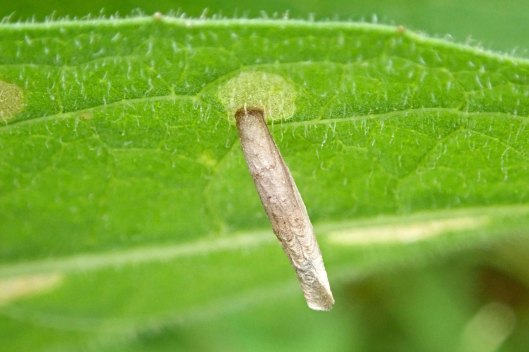
When I got home and checked my photos of this Coleophora, much head scratching ensued. From the British Leafminers website, I could see that there are only three species of case-bearing moth larvae known to feed on Knapweed (Centaurea nigra) and this case didn’t look like any of them. The case of Coleophora conspicuella is described as black and glossy, and has a peculiar almost keel-like shape. Coleophora peribenanderi mostly mines thistle species, is only occasionally seen on Knapweed, and the larvae is active from August to October. Coleophora paripennella‘s case looked the most likely, but is also usually much darker, almost black. So, I ‘phoned a friend’.

And my friendly expert from British Leafminers also ‘phoned a friend’, checking with another moth larvae expert. Their opinions concurred: this was Coleophora paripennella, just with a much lighter-coloured case than usual. Like C. peribenanderi, C. paripennella uses both thistles and Knapweed as larval plants, but in this case, those larvae that use thistle are fully grown by the autumn, whereas those that munch on Knapweed, top up their larval development by feeding again from April to May/June. You can see the sleek and glossy adult moth that eventually results from all this leaf munching on the UK Moths website here.

Like Loading...

Coteries of orchids

08 Sunday Jun 2025

Posted by sconzani in flowers, wildflowers

≈ Leave a comment

Tags

Anacamptis pyramidalis, Bee orchid, British orchids, Dactylorhiza maculata, Dactylorhiza praetermissa, Heath spotted-orchid, native orchids, Ophrys apifera, orchids, Pyramidal orchid, Southern marsh orchid, Spring colour, spring orchids

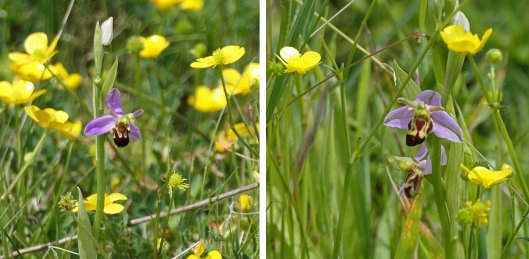
I was searching for adjectives to describe the many native orchids I’ve been seeing during my recent meanders, then decided that you didn’t really need my blathering to see how sublime they are.

Bee orchids (Ophrys apifera), at Cardiff’s Grangemoor Park. Note the unusual markings on the ‘face’ of the orchid on the right – it looks to me to be crying.

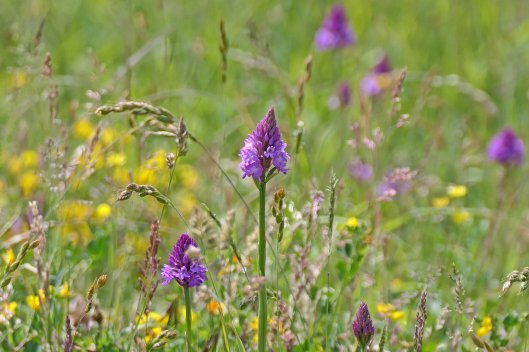
Also from Grangemoor Park, a feast of Pyramidal orchids (Anacamptis pyramidalis)

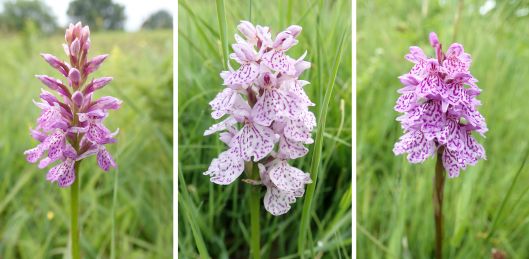
Heath spotted-orchids (Dactylorhiza maculata) from last Wednesday’s visit to Aberbargoed Grasslands NNR

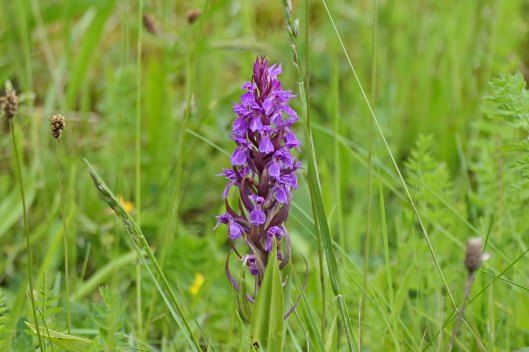
One of just a few Southern marsh orchids (Dactylorhiza praetermissa) growing on the coal spoil tip at Aberbargoed

Like Loading...

Grassland pearls

07 Saturday Jun 2025

Posted by sconzani in insects

≈ Leave a comment

Tags

Aberbargoed Grasslands, Boloria selene, British butterflies, British fritillaries, butterfly, fritillaries, fritillary butterflies, Small Pearl-bordered Fritillary

Wednesday’s weather wasn’t the best for trying to find butterflies – a constant westerly wind was keeping the temperatures low even when the sun did manage to peak out from behind the constant parade of big clouds rolling through, but my friend Shar’s optimism proved well founded.

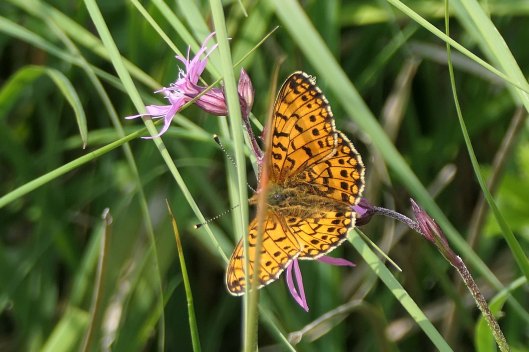
Though even her sharp eyes didn’t manage to spot any Marsh fritillaries (as they seem to have emerged early everywhere this year, we were probably too late for them at this site), we did find a few gorgeous Small pearl-bordered fritillaries (Boloria selene), the species I was really hoping to see that day. Initially, we thought we had two but on checking my photos at home later, I realised from the wing markings that we’d actually seen three.

As usual, we were conducting our butterfly hunt in the habitat most favoured by these fritillaries, the damp grasslands of the Aberbargoed Grasslands National Nature Reserve, where the butterflies particularly enjoy flowers like common violets and bluebells, Marsh thistles and Ragged robin. The reserve is also home to a large population of orchids, both Common and Heath spotted-orchids, as well as Cross-leaved heath, Tormentil, Devil’s-bit scabious and Knapweed, amongst other wildflower species, making a wander around its fields a pleasure even when you don’t see very many butterflies.

Like Loading...

Rhopalus subrufus

06 Friday Jun 2025

Posted by sconzani in insects

≈ Leave a comment

Tags

British bugs, bugs, mating bugs, Rhopalus subrufus

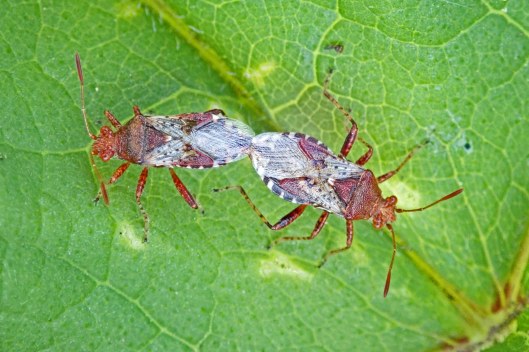
I felt a bit like a voyeur watching these handsome bugs doing their private business but I’d never seen their species before and, with them being preoccupied, it was the perfect opportunity to take a closer look and get some photographs. Rhopalus subrufus is one of four species in the genus Rhopalidae but, fortunately, R. subrufus is relatively easy to identify by the light and dark banding around the edge of its body (that flange is called the connexivum). The location where I found these two is typical of the habitat they favour: on low scrubby vegetation near trees or woodland.

Like Loading...

Cool cats, 2

05 Thursday Jun 2025

Posted by sconzani in insects

≈ Leave a comment

Tags

British moth caterpillars, caterpillars, Common quaker caterpillar, Lackey caterpillar, moth caterpillars, moth larvae, Mottled umber caterpillar, Ruby tiger caterpillar, Vapourer caterpillar

When I’m out walking at this time of year, I always keep a look out for leaf damage as that’s often the way to find invertebrates, whether they be weevils or beetle larvae or moth caterpillars or many other things. Today I thought I’d share some of the cool caterpillars I’ve been finding, most of which are relatively common and easy for everyone to identify. (I’ve linked each name to the relevant page on the UK Moths website so the curious amongst you can see what these cats will look like as moths; it always amazes me how different the adults are from their progeny.)

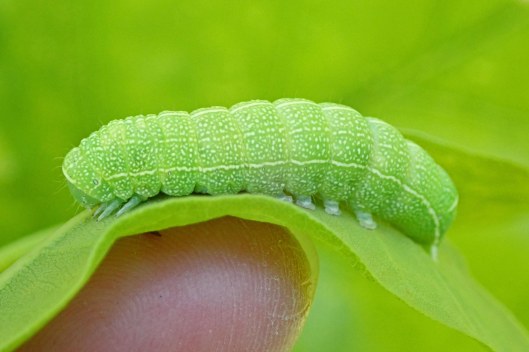
Having said that most of these are relatively common, I’d never actually seen a Common quaker (Orthosia cerasi) caterpillar before but found several recently on one Oak tree. Judging by how plump they were, all had been feeding well, and would be pupating quite soon after I saw them.

As you can perhaps see in my photo, this Lackey (Malacosoma neustria) caterpillar had just moulted (that’s the shed skin on the leaf next to it) and so was looking very vibrant. The Lackey is mostly found in southern parts of Britain and is a good example of how different the adult is – really quite drab.

Do these Mottled umber (Erannis defoliaria) caterpillars think their twig impression will deter hungry birds? Perhaps so. Judging by the fact that I spotted more than 20, of varying sizes and with slight colour variations, on a group of Lombardy poplar trees, their disguise was working.

I have to admit that I wasn’t the first to spot this lovely little Ruby tiger (Phragmatobia fuliginosa) heading purposefully across a local footpath. A young boy, who was out with his parents and their dog, had seen it and was trying, unsuccessfully, to feed it Dandelion leaves.

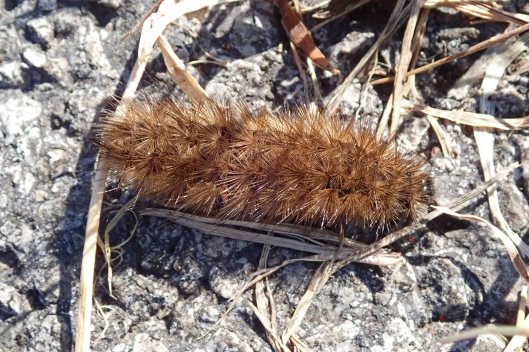
You may recall that, back in January, I blogged about finding a Vapourer cocoon and eggs. Well, though I found this particular caterpillar in a different place entirely, this is what would eventually have emerged from those eggs, the wonderfully flamboyant caterpillar of a Vapourer moth (Orgyia antiqua).

Like Loading...

Spider: Anyphaena accentuata

04 Wednesday Jun 2025

Posted by sconzani in spiders

≈ Leave a comment

Tags

Anyphaena accentuata, British spiders, buzzing spiders

When I read in my guide book that spiders of the genus Anyphaena, which my find definitely looked like (those dark markings on its abdomen are distinctive), required ‘microscopic examination of the genitalia … to distinguish between the species’, I thought to myself ‘Oh, no, not again!’ Fortunately, this time things were actually a little more straight forward than that statement implied, as the other two species are rare and currently confined to known areas in and around London. So, I submitted my record and it’s now been confirmed.

This handsome spider is Anyphaena accentuata, a buzzing spider. They’re called buzzing spiders because, during courtship, the male vibrates its abdomen against a leaf, which results in a high-pitched buzzing sound – a novel way to attract a female, to be sure. These spiders are mostly found in woodland and well-vegetated locations, where they live, hunt and mate amongst the leaves. Anyphaena accentuata is currently found mostly in the southern half of Britain, though it does appear to be expanding its range slowly northwards.

Like Loading...

Juniper shieldbug

03 Tuesday Jun 2025

Posted by sconzani in insects, trees

≈ Leave a comment

Tags

British shieldbugs, Cyphostethus tristriatus, Juniper shieldbug, shieldbug on Juniper, shieldbug on Lawson's cypress

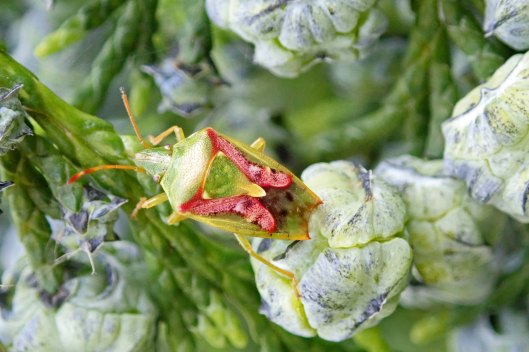
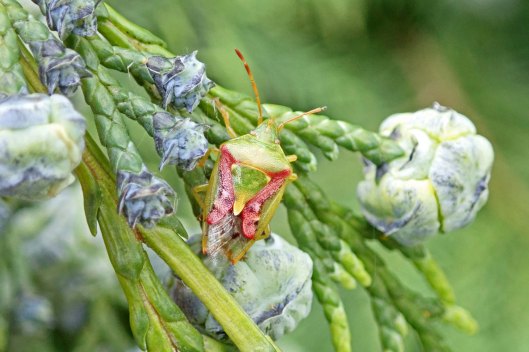
This is a bug I never thought I’d see locally as I don’t know any locations where Juniper trees grow. Fortunately for me, and as stated on the British Bugs website, the Juniper shieldbug (Cyphostethus tristriatus) has started living on Lawson’s cypress (Chamaecyparis lawsoniana) as well as its traditional host tree, the Juniper (Juniperus communis) for which it is named. And Lawson’s cypress is a popular planting in gardens and parks, which is where this tree was growing, alongside a path that runs around a local recreation ground.

British Bugs explains that adult Juniper shieldbugs, with the beautiful reddish-pink markings on their backs, can be seen all year round, though they tend not to be too active during the coldest winter months, like most of us. The nymphs that hatch from mid to late Spring feed on Juniper and Cypress berries and, like all shieldbugs, they go through a series of instars before reaching adulthood. The website has excellent, illustrated downloadable charts of the various stages of most shieldbug species for easy identification if you happen to spot a nymph and, now that I know where this Juniper shieldbug lives, I’ll have to go back and look for more, adults and nymphs.

Like Loading...
← Older posts
Newer posts →

About me

sconzani

sconzani

I'm a writer and photographer; researcher and blogger; birder and nature lover; countryside rambler and city strider; volunteer and biodiversity recorder.

View Full Profile →

Follow earthstar on WordPress.com

Enter your email address to follow this blog and receive notifications of new posts by email.

Recent blog posts

  • Nesting material April 28, 2026
  • Lifer: Box bug April 27, 2026
  • Peak Wild garlic April 26, 2026
  • First damsels of 2026 April 25, 2026
  • NFY: Green-veined white April 24, 2026

From the archives

COPYRIGHT

Unless otherwise acknowledged, the text and photographs on this blog are my own and are subject to international copyright. Nothing may be downloaded or copied without my permission.

Fellow Earth Stars!

  • Unknown's avatar
  • Unknown's avatar
  • Unknown's avatar
  • Unknown's avatar
  • Unknown's avatar
  • Unknown's avatar
  • Unknown's avatar
  • Unknown's avatar
  • Unknown's avatar
  • Unknown's avatar
  • Unknown's avatar
  • Unknown's avatar
  • Unknown's avatar
  • Unknown's avatar
  • Unknown's avatar
  • Unknown's avatar
  • Unknown's avatar
  • Unknown's avatar
  • Unknown's avatar
  • Unknown's avatar
  • Unknown's avatar
  • Unknown's avatar
  • Unknown's avatar
  • Unknown's avatar
  • Unknown's avatar
  • Unknown's avatar
  • Unknown's avatar
  • Unknown's avatar
  • Unknown's avatar
  • Unknown's avatar
  • Unknown's avatar
  • Unknown's avatar
  • Unknown's avatar
  • Unknown's avatar
  • Unknown's avatar
  • Unknown's avatar
  • Unknown's avatar
  • Unknown's avatar
  • Unknown's avatar
  • Unknown's avatar
  • Unknown's avatar
  • Unknown's avatar
  • Unknown's avatar
  • Unknown's avatar
  • Unknown's avatar
  • Unknown's avatar
  • Unknown's avatar
  • Unknown's avatar
  • Unknown's avatar
  • Unknown's avatar

Blog at WordPress.com.

Privacy & Cookies: This site uses cookies. By continuing to use this website, you agree to their use.
To find out more, including how to control cookies, see here: Cookie Policy
  • Subscribe Subscribed
    • earthstar
    • Join 642 other subscribers
    • Already have a WordPress.com account? Log in now.
    • earthstar
    • Subscribe Subscribed
    • Sign up
    • Log in
    • Report this content
    • View site in Reader
    • Manage subscriptions
    • Collapse this bar

Loading Comments...

You must be logged in to post a comment.

    %d