• ABOUT
  • BIRDING 2018
  • Birding 2019
  • BLOG POSTS
  • Butterflies 2018
  • Resources

earthstar

~ a celebration of nature

earthstar

Author Archives: sconzani

Swine-cress

22 Sunday Jun 2025

Posted by sconzani in wildflowers

≈ Leave a comment

Tags

British wildflowers, Coronopus squamatus, Lepidium coronopus, roadside wildflowers, Swine-cress

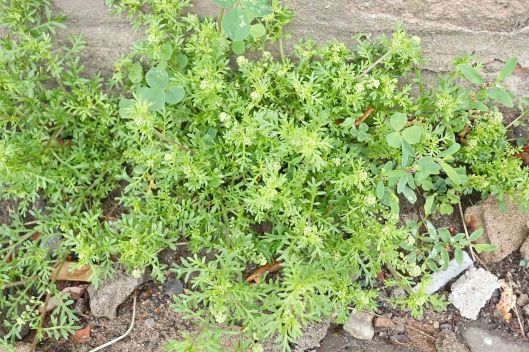
After that wonderful short break away, it was back to earth with a bang; in fact, not just back to earth but in to the gutter with the pigs. Okay, not literally with the pigs but today’s wildflower is called Swine-cress, and I’ve found it growing very happily in the gutters and along the roadside, pavement and lane edges all around my coastal town.

As I’m fairly good at recognising the wildflowers I see these days, I was quite surprised to notice this little plant, whose name I didn’t know, growing so profusely. Swine-cress, which seems to have a variety of names: Coronopus squamatus and Lepidium coronopus, is a very small member of the Brassica family, an annual or biennial, with deeply cut leaves and tiny, almost unnoticeable white flowers. I haven’t yet discovered the reason for the ‘swine’ in its name so, if you know, please do tell me in the comments.

Like Loading...

The Marbled white and the Skylark

21 Saturday Jun 2025

Posted by sconzani in birds, insects

≈ 4 Comments

Tags

birding, birdwatching, British birds, British butterflies, butterflies in Tout Quarry, butterfly, Isle of Portland butterflies, Marbled white, Skylark, Tout Quarry

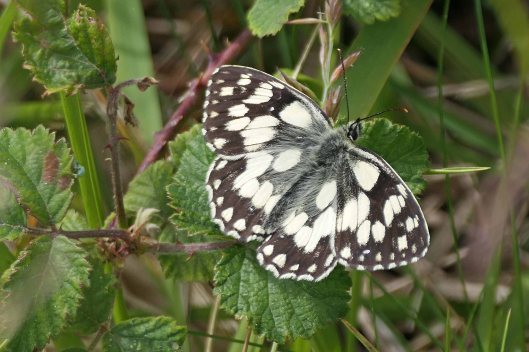
Today’s blog title puts me in mind of one of Aesop’s fables. I’m sure there was one where the butterfly was tired and asked the bird if it could ride on its back but the bird ended up eating it? Just kidding! Before I sign off from my blogs about my Weymouth trip I just wanted to share two more random moments …

The Marbled white butterfly (Melanargia galathea), though common in many parts of Britain, is rarely seen in my part of coastal south Wales, so it was a special treat to see three on the wing in Weymouth. The first was a distant blur in a field in the Wildlife Trust reserve Lorton Meadows, an area that looked like it would have good potential for butterflies and wildflowers if it wasn’t for the excessive number of off-lead dogs being allowed to roam everywhere, even into the one dragonfly pond. Fortunately, Portland’s Tout Quarry came up trumps again, and I saw two more Marbled whites there, including this obliging beauty.

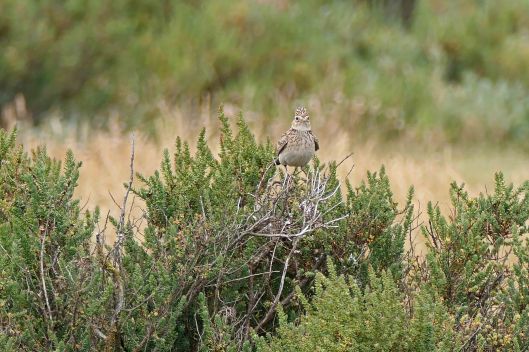
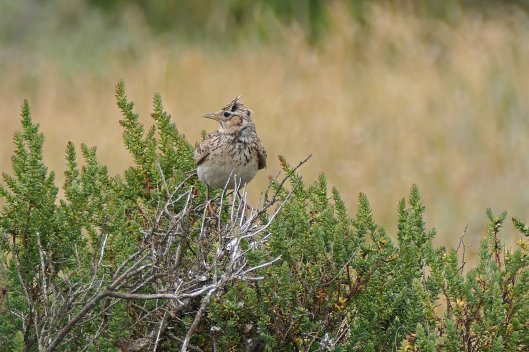
Seeing this stunning Skylark up close was another of this trip’s special moments. I was walking back from Portland to Weymouth and had almost reached the information centre at Chesil Beach when I heard Skylark song in front of me. I searched the sky for a couple of minutes before realising that the bird was, in fact, sitting on a bush adjacent to the track directly ahead of me.

Such a singing spot seemed odd but I wondered if there might be a nest in the scrubby area I was walking through and so this male was trying to distract me from going near that. Though I had never intended to move off the path, its tactic certainly focused my attention, and I grabbed a few photos before walking onward.

Like Loading...

Sedge warblers

20 Friday Jun 2025

Posted by sconzani in birds

≈ 2 Comments

Tags

birding, birding at Radipole, birdwatching, British birds, Radipole birds, RSPB Radipole, Sedge warbler

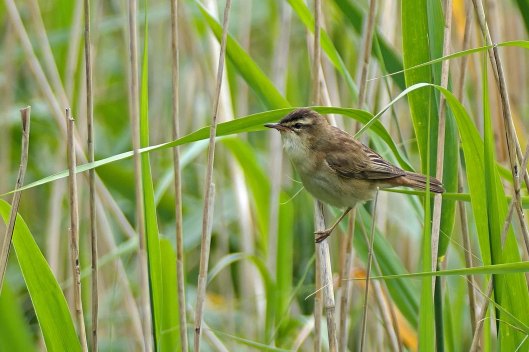
I don’t see Sedge warblers very often; if I’m lucky, I might see or, sometimes only hear, one or two as they pass through the local area during Spring and Autumn migration. That’s my excuse for not recognising these two birds, seen on two separate visits to RSPB Radipole in Weymouth. As I could hear Reed warblers singing all around me while I was exploring the reserve, which is jam-packed full of Reed beds, I just assumed these were also Reed warblers.

Wrong! The streaking of dark and light above the eyes is a sure sign of a Sedge warbler. My more expert birding friends think that the first bird, above, is an adult, though I’m not entirely convinced that it isn’t a well-grown youngster, as it was flapping its wings in the way juvenile birds do to get their parents to feed them.

The bird below is definitely a youngster; one of my friends pointed out that you can still see the gape, the yellow fleshy part at the base of its beak that is a characteristic of chicks. And it behaved like a chick: ‘My mum told me to stay right here until she got back so I’m not moving even though you’re coming along the path towards me, getting closer and closer with that black thing in front of your face, and I’m a little bit scared.’

After quickly grabbing a couple of photos, I moved past, then stopped further along the path and watched as one of its parents brought it food, and moved it to a different bush, a bit further away from the main path.

Like Loading...

Lifer: Scarce chaser

19 Thursday Jun 2025

Posted by sconzani in insects

≈ Leave a comment

Tags

Blue chaser, British chasers, British dragonflies, dragonflies at Radipole, dragonfly, Libellula fulva, RSPB Radipole, Scarce chaser

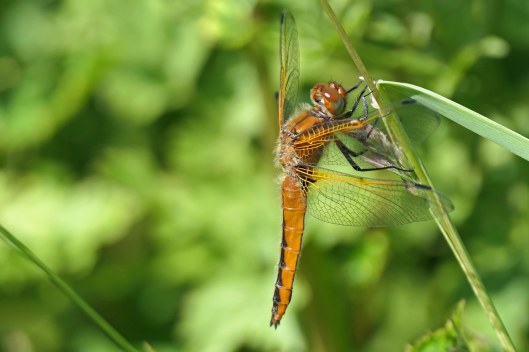
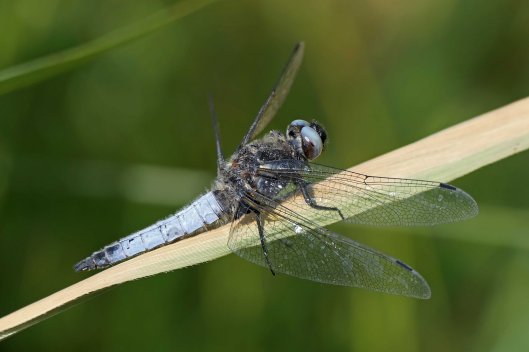
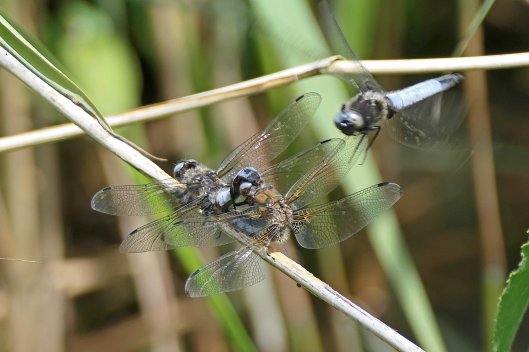
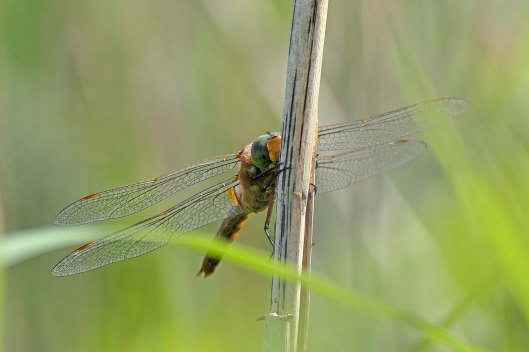
Here they are, the extremely confiding dragonflies mentioned in yesterday’s blog, the Scarce chasers (Libellula fulva) (also known as the Blue chaser). They were everything you could want in a photographer’s model, perching this way and that to show their best sides; not flying off at the slightest hint of movement behind the camera; the consummate professionals!

So, I managed to get photos of a male, female and the two together in cop. The female (above) is described in my guide book as having an olive-brown thorax and ochre-brown abdomen but, as you can see, she was much more vibrant than those descriptions suggest.

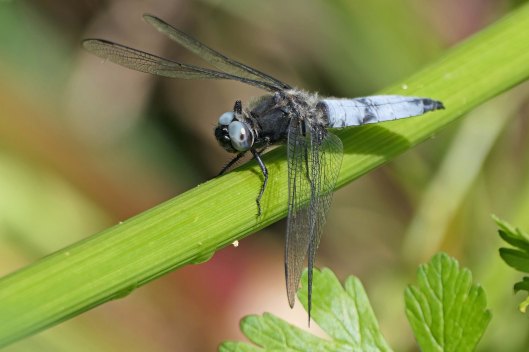
The males have a black thorax and blue abdomen with a dark tip. At a glance, with those colours, they could be mistaken for other dragonflies with similar colouration, until you see their eyes, which are the most amazing shade of blue. (In fact, I’ve just decided to add in a second photo of the male so you can get a better look at those eyes.)

I saw several of these dragons at RSPB Radipole Lakes in Weymouth, which left me wondering why they are called ‘Scarce’ chasers. It seems that, where they are found (in isolated spots in the east and south of England) their populations are relatively small, so they are officially designated as rare. Indeed, in the 2008 British Odonata Red List they were officially listed as ‘near threatened’, so I feel very privileged to have enjoyed such excellent views of these stunning creatures.

Like Loading...

Lifer: Norfolk hawker

18 Wednesday Jun 2025

Posted by sconzani in insects

≈ Leave a comment

Tags

Aeshna isoceles, British dragonflies, British hawkers, Dorset dragonflies, dragonflies at Radipole, dragonfly, hawker, Norfolk hawker, RSPB Radipole

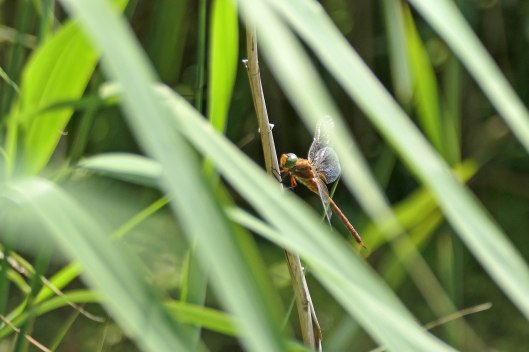
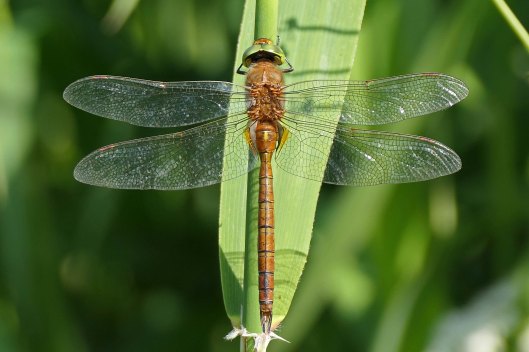
My wildlife-watching hopes for my short break in Weymouth centred on butterflies and, perhaps, a few birds that I might not see locally, so it was a wonderful surprise to see two new dragonfly species, one extremely confiding (it’ll feature in tomorrow’s blog), one elusive to the point of frustration.

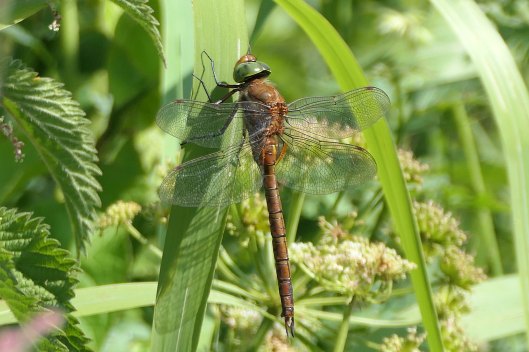
The Norfolk hawker (Aeshna isoceles) was the latter and, on my first visit to the RSPB Radipole reserve, the few times I spotted these dragonflies (easily recognisable by their brown colouring and green eyes), they stayed mostly hidden, perching – when they did actually stop flying – in obscure locations, as you can see from the photos above and below.

Finally, on my last afternoon, when there were fewer people out walking after a morning’s heavy rain and I was battling my way through the extremely overgrown vegetation along the path to the northern bird hide, one of these stunning dragons posed perfectly for me.

Although called Norfolk hawkers, these medium-sized dragonflies have been expanding their range beyond the English county of Norfolk. Their preference for reed beds in swamps and ponds, along streams and ditches, means Radipole provides the perfect location for them to thrive.

Like Loading...

Breeding Common terns

17 Tuesday Jun 2025

Posted by sconzani in birds

≈ Leave a comment

Tags

birding, birdwatching, breeding Common terns, British birds, Common tern, Common tern chicks, Lodmoor Nature Reserve, RSPB Lodmoor

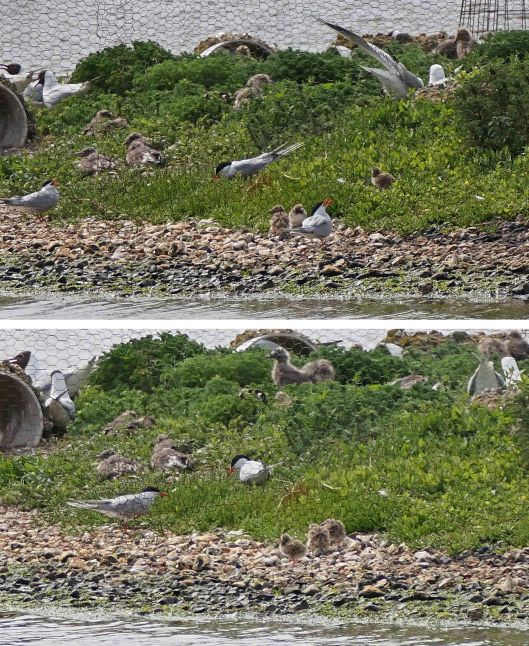
My afternoon walk to Lodmoor Nature Reserve proved the perfect antidote to my five-hour journey on four different trains to get to Weymouth. And what an absolute delight it was when I arrived at Lodmoor to first hear – very raucous, and then see the Common terns and their Black-headed gull companions breeding in close proximity on two artificial islands near the edge of the lakes. (These islands are ring-fenced and fitted out with some enclosed nesting ‘boxes’ to try to offer the birds better protection during the breeding season.)

Though Common terns can be seen at certain times of year when moving on passage up and down the Bristol Channel, I’ve rarely managed to catch sight of them in my local stomping ground, so seeing them at reasonably close quarters, and with their tiny chicks just beginning to explore the world around them, was another special treat of this holiday.

Terns are magnificent aeronauts. Their skill at manoeuvring their streamlined shape through the thermal airwaves, their ability to twist and turn and plunge and lift – these fliers are a joy to watch, particularly when diving for the tiny fish swimming just below the water’s surface. And, with several tiny chicks to feed, these terns were almost constantly in the air. Many seemed to fly straight out to sea where, presumably, their prey was more bountiful but I also noticed, when walking around Weymouth’s other local nature reserve, Radipole Lakes, that the Common terns were successfully exploiting the fishing opportunities there as well.

Like Loading...

Lifer: Lulworth skipper

16 Monday Jun 2025

Posted by sconzani in insects

≈ 2 Comments

Tags

British butterflies, British skippers, butterfly, Isle of Portland butterflies, Lulworth skipper, summer butterflies, Thymelicus acteon, Tout Quarry

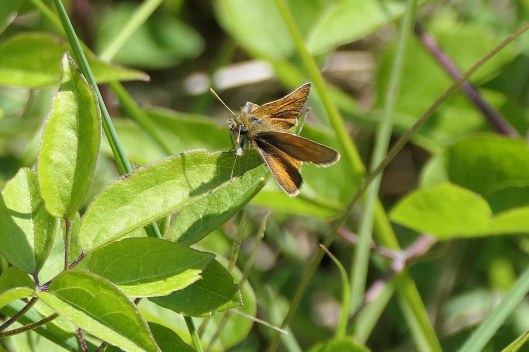
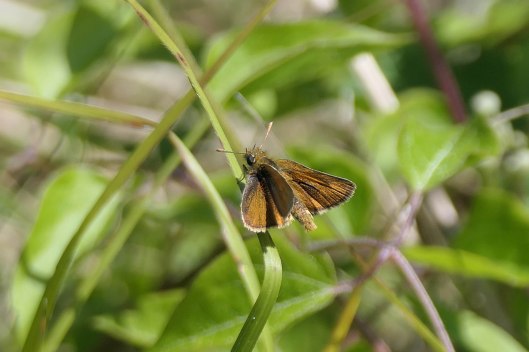
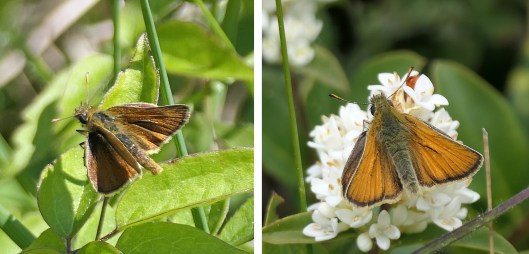
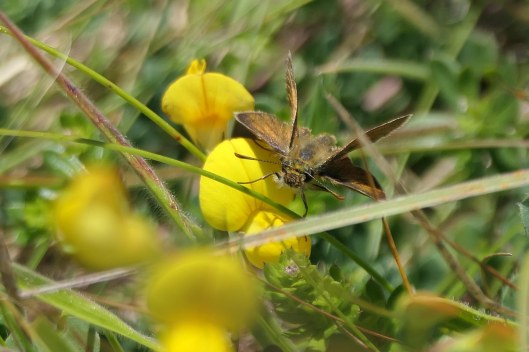
This was another new-to-me butterfly, the Lulworth skipper (Thymelicus acteon), and this was the butterfly that I really hoped to see during my visit to Weymouth. Clearly, I was not disappointed.

This was another find in the sculpture park that is Tout Quarry on the Isle of Portland, and I saw my first Lulworth skipper almost as soon as I arrived. At first glance, they could easily be mistaken for Small skippers, but Lulworths are slightly smaller and generally darker, often turning an olive-brown colour as they age. The females also have a series of golden marks that form a notable circle on their wings, though that didn’t help me. As is common amongst butterfly species, the males emerge first, and I saw no females.

However, by sheer good luck, I also spotted my first Small skipper of the year as I explored Tout Quarry, which proved a very good comparison for the Lulworths I was seeing. I’ve included a photo of the two species below; this is not precise as to their size relationship but does, hopefully, give some idea of their colour differences (Lulworth on the left, Small skipper on the right).

The Lulworth skipper is named after the Dorset town of Lulworth, where it was first found in 1832. Though these butterflies have expended their range a little in the intervening 190 years, they are still only found in locations along the south Dorset coast. I had expected to have to catch a bus to Lulworth until I read the butterflies could be found on Portland, and I booked my little break away as soon as I heard they were on the wing. So, it was a real treat to find them so quickly and easily, and then to spend perhaps 90 minutes in the quarry, enjoying all the butterfly species, the local plants, and, yes, I did also look at the stone sculptures.

Like Loading...

Portland spurge

15 Sunday Jun 2025

Posted by sconzani in wildflowers

≈ Leave a comment

Tags

British wildflowers, Euphorbia, Euphorbia portlandica, Portland spurge, spurge, summer colour, summer wildflowers, yellow wildflowers

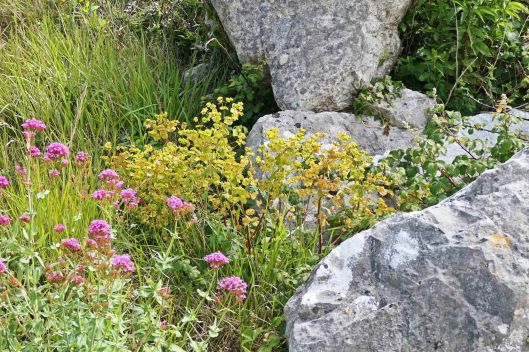
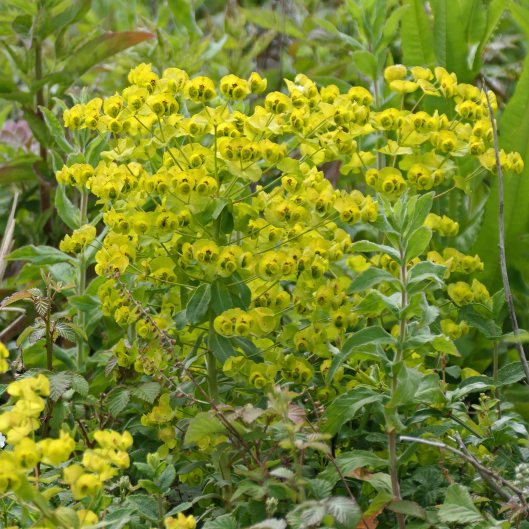
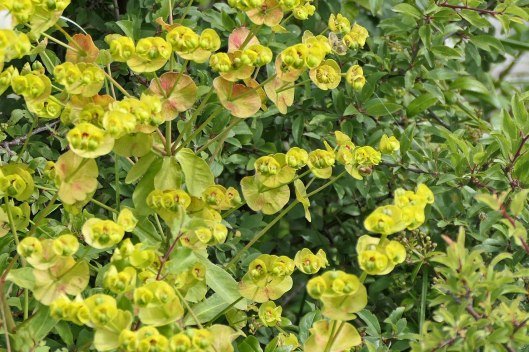
From its structure I knew this wonderfully sunny plant was a Euphorbia, a member of the Spurge family, as soon as I saw it, but I had no idea until I researched it later that the Isle of Portland had its very own species.

This is Portland spurge (Euphorbia portlandica), a close relative of Sea spurge (Euphorbia paralias) but with some subtle differences in the shape of its leaves: Sea spurge has thick fleshy leaves, whereas those of Portland spurge are thinner, with more pointy tips. Unfortunately, I wasn’t aware of that until later so the leaves are rather obscured in my photographs. I was just delighted by the joyous colour of Portland’s flowers, so appropriate for this seaside location.

Portland spurge is not confined to the Isle of Portland; it can also be found growing on dune sands and coastal sea cliffs around the south and west of Britain and Ireland.

Like Loading...

Lifer: Silver-studded blue

14 Saturday Jun 2025

Posted by sconzani in insects

≈ Leave a comment

Tags

British butterflies, butterfly, Dorset butterflies, Isle of Portland butterflies, Plebejus argus, Silver-studded blue, Tout Quarry

I’ve just returned from four wonderful nights in Weymouth, on England’s south coast, my days full of walking and wildlife. I may see a lot of wildlife where I live but part of the reason for my recent house move was so that I could afford to have a few short breaks away to explore new areas and see different wildlife while I still have the energy and mobility to do that, and also while being as low-carbon as possible in the process, of course, so travelling by train and/or bus and with a lot of walking as well. So, there will be a few blogs in the next week or so, covering some of the things I saw while away.
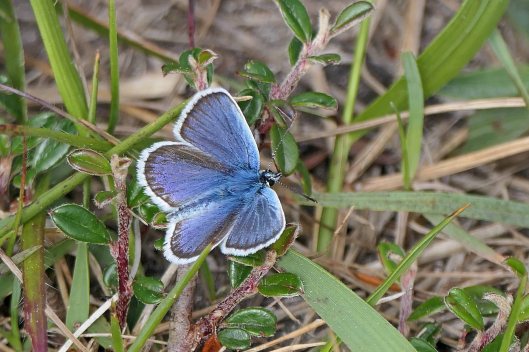
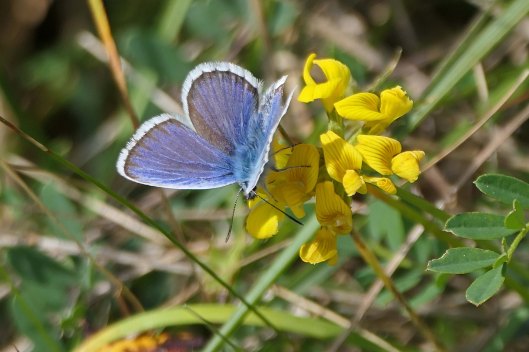
First up, in an old disused quarry on the Isle of Portland, were my first ever Silver-studded blue butterflies (Plebejus argus). The ‘silver-studded’ part of the name comes from the way the light is reflected off the light blue scales on the underside of the adults’ hindwings, making them shimmer like silver. And the ‘argus‘ epithet in its scientific name is a nod to the multi-eyed shepherd of Greek mythology, a reference to the spots on the undersides of the wings.
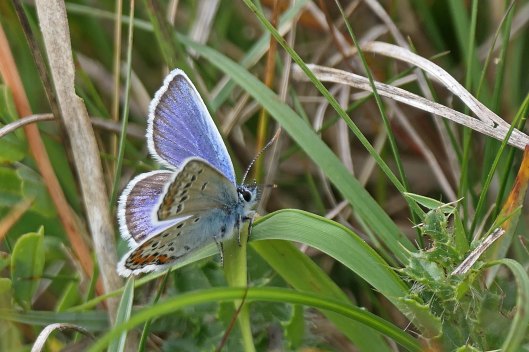
Silver-studded blues are rare and only seen in a few isolated areas around the southern coast of England, in Pembrokeshire and around the Great Orme in Wales, and in a couple of coastal locations in Norfolk and Suffolk. From those locations, you can perhaps guess that they prefer heathland, sand-dune systems and limestone grassland, in particular sheltered sunny spots where their companions, the black Lasius ant species, thrive. As is seen in several butterfly species, ants provide the butterflies with protection from insect predators throughout their life cycle.
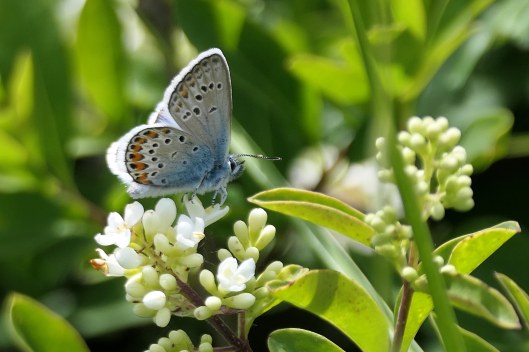
Tout quarry provides the perfect environment for the Silver-studded blues. Quarrying has hollowed out large areas of ground, making it a sun trap and leaving stony areas where specialist wildflower species have managed to seed and flourish, though the vegetation does have to be managed to ensure the more aggressive plant species don’t overwhelm large areas of ground.
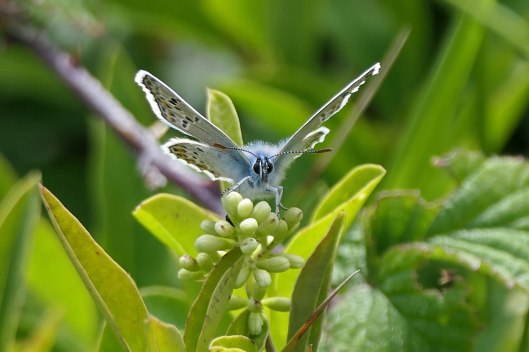
I was extremely lucky with the timing of my trip as these butterflies had only just emerged in the few days prior to my arrival, and that’s why I only saw the vibrant blue male butterflies; the females are brown on both the upper- and undersides of their wings. To see them is the perfect incentive for a return trip!

Like Loading...

Destructive Woodpigeons

13 Friday Jun 2025

Posted by sconzani in birds, trees

≈ Leave a comment

Tags

Ash trees, bird behaviour, birding, birdwatching, British birds, damage to Ash leaves, Woodpigeon, Woodpigeon eating Ash leaves

Although I am officially on the ground floor in my new home, the site slopes quite steeply so my flat is actually on the middle of three levels and, from my windows, I look out over the small slice of ancient woodland that’s adjacent to this property at the level of the tree tops. This is perfect for watching the antics of the local bird life, from the several species of tits to the larger Carrion crows and Woodpigeons, and I’m noticing behaviour that I couldn’t previously see from ground level.

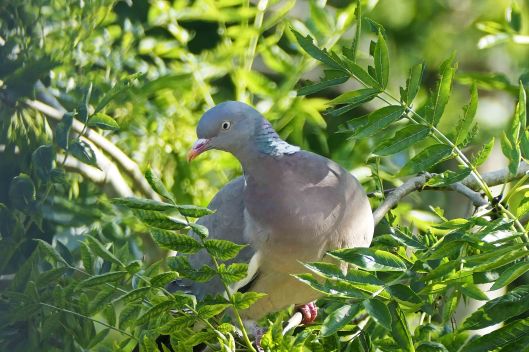
The Woodpigeons, of which there are many, spend quite a lot of time in the Ash trees. Looking through my binoculars, I’ve noticed that they appear to be carefully inspecting the leaves before pecking at them. Though they are predominantly vegetarian, they are known to eat some small invertebrates so, initially, I thought they were picking off aphids from the leaves. In the process they peck off chunks of leaf matter, which actually causes quite a lot of damage to the foliage. I have now read that they are actually eating the Ash leaves, targeting, in particular the shoots and younger leaves, presumably because those have the most nutrients. This feeding behaviour is really quite destructive – you can see the leaf damage to the right of this pigeon’s head in my photos, and something I was completely unaware of until I moved.

Like Loading...
← Older posts
Newer posts →

About me

sconzani

sconzani

I'm a writer and photographer; researcher and blogger; birder and nature lover; countryside rambler and city strider; volunteer and biodiversity recorder.

View Full Profile →

Follow earthstar on WordPress.com

Enter your email address to follow this blog and receive notifications of new posts by email.

Recent blog posts

  • Nesting material April 28, 2026
  • Lifer: Box bug April 27, 2026
  • Peak Wild garlic April 26, 2026
  • First damsels of 2026 April 25, 2026
  • NFY: Green-veined white April 24, 2026

From the archives

COPYRIGHT

Unless otherwise acknowledged, the text and photographs on this blog are my own and are subject to international copyright. Nothing may be downloaded or copied without my permission.

Fellow Earth Stars!

  • Unknown's avatar
  • Unknown's avatar
  • Unknown's avatar
  • Unknown's avatar
  • Unknown's avatar
  • Unknown's avatar
  • Unknown's avatar
  • Unknown's avatar
  • Unknown's avatar
  • Unknown's avatar
  • Unknown's avatar
  • Unknown's avatar
  • Unknown's avatar
  • Unknown's avatar
  • Unknown's avatar
  • Unknown's avatar
  • Unknown's avatar
  • Unknown's avatar
  • Unknown's avatar
  • Unknown's avatar
  • Unknown's avatar
  • Unknown's avatar
  • Unknown's avatar
  • Unknown's avatar
  • Unknown's avatar
  • Unknown's avatar
  • Unknown's avatar
  • Unknown's avatar
  • Unknown's avatar
  • Unknown's avatar
  • Unknown's avatar
  • Unknown's avatar
  • Unknown's avatar
  • Unknown's avatar
  • Unknown's avatar
  • Unknown's avatar
  • Unknown's avatar
  • Unknown's avatar
  • Unknown's avatar
  • Unknown's avatar
  • Unknown's avatar
  • Unknown's avatar
  • Unknown's avatar
  • Unknown's avatar
  • Unknown's avatar
  • Unknown's avatar
  • Unknown's avatar
  • Unknown's avatar
  • Unknown's avatar
  • Unknown's avatar

Blog at WordPress.com.

Privacy & Cookies: This site uses cookies. By continuing to use this website, you agree to their use.
To find out more, including how to control cookies, see here: Cookie Policy
  • Subscribe Subscribed
    • earthstar
    • Join 642 other subscribers
    • Already have a WordPress.com account? Log in now.
    • earthstar
    • Subscribe Subscribed
    • Sign up
    • Log in
    • Report this content
    • View site in Reader
    • Manage subscriptions
    • Collapse this bar

Loading Comments...

You must be logged in to post a comment.

    %d