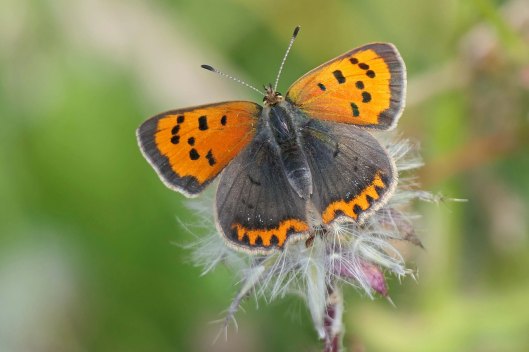
Just when I thought I would see no more, this year, of the bright beauties that are Small coppers up popped this gorgeous creature. I have never been more glad to be proved wrong.

20 Wednesday Sep 2023
Posted in insects
Just when I thought I would see no more, this year, of the bright beauties that are Small coppers up popped this gorgeous creature. I have never been more glad to be proved wrong.
19 Tuesday Sep 2023
Tags
aphid on Oak, aphid parasitised by wasp, leaf-turning, oak aphid, parasitic wasp, parasitic wasp on Oak, Praon, Praon wasp species
*** This post has been edited to correct previously wrong information. ***
I’ve seen these odd sights previously but only recently learned what they were and have been searching for an example to show you since then. Finally, during last Friday’s walk, with a little Oak-leaf-turning, I found another. Unfortunately the light wasn’t great so my photos aren’t as crisp as I would’ve liked but hopefully you’ll get the idea.

The creature is an aphid, most likely a Common oak aphid (Tuberculatus annulatus), but my poor photos mean I can’t be sure of that. The aphid has been parasitised by a tiny wasp that has laid its egg inside the aphid’s body. When it hatches, the larva cuts a hole in the aphid’s body and spins silk to attach itself and its host to the leaf. Then, once it has sucked the life out of the aphid and grown sufficiently, the wasp larva builds its cocoon beneath the aphid – I guess the aphid’s body acts as camouflage and protection for the wasp pupa.

The Praon genus of parasitic wasps are the only ones that create this puff-pastry-like attachment beneath their host, and, according to a local expert I’ve consulted, this is likely to be the species Praon flavinode, which is known to parasitise aphids on Oak and Birch. I’ve a mind to try to find another of these and, if the adult wasp hasn’t emerged, bring it home, put it in a jar and wait to see what emerges. Watch this space!
18 Monday Sep 2023
Tags
It’s been a while since I’ve seen a Nuthatch coming down for seed as they tend to disappear during the breeding season and only reappear when the weather turns colder and food becomes harder to find. So, this sight last week was a real treat!

17 Sunday Sep 2023
Posted in insects, wildflowers
Tags
British butterflies, butterflies on scabious, butterfly, Devil's-bit scabious, Painted Lady, Red Admiral
Monday’s blog featured the typical late summer/early autumn sight of a Meadow brown feasting on Devil’s-bit scabious. It’s one of the few plants that flower in abundance at this time of year at Cosmeston Lakes Country Park and, as you can see below, the east paddock is a sea of purple.

On Wednesday I noticed that the previous week’s heat had brought a small influx of Painted ladies, and counted four during my walk along one edge of the paddock. I’m sure there were, in fact, many more.
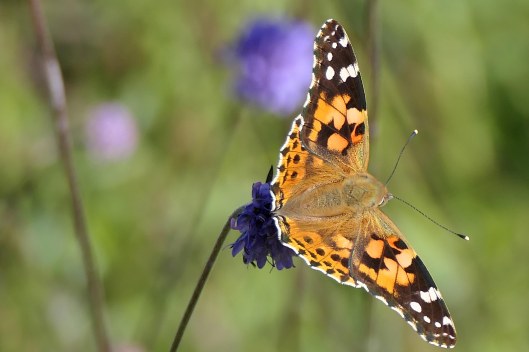
And, during Friday’s wander, the migrating Red admirals were pausing in the field to fuel their journey with slurps of scabious nectar. It’s such a valuable plant for the insects at this time of year.

16 Saturday Sep 2023
I was a little surprised to see this female Grey squirrel showing obvious signs of recent breeding but the Woodland Trust website explains that, if food is plentiful enough, these mammals can have two litters, of 3 or 4 kittens, each year. They may not be everybody’s favourite animal but it’s not their fault they were unwisely introduced to their country.

15 Friday Sep 2023
Posted in insects
I was very excited to find a Roesel’s bush-cricket (Metrioptera roeselii) earlier this week, only my second ever sighting of one of these handsome beasts, so I was quite surprised to read on British Wildlife Wiki that it is ‘becoming one of the most commonly found Orthoptera in the country, and makes up about 16% of records.’ The entry goes on to state that this bush-cricket
used to be found uniquely on the inland side of saltmarshes, and in coastal regions around estuaries, on the North Sea coast. It is becoming increasingly common in southeast England, as well as spreading further north. Over the past 50 years it has ranged further to the west, and large numbers have settled in areas of urban wasteland, especially near railways. It is generally found below 100 metres altitude. Extension to the species range has increased substantially since 1985. [The Orthoptera & Allied Insects website has a particularly interesting map that shows this range extension.]

Once I got over my excitement, I couldn’t help wondering who Roesel had been. Turns out August Johann Rösel von Rosenhof (1705-1759), was a German entomologist, who was also interested in many other creatures and was a talented painter – his illustrations of frogs look particularly fine.
14 Thursday Sep 2023
The gardeners amongst you will not welcome the sight of this moth in your vicinity, at least not if you grow any species of Box (Buxus) in your garden, as its larvae eat the leaves of Box and cover the plant in a webbing like thick cobweb. This is the appropriately named Box tree moth (Cydalima perspectalis), a native of east Asia that established itself in Europe and hopped across the Channel to Britain in 2007. From the Aderyn biodiversity records database, the first Welsh sightings were recorded in 2016 and, in the seven years since then, a further 260 records have been added to the database, with most sightings along the coast of south Wales and a smattering across the top of north Wales.

13 Wednesday Sep 2023
Tags
British sawflies, Euura pavida, Euura pavida larvae, Nematus pavidus, sawfly larvae, sawfly on willow, willow, willow species
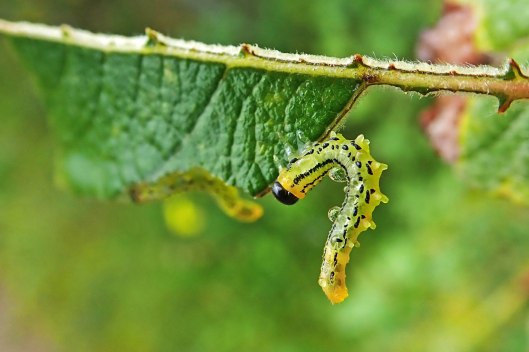
After last week’s heatwave (which kept me indoors a couple of days – I do NOT like the heat!), Monday’s walk was deliciously cool, if a little damp from un-forecast rain, and, even better, I found two new-to-me creatures. The first was a new species of sawfly larvae that I spotted when I saw this barely-there leaf. I’m always curious when I see leaves like this to find what has caused the damage.
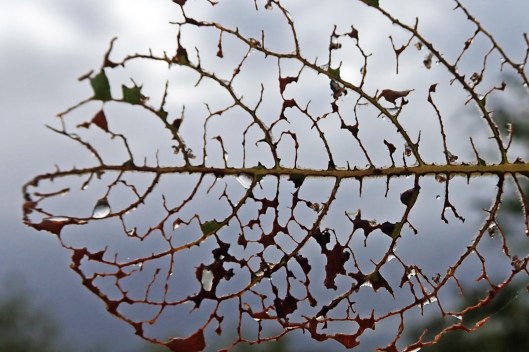
It didn’t take long to find the culprits this time – at least 20, possibly more, hungry larvae munching the tough leaves of a willow species right down to their veins.
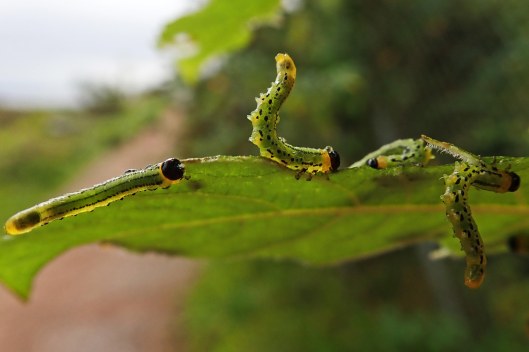
Previously known as Nematus pavidus, their species name has now changed to Euura pavida. The larvae are usually found chewing on willow leaves but can also be found on Alder and Poplar. You can see what the adult sawfly looks like on The Sawflies (Symphyta) of Britain and Ireland website.
12 Tuesday Sep 2023
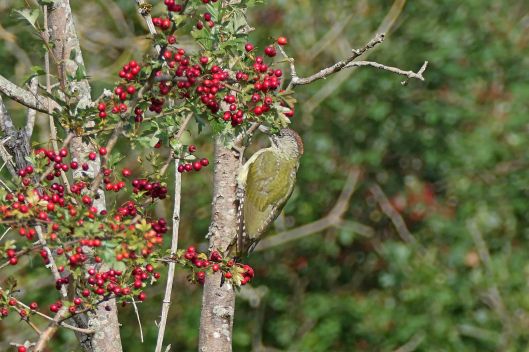
Is it a canny eye for detail or simply good luck that both these Green woodpeckers chose Hawthorn trees bedecked with red berries to perch on?
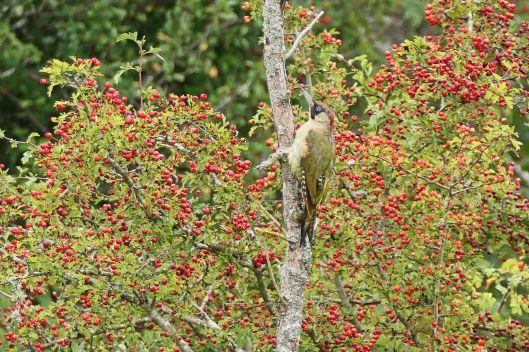
The combination of green leaves, red berries and beige-ish bark and branches is almost a perfect match for the joyful colours of the birds but, if this is an attempt at camouflage, though they haven’t quite nailed it I’d give them an eight out of ten for effort.
11 Monday Sep 2023
Posted in autumn, insects, wildflowers
Tags
British butterflies, British wildflowers, butterfly, butterfly on scabious, Devil's-bit scabious, Meadow Brown
Nothing says late summer/early autumn to me more than a Meadow brown butterfly on Devil’s-bit scabious. This is a typical sight now at my local country park.

 earthstar
You must be logged in to post a comment.