• ABOUT
  • BIRDING 2018
  • Birding 2019
  • BLOG POSTS
  • Butterflies 2018
  • Resources

earthstar

~ a celebration of nature

earthstar

Category Archives: insects

Large whites and parasitism, part 1

23 Monday Jun 2025

Posted by sconzani in insects

≈ Leave a comment

Tags

British butterflies, Cotesia glomerata, hyperparasitism, Large white butterfly, parasitic wasps, parasitism of butterfly larvae, parasitism of Cotesia glomerata, parasitism of Large white larvae

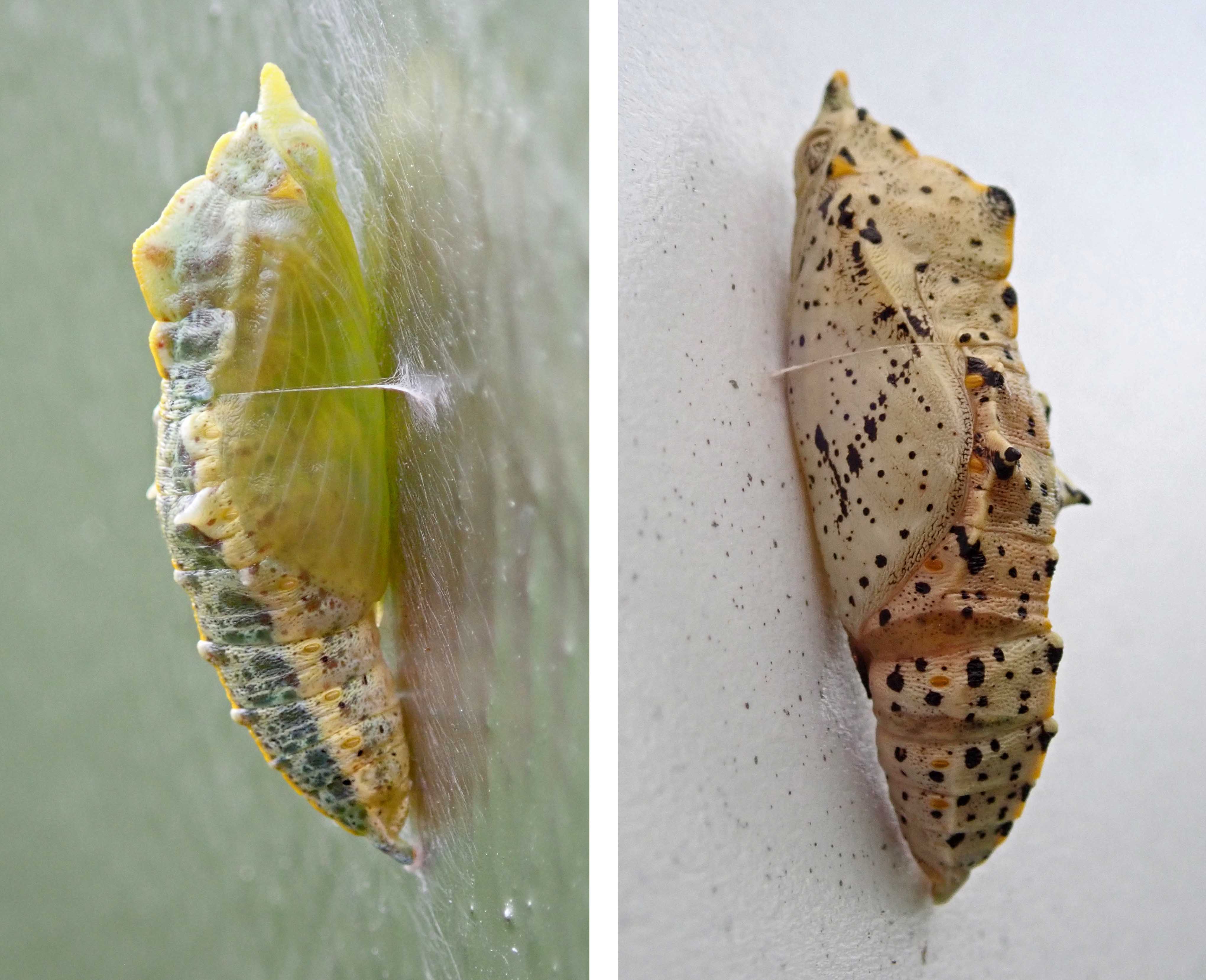
Though I’ve been in Wales almost 10 years and was fascinated by British butterflies even before I settled here, I only saw my first Large white caterpillars in June last year. So, when I spotted several more on the large advertising signage fencing off a local building site, I was delighted … until I looked more closely (and just a warning, this is a bit gruesome!).
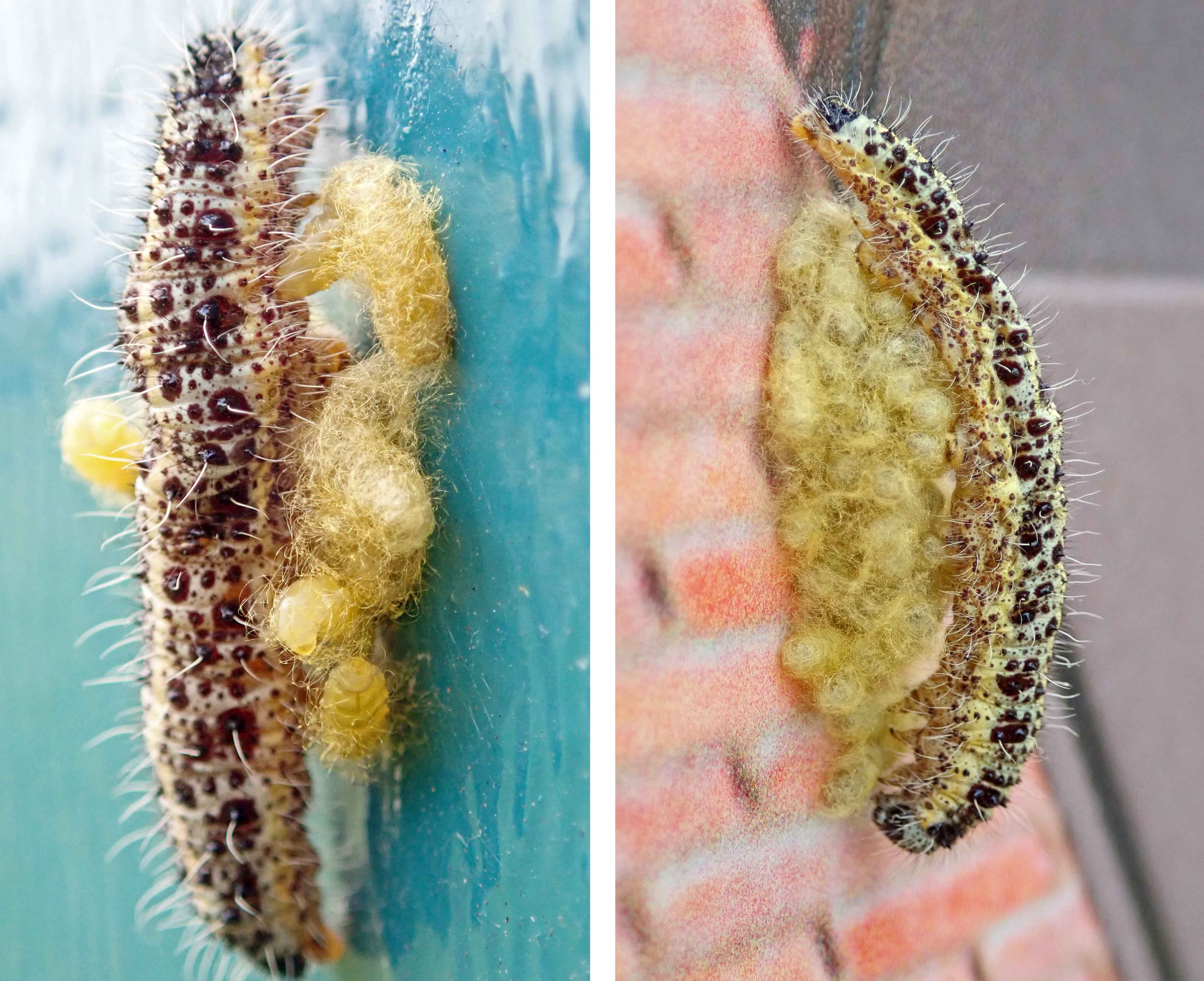
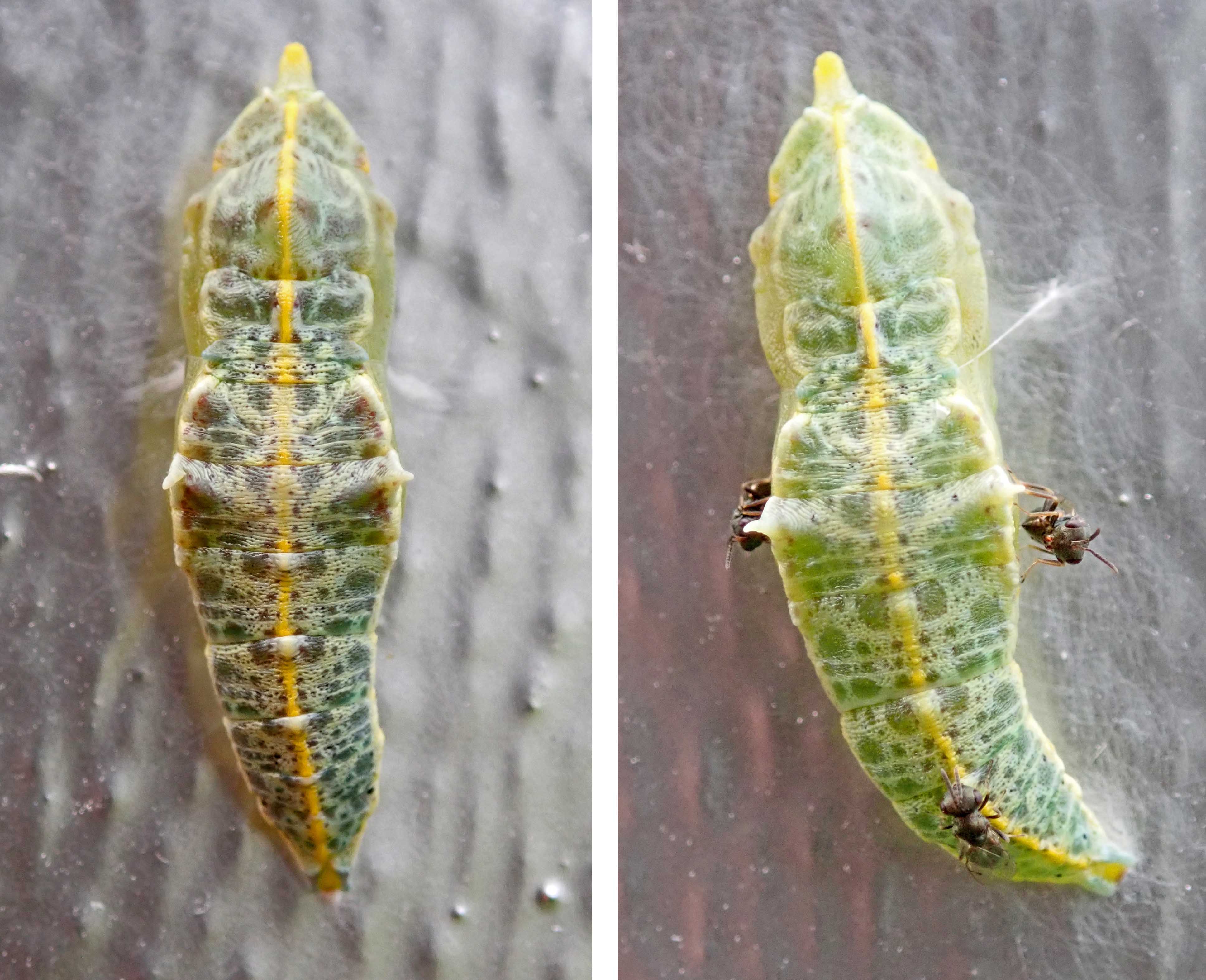
The larvae were surrounded by small yellow cocoons and, when I looked even closer, I could see small yellowish larvae squirming between the bodies of the caterpillars and the cocoons. It is highly likely that the Large whites have been parasitised by the wasp Cotesia glomerata. In Life Cycles of British & Irish Butterflies, Peter Eeles writes that the wasp

deposits between 15 and 80 eggs inside each young larva that it parasitizes. The wasp larvae feed on the layer of fat beneath the skin of their host, thereby avoiding vital organs, and, when their host is fully grown, break through the skin and pupate within yellow cocoons on or near their host.
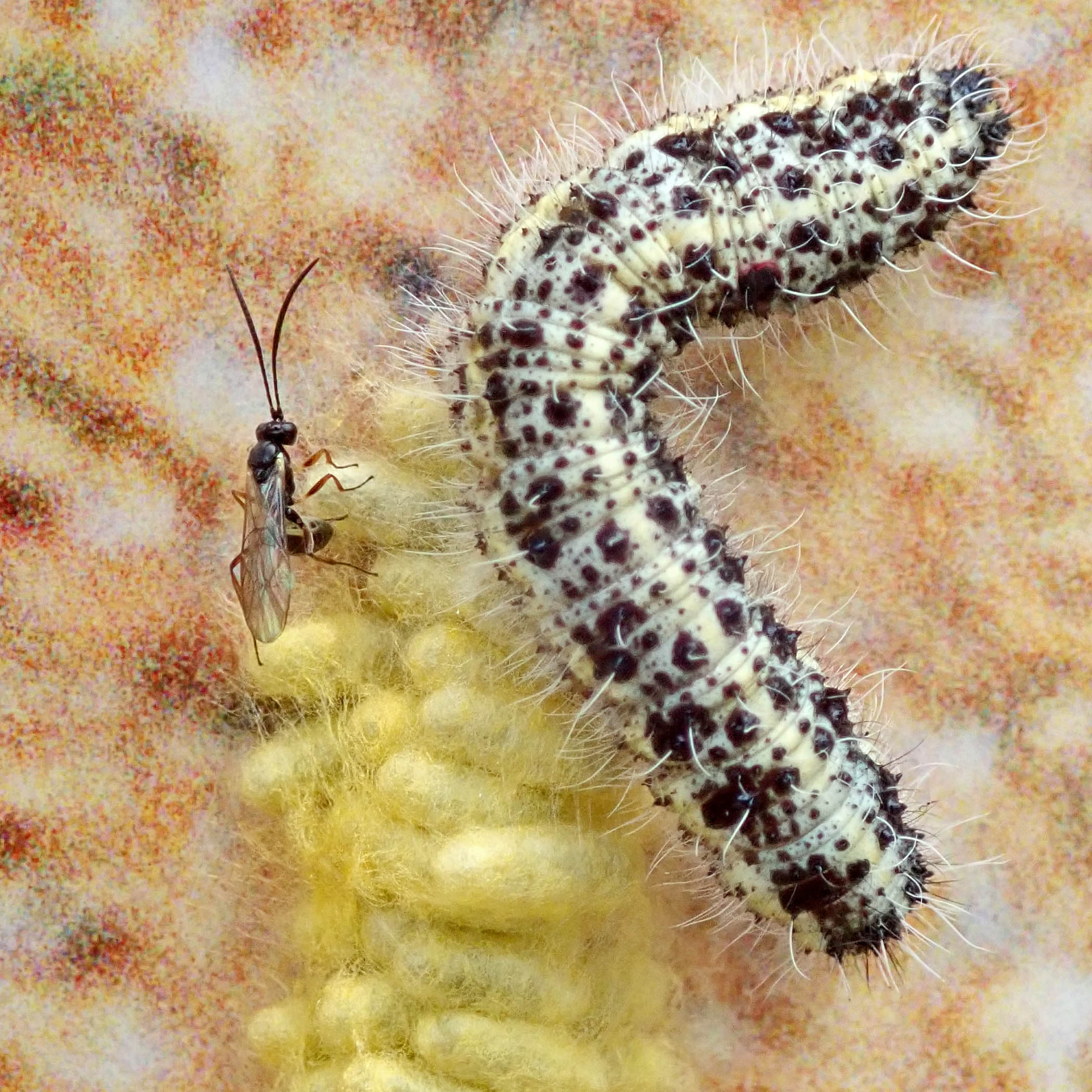
If this wasn’t gruesome enough for one morning’s finds, I then noticed a tiny wasp amongst the cocoons. At first, I thought it must be one of the Cotesia glomerata that had hatched, but no. When I checked at home later, a quick internet image search revealed that this did not resemble C. glomerata and, on Wikipedia, I found the information that C. glomerata is itself parasitised by a couple of other wasp species, Lysibia nana [it is listed as L. nanus in British taxonomic listings] and Gelis agilis. I’ve just been reading that the female G. agilis is wingless so I’m wondering if the wasp I saw is L. nanus. As this species is rarely recorded and there are no Welsh records, I’ve sent a query to the parasitic wasp expert at the Natural History Museum; I’ll update this post if/when I get an answer.
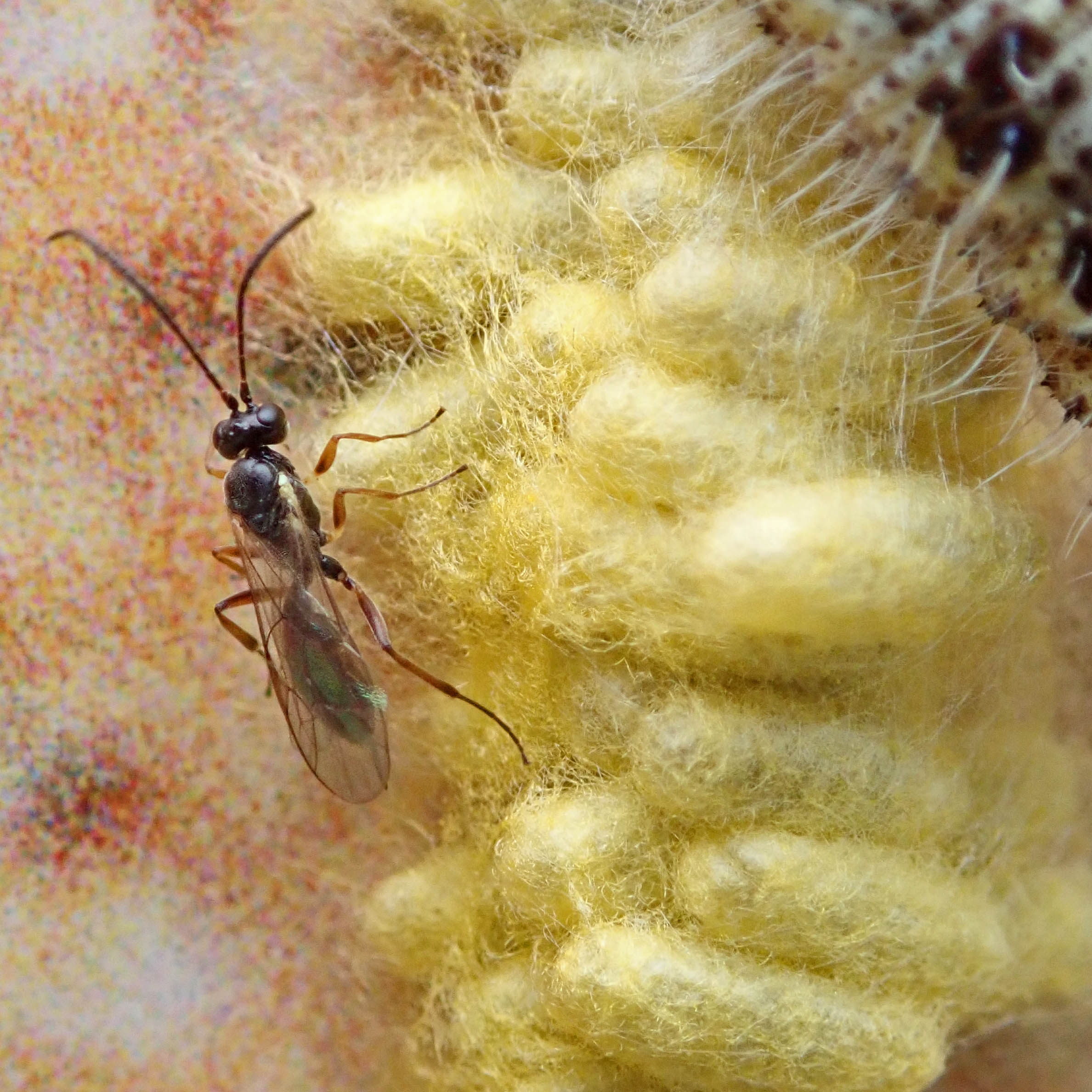
**UPDATE** This is the response I received from Dr Gavin Broad from the Natural History Museum: ‘You are correct, your wasps are most probably Lysibia nanus. There is a very similar species, Lysibia tenax, more rarely recorded but with much the same hosts. I don’t believe it is actually a separate species and L. nanus is certainly the usual suspect reared from Cotesia glomerata cocoons.’

Like Loading...

The Marbled white and the Skylark

21 Saturday Jun 2025

Posted by sconzani in birds, insects

≈ 4 Comments

Tags

birding, birdwatching, British birds, British butterflies, butterflies in Tout Quarry, butterfly, Isle of Portland butterflies, Marbled white, Skylark, Tout Quarry

Today’s blog title puts me in mind of one of Aesop’s fables. I’m sure there was one where the butterfly was tired and asked the bird if it could ride on its back but the bird ended up eating it? Just kidding! Before I sign off from my blogs about my Weymouth trip I just wanted to share two more random moments …

The Marbled white butterfly (Melanargia galathea), though common in many parts of Britain, is rarely seen in my part of coastal south Wales, so it was a special treat to see three on the wing in Weymouth. The first was a distant blur in a field in the Wildlife Trust reserve Lorton Meadows, an area that looked like it would have good potential for butterflies and wildflowers if it wasn’t for the excessive number of off-lead dogs being allowed to roam everywhere, even into the one dragonfly pond. Fortunately, Portland’s Tout Quarry came up trumps again, and I saw two more Marbled whites there, including this obliging beauty.

Seeing this stunning Skylark up close was another of this trip’s special moments. I was walking back from Portland to Weymouth and had almost reached the information centre at Chesil Beach when I heard Skylark song in front of me. I searched the sky for a couple of minutes before realising that the bird was, in fact, sitting on a bush adjacent to the track directly ahead of me.

Such a singing spot seemed odd but I wondered if there might be a nest in the scrubby area I was walking through and so this male was trying to distract me from going near that. Though I had never intended to move off the path, its tactic certainly focused my attention, and I grabbed a few photos before walking onward.

Like Loading...

Lifer: Scarce chaser

19 Thursday Jun 2025

Posted by sconzani in insects

≈ Leave a comment

Tags

Blue chaser, British chasers, British dragonflies, dragonflies at Radipole, dragonfly, Libellula fulva, RSPB Radipole, Scarce chaser

Here they are, the extremely confiding dragonflies mentioned in yesterday’s blog, the Scarce chasers (Libellula fulva) (also known as the Blue chaser). They were everything you could want in a photographer’s model, perching this way and that to show their best sides; not flying off at the slightest hint of movement behind the camera; the consummate professionals!

So, I managed to get photos of a male, female and the two together in cop. The female (above) is described in my guide book as having an olive-brown thorax and ochre-brown abdomen but, as you can see, she was much more vibrant than those descriptions suggest.

The males have a black thorax and blue abdomen with a dark tip. At a glance, with those colours, they could be mistaken for other dragonflies with similar colouration, until you see their eyes, which are the most amazing shade of blue. (In fact, I’ve just decided to add in a second photo of the male so you can get a better look at those eyes.)

I saw several of these dragons at RSPB Radipole Lakes in Weymouth, which left me wondering why they are called ‘Scarce’ chasers. It seems that, where they are found (in isolated spots in the east and south of England) their populations are relatively small, so they are officially designated as rare. Indeed, in the 2008 British Odonata Red List they were officially listed as ‘near threatened’, so I feel very privileged to have enjoyed such excellent views of these stunning creatures.

Like Loading...

Lifer: Norfolk hawker

18 Wednesday Jun 2025

Posted by sconzani in insects

≈ Leave a comment

Tags

Aeshna isoceles, British dragonflies, British hawkers, Dorset dragonflies, dragonflies at Radipole, dragonfly, hawker, Norfolk hawker, RSPB Radipole

My wildlife-watching hopes for my short break in Weymouth centred on butterflies and, perhaps, a few birds that I might not see locally, so it was a wonderful surprise to see two new dragonfly species, one extremely confiding (it’ll feature in tomorrow’s blog), one elusive to the point of frustration.

The Norfolk hawker (Aeshna isoceles) was the latter and, on my first visit to the RSPB Radipole reserve, the few times I spotted these dragonflies (easily recognisable by their brown colouring and green eyes), they stayed mostly hidden, perching – when they did actually stop flying – in obscure locations, as you can see from the photos above and below.

Finally, on my last afternoon, when there were fewer people out walking after a morning’s heavy rain and I was battling my way through the extremely overgrown vegetation along the path to the northern bird hide, one of these stunning dragons posed perfectly for me.

Although called Norfolk hawkers, these medium-sized dragonflies have been expanding their range beyond the English county of Norfolk. Their preference for reed beds in swamps and ponds, along streams and ditches, means Radipole provides the perfect location for them to thrive.

Like Loading...

Lifer: Lulworth skipper

16 Monday Jun 2025

Posted by sconzani in insects

≈ 2 Comments

Tags

British butterflies, British skippers, butterfly, Isle of Portland butterflies, Lulworth skipper, summer butterflies, Thymelicus acteon, Tout Quarry

This was another new-to-me butterfly, the Lulworth skipper (Thymelicus acteon), and this was the butterfly that I really hoped to see during my visit to Weymouth. Clearly, I was not disappointed.

This was another find in the sculpture park that is Tout Quarry on the Isle of Portland, and I saw my first Lulworth skipper almost as soon as I arrived. At first glance, they could easily be mistaken for Small skippers, but Lulworths are slightly smaller and generally darker, often turning an olive-brown colour as they age. The females also have a series of golden marks that form a notable circle on their wings, though that didn’t help me. As is common amongst butterfly species, the males emerge first, and I saw no females.

However, by sheer good luck, I also spotted my first Small skipper of the year as I explored Tout Quarry, which proved a very good comparison for the Lulworths I was seeing. I’ve included a photo of the two species below; this is not precise as to their size relationship but does, hopefully, give some idea of their colour differences (Lulworth on the left, Small skipper on the right).

The Lulworth skipper is named after the Dorset town of Lulworth, where it was first found in 1832. Though these butterflies have expended their range a little in the intervening 190 years, they are still only found in locations along the south Dorset coast. I had expected to have to catch a bus to Lulworth until I read the butterflies could be found on Portland, and I booked my little break away as soon as I heard they were on the wing. So, it was a real treat to find them so quickly and easily, and then to spend perhaps 90 minutes in the quarry, enjoying all the butterfly species, the local plants, and, yes, I did also look at the stone sculptures.

Like Loading...

Lifer: Silver-studded blue

14 Saturday Jun 2025

Posted by sconzani in insects

≈ Leave a comment

Tags

British butterflies, butterfly, Dorset butterflies, Isle of Portland butterflies, Plebejus argus, Silver-studded blue, Tout Quarry

I’ve just returned from four wonderful nights in Weymouth, on England’s south coast, my days full of walking and wildlife. I may see a lot of wildlife where I live but part of the reason for my recent house move was so that I could afford to have a few short breaks away to explore new areas and see different wildlife while I still have the energy and mobility to do that, and also while being as low-carbon as possible in the process, of course, so travelling by train and/or bus and with a lot of walking as well. So, there will be a few blogs in the next week or so, covering some of the things I saw while away.

First up, in an old disused quarry on the Isle of Portland, were my first ever Silver-studded blue butterflies (Plebejus argus). The ‘silver-studded’ part of the name comes from the way the light is reflected off the light blue scales on the underside of the adults’ hindwings, making them shimmer like silver. And the ‘argus‘ epithet in its scientific name is a nod to the multi-eyed shepherd of Greek mythology, a reference to the spots on the undersides of the wings.

Silver-studded blues are rare and only seen in a few isolated areas around the southern coast of England, in Pembrokeshire and around the Great Orme in Wales, and in a couple of coastal locations in Norfolk and Suffolk. From those locations, you can perhaps guess that they prefer heathland, sand-dune systems and limestone grassland, in particular sheltered sunny spots where their companions, the black Lasius ant species, thrive. As is seen in several butterfly species, ants provide the butterflies with protection from insect predators throughout their life cycle.

Tout quarry provides the perfect environment for the Silver-studded blues. Quarrying has hollowed out large areas of ground, making it a sun trap and leaving stony areas where specialist wildflower species have managed to seed and flourish, though the vegetation does have to be managed to ensure the more aggressive plant species don’t overwhelm large areas of ground.

I was extremely lucky with the timing of my trip as these butterflies had only just emerged in the few days prior to my arrival, and that’s why I only saw the vibrant blue male butterflies; the females are brown on both the upper- and undersides of their wings. To see them is the perfect incentive for a return trip!

Like Loading...

Five big hovers

12 Thursday Jun 2025

Posted by sconzani in insects

≈ Leave a comment

Tags

British hoverflies, Chrysotoxum cautum, hoverfly, large hoverflies, Merodon equestris, Volucella bombylans, Volucella inflata, Volucella pellucens

I’ve come to the conclusion, rightly or wrongly, that large hoverflies are like buses: you don’t see any at all and then they all come along at once. At least that has been my recent experience (it’s probably more to do with the weather and the time of year, but I like my buses theory). The five big beasties shown here were all seen over just four days, between 29 May and 1 June.

With its black-and-yellow striping, it’s easy to see that Chrysotoxum cautum is one of the wasp-mimicking hoverflies. The eight British species of Chrysotoxum all have quite long antennae, and it is the relative lengths of the segments of those antennae that are used to differentiate between the five most similar species.

Merodon equestris comes in a variety of colour forms, each of which mimics bumblebees. The one pictured above is a rather worn specimen of form validus, which has a totally dark thorax and a grey-buff coloured bottom.

These final three are all members of the Volucellini, of which there are five British species. Like Merodon equestris, Volucella bombylans is a bumblebee mimic; which bumblebee it is attempting to mimic depends on which of the colour variations you see. This yellow-and-black form mimics Bombus lucorum, the White-tailed bumblebee, but there is also a mostly black, orange-bottomed variation of Volucella bombylans that mimics Bombus lapidarius, the Red-tailed bumblebee.

I was particularly pleased to see Volucella inflata as I’ve only found it once before. With its vivid and very distinctive markings, its round body, and protruding yellow snout, it’s a stunning hoverfly to encounter. Sadly for those of you in northern Britain, it’s mostly found in the southern counties and south Wales.

Volucella pellucens, on the other hand, is common and abundant throughout Britain, often seen hovering around head height along woodland rides and forest tracks. Due to its black-and-white colouring, it’s also known as the Great pied hoverfly.

Like Loading...

Rhabdomiris striatellus

10 Tuesday Jun 2025

Posted by sconzani in insects, trees

≈ Leave a comment

Tags

British miridae, British plant bugs, bugs on Oak, insects on Oak trees, Miridae, oak tree, plant bug on Oak, Rhabdomiris striatellus

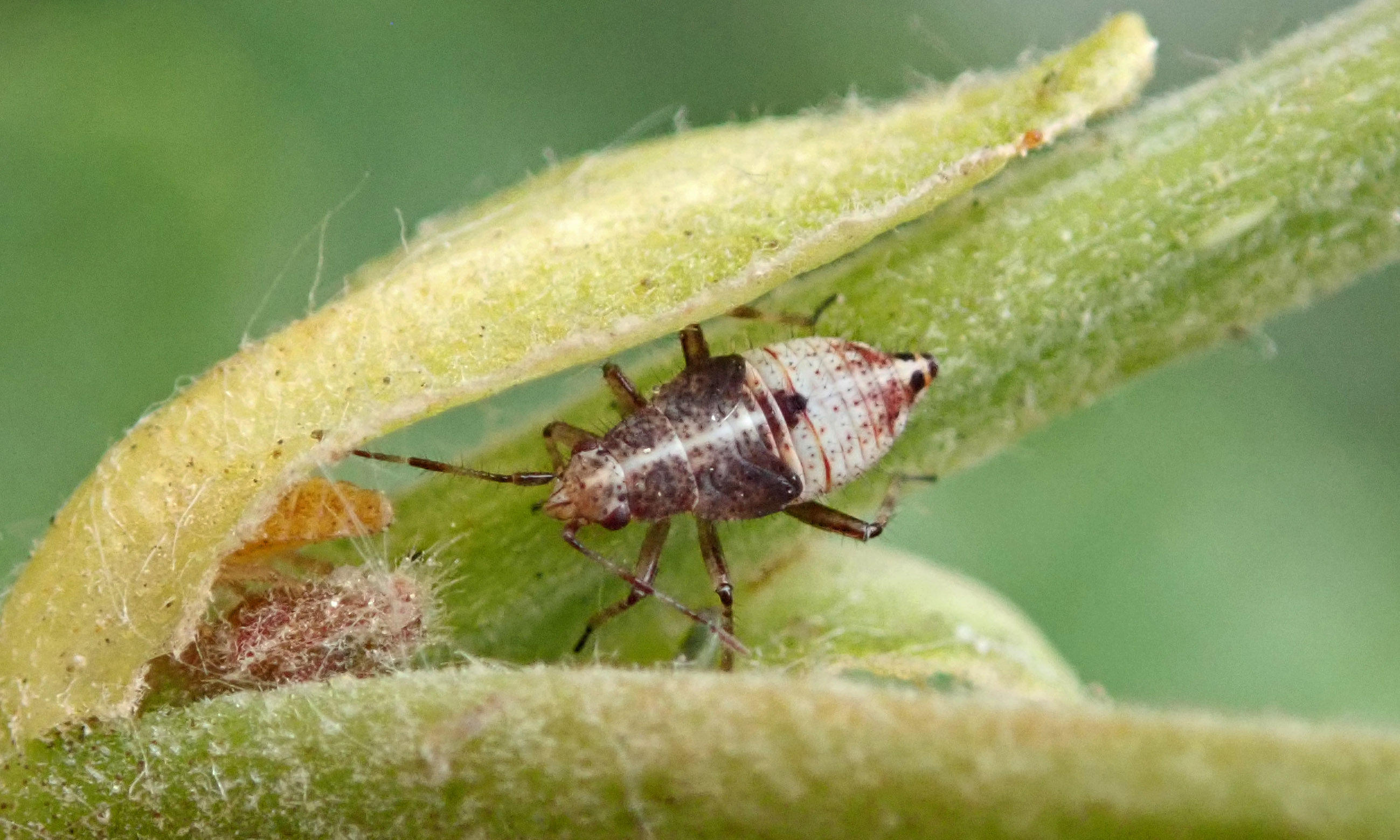
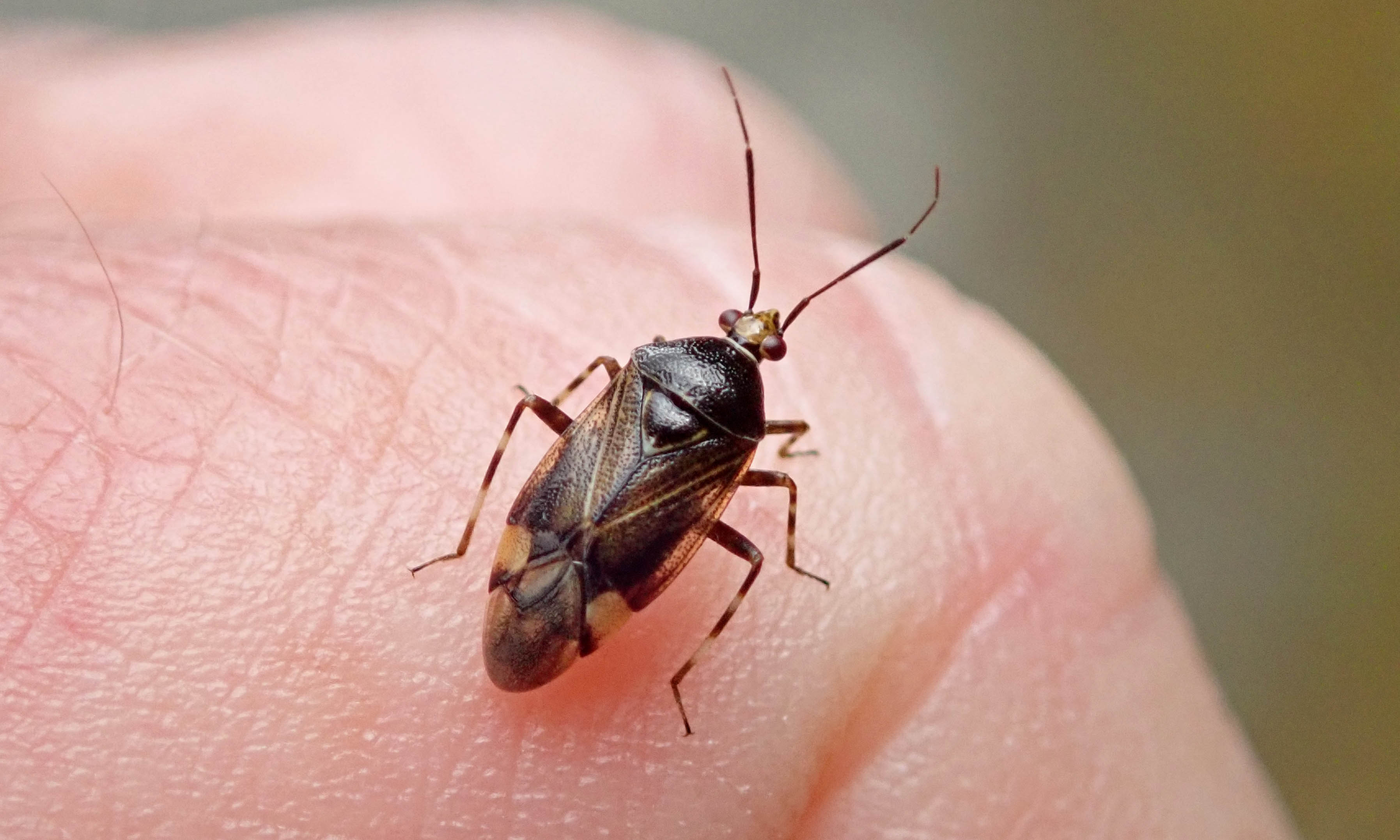
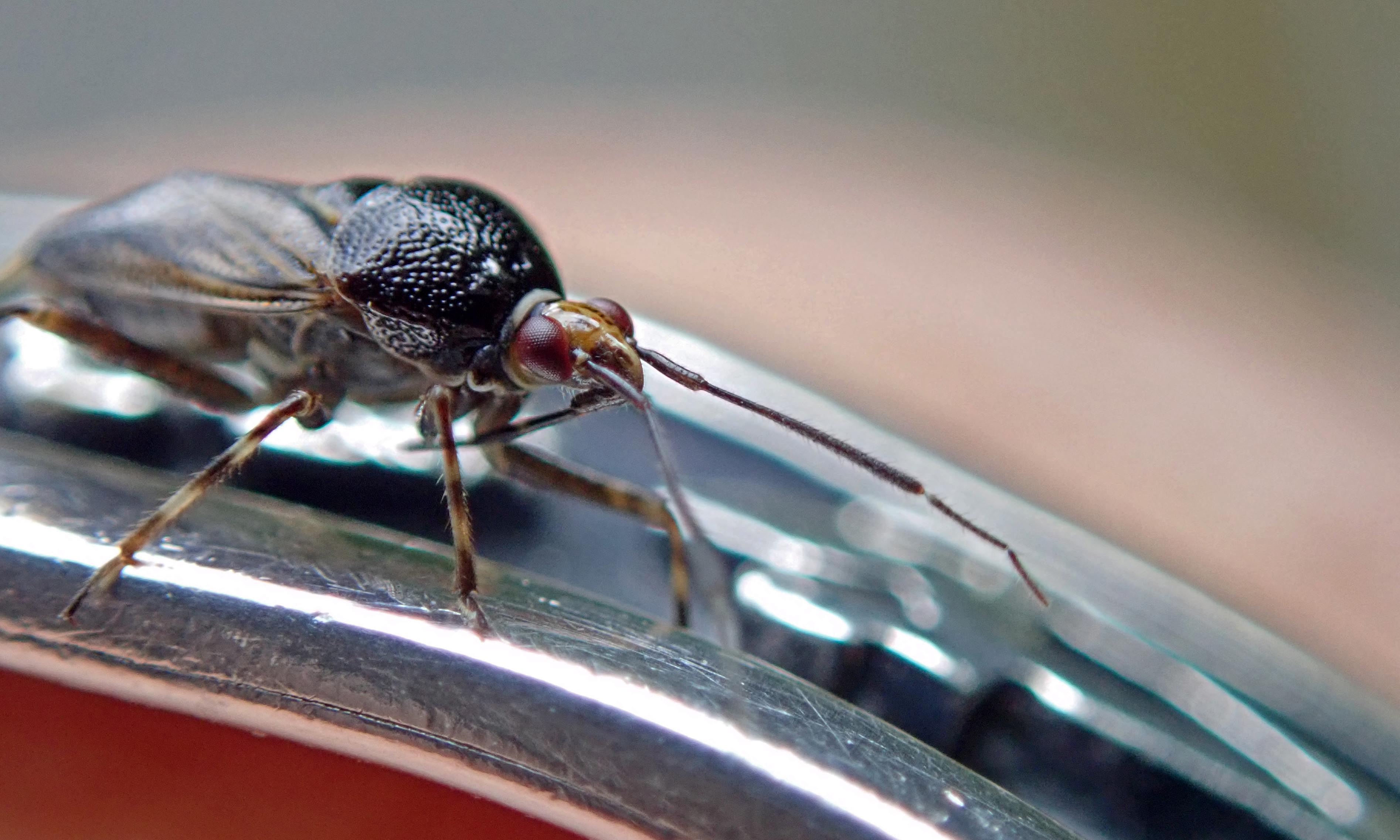
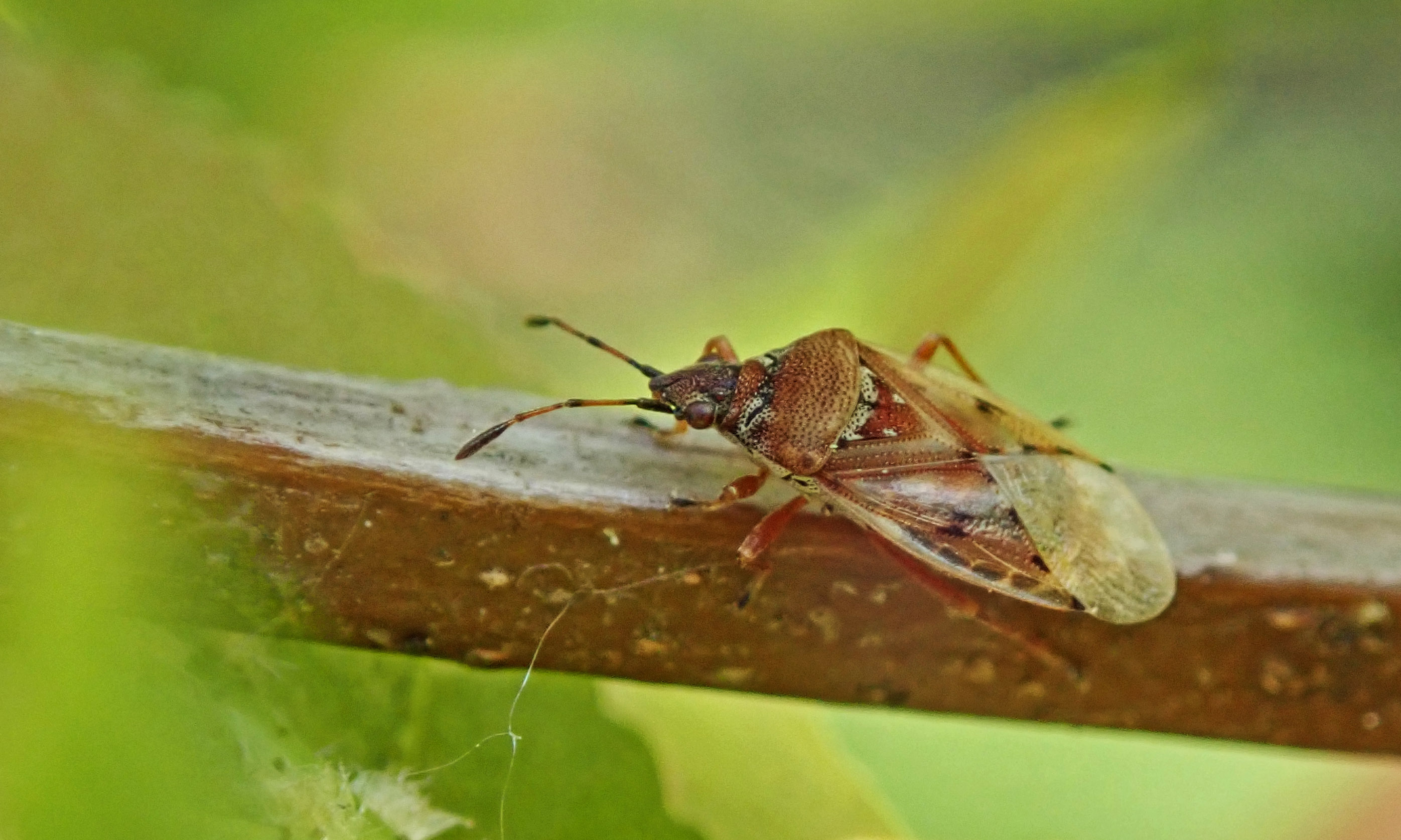
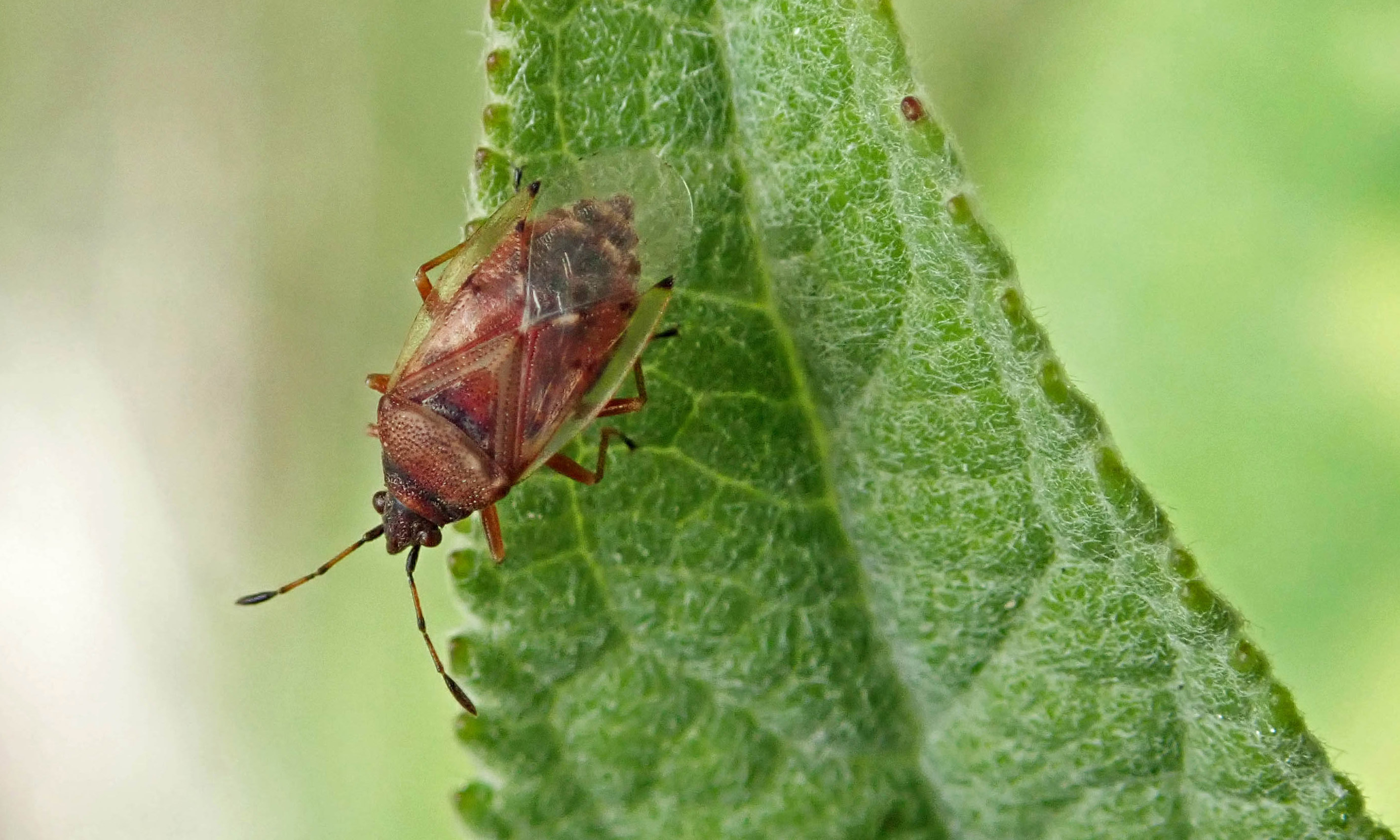
Here’s another bug that I’d never seen before this year and I’ve been lucky enough to find both a nymph and an adult. This is Rhabdomiris striatellus, one of the UK’s 200-plus species of plant bugs in the Miridae family. (I’ve probably only seen about a tenth of them so I’ve got plenty more discoveries yet to make.)

As this bug’s larvae feed on unripe catkins, it is usually found on or around Oak trees, and that’s certainly where I found the adult bug, shown below. The nymph above had probably fallen out of an Oak tree, or had decided to go walkabout to find a neighbouring Oak; I found it on the railings of my local park, where I’ve found so many invertebrates.

Rhabdomiris striatellus overwinters as an egg, hatches out in mid Spring, then passes through a series of instars until it reaches adulthood. The adults can then be seen from May through to July. Those timings certainly fit with my discoveries; I found the nymph on 25 April and the adult, in a different location, on 3 May.

Like Loading...

Leafmines: Coleophora paripennella

09 Monday Jun 2025

Posted by sconzani in insects, plants

≈ Leave a comment

Tags

British coleophora, British moths, case-bearing moth larva, case-bearing moth larva on Knapweed, Coleophora, Coleophora paripennella, leaf-mining moth larvae, moth larva on Knapweed

When I got home and checked my photos of this Coleophora, much head scratching ensued. From the British Leafminers website, I could see that there are only three species of case-bearing moth larvae known to feed on Knapweed (Centaurea nigra) and this case didn’t look like any of them. The case of Coleophora conspicuella is described as black and glossy, and has a peculiar almost keel-like shape. Coleophora peribenanderi mostly mines thistle species, is only occasionally seen on Knapweed, and the larvae is active from August to October. Coleophora paripennella‘s case looked the most likely, but is also usually much darker, almost black. So, I ‘phoned a friend’.

And my friendly expert from British Leafminers also ‘phoned a friend’, checking with another moth larvae expert. Their opinions concurred: this was Coleophora paripennella, just with a much lighter-coloured case than usual. Like C. peribenanderi, C. paripennella uses both thistles and Knapweed as larval plants, but in this case, those larvae that use thistle are fully grown by the autumn, whereas those that munch on Knapweed, top up their larval development by feeding again from April to May/June. You can see the sleek and glossy adult moth that eventually results from all this leaf munching on the UK Moths website here.

Like Loading...

Grassland pearls

07 Saturday Jun 2025

Posted by sconzani in insects

≈ Leave a comment

Tags

Aberbargoed Grasslands, Boloria selene, British butterflies, British fritillaries, butterfly, fritillaries, fritillary butterflies, Small Pearl-bordered Fritillary

Wednesday’s weather wasn’t the best for trying to find butterflies – a constant westerly wind was keeping the temperatures low even when the sun did manage to peak out from behind the constant parade of big clouds rolling through, but my friend Shar’s optimism proved well founded.

Though even her sharp eyes didn’t manage to spot any Marsh fritillaries (as they seem to have emerged early everywhere this year, we were probably too late for them at this site), we did find a few gorgeous Small pearl-bordered fritillaries (Boloria selene), the species I was really hoping to see that day. Initially, we thought we had two but on checking my photos at home later, I realised from the wing markings that we’d actually seen three.

As usual, we were conducting our butterfly hunt in the habitat most favoured by these fritillaries, the damp grasslands of the Aberbargoed Grasslands National Nature Reserve, where the butterflies particularly enjoy flowers like common violets and bluebells, Marsh thistles and Ragged robin. The reserve is also home to a large population of orchids, both Common and Heath spotted-orchids, as well as Cross-leaved heath, Tormentil, Devil’s-bit scabious and Knapweed, amongst other wildflower species, making a wander around its fields a pleasure even when you don’t see very many butterflies.

Like Loading...
← Older posts
Newer posts →

About me

sconzani

sconzani

I'm a writer and photographer; researcher and blogger; birder and nature lover; countryside rambler and city strider; volunteer and biodiversity recorder.

View Full Profile →

Follow earthstar on WordPress.com

Enter your email address to follow this blog and receive notifications of new posts by email.

Recent blog posts

  • Three Common sandpipers February 17, 2026
  • Beetle: Athous bicolor February 16, 2026
  • Crocus flower power February 15, 2026
  • Delightful doves February 14, 2026
  • Fan-like fungi February 13, 2026

From the archives

COPYRIGHT

Unless otherwise acknowledged, the text and photographs on this blog are my own and are subject to international copyright. Nothing may be downloaded or copied without my permission.

Fellow Earth Stars!

  • Unknown's avatar
  • Unknown's avatar
  • Unknown's avatar
  • Unknown's avatar
  • Unknown's avatar
  • Unknown's avatar
  • Unknown's avatar
  • Unknown's avatar
  • Unknown's avatar
  • Unknown's avatar
  • Unknown's avatar
  • Unknown's avatar
  • Unknown's avatar
  • Unknown's avatar
  • Unknown's avatar
  • Unknown's avatar
  • Unknown's avatar
  • Unknown's avatar
  • Unknown's avatar
  • Unknown's avatar
  • Unknown's avatar
  • Unknown's avatar
  • Unknown's avatar
  • Unknown's avatar
  • Unknown's avatar
  • Unknown's avatar
  • Unknown's avatar
  • Unknown's avatar
  • Unknown's avatar
  • Unknown's avatar
  • Unknown's avatar
  • Unknown's avatar
  • Unknown's avatar
  • Unknown's avatar
  • Unknown's avatar
  • Unknown's avatar
  • Unknown's avatar
  • Unknown's avatar
  • Unknown's avatar
  • Unknown's avatar
  • Unknown's avatar
  • Unknown's avatar
  • Unknown's avatar
  • Unknown's avatar
  • Unknown's avatar
  • Unknown's avatar
  • Unknown's avatar
  • Unknown's avatar
  • Unknown's avatar
  • Unknown's avatar

Blog at WordPress.com.

Privacy & Cookies: This site uses cookies. By continuing to use this website, you agree to their use.
To find out more, including how to control cookies, see here: Cookie Policy
  • Subscribe Subscribed
    • earthstar
    • Join 670 other subscribers
    • Already have a WordPress.com account? Log in now.
    • earthstar
    • Subscribe Subscribed
    • Sign up
    • Log in
    • Report this content
    • View site in Reader
    • Manage subscriptions
    • Collapse this bar
 

Loading Comments...
 

You must be logged in to post a comment.

    %d