
Following on from yesterday’s gorgeous crocuses for Floral Friday, here’s a little something I found bumbling about in those flowers …



24 Saturday Feb 2018
Posted in flowers, insects, nature, spring, wildflowers
Following on from yesterday’s gorgeous crocuses for Floral Friday, here’s a little something I found bumbling about in those flowers …
11 Sunday Feb 2018
Tags
Buttercup, fly, fly larva, fly puparium, leaf mine on buttercup, leaf mine on Lesser celandine, leaf mines, leafminer, Lesser Celandine, Phytomyza ranunculi
You might think there are no insects around in winter but you’d be wrong, as I’ve been discovering in the past week or so. In my checks for blooming wildflowers, I’ve seen the odd Lesser celandine and Buttercup flower and, looking more closely at the plants, I’ve noticed leaf mines on some. And where there are leaf mines, there are insects laying eggs and larvae developing from those eggs to create the mines.


These particular mines are created by Phytomyza ranunculi, an incredibly tiny fly which I haven’t yet seen. But I have seen – and can show you here – a larva and a puparium. I brought home a couple of Lesser celandine leaves, intending to take better photos of them, but I didn’t reckon on them shrivelling up overnight. On the positive side, when I picked up one leaf, a tiny larva was sitting underneath, presumably having popped out of the leaf as it dried up.


A couple of days later I brought home another couple of leaves, for the same purpose, but this time left them in a sealed container. The next day, when I opened it, I saw this tiny speck in the bottom of the container and realised a larva from one of the leaves must have pupated. I’m trying to hatch it so I – and you – get to see the fly. Fingers crossed!


29 Monday Jan 2018
Tags
bramble, British micro moth, British moths, Golden pigmy moth, leaf mines, leafminer, moth larvae in leaf mines, Rubus fruticosus agg, Stigmella aurella
Following on from my Leafmines 101 post and the one about leafminers on Hart’s tongue fern, here’s another leaf mine I think I can identify (note the ‘I think’!).
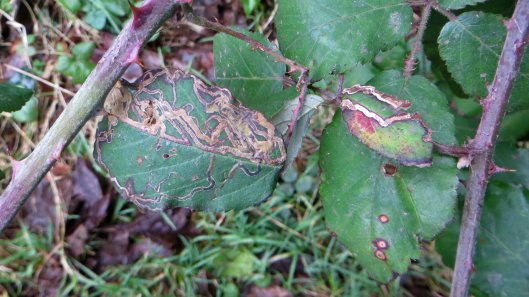
The reason I’m hesitant about positively IDing this one is because there are two species of micro moth whose larvae produce very similar mines on bramble (Rubus fruticosus agg.) leaves. One is the Glossy bramble pigmy moth (Stigmella splendidissimella) but the more likely in this case is the Golden pigmy moth (Stigmella aurella).


Though it’s very common and widespread in Britain, I’ve never seen this tiny moth (images on the UK moths website here) but the mines its larvae create on bramble leaves are everywhere I look. As you can see, the mine starts out small but, as the larva within chews and chews, so it widens its mine to accommodate its expanding girth.
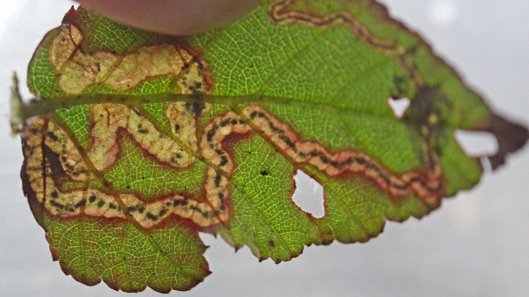
You can see if the inhabitant is still at home by holding the leaf up to the light. Most of these seemed to be empty, as you can see from the images below (the central black lines are the frass). I’ve never actually opened a mine to have a look at the larva when it has been inside but, if I did, I would see an orangey-yellow grub with a brownish tinge to its head (there are images on the Bladmineerders website here).

16 Tuesday Jan 2018
Tags
Agromyzidae, Chromatomyia scolopendri, Hart's tongue, leaf mine on Hart's tongue, leafminers, leafmines
After my recent introductory post on leafminers, I thought I’d get the ball rolling with an example of a leaf mine I have actually been able to identify, as, fortunately for me, it is the only creature that creates a linear mine on the leaves of Hart’s tongue fern (Asplenium scolopendrium). The mines in my photographs were created by the larvae of a tiny fly, Chromatomyia scolopendri.

As you can see, the larvae tends to mine along the midrib of the leaf but occasionally veers out towards the exterior before doubling back again. The mine is narrow and can be up to 10cms long, though I didn’t actually measure these ones. The larvae can be active any time from early spring through to autumn and they usually pupate in these mines.
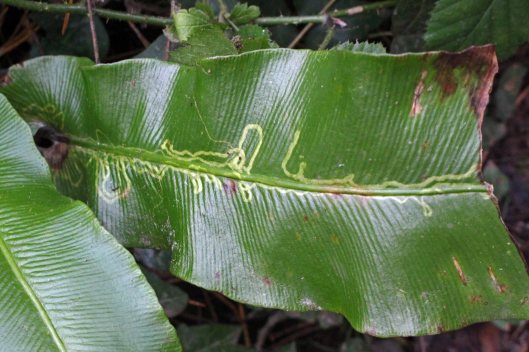
I found the mines on Christmas Eve, when I was on holiday in Somerset – they were at Ham Hill Country Park, near Yeovil. I’m not sure how common the little Chromatomyia scolopendri fly is, as there are 72 records showing in the Welsh Aderyn biodiversity database but only 38 records for the whole of Britain in the NBN Atlas (so where are all the Welsh records?). It’s also likely that leaf mines are under-recorded so the species may well be more common than these records suggest. Now that I know what to look for, I’ll be keeping an eye out for this one on my walks around south Wales.
13 Saturday Jan 2018
Tags
British insects, homes of insect larvae, insect larvae in leaves, leaf mine, leafmine, leafminer, mines on leaves
Leafmines and their miners are a subject I started to look at last summer but I quickly discovered that, in order to identify the miner, you had to know the plant they were mining, so I needed to improve my botanical knowledge before I could go much further. That effort has begun, and is ongoing, so I will start to look again at the miners in the coming months.


Firstly though, in case you don’t know, leafmines are made by the larvae of various insects. The mines are their homes and their larders – as well as providing them with some degree of protection from predators, the larvae eat the tissue of the leaves they live within, thus creating their mines. The larvae can be the immature stages of various species of flies, sawflies or moths, and, apparently, some beetles also mine leaves.


If you look at a mine, you will often see a tiny hole at one end, which means the creature that made it has left the premises, to pupate or to being life as an adult. Sometimes, you can still see the larva within, and you can often also see the pooh (known as frass) it has left behind as it eats and tunnels.


The shapes of the mines can vary considerably, from long meandering or straight lines to roundish blotches, and these shapes, plus the placement of the mine within the leaf (some occupy just the upper or lower surface, some go right through) and the identity of the plant, are the main ways to determine which creature has made the mine.
**p.s. Since posting this, I’ve been told what I thought was a leaf mine on ivy (the photo on the right in the middle) is actually caused by a fungus, possibly Phoma hedericola, the most common leaf spot of ivy. I can see these leafmines are going to be even more tricky than I anticipated!
11 Thursday Jan 2018
Tags
bark, bark of trees, Birch bark, properties of bark, Scots pine bark, Sessile oak bark, tree bark, treecreeper, uses of bark
The skin of a tree is an amazing thing but, rather than launch in to a scientific description of its various layers, I thought I’d share just a few examples of its incredible capabilities.


The bark of the Birch tree (Betula sp.) contains good quantities of volatile oils, making it both waterproof and highly resistant to decay – the wood inside rots before the bark does.
The cracks and crevices in the bark of many tree species are great hidey holes for a wide range of small insects that make their homes there.
A good number of insects means a plentiful supply of food for birds like the Treecreeper whose beak can easily probe those hidey holes.


The high levels of toxic tannins in the bark of the Sessile oak (Quercus petraea) help protect it from insects.
The bark of the Scots pine (Pinus sylvestris) is thick enough to protect it from the fires that would occasionally sweep through its forests in prehistoric times.


Bark is also home to huge numbers of different lichen and moss species, many of which have adapted to life on the barks of specific trees.
Some animals eat bark – voles, deer and beavers, for example, and squirrels will strip the fibrous bark of certain trees to make their dreys warm and cosy.
The bark of some trees is fibrous enough to make rope and weave baskets.


07 Sunday Jan 2018
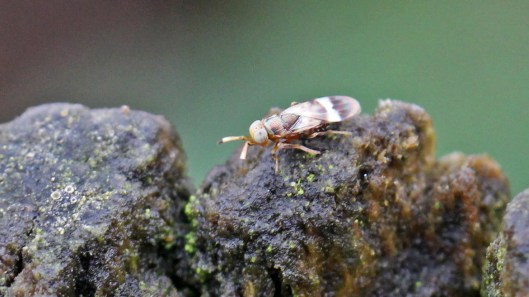
Just when I was thinking the wee flying critters had probably all disappeared for winter, up pops this little chap, tootling around on the top of an old fence post that I was checking out for lichen. I’m reliably informed, by experts on a couple of specialist pages on Facebook, that this is a member of the Encyrtidae, one of a large family of over 3700 different parasitic wasps (and that’s just the ones that have so far been identified – there are probably many many more).

Information on the Natural History Museum website states that ‘About half of the species of Encyrtidae are associated with scale-insects … generally as endoparasitoids of immatures or less commonly adults’, which means the wasp’s larvae live inside and eat the larvae, and occasionally the adults, of scale-insects – not a particularly nice way to survive, I have to say. Some of these wasps are also parasitic on the larvae of moths and butterflies – also not nice. Still, the wasp itself is a pretty little thing, and some Encyrtidae species have been used as biological control agents to control insect pests, so the news isn’t all bad.
24 Sunday Dec 2017
Blue feathers, blue water, blue flowers, blue butterflies …
The reasons why our eyes perceive these things as blue (or don’t, if we’re colour-blind) vary depending on what we’re looking at. With birds’ feathers, for example, the blue is actually a ‘structural colour’, because ‘When white light strikes a blue feather, the keratin pattern causes red and yellow wavelengths to cancel each other out, while blue wavelengths of light reinforce and amplify one another and reflect back to the beholder’s eye’ (from the amazing Smithsonian website).
Water looks blue because it more readily absorbs light in red, orange and yellow wavelengths but reflects the blue wavelength, so it’s reflecting the colour of the sky above. Blue flowers occur in plants that are able to chemically modify red anthocyanin pigments to reflect white light as blue, and those butterflies that look blue are also reflecting white light, the blue colour being dependent on the placement of the minute scales on their wings. Colour is so complicated!


02 Saturday Dec 2017
Tags
British dragonflies, Common Darter, Cosmeston Lakes Country Park, flies, fly, hoverfly, Mary Gillham Archive Project
I’ve only had a couple of visits to Cosmeston Lakes Country Park this month because my volunteer work on the Mary Gillham Archive Project has been taking up a bit more time as we try to get as much as possible done before the project effectively finishes at Christmas – though, having said that, I did spend four hours at Cosmeston last Friday trying to replicate, for the project website, photos Mary had taken in the early days of the park. These are a couple of those: Mary’s photo of the west lake in September 1987 on the left, and my photo from the same spot thirty years later on the right.


But I digress … apart from the berry-eating visitors, the Redwings and the Mistle thrushes, and finally managing to grab a couple of half-decent photographs of a Green woodpecker, I haven’t found anything particularly noteworthy bird-wise at Cosmeston during November. I have, however, been impressed by the numbers of insects still around, despite the fact that it has been noticeably colder, with daytime highs in the low teens and several overnight frosts.


On 5 November, the ‘fireworks’ at Cosmeston were these lovely little Common darters. In an area shaded from the cool westerly wind but warmed by the bright sun, each had claimed itself a fencepost to bask on. And, nearby, a lone bumblebee looked like it wanted to snuggle for warmth into this seed-head ‘duvet’ of Old man’s beard (Clematis vitalba).


On 24 November, though my focus was on finding the exact spots where Mary had taken her photos, I did still have one eye on the wildlife and noticed quite a lot of flies about. Like the dragonflies of two weeks earlier, these two flies and one hoverfly were favouring sheltered spots on wood to make the most of the sunshine.
08 Wednesday Nov 2017
Tags
#WildWords, Andricus kollari, gall wasps, hymenoptera living in Marble gall, Inquiline, Marble gall, oak galls, Oak Marble gall
I learnt this word the day a mystery wasp hatched out of an Oak Marble gall I’d brought home. Though I thought it must be the gall-causing wasp, it turned out that it was not and could, in fact, have been any one of 29 other species of hymenoptera that can, potentially, make their home in a Marble gall. According to an article I found on the Natural History Museum website (‘Oak-galls in Britain’ by Robin Williams), 21 of those other gall inhabitants are parasitoid (their larvae consume the original gall wasp’s larvae) and 8 are inquiline, which is to say that they are simply ‘exploiting the living space of another’ creature. And the Oxford Dictionary online actually gives the instance of ‘an insect that lays its eggs in a gall produced by another’.
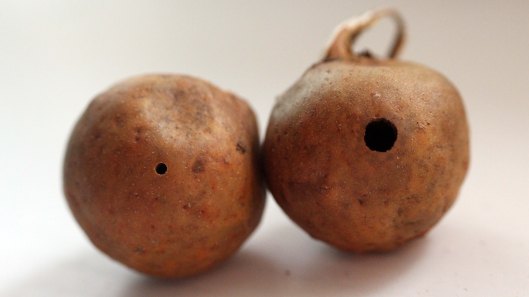
Of course, if I’d been smart and compared the size of the holes in other Marble galls I have to that of the newly emerged creature, I would’ve twigged that they must be quite different. I’m afraid my curiosity then got the better of me and I sliced in half one of the Marble galls I had, which means that the little creatures I exposed will not survive. The larva (and large hole) in the centre is the gall wasp Andricus kollari, and the little larvae and holes are representatives of the other 29 possibilities.


Lesson – and new word – learnt, I have now returned to the wild the other various galls, of several kinds, that I’d brought home thinking they were empty, in case they also have little creatures growing inside them!
 earthstar
You must be logged in to post a comment.