• ABOUT
  • BIRDING 2018
  • Birding 2019
  • BLOG POSTS
  • Butterflies 2018
  • Resources

earthstar

~ a celebration of nature

earthstar

Category Archives: insects

Wild words: Inquiline

08 Wednesday Nov 2017

Posted by sconzani in insects, nature

≈ 2 Comments

Tags

#WildWords, Andricus kollari, gall wasps, hymenoptera living in Marble gall, Inquiline, Marble gall, oak galls, Oak Marble gall

I learnt this word the day a mystery wasp hatched out of an Oak Marble gall I’d brought home. Though I thought it must be the gall-causing wasp, it turned out that it was not and could, in fact, have been any one of 29 other species of hymenoptera that can, potentially, make their home in a Marble gall. According to an article I found on the Natural History Museum website (‘Oak-galls in Britain’ by Robin Williams), 21 of those other gall inhabitants are parasitoid (their larvae consume the original gall wasp’s larvae) and 8 are inquiline, which is to say that they are simply ‘exploiting the living space of another’ creature. And the Oxford Dictionary online actually gives the instance of ‘an insect that lays its eggs in a gall produced by another’.
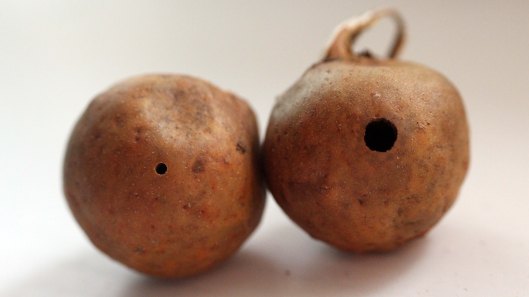
171108 Oak marble gall inhabitants (1)

Of course, if I’d been smart and compared the size of the holes in other Marble galls I have to that of the newly emerged creature, I would’ve twigged that they must be quite different. I’m afraid my curiosity then got the better of me and I sliced in half one of the Marble galls I had, which means that the little creatures I exposed will not survive. The larva (and large hole) in the centre is the gall wasp Andricus kollari, and the little larvae and holes are representatives of the other 29 possibilities.

171108 Oak marble gall inhabitants (2)
171108 Oak marble gall inhabitants (3)

Lesson – and new word – learnt, I have now returned to the wild the other various galls, of several kinds, that I’d brought home thinking they were empty, in case they also have little creatures growing inside them!
Like Loading...

Life in an Oak Marble gall

28 Saturday Oct 2017

Posted by sconzani in insects, nature, trees

≈ 2 Comments

Tags

Andricus kollari, gall wasps, galls on oak trees, hymenoptera in Oak marble galls, hymenoptera living in galls, Marble gall, oak galls, oak tree

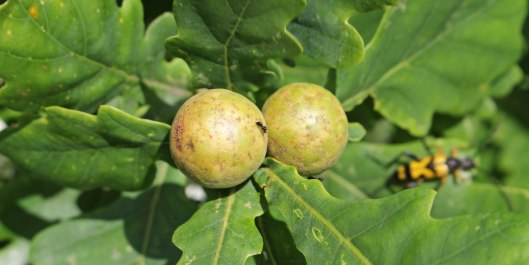
Back in August, as part of a mini-series on some of the galls to be found on Oak trees, I posted about the Marble galls caused by the incredibly tiny wasp, Andricus kollari. Although most of the galls I’ve found have had tiny holes in them, meaning the wasps had already pupated and flown, a couple of weeks ago I found a couple with no holes. So, my curiosity got the better of me and I brought them home to see what might eventuate.

171028 Oak marble gall

Note the tiny creature sitting on the gall.

Today, when I looked in the jar I’d put them in, I was so excited to see a tiny creature had appeared. Now, I initially thought this must be A. kollari, the gall-maker, but I was wrong … and, looking at images online, I don’t think I’m the only one who’s ever been fooled by this. However, with the help of friends who questioned and strangers who know much more than me, I’ve discovered there are at least 29 (twenty-nine!!) species of hymenoptera (bees, wasp, ants and sawflies) that might live within an Oak marble gall.

171028 Wasp living in Oak marble gall (1)
171028 Wasp living in Oak marble gall (2)

Though some of these critters simply use the gall for shelter, it seems that, for others, the gall tissue is a good source of nutrients, while still others are parasites whose larvae kill some or all of the larvae of the original gall-making wasp. Without detailed microscopic examination, I’m not able to determine which species this tiny wasp is but I thought you might like to see this little video of it performing its ablutions earlier. I have now released it back in the area where I found it so let’s hope it survives.

Like Loading...

Leps at Combefield Quarry

24 Tuesday Oct 2017

Posted by sconzani in insects, nature

≈ Leave a comment

Tags

British butterflies, butterflies, butterfly, Clouded yellow, Colias croceus, Colias croceus f. helice, Combefield Quarry, Comma, Peacock, Red Admiral

171024 Combefield Quarry

We went for a wander around Combefield Quarry in Portland looking for birds but found butterflies instead. And very nice butterflies they were too, especially considering we are now half way through autumn. There were two Peacocks, a Comma, Speckled woods and Red admirals …

171024 Peacock (1)

171024 Comma
171024 Red admiral

And the icing on the cake was not one but two Clouded yellows (Colias croceus). But wait there’s more … I’ve been told that the paler of these Clouded yellows may well be the helice variety (Colias croceus f. helice), which is something of a rarity. So, we were privileged indeed with our Lepidoptera sightings that day.

171024 Clouded Yellow f. helice
171024 Clouded yellow
Like Loading...

Moth trapping at the Obs

22 Sunday Oct 2017

Posted by sconzani in insects, nature

≈ 4 Comments

Tags

Black rustic, British moths, Brown-tail moth webs, Feathered Brindle, Fox moth caterpillar, Green-brindled Crescent, Lunar Underwing, moth larvae, moths, Portland moths

These are just a few moths from last weekend at Portland Bird Observatory in Dorset. They trap every night at the Obs and, because of their southern-coast location, just as with the birds they also get many migrant moths. However, I was too busy birding to take many moth photos and I’m fairly sure these are all common Brits. They’re not species I would necessarily see in Wales though and they are pretty, especially that third one (bottom left).

171022 Black rustic
171022 Feathered Brindle
171022 Green-brindled crescent
171022 Lunar underwing

These are: Black rustic (Aporophyla nigra), Feathered Brindle (Aporophyla australis), Green-brindled Crescent (Allophyes oxyacanthae), and Lunar Underwing (Omphaloscelis lunosa).

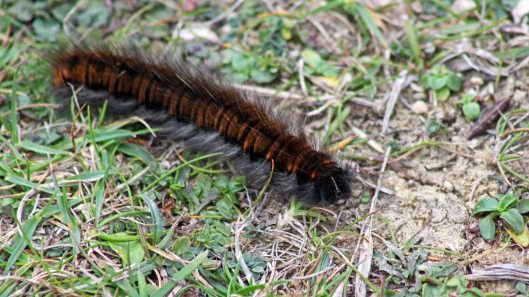
171022 Fox moth caterpillar

While out walking the cliff-top paths on Saturday afternoon, one of our team also found this little fella pottering along on the grass beside the track. It’s a Fox moth larva (Macrothylacia rubi).

171022 Brown-tail moth web (1)
171022 Brown-tail moth web (2)

We also spotted a ton of these webs in the brambles near the main lighthouse. They house the larvae of Brown-tail moths (Euproctis chrysorrhoea).

Like Loading...

Sitting on the fence

12 Thursday Oct 2017

Posted by sconzani in insects, nature

≈ 2 Comments

Tags

Black darter, Common Darter, dragonflies, flies, hoverflies, Myathropa florea, sitting on the fence

Have you ever noticed that some small beasties like to sit on fences?

171012 Common darter (3)

I guess fences are often a good spot to sunbathe, and to keep a look out, and they probably resemble logs and branches to the mini-beasts.

171012 Common darter (1)
171012 Common darter (2)

Common darter dragonflies are keen fence-sitters – they don’t even mind barbed-wire fences. And I was particularly delighted to find the Black darter dragonfly (below) sitting on a fence at Cosmeston the other day – my first sighting of this species.

171012 Black darter

Flies and hoverflies also enjoy a spot of fence-sitting and can often be found taking care of their ablutions in such places. So, the next time you decide to sit on the fence, make sure some other creature hasn’t beaten you to it! 

171012 fly (1)
171012 fly (2)
171012 Myathropa florea
171012 Pollenia rudis
Like Loading...

A mini challenge

09 Monday Oct 2017

Posted by sconzani in insects, nature

≈ 8 Comments

Tags

biodiversity, Cosmeston Lakes Country Park, flies, galls, leaf mines, Speckled wood, spiders, spotting insects

On Friday I went for a wander around one of my favourite local haunts, Cosmeston Lakes Country Park and, while there, I set myself a little challenge. How many critters could I find in one small area, perhaps no more than 2 metres square?

171008 mini challenge

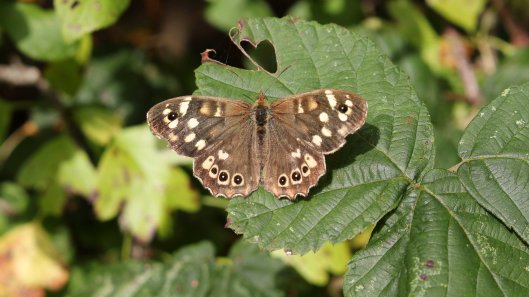
My challenge wasn’t pre-planned: I had seen very little at this point on my walk and was thinking to myself that this was due to autumn and the cooler weather but, when I saw a Speckled wood butterfly at this particular spot – a bank covered with shrubs and small trees – I started wondering how much more there was that I simply wasn’t seeing. So, I stopped and looked harder. There was no poking under grasses or bushes, no sweeping or brushing to encourage movement, just focussing my eyes and ears to really see and hear.

171008 spider (1)
171008 spider (2)
171008 spider (3)

There were, in fact, three Speckled woods – I just hadn’t noticed the other two, plus three different species of spider (the Garden spider was lunching on another critter but it was partly consumed and too tiny to identify), one hoverfly, three species of flies, a gall on Bramble that would’ve been home to the larvae of the tiny gall wasp Diastrophus rubi, and a leaf mine, made by the larva of some unidentified mini-beast. And I’m absolutely sure I didn’t spot everything!

171008 mini challenge (1)
171008 mini challenge (2)
171008 mini challenge (3)
171008 mini challenge (4)
171008 mini challenge (5)
171008 mini challenge (6)
Like Loading...

Lucky last?

05 Thursday Oct 2017

Posted by sconzani in flowers, insects, nature, nature photography, wildflowers

≈ Leave a comment

Tags

butterfly quote, Devil's-bit scabious, Irish blessing, Painted Lady

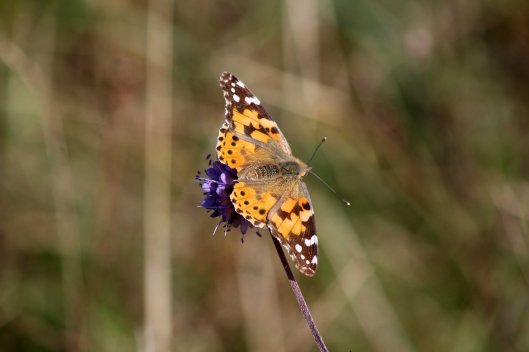
171005 Painted lady on Devil's-bit scabious

May the wings of the butterfly kiss the sun
And find your shoulder to light on
To bring you luck, happiness and riches
Today, tomorrow and beyond.
~  an Irish blessing, to be sure, to be sure, to be sure

Like Loading...

More galls, part 2

04 Wednesday Oct 2017

Posted by sconzani in insects, nature, plants

≈ 1 Comment

Tags

galls, Galls on Cirsium cardui, galls on Creeping thistle, Thistle gall fly, Urophora cardui

Following on from yesterday’s More galls, part 1 …

This second gall’s host is not a tree, it’s a thistle, Creeping thistle (Cirsium cardui) to be precise, and the gorgeous little fly that causes the gall is Urophora cardui, the Thistle gall fly, a member of the Tephritidae or fruit fly family. Interestingly, this fly has been introduced into Canada, from populations originating in Austria, Germany, France and Finland, in an attempt to control Creeping thistle, which is there called Canada thistle and is regarded as an invasive weed. The gall production initiated by the flies disrupts the development of flowers and also significantly reduces the vigour of the thistle by diverting nutrients into the gall.

171003 Urophora cardui Thistle gall fly (1)
171003 Urophora cardui Thistle gall fly (2)

In Britain, the adult Urophora cardui fly can be seen between May and September when, after mating, it lays its eggs on a nearby Creeping thistle. The larvae burrow into the thistle’s stem, often causing a single gall to develop to house several larvae. The larvae also pupate inside the gall, emerging as flies between June and October. I’ll be checking all the Creeping thistles I see for a glimpse of them.

Like Loading...

More galls, part 1

03 Tuesday Oct 2017

Posted by sconzani in insects, nature, plants, trees

≈ 4 Comments

Tags

Cecidomyia salicis-folii, gall flies, gall midges, gall on Salix caprea, gall on willow, galls, Iteomyia capraea

Today’s and tomorrow’s galls are not on the gall-beleaguered Oak tree and, for a change, they are not caused by wasps, as so many galls seem to be. These two galls are caused by tiny members of the enormous order of flies, the Diptera.

171003 Iteomyia capraea on Salix capraea (1)

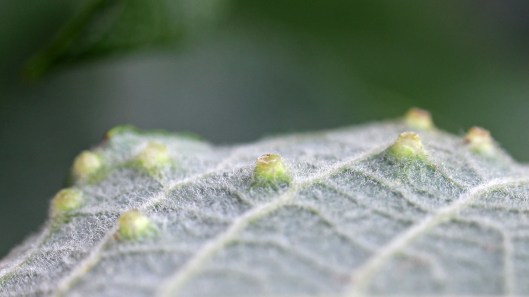
Today’s is Iteomyia capraea (sometimes known as Cecidomyia salicis-folii) (Cecidomyiidae is the family name for gall midges or gall flies). I think I would need better specs to actually see the midge that laid its eggs on this Goat willow (Salix caprea) leaf as it’s only 2-3mm long. Indeed, the galls themselves were pretty small (5-8mm), as you can see from the leafy picture below. When they hatch, the larvae of the midge feed within the leaf tissue causing the willow to develop a gall, sometimes on the midrib of the leaf, sometimes on a thick side vein. I’ve read one report that the larvae are white, another that they are an orange-red colour but I didn’t open up any of the galls for a look at the larva inside so I can’t confirm either report.

171003 Iteomyia capraea on Salix capraea (2)
171003 Iteomyia capraea on Salix capraea (3)

I’ve not been able to discover much about Iteomyia capraea. There are only 215 records showing in the NBN (National Biodiversity Network) database for the whole of Britain, 45 of which are in Wales, but I think that is more a reflection on the under-recording of galls that the rarity of the midge itself. Apparently, the species only breeds a single generation per year and they hibernate over winter in the soil underneath their host tree.

Like Loading...

Humming-bird hawk-moth

25 Monday Sep 2017

Posted by sconzani in insects, nature, seaside, wildflowers

≈ 8 Comments

Tags

British moths, Humming-bird hawk-moth, Macroglossum stellatarum, moth, moth like hummingbird, Red valerian

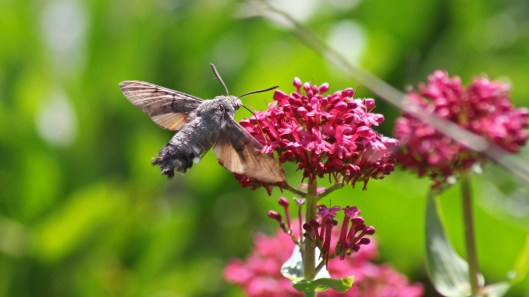
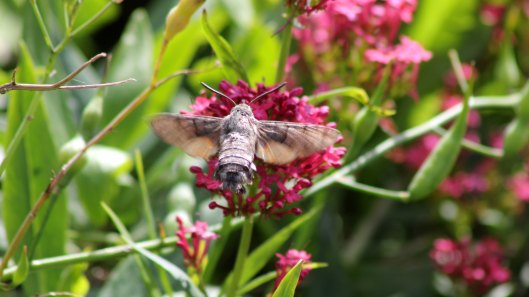
Remember how I wrote yesterday about some days being magical: first I was mobbed by Red admirals, next I discovered the Ivy bee colony and marvelled at its mating antics, and then, la pièce de résistance, I saw my very first Humming-bird hawk-moth.

170925 Humming-bird Hawk-moth (4)

And, by golly, it was difficult to photograph. I took around 70 pictures but most are a blur because, like the bird it’s named after, this moth just does not keep still. Macroglossum stellatarum is its formal name, and it came to Britain originally from Africa and southern Europe. The adult moths can be seen flying any time from April to late November, at which time they start looking for a crevice in a building, a hole in a wall, or a handy crack in a tree to while away the winter months.

170925 Humming-bird Hawk-moth (2)
170925 Humming-bird Hawk-moth (1)

That super-long tongue allows them to specialise in feeding from tube-shaped flowers like the Echiums, though this one was enjoying the nectar of Red valerian plants growing along the high-tide line at a local beach, humming (its wings) as it hovered from one flower to the next. Incredibly, studies have shown that Humming-bird hawk-moths often return to the same flowers at the same time every day. So, it’s a moth that looks like a bird but has the memory of an elephant – simply amazing!

170925 Humming-bird Hawk-moth (3)

Like Loading...
← Older posts
Newer posts →

About me

sconzani

sconzani

I'm a writer and photographer; researcher and blogger; birder and nature lover; countryside rambler and city strider; volunteer and biodiversity recorder.

View Full Profile →

Follow earthstar on WordPress.com

Enter your email address to follow this blog and receive notifications of new posts by email.

Recent blog posts

  • NFY: Orange-tip April 20, 2026
  • All the yellows April 19, 2026
  • Spider: Dysdera crocata April 18, 2026
  • Recent Reed buntings April 17, 2026
  • Tiny but feisty April 16, 2026

From the archives

COPYRIGHT

Unless otherwise acknowledged, the text and photographs on this blog are my own and are subject to international copyright. Nothing may be downloaded or copied without my permission.

Fellow Earth Stars!

  • Unknown's avatar
  • Unknown's avatar
  • Unknown's avatar
  • Unknown's avatar
  • Unknown's avatar
  • Unknown's avatar
  • Unknown's avatar
  • Unknown's avatar
  • Unknown's avatar
  • Unknown's avatar
  • Unknown's avatar
  • Unknown's avatar
  • Unknown's avatar
  • Unknown's avatar
  • Unknown's avatar
  • Unknown's avatar
  • Unknown's avatar
  • Unknown's avatar
  • Unknown's avatar
  • Unknown's avatar
  • Unknown's avatar
  • Unknown's avatar
  • Unknown's avatar
  • Unknown's avatar
  • Unknown's avatar
  • Unknown's avatar
  • Unknown's avatar
  • Unknown's avatar
  • Unknown's avatar
  • Unknown's avatar
  • Unknown's avatar
  • Unknown's avatar
  • Unknown's avatar
  • Unknown's avatar
  • Unknown's avatar
  • Unknown's avatar
  • Unknown's avatar
  • Unknown's avatar
  • Unknown's avatar
  • Unknown's avatar
  • Unknown's avatar
  • Unknown's avatar
  • Unknown's avatar
  • Unknown's avatar
  • Unknown's avatar
  • Unknown's avatar
  • Unknown's avatar
  • Unknown's avatar
  • Unknown's avatar
  • Unknown's avatar

Blog at WordPress.com.

Privacy & Cookies: This site uses cookies. By continuing to use this website, you agree to their use.
To find out more, including how to control cookies, see here: Cookie Policy
  • Subscribe Subscribed
    • earthstar
    • Join 642 other subscribers
    • Already have a WordPress.com account? Log in now.
    • earthstar
    • Subscribe Subscribed
    • Sign up
    • Log in
    • Report this content
    • View site in Reader
    • Manage subscriptions
    • Collapse this bar
 

Loading Comments...
 

You must be logged in to post a comment.

    %d