• ABOUT
  • BIRDING 2018
  • Birding 2019
  • BLOG POSTS
  • Butterflies 2018
  • Resources

earthstar

~ a celebration of nature

earthstar

Category Archives: insects

Go, green tiger!

20 Saturday May 2023

Posted by sconzani in insects

≈ Leave a comment

Tags

British tiger beetles, Cicindela campestris, Green tiger beetle, metallic beetles, Slade Wood

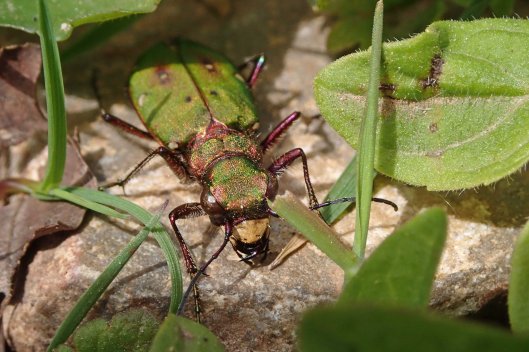
This was the third Green tiger beetle (Cicindela campestris) I saw during Wednesday’s wander around Gwent’s Slade Wood but the other two, true to their tiger name, sped off on their long legs before I could get close enough for photos. I think this one probably thought it was well enough camouflaged amongst the vegetation but a beam of sunlight reflecting off its iridescent green colouring gave it away. In fact, the genus name Cicindela is the Latin word for glowworm, which, presumably, is named for that metallic sheen. It’s a beautiful creature, though I do think it would be rather scary and quite intimidating if it were any more than 10-15mm long.

230520 green tiger beetle

Like Loading...

Andrena haemorrhoa

17 Wednesday May 2023

Posted by sconzani in insects

≈ Leave a comment

Tags

Andrena bees, Andrena haemorrhoa, British bees, Early mining bee, mining bees, Orange-tailed mining bee

Bee-cause I hardly ever manage to identify bees to species, I just had to share this one that was a first for me and has been identified. My local go-to guy for bee identification, Liam from Buglife Cymru, says this is a ‘nice distinctive one with the orange thorax and black abdomen with bright orange tail. Also orange hind legs beneath the pollen brush’. Meet Andrena haemorrhoa, in this case a female specimen. When I recorded it, the common name came up as Orange-tailed mining bee, though the Naturespot website calls it the Early mining bee. Same same, but different.

230517 Andrena haemorrhoa

Like Loading...

Hairy dragonfly

16 Tuesday May 2023

Posted by sconzani in insects

≈ Leave a comment

Tags

Brachytron pratense, British dragonflies, British odonata, dragonfly, Hairy dragonfly, Odonata

The British Dragonfly Society website describes this lovely creature as the ‘UK’s smallest, hairiest Hawker that emerging [sic] before other Hawkers in May’, so the name Hairy dragonfly (Brachytron pratense) seems appropriate. The website also says it is ‘mainly found near unpolluted, well-vegetated water bodies’, though this particular beastie was in a secluded woody clearing, with a probably polluted (as once a quarry), definitely not well-vegetated lake a couple of hundred metres away. So, don’t write off the possibility if you see a potential Hairy dragonfly in an odd habitat! All that being said, this is a species I don’t see very often so I was very pleased to have found one.

Like Loading...

Leafmines: Coleophora serratella

15 Monday May 2023

Posted by sconzani in insects, trees

≈ Leave a comment

Tags

British leafminers, British moths, case-bearing moth larva, Coleophora serratella, Common case-bearer, leafminers on Birch, moth larvae

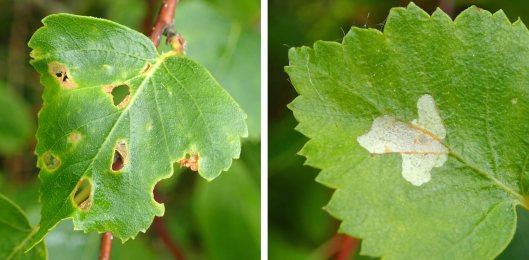
I’ve been checking Birch trees since their green leaves first started to unfold, prompted by a post I’d seen by Rob Edmunds (@leafminerman on Twitter) of the British Leafminers website to check for the small holes created by the feeding of the tiny Common case-bearer moth, Coleophora serratella. Finally, last Tuesday, I found some on a tree in Cardiff’s Grangemoor Park.

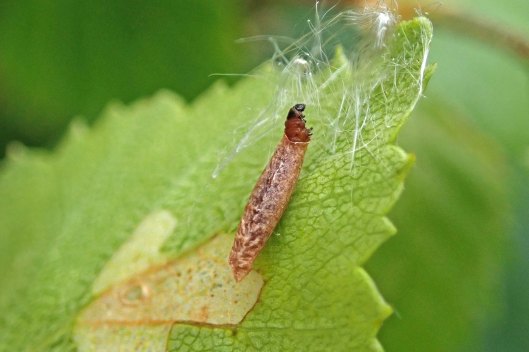
And, luckily, the little case-bearing larva was still in situ, initially checking out some silky seedhead fibres that had lodged on the end of its leaf, then retreating to the patch that marked where it had been feeding and resumed munching. You can read more about this beauty on the British Leafminers website and see the adult moth on the UK Moths website.

Like Loading...

Red admiral egg

11 Thursday May 2023

Posted by sconzani in insects

≈ 2 Comments

Tags

British butterflies, butterfly, butterfly egg, Red Admiral, Red admiral egg

During Sunday’s wander around the boundaries of some local horse fields (minus the nosey horses, this time), the sun wasn’t shining or warm enough for any butterflies to be found on the thick hedges and scrubby edges. This lovely female Red admiral was the one exception, appearing suddenly from behind a large bramble patch.

230511 red admiral

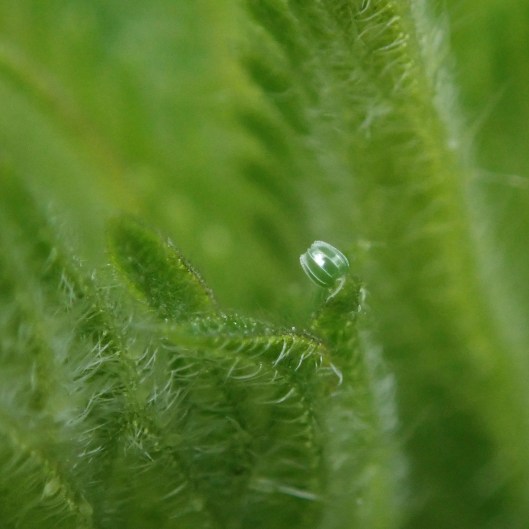
How do I know it was a female? Well, instead of flying off to patrol the bushes, she floated above and around the abundant, fresh Stinging nettles, looking for the best places to lay her eggs. How do I know they were Stinging nettles? Well, despite wrapping my fingers in the layers of my scarf, I still got stung on a couple of fingers while getting my first ever sighting and photographs of one of her eggs, a magnificent little ribbed barrel that should produce a tiny caterpillar in a week or so.

230511 red admiral egg

Like Loading...

Hairy in hiding

10 Wednesday May 2023

Posted by sconzani in insects

≈ Leave a comment

Tags

British shieldbugs, dandelion seedhead, Hairy shieldbug

I’m not sure what this Hairy shieldbug was doing – well, actually there were two of them, and they’d both decided they were going to play hide and seek under the fluffy umbrella of a Dandelion seedhead. Crazy, but cute!

230510 hairy shieldbugs

Like Loading...

The gift

09 Tuesday May 2023

Posted by sconzani in insects

≈ Leave a comment

Tags

Dagger fly, Empis tessellata, male insect gift-giving, mating dagger flies

With its bristly body, brown-tinged wings, black femora, and red/brown tibia and tarsi, I think this may be the dagger fly Empis tessellata, but these are tricky flies to identify so don’t take my word on that.

230509 empis tessellata (1)

And, to be honest, I’m not too concerned about identifying the exact species because what fascinates me more is their mating behaviour, which I was fortunate to witness during Sunday’s walk. According to the Naturespot website

Though it feeds on nectar it is also a predator and catches other insects using its long pointed proboscis to pierce their bodies. Males of Empis opaca and E. tessellata present a ‘gift’ to the female, in the form of a dead insect, before mating takes place. Females will not mate with males who do not present a gift.

230509 empis tessellata (2)

Like Loading...

Pieris napi

08 Monday May 2023

Posted by sconzani in insects

≈ 2 Comments

Tags

British butterflies, butterfly, Green-veined white, Pieris napi

My first confirmed sighting of a Green-veined white of 2023 came later than usual, last Thursday, 4 May, but it more than made up for its tardiness by posing beautifully on some not-quite-opened Hawthorn blossom. I love its scientific name Pieris napi, the Latin Pieris coming from the Ancient Greek Πιερίς meaning a muse and its specific name napi being a reference to one of its larval foodplants, Oil-seed rape (Brassica napus).

230508 green-veined white

Like Loading...

The first skipper

04 Thursday May 2023

Posted by sconzani in insects

≈ Leave a comment

Tags

British butterflies, butterfly, Dingy Skipper, skipper butterflies, Skippers

I tend to avoid the local country park on bank holidays, as it can be difficult to find the peace and solitude I prefer during my walks but, luckily, on the May Day holiday, most people were sticking to the walks around the lakes, the children’s playground and those places where they could buy food and drinks. So, a circuitous walk around the various paddocks and through a sheltered woodland clearing turned up my first Small tortoiseshell butterfly of the year and this beauty, my first Dingy skipper. Bank holiday bonuses both!

230504 dingy skipper

Like Loading...

Wild words : extrafloral nectary

03 Wednesday May 2023

Posted by sconzani in insects, plants

≈ Leave a comment

Tags

Bracken, extrafloral nectaries, nectaries on Bracken, nectary, Pteridium aquilinum

Nectary: noun, biology; ‘a nectar-secreting glandular organ in a flower (floral) or on a leaf or stem (extrafloral)’ (Oxford Dictionary).

230503 extrafloral nectaries (1)

Like most people, I knew that most flowers produce nectar as a reward to attract pollinators but I’ve only recently learned that many plants produce nectar through extrafloral nectaries, as the definition explains, on their leaves or stems. I read that these particular nectaries can be found on many species of fern, and I’ve finally found some examples on the stems of Bracken (Pteridium aquilinum) that has just begun to sprout locally. The nectaries are the small smooth pale lumps on the back of the stipe, and, in Bracken, their purpose is apparently to attract ants that will then defend the fern against the insects that might eat it, like some species of bug and fly, and the larvae of various moths, amongst others.

230503 bracken and ant

ant leaving nectary on Bracken

However, I also found a journal article, referenced below, which reported that the ants actually had ‘no significant effect on bracken-specific herbivores’ so, in this case, the plant may be producing nectar for nothing.

Reference: ‘Bracken, Ants and Extrafloral Nectaries. I. the Components of the System’, J. H. Lawton and P. A. Heads, Journal of Animal Ecology, vol. 53, no. 3, October 1984, pp. 995-1014. I do not have access to Jstor so was only able to read the information contained in the article summary.

230503 common froghopper nymphs

Common froghopper nymphs on Bracken

Like Loading...
← Older posts
Newer posts →

About me

sconzani

sconzani

I'm a writer and photographer; researcher and blogger; birder and nature lover; countryside rambler and city strider; volunteer and biodiversity recorder.

View Full Profile →

Follow earthstar on WordPress.com

Enter your email address to follow this blog and receive notifications of new posts by email.

Recent blog posts

  • First bee-flies April 7, 2026
  • Bloody-nosed beetle April 6, 2026
  • Gorse and its weevil April 5, 2026
  • Chiffchaffs chiffchaffing April 4, 2026
  • Bearded tit!!! April 3, 2026

From the archives

COPYRIGHT

Unless otherwise acknowledged, the text and photographs on this blog are my own and are subject to international copyright. Nothing may be downloaded or copied without my permission.

Fellow Earth Stars!

  • Unknown's avatar
  • Unknown's avatar
  • Unknown's avatar
  • Unknown's avatar
  • Unknown's avatar
  • Unknown's avatar
  • Unknown's avatar
  • Unknown's avatar
  • Unknown's avatar
  • Unknown's avatar
  • Unknown's avatar
  • Unknown's avatar
  • Unknown's avatar
  • Unknown's avatar
  • Unknown's avatar
  • Unknown's avatar
  • Unknown's avatar
  • Unknown's avatar
  • Unknown's avatar
  • Unknown's avatar
  • Unknown's avatar
  • Unknown's avatar
  • Unknown's avatar
  • Unknown's avatar
  • Unknown's avatar
  • Unknown's avatar
  • Unknown's avatar
  • Unknown's avatar
  • Unknown's avatar
  • Unknown's avatar
  • Unknown's avatar
  • Unknown's avatar
  • Unknown's avatar
  • Unknown's avatar
  • Unknown's avatar
  • Unknown's avatar
  • Unknown's avatar
  • Unknown's avatar
  • Unknown's avatar
  • Unknown's avatar
  • Unknown's avatar
  • Unknown's avatar
  • Unknown's avatar
  • Unknown's avatar
  • Unknown's avatar
  • Unknown's avatar
  • Unknown's avatar
  • Unknown's avatar
  • Unknown's avatar
  • Unknown's avatar

Blog at WordPress.com.

Privacy & Cookies: This site uses cookies. By continuing to use this website, you agree to their use.
To find out more, including how to control cookies, see here: Cookie Policy
  • Subscribe Subscribed
    • earthstar
    • Join 642 other subscribers
    • Already have a WordPress.com account? Log in now.
    • earthstar
    • Subscribe Subscribed
    • Sign up
    • Log in
    • Report this content
    • View site in Reader
    • Manage subscriptions
    • Collapse this bar
 

Loading Comments...
 

You must be logged in to post a comment.

    %d