• ABOUT
  • BIRDING 2018
  • Birding 2019
  • BLOG POSTS
  • Butterflies 2018
  • Resources

earthstar

~ a celebration of nature

earthstar

Category Archives: nature

217/366 Lep larvae

04 Tuesday Aug 2020

Posted by sconzani in insects, nature

≈ 2 Comments

Tags

British butterflies, British moths, butterfly larvae, Cinnabar moth, Lepidoptera, moth larvae, Small tortoiseshell

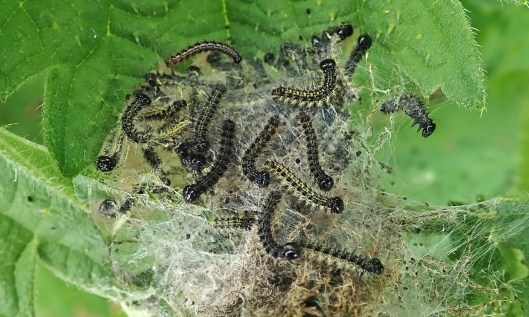
Last week we had a closer look at a couple of butterfly eggs; today we have some Lepidoptera larvae. First up, the caterpillars of the beautiful Small tortoiseshell butterfly, which has two generations of eggs and larvae each year – these will be second generation. The eggs are laid in batches and, when they hatch, the caterpillars stay together to create a communal web where they shelter when they’re not out basking in the sun or munching on nettles. The caterpillars go through five stages (instars) before pupating – these look to be 3rd instars.

200804 small tortoiseshell (1)

200804 small tortoiseshell (2)
200804 small tortoiseshell (3)

In total contrast to the Small tortoiseshell larvae, which are subtle and subdued in their colour and patterns, the larvae of the Cinnabar moth are vibrant, even flamboyant. Their bright orange and black stripes are designed to be seen, warning predators not to eat them as they are poisonous.

200804 cinnabar moth (1)200804 cinnabar moth (2)

Like Loading...

216/366 Red bartsia

03 Monday Aug 2020

Posted by sconzani in nature, plants, wildflowers

≈ 2 Comments

Tags

British wildflowers, Cosmeston Lakes Country Park, Odontites vernus, Red bartsia, wildflowers

Red bartsia (Odontites vernus) is an unobtrusive wildflower that I have tended to overlook until now but it’s very common in Cosmeston Lakes Country Park, one of my local haunts, so I thought I should take a closer look at it.

200803 red bartsia (1)

The Wildlife Trust website says Red bartsia can be found growing on low-fertility soils – places like waste ground, brownfield sites, along the edges of roads and railway tracks, and it survives in these more barren places because it’s semi-parasitic on the plants around it, tapping in to their root systems to gather extra nutrients.

200803 red bartsia (2)
200803 red bartsia (3)

Its scientific name is interesting: Odontites comes from Ancient Greek ὀδούς meaning tooth and apparently refers to the fact that Pliny the Elder used this plant to treat toothache; vernus refers to springtime, presumably when this plant comes to life for the year. It flowers for several months over the summer, providing a good nectar source for many species of bee and wasp.

200803 red bartsia (4)

Like Loading...

215/366 Mr Warty

02 Sunday Aug 2020

Posted by sconzani in amphibian, nature

≈ Leave a comment

Tags

British amphibians, Bufo bufo, Common toad, toad, warty skin

Or it might be Mrs Warty – I’m not sure how you tell the gender of a Common toad, and this one wasn’t hanging around to let me have a second look anyway. Those warts aren’t really warts, of course – they’re swellings above glands in the skin that can secrete a poisonous substance that acts as a defence mechanism.

200802 toad (1)

Though they’re not the most attractive of creatures, toads are, according to my Fauna Britannica, ‘highly intelligent, learn quickly and can be tamed, and they are extremely long-lived (40 years at least)’. Apparently, they also have ‘a marked homing instinct and will return to the same resting spot in some damp corner time after time’, so perhaps I need to go back for another look at this one.

200802 toad (2)

Like Loading...

214/366 Butterfly eggs

01 Saturday Aug 2020

Posted by sconzani in insects, nature, plants

≈ 3 Comments

Tags

British butterflies, butterfly, butterfly egg, Common blue butterfly, Common blue butterfly egg, Painted Lady, Painted lady egg, thistle

This Painted lady is only the fourth individual I’ve seen this year but she was by far the best, not because of her appearance, which is a little ragged around the edges, but because she was laying eggs … and I’d never seen a Painted lady egg before.

200801 painted lady

At just 0.65mm high, the egg is tiny and, in my reference book, it’s described as green but, to my eye, this one is more of a pale turquoise – the plant stem is green. And the plant is a thistle – Creeping thistle, I think, though it was a young plant with no flowers, which makes it harder for me to identify but probably more nourishing for the teeny tiny caterpillar to munch on when it emerges. Now if I can only find this exact plant again in approximately a week’s time …

200801 painted lady egg (1)
200801 painted lady egg (2)

And following hot on the heels of finding that Painted lady egg, today I spotted a female Common blue butterfly laying her eggs in a sheltered clearing. You can perhaps see in the photo how she is angling her body to deposit an egg underneath the foliage.

200801 Common blue egg laying

So, once again, I was able to find the newly laid egg and take some photos. According to my book, these eggs are usually 0.5mm in diameter and just 0.25mm high, so really tiny. I have no chance of finding this egg again but I’m really glad I had the chance to see it.

200801 common blue egg (1)
200801 common blue egg (2)
Like Loading...

213/366 Common lizards

31 Friday Jul 2020

Posted by sconzani in nature, reptiles

≈ Leave a comment

Tags

Aberbargoed coal tip, British reptiles, Common lizard, Lacerta vivipara, lizard, viviparous, Viviparous lizard, Zootoca vivipara

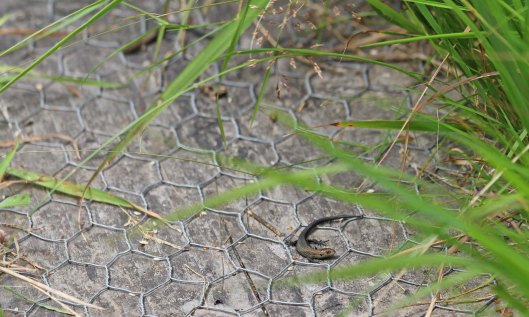
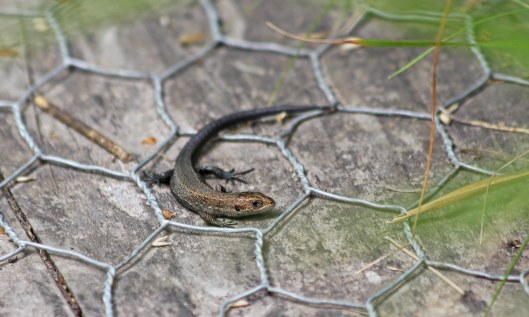
As well as the lovely Grayling butterfly spotted on Wednesday’s walk in Aberbargoed, we had a wonderful surprise when my friend Sharon spotted these two tiny reptiles, basking on a wooden boardwalk in the Grasslands National Nature Reserve.

200731 common lizards (1)

The reptile known as the Common lizard and also the Viviparous lizard, once had the scientific moniker Lacerta vivipara but is now Zootoca vivipara. Viviparous is a zoological term meaning ‘bringing forth live young which have developed inside the body of the parent’ (Oxford Dictionary), though what apparently happens in this lizard’s case is that the young hatch from their eggs as they are deposited outside the body (Fauna Britannica).
200731 common lizards (2)

As their name suggests, these lizards are common in Britain, though I’ve only seen them twice in my five years’ residence in Wales, which is why Wednesday’s sightings were such a delight. You can find out more about them on the Amphibian and Reptile Conservation Trust website.

200731 common lizards (3)

Like Loading...

212/366 A tip top butterfly

30 Thursday Jul 2020

Posted by sconzani in insects, nature

≈ 2 Comments

Tags

Aberbargoed coal tip, British butterflies, butterflying, coal spoil biodiversity, Grayling

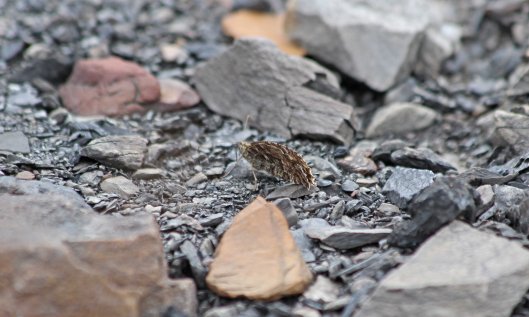
I had big plans to see more of Britain’s butterfly species this year but, in the immortal words of Robbie Burns, plans and schemes ‘gang aft agley’. The Covid 19 lockdown put a stop to all the butterflying plans I was hatching and I’ve missed seeing an awful lot of species this year. But, yesterday, I did manage one more species for 2020, that master of camouflage, the Grayling.

200730 grayling (1)

I have a friend who lives not far from Aberbargoed, with its Grasslands National Nature Reserve and the neighbouring coal spoil tip, so I was able to combine a delightful socially distanced walk with some butterflying. It was a little late in the month – last year I visited the tip in mid July – but we got lucky, with wonderful close sightings of just one individual.

200730 grayling (2)

In his Life Cycles of British & Irish Butterflies, Peter Eeles notes that the Grayling was once known as the Rock Underwing, a testament to its ability to blend in perfectly with the surrounding earth and pebbles when it lowers its forewings. Fortunately, when the Grayling is feeding, it raises its forewings and we were able to see more clearly its two eye spots.

200730 grayling (3)

Like Loading...

211/366 Rhubarb and custard

29 Wednesday Jul 2020

Posted by sconzani in insects, nature

≈ Leave a comment

Tags

British dragonflies, Common Darter, dragonfly, Sympetrum striolatum

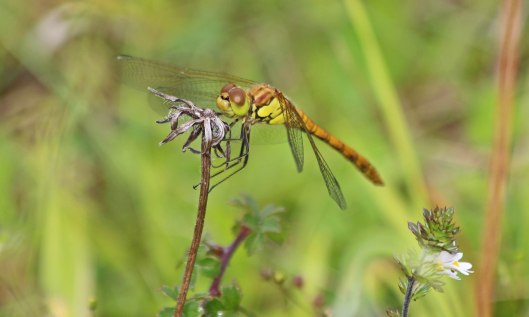
From Brett Westwood and Stephen Moss’s Wonderland: A Year of Britain’s Wildlife Day by Day:
‘Common and widespread though it may be, this small, neat dragonfly is always worth a second look. The males are brick red and the females yellow, so I use the aide-memoire “rhubarb and custard” to remember this.’

200729 common darter (1)

Which dragonfly is being described? I’m sure many of you worked out it was the Common darter, which is flying now in my local parks and reserves, though in quite small numbers so far.

200729 common darter (2)

Like Loading...

210/366 Today along the Ely

28 Tuesday Jul 2020

Posted by sconzani in birds, nature

≈ Leave a comment

Tags

birding, birdwatching, British birds, Ely embankment, Great Crested Grebe, House martin, Mute swan, Pied wagtail, River Ely

This morning’s wander took me down to Cardiff Bay to walk the path along the embankment of the River Ely, my first walk that way for a while, as there tend to be less interesting birds to see during the summer months and more people to avoid. And so it was, though there is never nothing to see.

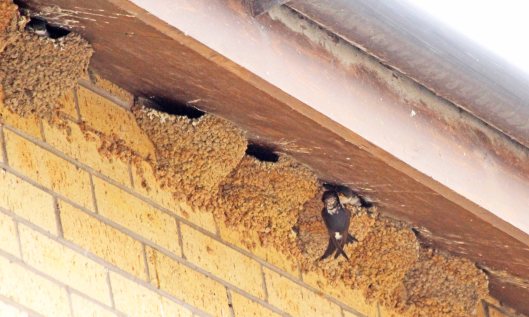
200728 4 house martins

200728 1 house martins
200728 2 house martins
200728 3 house martins

House martins were still filling the air with their calls and zipping swiftly back and forth, hunting low over the water then taking insects back to feed their young, which must be second or even third broods now.

200728 5 swan

Large numbers of Coot and Mallard were feeding on the water weed or sitting preening on the water’s edge of the embankment, and several Swan were floating regally past. A couple fell out and were half-heartedly chasing each other.

200728 6 juvenile gcg200728 7 gcg

I saw only three Great crested grebes, a low number for this location. Two were adults and one a well grown juvenile that was snoozing amongst the weed.

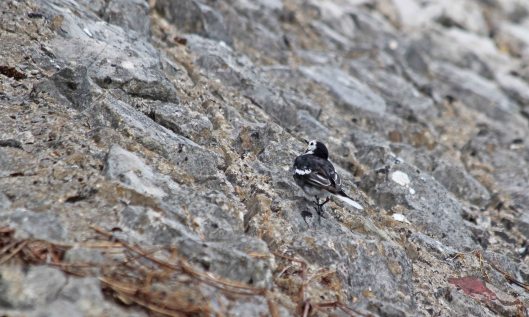
200728 8 pied wag

And I saw only two Pied wagtails, which is also a small quantity for the embankment. Their jaunty striding back and forth always makes me grin.

Like Loading...

209/366 Song thrush fledgling

27 Monday Jul 2020

Posted by sconzani in birds, nature

≈ 2 Comments

Tags

birding, birdwatching, British birds, fledgling, Song thrush, Song thrush fledgling

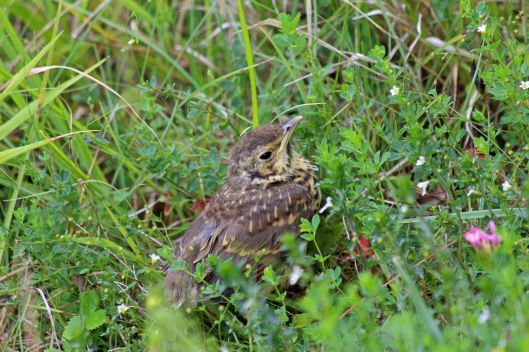
I hope this little Song thrush fledgling managed to find its parents, or they found it. I spotted sitting in the middle of a footpath but it managed to hop into the vegetation at the side of the path as I approached, and I could hear what might have been adult birds peeping softly from the surrounding bushes and trees. Fingers crossed!

200727 song thrush fledgling

Like Loading...

208/366 A pod of peas

26 Sunday Jul 2020

Posted by sconzani in nature, wildflowers

≈ 1 Comment

Tags

British wildflowers, Broad-leaved everlasting pea, Common bird's foot trefoil, Goat's-rue, Grass vetchling, Leguminosae, Meadow vetchling, Melilotus species, Pea family

The Pea family (properly known as the Leguminosae) is a large one, and its members are easily recognised by their flower shape. I see them a lot during my meanders – Red and White clovers, the Bird’s-foot trefoil and Melilotus species, Tufted and Bush vetch are all common hereabouts.

200726 1 birds-foot trefoil
200726 1 melilotus sp
200726 2 tufted vetch
200726 2 bush vetch

Those that follow are the peas I see less often, starting with Meadow vetchling (Lathyrus pratensis), which is not an uncommon plant in my area – it’s just that I’ve seen it more often since lockdown started, as my walks have taken me along the less-used footpaths across local farm fields and meadows.

200726 3 meadow vetchling

Grass vetchling (Lathyrus nissolia) is less common – or, perhaps, less easily found, as it’s a delicate plant, easily lost amongst the long grass in which it grows, unless you manage to spot its one or two bright pink flowers on fine, tall stems.

200726 4 grass vetchling (2)
200726 4 grass vetchling (1)

Broad-leaved everlasting pea (Lathyrus latifolius): I’ve found this lovely, sprawling pea in two local parks, both former rubbish dumps. It seems an aggressive climber and rambler, adorning bramble and low scrub with its attractive blooms. It is a favourite plant of the Long-tailed blue butterfly so I know where to look if this pretty migrant butterfly ever decides to fly as far as south Wales.

200726 5 broad-leaved everlasting pea

Goat’s rue (Galega officinalis) is new to me, and I’ve only seen it in one location, near a large local hospital, perhaps blown in by the constant comings and goings of traffic. My Flora Britannica says it ‘was introduced … in the sixteenth century as a vegetable and medicinal herb, and later grown for ornament’. It certainly has very beautiful flowers.

200726 6 goats-rue

Like Loading...
← Older posts
Newer posts →

About me

sconzani

sconzani

I'm a writer and photographer; researcher and blogger; birder and nature lover; countryside rambler and city strider; volunteer and biodiversity recorder.

View Full Profile →

Follow earthstar on WordPress.com

Enter your email address to follow this blog and receive notifications of new posts by email.

Recent blog posts

  • Three Common sandpipers February 17, 2026
  • Beetle: Athous bicolor February 16, 2026
  • Crocus flower power February 15, 2026
  • Delightful doves February 14, 2026
  • Fan-like fungi February 13, 2026

From the archives

COPYRIGHT

Unless otherwise acknowledged, the text and photographs on this blog are my own and are subject to international copyright. Nothing may be downloaded or copied without my permission.

Fellow Earth Stars!

  • Unknown's avatar
  • Unknown's avatar
  • Unknown's avatar
  • Unknown's avatar
  • Unknown's avatar
  • Unknown's avatar
  • Unknown's avatar
  • Unknown's avatar
  • Unknown's avatar
  • Unknown's avatar
  • Unknown's avatar
  • Unknown's avatar
  • Unknown's avatar
  • Unknown's avatar
  • Unknown's avatar
  • Unknown's avatar
  • Unknown's avatar
  • Unknown's avatar
  • Unknown's avatar
  • Unknown's avatar
  • Unknown's avatar
  • Unknown's avatar
  • Unknown's avatar
  • Unknown's avatar
  • Unknown's avatar
  • Unknown's avatar
  • Unknown's avatar
  • Unknown's avatar
  • Unknown's avatar
  • Unknown's avatar
  • Unknown's avatar
  • Unknown's avatar
  • Unknown's avatar
  • Unknown's avatar
  • Unknown's avatar
  • Unknown's avatar
  • Unknown's avatar
  • Unknown's avatar
  • Unknown's avatar
  • Unknown's avatar
  • Unknown's avatar
  • Unknown's avatar
  • Unknown's avatar
  • Unknown's avatar
  • Unknown's avatar
  • Unknown's avatar
  • Unknown's avatar
  • Unknown's avatar
  • Unknown's avatar
  • Unknown's avatar

Blog at WordPress.com.

Privacy & Cookies: This site uses cookies. By continuing to use this website, you agree to their use.
To find out more, including how to control cookies, see here: Cookie Policy
  • Subscribe Subscribed
    • earthstar
    • Join 670 other subscribers
    • Already have a WordPress.com account? Log in now.
    • earthstar
    • Subscribe Subscribed
    • Sign up
    • Log in
    • Report this content
    • View site in Reader
    • Manage subscriptions
    • Collapse this bar
 

Loading Comments...
 

You must be logged in to post a comment.

    %d