• ABOUT
  • BIRDING 2018
  • Birding 2019
  • BLOG POSTS
  • Butterflies 2018
  • Resources

earthstar

~ a celebration of nature

earthstar

Category Archives: nature

I’m following a tree: January 2018

08 Thursday Feb 2018

Posted by sconzani in nature, trees

≈ 11 Comments

Tags

#treefollowing, Acer mono, Acer pictum, Bute Park, Korean maple, Mono maple, Painted maple, tree following

If I hadn’t decided to keep the title of my 2018 tree-following blogs fairly simple, I would probably have titled this post ‘The mysterious case of the tree with the confused identity’!

The tag on the tree, which is growing in Cardiff’s Bute Park, names it Mono maple (Acer mono). That seems fairly straight forward but, when I checked it on the Cardiff Parks website, I found it labelled Painted maple (with Mono as an alternative) and its scientific name listed as Acer pictum. So then I looked the tree up in the Cardiff Council Horticultural Database, where its common name is given as Korean maple and its scientific name as Acer pictum (a.k.a. Acer mono). So then I went to The Plant List, which is meant to be the definitive list: there I was informed that Acer pictum is the accepted name and Acer mono is a synonym.
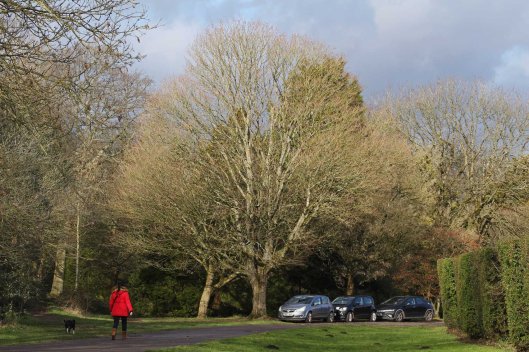
180208 Mono maple (1)

And then, after a bit more searching, I found an extremely helpful blog post from the JC Raulston Arboretum at North Carolina State University, where they use the common name Painted maple and explain its scientific name as follows:

It was first described in western literature by the Swedish botanist Karl von Thunberg in 1784 but was widely known as Acer mono after it was introduced to the west in the 1880s. Its name continues to cause confusion with some authorities using A. pictum to cover the entire species while other botanists break it down into several subspecies including A. pictum subsp. mono.

180208 Mono maple (2)
180208 Mono maple (3)

And, in response to a question from a reader:

… many taxonomists disagree on the name of this maple. According to van Gelderen, they should all be Acer mono since he contends that Acer pictum is an invalid name. In any case, there is much disagreement over whether they constitute different varieties or subspecies or are just part of a large very variable species. A. p. subsp. pictum has short hairs on the back side of the leaf, while A. p. subsp. mono has no hairs on the abaxial surface.
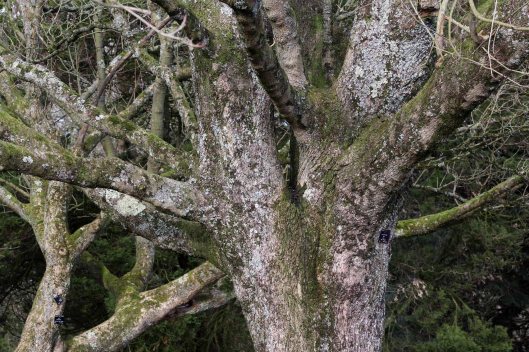
180208 Mono maple (4)

As even the experts can’t agree, for the twelve months that I will be following this magnificent tree, I am simple going to call it Mono. More next month …

Why not join the tree following community. You can find out more here.
Like Loading...

Wild words: apricity

07 Wednesday Feb 2018

Posted by sconzani in birds, nature, winter

≈ 2 Comments

Tags

#WildWords, apricity, Black-headed gull, gull, warmth of sun in winter, winter sunshine

This wonderful old word doesn’t appear in the Oxford Dictionary online, presumably because they’ve replaced it with something trendy like ‘mansplain’ and ‘youthquake’. Well, call me old-fashioned but I much prefer something old and meaningful to these modern inventions.

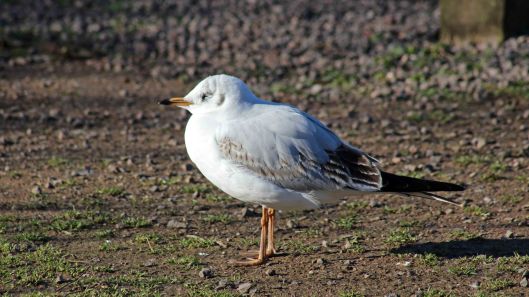
So, then, apricity (thanks to the Merriam-Webster) ‘appears to have entered our language in 1623, when Henry Cockeram recorded (or possibly invented) it for his dictionary The English Dictionary; or, An Interpreter of Hard English Words.’ And it means ‘the warmth of the sun in winter’, something even this gull was seen, last week, to enjoy and appreciate.

180207 apricity

Like Loading...

A stroll at Sully

06 Tuesday Feb 2018

Posted by sconzani in birds, coastal fauna, nature, seaside, walks

≈ Leave a comment

Tags

birding, birdwatching, British birds, Curlew, Grey plover, Little ringed plover, Oystercatchers, Rock pipit, Sully, Turnstone, Wales Coastal Path

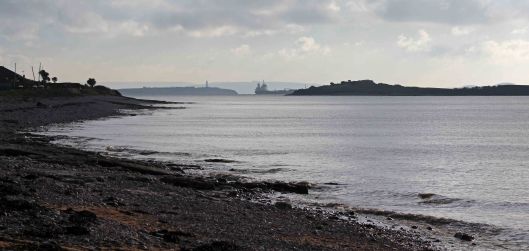
At 9:20am yesterday I was on the bus to Sully, looking forward to seeing what seabirds might be scavenging along the shore at the 10:16 high tide. A bonus was seeing my first pheasant of the year in a passing field.

180206 Sully stroll (1)

Walking down the long narrow path to the beach, I was immediately rewarded with the sight of Black-headed gulls and Oystercatchers looking for worms in the neighbouring field, and a Rock pipit flew up from the shore to join them in their foraging.

180206 Sully stroll (2)
180206 Sully stroll (3)

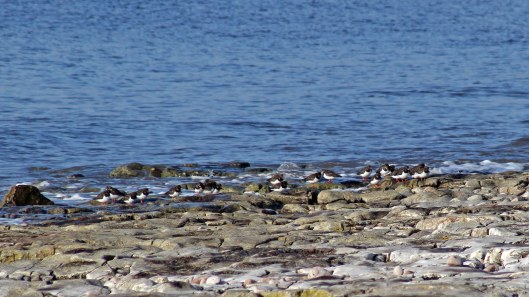
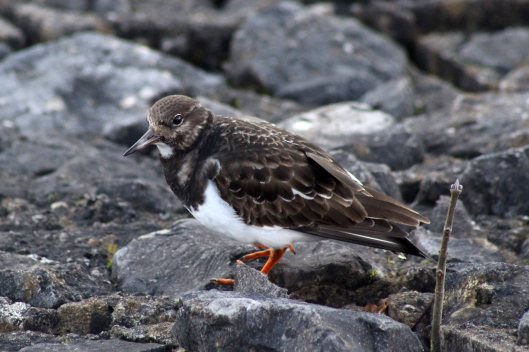
The beach looked empty as I strolled along the ‘coastal path’ – really just a line of rocks and mud here – but a flurry of loud peeping made me turn my head and bring the camera up in time to catch this flock of Turnstones flying in.

180206 Sully stroll (4)180206 Sully stroll (5)

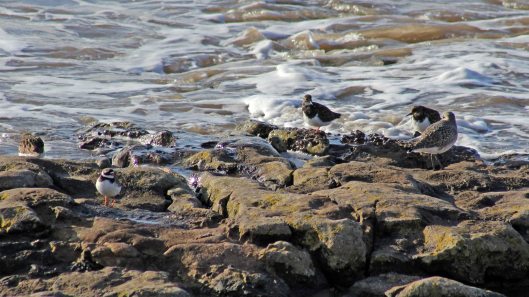
Further east, scanning the water’s edge with my binoculars, I finally spotted an interesting little group of 3 Turnstones, a Little ringed plover and a Grey plover, the latter two year ticks for me, and I’d not seen a Grey plover so close before (I’m still talking a couple of hundred metres away but see-able with bins and long lens). I watched them for perhaps 10 minutes before two loud women and their dog scared the birds off.

180206 Sully stroll (6)

180206 Sully stroll (7)
180206 Sully stroll (8)

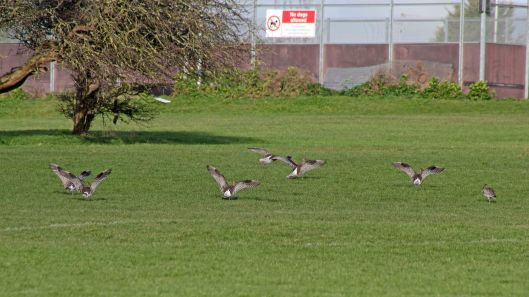
Last, but mostly certainly not least, as these beautiful birds are endangered in Britain, 28 handsome Curlews were using their long curving beaks to probe the playing fields that abut the coastal path in search of worms. After 15 minutes’ watching I left them to their feast, with a silent ‘thanks for being the icing on the cake of my lovely morning at Sully’, and strolled on …

180206 Sully stroll (9)180206 Sully stroll (10)

Like Loading...

Patterns in Nature, 5

05 Monday Feb 2018

Posted by sconzani in leaves, lichen, nature, trees

≈ Leave a comment

Tags

bark, bracket fungi, lichen, nature's patterns, patterns, patterns in nature, reeds, water, wood

The ‘undiscovered country of the nearby’ ~ Robert Macfarlane, The Wild Places

180205 patterns in nature (1)
180205 patterns in nature (2)
180205 patterns in nature (3)
180205 patterns in nature (4)
180205 patterns in nature (5)
180205 patterns in nature (6)
180205 patterns in nature (7)
180205 patterns in nature (8)
180205 patterns in nature (9)
Like Loading...

Gloop

04 Sunday Feb 2018

Posted by sconzani in nature

≈ 6 Comments

Tags

cynobacterium, mare's eggs, Nostoc, Nostoc commune, star jelly, witch's butter, witch's jelly

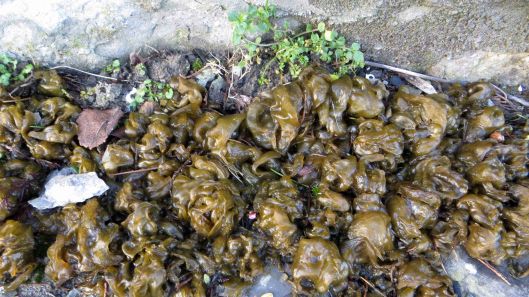
When I first saw this gloop some time last year, I thought it was a type of fungus – the round cup-shaped bodies reminded me of various ascomycetes species – but my Glamorgan Fungus Group friends were quick to inform me otherwise.

180204 Nostoc (1)

This is, in fact, a cynobacterium called Nostoc, probably Nostoc commune, but I can’t be sure of that. It has a very descriptive set of common names: star jelly and witch’s jelly, witch’s butter and mare’s eggs. And, though I’m absolutely sure I wouldn’t want to eat any of this jelly, butter or eggs, Nostoc is considered a salad vegetable in the Philippines and, in China, is a food traditionally eaten at the Lunar New Year celebrations. To me, it looks like slime but with structure, and it feels quite revolting, slippery and scummy.

180204 Nostoc (5)
180204 Nostoc (2)

I’ve seen it three times now but it’s actually more common than my limited sightings suggest – it’s just that, when it’s dry, it can look just like muddy, dehydrated plant material, and it’s only when it’s rehydrated that it becomes more noticeable. And this ‘gloop’ is a survivor – it can endure extreme variations in climate, from the freezing temperatures of the Arctic to the dry heat of arid regions, and is even known to endure in areas where radiation levels are high.

180204 Nostoc (4)
180204 Nostoc (3)
Like Loading...

The habit of looking

03 Saturday Feb 2018

Posted by sconzani in birds, nature

≈ 4 Comments

Tags

birding, birdwatching, British birds, Collared dove, habit of looking

Someone asked me recently how you become a good birder. Well, I’m not sure I am, yet, a good birder but I was reminded of some thoughts I read in Simon Barnes’s most excellent book How to be a bad birdwatcher (Short Books, London, 2006) (which you really should read): ‘I have developed the habit of looking: when I see a bird I always look, wherever I am.’ And, in response to seeing a ‘How often do you go birdwatching?’ questionaire in a birdwatching magazine, ‘I don’t go birdwatching. I am birdwatching’ (my emphasis).

180203 Collared dove

This photograph is, I think, an example of what Simon meant. A couple of days ago I went for a wander around the local town of Barry and was at the station, waiting for my train home, when, out of the corner of my eye, I noticed movement above me. Two birds were walking along the beams that support the platform roof. So, of course, I had to look closer to see what they were – two lovely Collared doves – and, as I had my camera in my backpack, I had to quickly grab a couple of photos before my train pulled in. I am always looking! I am always birdwatching!

Like Loading...

Signs of spring: Marsh marigolds

02 Friday Feb 2018

Posted by sconzani in flowers, nature, parks, spring

≈ 2 Comments

Tags

British wildflowers, Caltha palustris, Heath Park, marsh marigold, signs of spring

180202 Marsh marigolds (2)

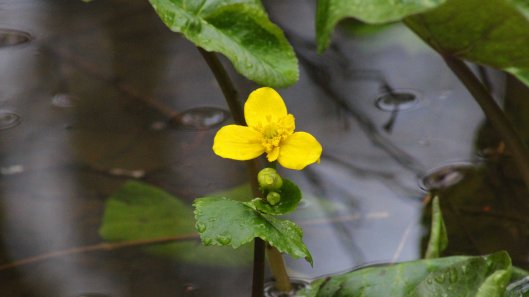
Though it’s hard to believe today, as I look out the window at yet another grey rainy day and the temperature is set to go down all day not up, here is yet another sign that spring really is just around the corner. I spotted these Marsh marigolds (Caltha palustris) blooming in a muddy pond in Cardiff’s Heath Park last week.

180202 Marsh marigolds (1)180202 Marsh marigolds (3)

Like Loading...

January at Cosmeston

01 Thursday Feb 2018

Posted by sconzani in birds, nature, parks

≈ 6 Comments

Tags

birding, birdwatching, blackbird, British birds, chaffinch, coal tit, Common Gull, Cosmeston, Cosmeston Lakes Country Park, Gadwall, Great tit, long-tailed tit, Marsh tit, nuthatch, Pochard, Reed bunting, robin, shoveler

180201 1 Long-tailed tits & Blackbird

7 January Gale-force winds were blasting across the exposed areas around the lake today but, with blue skies overhead, the park was full of people out walking, despite the chill. The wee birds were hungry and I was greeted with much happy peeping wherever I scattered seed and virtually mobbed at the dragon tree in Cogan Woods, by Great, Blue, Coal and Long-tailed tits, Dunnocks and Robins, Chaffinches and Nuthatches, Blackbirds and a Reed bunting were all happy to accept any tasty little morsels.

180201 2 Reed bunting
180201 3 Chaffinch
180201 4 Nuthatch
180201 5 Great tit
180201 6 Robin
180201 7 Coal tit

On the lakes the birds were mostly hunkered down, as it was too windy for flying. Teal, Gadwall, Pochard and a Shoveler were some of the highlights.

180201 8 Shoveler
180201 9 Gadwall & Pochard

17 January After much scrutinising of the huge numbers of gulls that you nearly always find at Cosmeston, I spotted my first Common gull of the year.

180201 10 Common gull

23 January A regular Cosmeston-going birding friend had reported an adult Yellow-legged gull the previous day and I fancied a good walk so I headed to Cossie for a look. These was no sign of the gull but I was delighted to see one of the Marsh tits that frequents a particular spot in Cogan Woods, and it became bird number 67 on this year’s list, before I strode quickly home in pouring rain (yep, drenched!).

180201 11 Marsh tit

I’ve been to Cosmeston a couple more times this month but those outings were more about braving the rain  to satisfy my cravings for fresh air and exercise than nature-watching, particularly as it’s been too wet to have camera and binoculars out and about. Let’s hope February is a bit drier.

Like Loading...

Wild words: catkin

31 Wednesday Jan 2018

Posted by sconzani in nature, spring, trees, winter

≈ Leave a comment

Tags

catkin, Corylus avellana, female Hazel flower, Hazel catkin, Hazel tree, wild words

Catkin: According to the Oxford Dictionary, a late 16th century noun, from the now-obsolete Dutch word katteken for kitten (how sweet is that?), meaning a downy, hanging flowering spike of trees such as willow and hazel, pollinated by the wind.

And now is the time to see catkins, at least where I live in south Wales. I took these photos of male Hazel catkins (Corylus avellana) earlier this week, the gusty breeze helping to spread their yellow pollen, hopefully to fall on the tiny pink female flowers of neighbouring trees, there to develop into fruit and later nuts.

180131 Hazel male catkins (2)
180131 Hazel male catkins (1)

180131 Hazel female flower

Like Loading...

January on the Ely embankment

30 Tuesday Jan 2018

Posted by sconzani in birds, nature, walks

≈ 2 Comments

Tags

birding, birdwatching, British birds, Carrion crow, Ely embankment, Goosander, Grey wagtail, little grebe, Pied wagtail, Redshank, River Ely, Rock pipit, Turnstone

31 December 2017 I’m being a bit sneaky here as I managed to fit in one last walk along the embankment before the start of 2018 but after I’d written my December summary. So, on the last day of last year there were 5 Turnstones, 2 Redshanks, 2 Pied wagtails and 2 Grey wagtails, 1 Rock pipit and a couple of Crows.

180130 Ely embankment birds (1)
180130 Ely embankment birds (2)
180130 Ely embankment birds (3)
180130 Ely embankment birds (4)

1 January 2018 The very next day, New Year’s Day, I passed this way as part of a complete circuit of Cardiff Bay. It was a glorious blue-sky day but there were just 3 Turnstones present.

180130 Ely embankment birds (5)

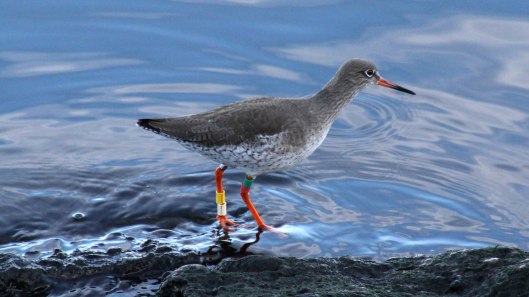
11 January This was another glorious day and another circuit of Cardiff Bay, though in the opposite direction. And it was a bumper day for the Ely embankment, with four Redshanks (including the ringed bird, shown above, which I’ve seen and written about previously), 6 Turnstones, 1 Pied and 4 Grey wagtails, and a Rock pipit.

180130 Ely embankment birds (6)
180130 Ely embankment birds (7)
180130 Ely embankment birds (8)

16 January With 40-mph winds blasting down from snow-covered areas further north, the air temperature was hovering below zero when I walked along the embankment late morning. I wasn’t surprised, then, to find very few birds around – a single Turnstone that was wandering along half way up the embankment (not wanting to put its feet in the chilly water?), which was good for me as it was closer for photos, and just two Grey wagtails. There weren’t many birds on the river either, just a couple of coots, one Great crested grebe and several Black-headed gulls looking hopefully in my direction.

180130 Ely embankment birds

20 January I didn’t get out till late afternoon as it had rained most of the day, so the light was going as I strolled along the embankment path. But I was pleasantly surprised to see a few birds: my friends the Grey wagtails never disappoint (two of those); just one Turnstone poking away amongst the stones; and two Redshanks, including my little buddy the colour-ringed bird. Floating along the river were a Little grebe, a Great crested grebe and a pair of Goosanders – the latter were scared away by a boat cruising by and flew off towards the other side of Cardiff Bay, where I had seen a pair a week or so previously – perhaps the same birds.

180130 Ely embankment birds (9)
180130 Ely embankment birds (10)
180130 Ely embankment birds (11)

25 January I detoured along the embankment on my return from a longer walk and was delighted to find six Turnstones (lovely to see so many), two Redshanks (but not my little ringed mate), two Grey and two Pied wagtails.

Like Loading...
← Older posts
Newer posts →

About me

sconzani

sconzani

I'm a writer and photographer; researcher and blogger; birder and nature lover; countryside rambler and city strider; volunteer and biodiversity recorder.

View Full Profile →

Follow earthstar on WordPress.com

Enter your email address to follow this blog and receive notifications of new posts by email.

Recent blog posts

  • The return of the Willow warblers April 23, 2026
  • Bug: Harpocera thoracica April 22, 2026
  • A female Tawny April 21, 2026
  • NFY: Orange-tip April 20, 2026
  • All the yellows April 19, 2026

From the archives

COPYRIGHT

Unless otherwise acknowledged, the text and photographs on this blog are my own and are subject to international copyright. Nothing may be downloaded or copied without my permission.

Fellow Earth Stars!

  • Unknown's avatar
  • Unknown's avatar
  • Unknown's avatar
  • Unknown's avatar
  • Unknown's avatar
  • Unknown's avatar
  • Unknown's avatar
  • Unknown's avatar
  • Unknown's avatar
  • Unknown's avatar
  • Unknown's avatar
  • Unknown's avatar
  • Unknown's avatar
  • Unknown's avatar
  • Unknown's avatar
  • Unknown's avatar
  • Unknown's avatar
  • Unknown's avatar
  • Unknown's avatar
  • Unknown's avatar
  • Unknown's avatar
  • Unknown's avatar
  • Unknown's avatar
  • Unknown's avatar
  • Unknown's avatar
  • Unknown's avatar
  • Unknown's avatar
  • Unknown's avatar
  • Unknown's avatar
  • Unknown's avatar
  • Unknown's avatar
  • Unknown's avatar
  • Unknown's avatar
  • Unknown's avatar
  • Unknown's avatar
  • Unknown's avatar
  • Unknown's avatar
  • Unknown's avatar
  • Unknown's avatar
  • Unknown's avatar
  • Unknown's avatar
  • Unknown's avatar
  • Unknown's avatar
  • Unknown's avatar
  • Unknown's avatar
  • Unknown's avatar
  • Unknown's avatar
  • Unknown's avatar
  • Unknown's avatar
  • Unknown's avatar

Blog at WordPress.com.

Privacy & Cookies: This site uses cookies. By continuing to use this website, you agree to their use.
To find out more, including how to control cookies, see here: Cookie Policy
  • Subscribe Subscribed
    • earthstar
    • Join 642 other subscribers
    • Already have a WordPress.com account? Log in now.
    • earthstar
    • Subscribe Subscribed
    • Sign up
    • Log in
    • Report this content
    • View site in Reader
    • Manage subscriptions
    • Collapse this bar
 

Loading Comments...
 

You must be logged in to post a comment.

    %d