• ABOUT
  • BIRDING 2018
  • Birding 2019
  • BLOG POSTS
  • Butterflies 2018
  • Resources

earthstar

~ a celebration of nature

earthstar

Category Archives: nature

The escapee

01 Sunday Oct 2017

Posted by sconzani in birds, nature

≈ Leave a comment

Tags

birding, birds of prey, birdwatching, Harris hawk, Harris's hawk, Parabuteo unicinctus

Before this week I’d only ever seen one Harris’s hawk (Parabuteo unicinctus) and that was a captive bird, located then at Cardiff Castle and one of several species of birds of prey used to scare away the ever-increasing numbers of feral pigeon and gull that are making their homes in our big cities. The presence of birds of prey in the skies above city buildings and factories, combined with the ear-piercing cries they emit, are enough to advertise that the territory belongs to them.

171001 Harris's hawk (1)
171001 Harris's hawk (2)

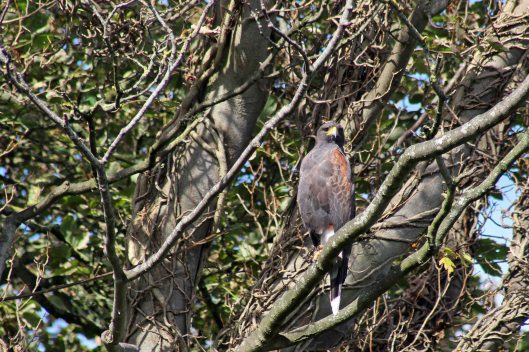
However, one Harris’s Hawk has escaped (no one knows where it escaped from) and is now living happily in the wild not far from where I live. Apparently, it’s been in the area for about a year, and I’ve been keeping an eye out for it while out walking. Last Thursday I finally spotted it and managed to get a few photos.

171001 Harris's hawk (3)

The Harris’s Hawk is not native to Britain – it hails from the Americas – but it’s a bird that is often used in falconry and as an airborne pest controller. I guess some birds just decide they’d rather be free – and who can blame them?
171001 Harris's hawk (4)

Like Loading...

Autumn migration: Garganey

30 Saturday Sep 2017

Posted by sconzani in autumn, birds, nature

≈ Leave a comment

Tags

Anas querquedula, autumn migration, birding, birdwatching, British birds, British ducks, ducks, Garganey, migrating birds, Roath Park Lake

When sightings of rare birds are reported, the birds are usually in out-of-the-way locations that are difficult to access by public transport so I can’t go looking but yesterday was different. A ‘scarce and very secretive’ duck had been spotted at Roath Park Lake, my old stomping ground, so I hopped on a train and was there like a shot.

170930 Garganey (1)

The bird was a Garganey (Anas querquedula) and it was certainly living up to its reputation: I spent 30 minutes or so walking and looking and couldn’t spot it (though the Teal and Shovelers were an added bonus amongst the resident water birds). A fellow birder told me he’d seen the Garganey briefly through his ’scope but it had then disappeared under overhanging tree branches. So, I went for a walk around the park, watched a young Heron fishing in the sluice and enjoyed the autumn colour, before heading around the lake again on my way back to the train. And there it was!

170930 Garganey (2)

The female Garganey looks much like a female Mallard at first glance but she is a much smaller duck, the markings on her face are stronger, with the eye stripe giving her quite an exotic look, and she has a bill that shows she’s a dabbler. She was very active, constantly ducking her head under the water for plant material and insects – in fact, most of my photos are of a headless duck!

170930 Garganey (5)
170930 Garganey (6)
170930 Garganey (7)

Garganeys are only seen in small numbers in Britain, as they pass through during spring and autumn migration, so being able to see and watch this beautiful female was a treat indeed!

170930 Garganey (3)
170930 Garganey (4)
Like Loading...

When is a water-lily not a water-lily?

29 Friday Sep 2017

Posted by sconzani in flowers, nature, wildflowers

≈ 2 Comments

Tags

Cosmeston Lakes Country Park, Fringed water-lily, Nymphoides peltata, water lily

This pretty plant may look like a water-lily, it even has the words water lily in its name but it’s not actually a member of the water-lily family.

170929 Fringed waterlily (2)

This is the Fringed Water-lily (Nymphoides peltata) and its closest plant relation is the Bogbean (the fringed edges to its petals are a bit of a giveaway). It can be found in ponds (the one in my photo is in the dipping pond at Cosmeston Lakes Country Park), lakes and other watery places where the water is still or slow moving. Apparently, it is well established in the Leeds and Liverpool canal, and in much of south-east England, as well as in the East Anglian fens. It is also widely planted in ornamental ponds in parks and gardens, and snippets of those plants may account for its spread in the wild. The gardeners amongst you may know it as Yellow floating heart, which is such a charming name, I think.

170929 Fringed waterlily (4)
170929 Fringed waterlily (1)
170929 Fringed waterlily (5)
170929 Fringed waterlily (3)
Like Loading...

Birding at Goldcliff

28 Thursday Sep 2017

Posted by sconzani in birds, nature

≈ 4 Comments

Tags

birding, birdwatching, British birds, Dunlin, Glamorgan Bird Club, Goldcliff lagoons, Greenshank, Knot, Newport Wetlands, Shelduck, Spotted redshank, Wheatear

190728 2 mixed flock

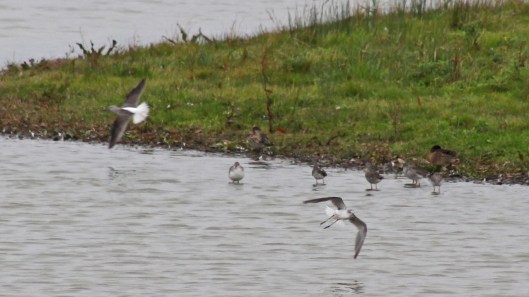
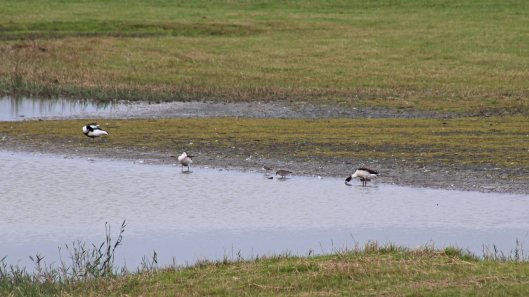
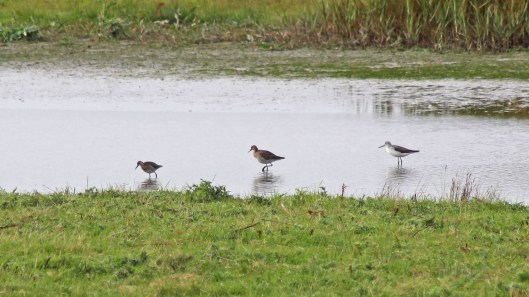
I am SO pleased I bought binoculars. My second trip to Goldcliff lagoons and Newport Wetlands with my Glamorgan Bird Club buddies last weekend was just so much better for having them, as there was an incredible diversity of birds to be seen but most were distant views from hides or platforms. Using the bins not only brings the birds closer but it also means I get to watch and learn more of each bird species’ habits and actions, which I really enjoy.

190728 4 spotted redshank dunlin greenshank flying

Though I’m not an obsessive twitcher, I am keeping a personal list of bird sightings this year and saw a few new birds to add to my list (which now totals a respectable but not huge 130). The Club’s list for the day totalled 77 species but I didn’t see (or hear) the Great Crested Grebe, Siskin, Great Spotted Woodpecker, Goldcrest, Song Thrush, Mistle Thrush and Yellow Wagtail, so my total was 69 species: Mute Swan, Canada Goose, Shelduck, Wigeon, Gadwall, Teal, Shoveler, Tufted Duck, Little Grebe, Grey Heron, Little Egret, Cormorant, Marsh Harrier, Buzzard, Kestrel, Sparrowhawk, Peregrine, Water Rail (heard), Moorhen, Coot, Oystercatcher, Ringed Plover, Lapwing, Knot,

190728 1 shelduck knot ringed plover

and Little Stint (below with Ringed plover),

190728 little stint ringed plover

and Dunlin, Ruff (two below with a Greenshank),

190728 3 ruff greenshank

and Snipe, Black-tailed Godwit, Whimbrel, Curlew, Spotted Redshank, Greenshank,

190728 5 greenshank

and Redshank, Black-headed Gull, Lesser Black-backed Gull, Herring Gull, Feral Pigeon, Woodpigeon, Collared Dove, Kingfisher, Magpie, Jay, Carrion Crow, Raven, Blue Tit, Great Tit, Skylark, House Martin, Swallow, Cetti’s Warbler (heard, several times), Long-tailed Tit, Chiffchaff, Willow Warbler, Sedge Warbler, Blackcap, Wren, Starling, Blackbird, Robin, Stonechat, Wheatear (they do like their fenceposts),

190728 6 wheatear
190728 7 wheatear

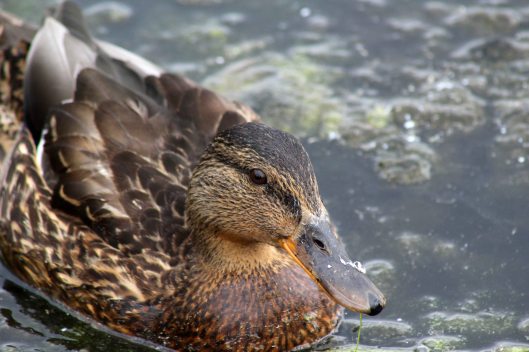
and House Sparrow, Pied Wagtail, Meadow Pipit, Chaffinch, Goldfinch, Linnet, Reed Bunting, and Mallard. It was a wonderful day’s birding.

190728 8 mallard female

Like Loading...

Smell a rat?

27 Wednesday Sep 2017

Posted by sconzani in animals, mammal, nature

≈ 10 Comments

Tags

British fauna, British mammals, brown rat, Cosmeston Lakes Country Park, rat, Rattus norvegicus

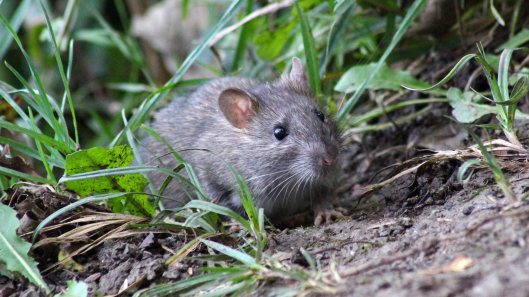
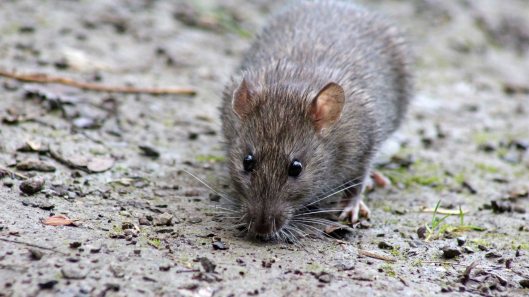
If you don’t like rats, look away now!

170927 Brown rat (4)

While I realise that a blog about rats might not appeal to everyone, I rarely get to see or write about mammals so, when these two rats came brazenly sniffing around for the seeds I was feeding to the birds at Cosmeston, I couldn’t resist taking photos. And once I have photos, a blog shall surely follow.

170927 Brown rat (1)
170927 Brown rat (2)
170927 Brown rat (3)

These are Brown rats (Rattus norvegicus), immigrants from central Asia that arrived in Britain around 1720. Of course, I don’t mean these two individuals arrived in 1720 – rats usually only live about a year in the wild – but their ancestors were sea-going rodents that just loved to sail the oceans wide and jumped ship wherever they docked. Nowadays, rats are more settled, and they’ll live almost anywhere – houses, gardens, parks, farmlands and farm buildings – you name it, there’s probably a rat in it somewhere.

170927 Brown rat (5)

They particularly like cereals – so, my bird seed would’ve gone down a treat – but they’ll eat pretty much anything, from small birds and their eggs to molluscs and food scraps. If you’re someone who hates these much-maligned creatures, remember that they too play an important part in the food chain, in particular as food for the owls and foxes that everyone loves.

Like Loading...

The seeds of success

26 Tuesday Sep 2017

Posted by sconzani in autumn, nature, plants, wildflowers

≈ 2 Comments

Tags

flower seeds, plant seeds, quotes about seeds, seed quotations, seeds, seeds of success

‘The vegetable life does not content itself with casting from the flower or the tree a single seed, but it fills the air and earth with a prodigality of seeds, that, if thousands perish, thousands may plant themselves, that hundreds may come up, that tens may live to maturity; that, at least one may replace the parent.’
~ Ralph Waldo Emerson

170926 seeds (1)
170926 seeds (3)
170926 seeds (6)
170926 seeds (2)
170926 seeds (5)
170926 seeds (4)
Like Loading...

Humming-bird hawk-moth

25 Monday Sep 2017

Posted by sconzani in insects, nature, seaside, wildflowers

≈ 8 Comments

Tags

British moths, Humming-bird hawk-moth, Macroglossum stellatarum, moth, moth like hummingbird, Red valerian

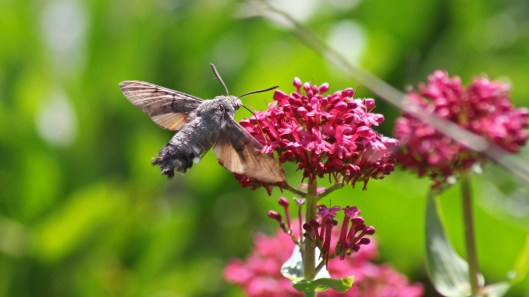
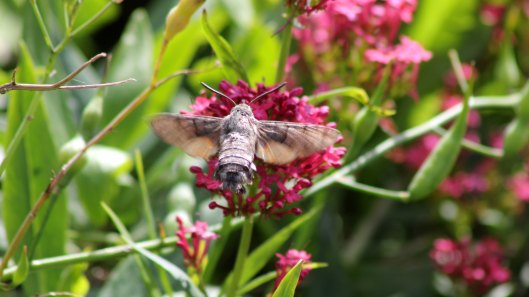
Remember how I wrote yesterday about some days being magical: first I was mobbed by Red admirals, next I discovered the Ivy bee colony and marvelled at its mating antics, and then, la pièce de résistance, I saw my very first Humming-bird hawk-moth.

170925 Humming-bird Hawk-moth (4)

And, by golly, it was difficult to photograph. I took around 70 pictures but most are a blur because, like the bird it’s named after, this moth just does not keep still. Macroglossum stellatarum is its formal name, and it came to Britain originally from Africa and southern Europe. The adult moths can be seen flying any time from April to late November, at which time they start looking for a crevice in a building, a hole in a wall, or a handy crack in a tree to while away the winter months.

170925 Humming-bird Hawk-moth (2)
170925 Humming-bird Hawk-moth (1)

That super-long tongue allows them to specialise in feeding from tube-shaped flowers like the Echiums, though this one was enjoying the nectar of Red valerian plants growing along the high-tide line at a local beach, humming (its wings) as it hovered from one flower to the next. Incredibly, studies have shown that Humming-bird hawk-moths often return to the same flowers at the same time every day. So, it’s a moth that looks like a bird but has the memory of an elephant – simply amazing!

170925 Humming-bird Hawk-moth (3)

Like Loading...

An Ivy bee mating ball

24 Sunday Sep 2017

Posted by sconzani in insects, nature, plants

≈ 5 Comments

Tags

bee mating frenzy, bees, bees on ivy, British bees, Colletes hederae, Ivy bee, Ivy bee mating ball, ivy flowers

Some days are just magical! I went out looking for birds – instead I got mobbed by Red admiral butterflies while walking along the coastal path, which made me grin like a Cheshire cat, and then I found these little buzzers.

170924 Ivy bees Colletes hederae (4)
170924 Ivy bees Colletes hederae (5)

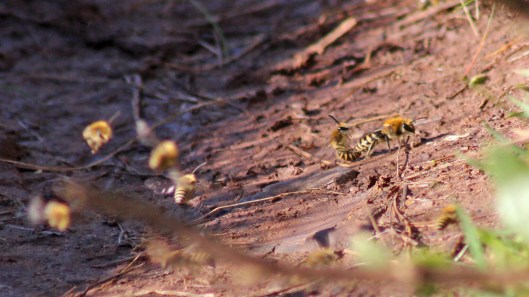
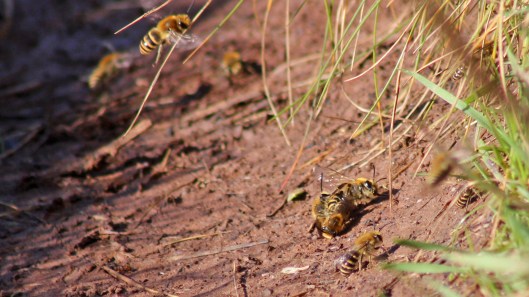
They’re Ivy bees (Colletes hederae) and, as their name suggests, they feed on ivy flowers so they don’t appear until early autumn, when most other bees are winding down activities for the year. With an orange woolly thorax and orange-and-black striped abdomen, these bees are easy to identify, though Colletes hederae was only described as a separate species back in 1993 (before that it was confused with two other species of Colletes). Ivy bees only arrived in Britain from Europe in 2001 but have since gradually spread across southern England and in to south Wales: the extent of their spread is being tracked by BWARS, the Bees, Wasps and Ants Recording Society, so please do log your sightings, either on their website here or with your local records centre.

170924 Ivy bees Colletes hederae (6)
170924 Ivy bees Colletes hederae (7)

I had seen my first Ivy bees for the year the previous week but this new sighting was more special because it was a colony. Though the Ivy bee is a solitary bee (it doesn’t form a hive), a group of females will often excavate their individual burrows and underground chambers together in a sandy bank or similar area of loose earth. And, as the BWARS website explains, male bees often wait by the burrows for females to return and then pounce on them. When the other males spot what’s happening, they also want a piece of the action, jumping on the mating couple to form a writhing mass or mating ball. I was lucky enough to see one of these happen, as shown below.

170924 Ivy bees Colletes hederae (1)170924 Ivy bees Colletes hederae (2)170924 Ivy bees Colletes hederae (3)

Like Loading...

The taming of the shrew

23 Saturday Sep 2017

Posted by sconzani in animals, mammal, nature

≈ Leave a comment

Tags

British mammals, mammal, Pygmy shrew, rodent, shrew, Sorex minutus

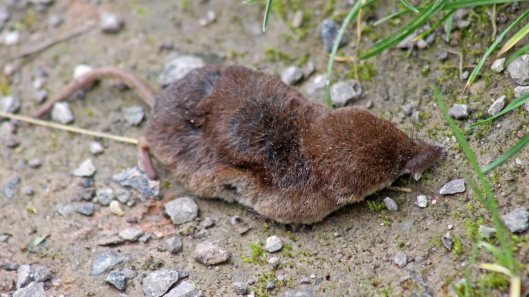
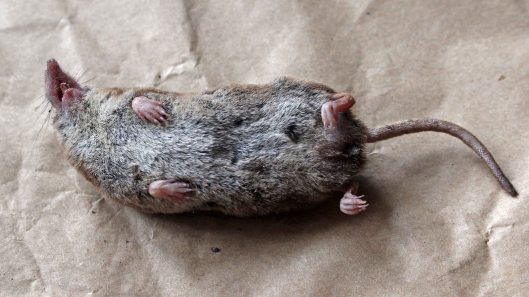
I have only ever seen two shrews, both sadly deceased. Britain has two species of shrew, the Common (Sorex araneus) and the Pygmy (Sorex minutus), but I believe the ones I have seen have been Pygmy shrews. Though both species have brown fur on their backs and silvery grey fur on their bellies, and they are of a similar size, the Pygmy shrew has a tail that is two-thirds the length of its body, whereas the Common shrew’s is half the length. It’s a small distinction and I’m sure experts could point to more scientific methods of distinguishing one from the other but, for me, the tail has to be the telling point.

170923 Pygmy shrew (1)

Pygmy shrews lead short but frantic lives. In their twelve to eighteen months of life the females can give birth to two, sometimes three litters of between 5 and 7 young. Though very few people ever see them, they are common in much of Britain, ferreting about frantically, in grasslands, woodlands, the fringes of arable fields and in the urban garden, for the small insects they like to eat. As you can see, they have tiny eyes but that relatively large snout gives them a keen sense of smell to help find their prey.

170923 Pygmy shrew (2)

In case you’re wondering how I managed to get such detailed photos of this little Pygmy shrew, I brought it home with me. This wasn’t just to get photos – through someone I know who is doing a PhD in biosciences at Cardiff University, this little creature has been donated to science. Its details will help in the study of these often elusive small mammals, and it will be preserved and used as a teaching aid. I was sad to find such a gorgeous wee beastie dead but at least its death has not been in vain.

170923 Pygmy shrew (3)
170923 Pygmy shrew (4)
170923 Pygmy shrew (5)
Like Loading...

Traveller’s joy

22 Friday Sep 2017

Posted by sconzani in flowers, nature, plants, wildflowers

≈ 2 Comments

Tags

biological recording, clematis vitalba, Old Man's Beard, SEWBReC, species of the month, Traveller's joy

The joy of this plant is that you see it wherever you travel in Britain. See what I did there?

170922 Travellers joy (1)

Clematis vitalba is most commonly called Traveller’s-joy but you might also know it as Old-man’s-beard, Father Christmas, Smokewood or Woodbine. Its feathery white seed heads are its most distinctive feature, making it easy to recognise and identify, and this really is a plant that you’ll see draped over hedges and fences almost everywhere in Britain.

170922 Travellers joy (4)
170922 Travellers joy (3)

Yet SEWBReC, the South East Wales Biodiversity Records Centre, have revealed that Traveller’s-joy is not well recorded: they have less than 2000 records in their database. And so they have made this plant their species of the month for September. If you spot Traveller’s-joy this month (or next, or the month after), please make a point of recording it with your local records centre – almost every county in Britain has its own records centre where you can log your biological sightings and those of you based in south-east Wales can find out more about biological recording, and the species of the month, on SEWBReC’s website.

170922 Travellers joy (2)

Like Loading...
← Older posts
Newer posts →

About me

sconzani

sconzani

I'm a writer and photographer; researcher and blogger; birder and nature lover; countryside rambler and city strider; volunteer and biodiversity recorder.

View Full Profile →

Follow earthstar on WordPress.com

Enter your email address to follow this blog and receive notifications of new posts by email.

Recent blog posts

  • Peak Wild garlic April 26, 2026
  • First damsels of 2026 April 25, 2026
  • NFY: Green-veined white April 24, 2026
  • The return of the Willow warblers April 23, 2026
  • Bug: Harpocera thoracica April 22, 2026

From the archives

COPYRIGHT

Unless otherwise acknowledged, the text and photographs on this blog are my own and are subject to international copyright. Nothing may be downloaded or copied without my permission.

Fellow Earth Stars!

  • Unknown's avatar
  • Unknown's avatar
  • Unknown's avatar
  • Unknown's avatar
  • Unknown's avatar
  • Unknown's avatar
  • Unknown's avatar
  • Unknown's avatar
  • Unknown's avatar
  • Unknown's avatar
  • Unknown's avatar
  • Unknown's avatar
  • Unknown's avatar
  • Unknown's avatar
  • Unknown's avatar
  • Unknown's avatar
  • Unknown's avatar
  • Unknown's avatar
  • Unknown's avatar
  • Unknown's avatar
  • Unknown's avatar
  • Unknown's avatar
  • Unknown's avatar
  • Unknown's avatar
  • Unknown's avatar
  • Unknown's avatar
  • Unknown's avatar
  • Unknown's avatar
  • Unknown's avatar
  • Unknown's avatar
  • Unknown's avatar
  • Unknown's avatar
  • Unknown's avatar
  • Unknown's avatar
  • Unknown's avatar
  • Unknown's avatar
  • Unknown's avatar
  • Unknown's avatar
  • Unknown's avatar
  • Unknown's avatar
  • Unknown's avatar
  • Unknown's avatar
  • Unknown's avatar
  • Unknown's avatar
  • Unknown's avatar
  • Unknown's avatar
  • Unknown's avatar
  • Unknown's avatar
  • Unknown's avatar
  • Unknown's avatar

Blog at WordPress.com.

Privacy & Cookies: This site uses cookies. By continuing to use this website, you agree to their use.
To find out more, including how to control cookies, see here: Cookie Policy
  • Subscribe Subscribed
    • earthstar
    • Join 642 other subscribers
    • Already have a WordPress.com account? Log in now.
    • earthstar
    • Subscribe Subscribed
    • Sign up
    • Log in
    • Report this content
    • View site in Reader
    • Manage subscriptions
    • Collapse this bar
 

Loading Comments...
 

You must be logged in to post a comment.

    %d