• ABOUT
  • BIRDING 2018
  • Birding 2019
  • BLOG POSTS
  • Butterflies 2018
  • Resources

earthstar

~ a celebration of nature

earthstar

Category Archives: nature

Rambling with reptiles

03 Monday Jul 2017

Posted by sconzani in 'Dedicated Naturalist' Project, nature, parks, reptiles, walks

≈ Leave a comment

Tags

adder, British reptiles, grass snake, Mary Gillham Archive Project, Parc Slip Nature Reserve, reptile ramble, reptile refugia, slow-worm, volunteering

If you’ve been following my ‘wild’ life for a while, you’ll remember that, in August last year, I went on a reptile ramble at the Wildlife Trust of South & West Wales’s Parc Slip Nature Reserve. Well, last Wednesday our team of trusty Mary Gillham Archives Project staff and volunteers went for another ramble, partly because we enjoyed the last one so much and partly as a way of farewelling the lovely Natalie, a university student who’s been working with us since last September. Though tinged with sadness at saying goodbye to Nat, we had an exciting ramble.

170703 Volunteers (1)
170703 Volunteers (2)

I thought perhaps the persistent drizzle might mean we wouldn’t see many reptiles but I was wrong. In fact, the reverse might actually have been true – the rain may well have encouraged the beasties to stay put under their refugia – except, that is, for one large adder, which I almost stepped on, as it was lying in the grass close to one of the shelters. So, though we didn’t see any lizards this time, we saw more adders, grass snakes and slow-worms than last year. Oh, and the bird’s-nest-shaped dried-grass vole nests under some of the refugia were really cute too.

170703 adder (1)
170703 adder (2)
170703 adder (3)
170703 grass snake
170703 slow-worm (1)
170703 slow-worm (2)
170703 Vole nest under refugia
Like Loading...
Square-bashing: SS9073

02 Sunday Jul 2017

Posted by sconzani in fungi, insects, molluscs, nature, walks

≈ 2 Comments

Tags

biodiversity, biodiversity in Wales, biological diversity, biological recording, biological records, square-bashing

170702 Square-bashing SS9073 (1)

A few days ago I posted about my square-bashing adventure near Llanbeder, in Gwent. Hilary and I have now also square-bashed another under-biodiversity-recorded 1-km square, this time near St Brides Major in Glamorgan.

170702 Square-bashing SS9073 (2)

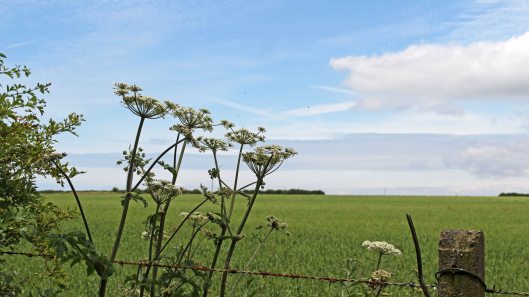
As the seagull flies we were within a kilometre of the sea and the geological substrate was very different, so the habitats we surveyed were more diverse. One public path led us down a heavily wooded driveway to an old house, another ran between the edge of that same woodland and fields sown with cereal crops (and there the hogweed was flowering which greatly improved my insect tally), and the third took us over paddocks of rough unimproved grassland, with patches of low rushes, all bordered by a wild old hedgerow.

170702 Square-bashing SS9073 (3)

Interestingly, this time Hilary’s plant list was about 20% lower than that from our previous square (though she still had around 80 species), whereas my list of everything else was about the same percentage higher (at around 100 species of insects, fungi and lichens, molluscs, etc).

170702 Banded burdock fly
170702 Bombus vestalis
170702 Cheilosia illustrata
170702 Chlorociboria sp Green elfcup
170702 Common marble moth
170702 Dark bush-cricket
170702 Fly
170702 fungi on cow dung Cheilymenia sp
170702 Horsefly
170702 Leptopterna dolabrata
170702 Small whites
170702 Snails and woodlice
Like Loading...

National Meadows Day

01 Saturday Jul 2017

Posted by sconzani in flowers, insects, nature, parks, seaside, walks, wildflowers

≈ Leave a comment

Tags

Lavernock Point, Lavernock Reserve, National Meadows Day, Wildlife Trust for South & West Wales

170701 Lavernock Reserve (3)

Happy National Meadows Day!

170701 Lavernock Reserve (2)

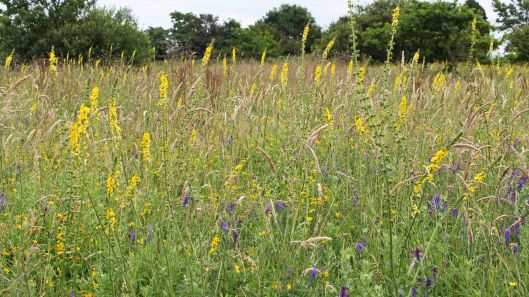
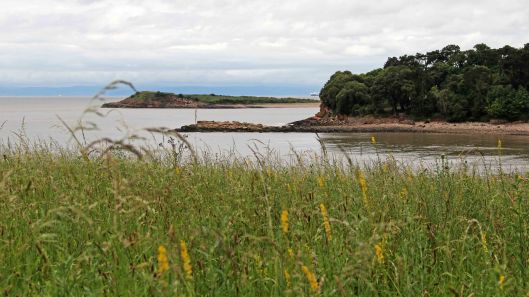
I had a slightly premature celebration by joining a Wildlife Trust walk around Lavernock Reserve on the south Wales coast yesterday. It’s an interesting place that has only become a reserve relatively recently. Due to its prime coastal position, a gun battery was built here back in 1860s and added to during the Second World War – these now form a scheduled ancient monument.

170701 Lavernock Reserve (1)

The meadows sit upon a substrate of clay over Jurassic limestone and, thanks to the tremendous efforts of dedicated volunteers who work constantly to contain the invading scrub, the grasslands are home to many lovely plant, insect and animal species, as well as a succession of migrating birds in spring and autumn.

170701 7-spot ladybird
170701 Centaury
170701 Common red soldier beetle
170701 Common spotted orchid & Selfheal
170701 Large skipper
170701 Marmalade hoverfly
170701 Orange-spot piercer
170701 Plume moth
170701 Restharrow
170701 Ringlet
170701 Snipe fly
170701 Swollen-thighed beetle
Like Loading...

In praise of hogweed

30 Friday Jun 2017

Posted by sconzani in insects, nature, plants, wildflowers

≈ 2 Comments

Tags

British flora, British wildflowers, food for insects, Heracleum sphondylium, Hogweed

170630 hogweed (1)

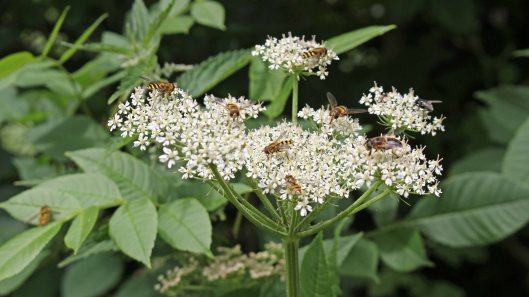
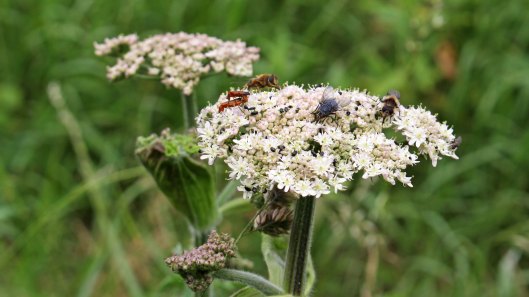
Hogweed is so named because the flowers are said to have a pig-like smell, though I can’t say that I’ve noticed. It has a ton of interesting-sounding common names, of which Bilers, Caddy, Eltrot, Limperscrimps, Cow-weed, Kirk, Chirk and Kek are just a few. Its Latin name, Heracleum sphondylium, is also interesting: Heracleum is a reference to the mythical Greek hero Heracles, who was said to have introduced the medicinal use of the plant to humans, and sphondylium comes from the Greek sphondylo, meaning backbone, and refers to the plant’s segmented stem.

170630 hogweed (3)

Hogweed is just coming in to flower now, adorning the roadsides, hedgerows and track edges in many of the parts of south Wales that I’ve visited recently.

170630 hogweed (2)

The statuesque purple-coloured-when-young stalks and those large white flower heads are glorious, indeed, but the very best thing about Hogweed, I think, is the food it provides for all manner of creatures, from flies and hoverflies to ants, bees and wasps, bugs and beetles.

170630 1 Common red soldier beetle
170630 2 Swollen-thighed beetle
170630 3 Cheilosia illustrata
170630 4 Noon fly
170630 5 Hogweed
170630 6 Broad centurion female
170630 7 Willow mason-wasp
170630 8 Stilt bug
170630 9 Hogweed leafminer
Like Loading...

The peace of wild things

29 Thursday Jun 2017

Posted by sconzani in nature, plants

≈ Leave a comment

Tags

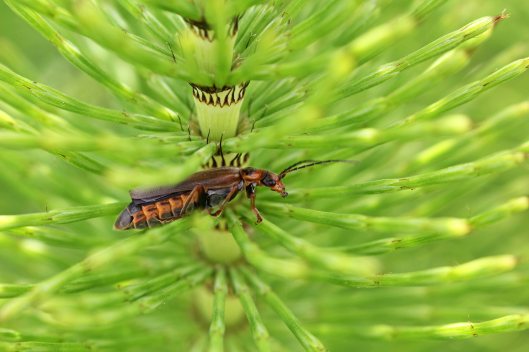
beetle, beetle in equisetum, Equisetum, Peace of wild things, Wendall Berry poem

170629 Peace of wild things

When despair for the world grows in me
and I wake in the night at the least sound
in fear of what my life and my children’s lives may be,
I go and lie down where the wood drake
rests in his beauty on the water, and the great heron feeds.
I come into the peace of wild things
who do not tax their lives with forethought
of grief. I come into the presence of still water.
And I feel above me the day-blind stars
waiting with their light. For a time
I rest in the grace of the world, and am free.

~ Wendell Berry (1934 – ), American poet, novelist and environmental activist

Like Loading...

Square-bashing: ST3990

28 Wednesday Jun 2017

Posted by sconzani in fungi, insects, nature, walks

≈ 5 Comments

Tags

bioblitz, biodiversity, biodiversity in Wales, biological recording, biological records, SEWBReC, square-bashing

I spent last Friday square-bashing with my friend Hilary, and what a brilliant day we had.

170628 ST3990 square-bashing (1)

For the uninitiated, square-bashing consists of taking a square kilometre that has very few existing biological records and walking the roads, tracks and paths through that square to see what you can find. Each month, my local biodiversity records centre SEWBReC publishes the details of just such a square in the counties they cover, Glamorgan and Gwent, in the hope that keen folks like Hilary and I will rectify the lack of records.

170628 ST3990 square-bashing (2)

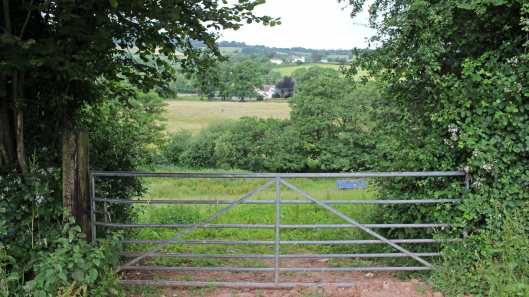
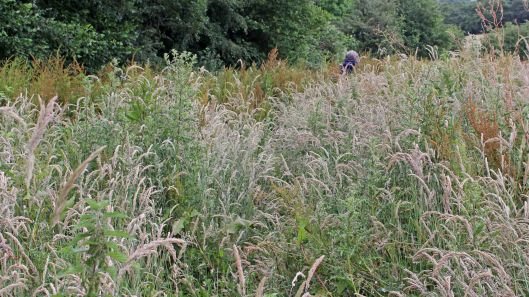
Although the term square-bashing is not meant to be taken literally, we did have to bash our way through one field in our square kilometre, where the public footpath was completely overgrown (spot Hilary in the photo below), but on the whole the countryside was beautiful, with rolling farmed fields, old narrow lanes and, the best part, an ancient holloway (more on that in a future post).

170628 ST3990 square-bashing (3)

Hilary’s something of a whizz when it comes to plants so she recorded those and I did everything else – insects, fungi, birds, you name it! As I’m not a whizz at anything, I mostly take lots of photos and then have to work out the IDs when I get home, which takes time but helps me learn. I have just a couple of outstanding queries but reckon my total will come to around 80 and Hilary has about 90 plants on her list, so it was a very good result indeed. Here are some of my finds – can you identify them?

170628 Beechmast candlesnuff Xylaria carpophila
170628 Common marble Celypha lacunana
170628 Cranefly Ptychoptera sp
170628 Eriophyes similis Gall mite
170628 Harlequin ladybird larva Harmonia axyridis
170628 Hawthorn shieldbug Acanthosoma haemorrhoidale
170628 Knot grass larva Acronicta rumicis
170628 Lagria hirta
170628 Meadow brown Maniola jurtina
170628 Pollen beetles Meligethes sp
170628 Snipe fly Rhagio tringarius
170628 Yellow dung fly Scathophaga stercoraria
Like Loading...

Cootlets, cootlings or cooties?

27 Tuesday Jun 2017

Posted by sconzani in birds, nature, spring

≈ 2 Comments

Tags

birding, birdwatching, British birds, chick, Coot, Coot babies, Coot chicks, Eurasian coot, Fulica atra


160627 Coot chicks (7)

The coot is a beauty but what of its chicks,
with their red baldy heads and orange hairy necks?

160627 Coot chicks (1)
160627 Coot chicks (2)
160627 Coot chicks (3)

Those gawdy colours soon change as they mature
to the timeless greys and blacks of haute couture.

160627 Coot chicks (4)
160627 Coot chicks (5)
160627 Coot chicks (6)

But what should we call these gorgeous wee cuties?
Should they be cootlets or cootlings or cooties?

160627 Coot chicks (8)

Like Loading...

The Welsh sheep

26 Monday Jun 2017

Posted by sconzani in animals, nature

≈ 2 Comments

Tags

New Zealand sheep, sheep, Welsh sheep

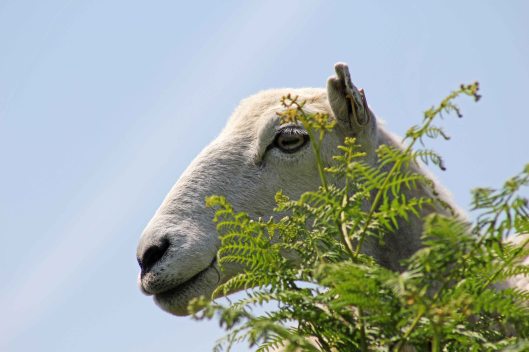
When I relocated from New Zealand to Wales in 2015, it didn’t occur to me that I was swopping one sheep-filled nation with another but so it has turned out.

170626 Welsh sheep (1)

Wales has around 10 million sheep; Welsh lamb is considered a delicacy; beautiful wool is produced locally; and I sometimes hear the same lewd sheep jokes that I used to hear in New Zealand.

170626 Welsh sheep (2)

The Welsh have taken their worship of the sheep one step further than New Zealand – there’s a National Wool Museum and, no, I haven’t been – but New Zealand still has a higher sheep to human ratio than Wales, at 7 to 1 as opposed to a measly 4 to 1.

170626 Welsh sheep (3)

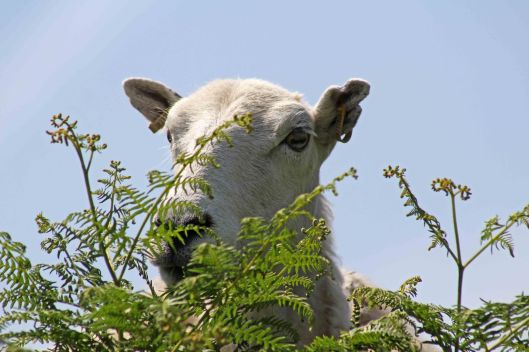
I met this friendly Welsh local on my recent birding trip to Lliw Reservoirs.

Like Loading...

Birding at Lliw Reservoirs

25 Sunday Jun 2017

Posted by sconzani in animals, birds, insects, nature, trees, walks, wildflowers

≈ Leave a comment

Tags

birding, birdwatching, Bog pimpernel, Foxgloves, Glamorgan Bird Club, Grey wagtail, Lliw Reservoirs, Red kite, slow-worm, Tormentil, Victorian dam, Victorian ironwork, Whitethroat

170625 Lliw Reservoirs (3)

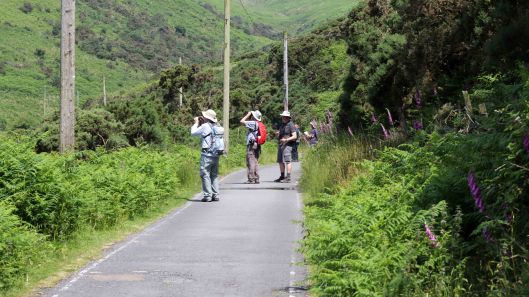
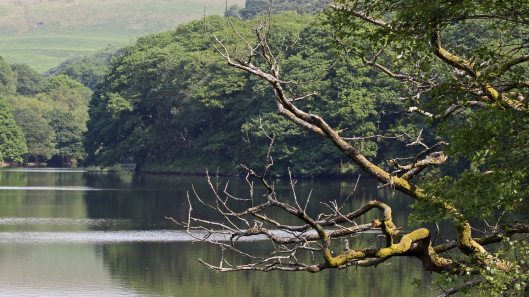
I celebrated the solstice with an outing with my Glamorgan Bird Club buddies to Lliw Reservoirs north of Swansea or, perhaps that should read, I sweated through the solstice – it was one of the hottest days of the year and the middle of a mini heatwave. Still, you know what they say about mad dogs and Englishmen (and Welshmen and a Kiwi) …

170625 Lliw Reservoirs (1)

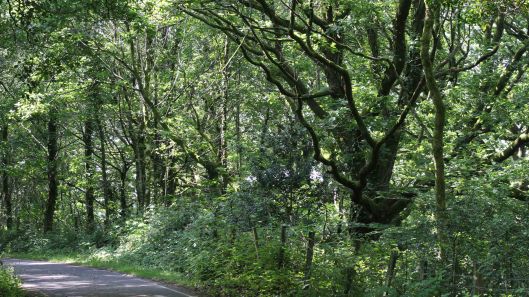
It’s a superb location. The two reservoirs were built in the second half of the 19th century, and still supply water to communities throughout south Wales. We only walked up one side of both reservoirs, through broadleaf woodland and then out onto open areas of grass and scrub and moorland, but there’s an 8-mile circular walk, which would be brilliant in cooler weather and includes large open commons of heath moorland on the hilltops.

170625 Lliw Reservoirs (2)

We heard more small birds than we saw (but that’s helping me learn their songs); buzzards and magnificent red kites were soaring overhead; we heard then saw the elusive grasshopper warbler in flight; dragonflies and damsels and the odd butterfly flitted about; and there were lots of lovely wildflowers (my particular favourites were the foxgloves, tormentil and bog pimpernel). Oh and, most importantly, the locals were friendly and the cafe serves delicious ice cream!

170625 Whitethroat
170625 Tormentil
170625 Slow-worm
170625 Lliw Reservoirs uplands
170625 Peacock
170625 Red kite
170625 Foxglove
170625 Grey wagtail
170625 Victorian ironwork
170625 Bog pimpernel
170625 Welsh sheep
170625 Pines & foxgloves
Like Loading...

The skimmers

24 Saturday Jun 2017

Posted by sconzani in insects, nature

≈ 4 Comments

Tags

Black-tailed skimmer, British dragonflies, dragonflies, dragonfly, Keeled skimmer, Orthetrum cancellatum, Orthetrum coerulescens

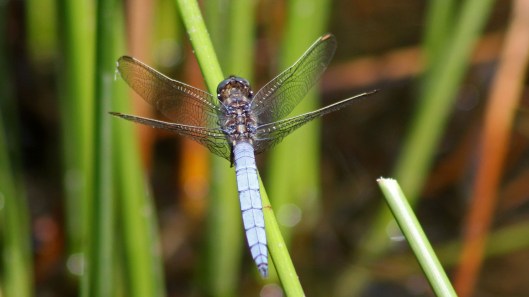
When the birds disappear behind the leaves of the trees during the summer months, my eye turns to the other creatures that delight and amaze with their aerial displays, and the dragonflies are some of the most impressive. In recent weeks I’ve seen my first Skimmers.

170624 Keeled skimmer

Keeled skimmer (Orthetrum coerulescens)
I was on a walk with my bird club buddies in the hills above Swansea this week when I saw my first Keeled skimmer. It was flitting back and forth quite restlessly in a boggy reed-filled area, perching on the reeds and other vegetation but only for short periods, so I was lucky to get some reasonable photos. I love the brilliant blue colour, called pruinescence, which is actually a covering of wax particles and which can be rubbed off during mating or if the dragonfly accidentally rubs against vegetation. Keeled skimmers are mostly found in western Britain and fly from June through to September.

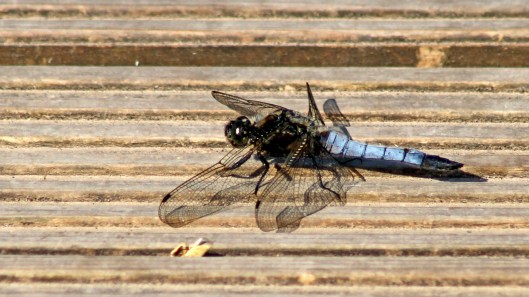
170624 Black-tailed skimmer

Black-tailed skimmer (Orthetrum cancellatum)
Though very similar in appearance to the Keeled skimmer, the Black-tailed skimmer has, as its name implies, a darker end to its abdomen, and it’s much more common, as it’s happy to live around any pond, lake or stream, rather than the acidic moorland that the Keeled skimmer prefers. Though it is more common in southern parts of Britain, it has gradually been extending its range northwards, and its flight period is a little longer than its keeled cousin, being on the wing sometimes as early as late April right through to October if conditions are mild enough.

170624 Keeled skimmer (2)
170624 Black-tailed Skimmer (2)
Like Loading...
← Older posts
Newer posts →

About me

sconzani

sconzani

I'm a writer and photographer; researcher and blogger; birder and nature lover; countryside rambler and city strider; volunteer and biodiversity recorder.

View Full Profile →

Follow earthstar on WordPress.com

Enter your email address to follow this blog and receive notifications of new posts by email.

Recent blog posts

  • Peak Wild garlic April 26, 2026
  • First damsels of 2026 April 25, 2026
  • NFY: Green-veined white April 24, 2026
  • The return of the Willow warblers April 23, 2026
  • Bug: Harpocera thoracica April 22, 2026

From the archives

COPYRIGHT

Unless otherwise acknowledged, the text and photographs on this blog are my own and are subject to international copyright. Nothing may be downloaded or copied without my permission.

Fellow Earth Stars!

  • Unknown's avatar
  • Unknown's avatar
  • Unknown's avatar
  • Unknown's avatar
  • Unknown's avatar
  • Unknown's avatar
  • Unknown's avatar
  • Unknown's avatar
  • Unknown's avatar
  • Unknown's avatar
  • Unknown's avatar
  • Unknown's avatar
  • Unknown's avatar
  • Unknown's avatar
  • Unknown's avatar
  • Unknown's avatar
  • Unknown's avatar
  • Unknown's avatar
  • Unknown's avatar
  • Unknown's avatar
  • Unknown's avatar
  • Unknown's avatar
  • Unknown's avatar
  • Unknown's avatar
  • Unknown's avatar
  • Unknown's avatar
  • Unknown's avatar
  • Unknown's avatar
  • Unknown's avatar
  • Unknown's avatar
  • Unknown's avatar
  • Unknown's avatar
  • Unknown's avatar
  • Unknown's avatar
  • Unknown's avatar
  • Unknown's avatar
  • Unknown's avatar
  • Unknown's avatar
  • Unknown's avatar
  • Unknown's avatar
  • Unknown's avatar
  • Unknown's avatar
  • Unknown's avatar
  • Unknown's avatar
  • Unknown's avatar
  • Unknown's avatar
  • Unknown's avatar
  • Unknown's avatar
  • Unknown's avatar
  • Unknown's avatar

Blog at WordPress.com.

Privacy & Cookies: This site uses cookies. By continuing to use this website, you agree to their use.
To find out more, including how to control cookies, see here: Cookie Policy
  • Subscribe Subscribed
    • earthstar
    • Join 642 other subscribers
    • Already have a WordPress.com account? Log in now.
    • earthstar
    • Subscribe Subscribed
    • Sign up
    • Log in
    • Report this content
    • View site in Reader
    • Manage subscriptions
    • Collapse this bar
 

Loading Comments...
 

You must be logged in to post a comment.

    %d