Signs of Spring, 3
25 Saturday Mar 2017
Posted in insects, ladybird, nature, spring, wildflowers
25 Saturday Mar 2017
Posted in insects, ladybird, nature, spring, wildflowers
24 Friday Mar 2017
23 Thursday Mar 2017
Tags
clouds, Understanding Clouds, weather, World Meteorological Day, World Meteorological Organization
Who hasn’t looked at a cloud and imagined they saw a giant, a face, a … ?

Today is World Meteorological Day, the brainchild of the World Meteorological Organization (WMO), and this year’s theme is ‘Understanding Clouds’. The WMO has a great website that not only explains the importance of clouds in weather forecasting and in driving the entire climate system but also has free downloadable resources to aid in cloud identification. Or, if you’d rather have a book with ‘hundreds of images of clouds, including a few newly classified cloud types’, plus ‘other meteorological phenomena such as rainbows, halos, snow devils and hailstones’ then 23 March also marks the launch of the latest edition of the International Cloud Atlas, which ‘has now been produced in a digital format and is accessible via both computers and mobile devices’.
I’m sure you won’t be surprised to learn I’m a big fan of clouds and, though I’m utterly hopeless at naming them – yet another subject I need to study, I do have rather a lot of cloud photos. The sequence below covers a period of about 18 months, from my time living in an apartment in Auckland, New Zealand, where I had the most wonderful views.
22 Wednesday Mar 2017
Posted in geology, nature, nature photography
Tags
Maras, Peru, Salineras, Salineras de Maras, salt, salt mining, salt pans

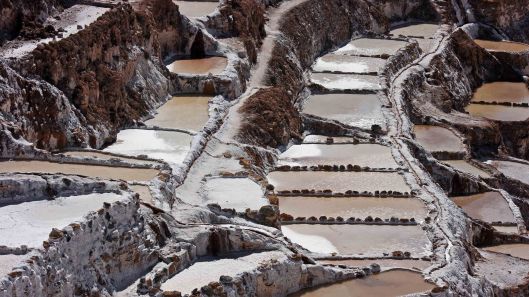
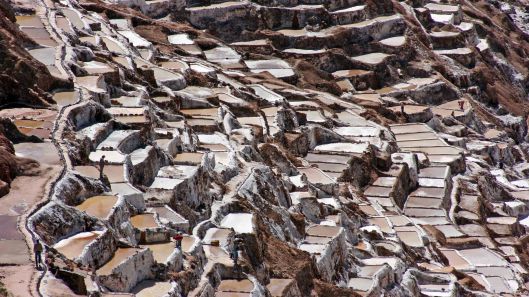
Last week I showed you the largest salt flats in the world in Bolivia. This week we’re still in South America but have moved north to Peru, to Salineras de Maras in the Andean Mountains about 40 kilometres from Cusco, where salt has been mined for hundreds of years.

The earliest salt pans are thought to have been constructed by the Wari civilisation, but it was their successors, the Incas, who recognised the commercial opportunities of salt-mining and increased the extent of the pans, which now cover much of a steep gorge that runs down in to the Sacred Valley. The salty water bubbles to the surface in a small spring from ancient salt lakes now buried deep below the earth’s surface, and is ingeniously conveyed down the mountainside via a meandering maze of irrigation channels. People from the local community work constantly to maintain these channels and to ensure just the right amount of water is allowed into each pan before the pan is closed off and allowed to dry out. The sun’s heat evaporates the water, leaving behind a thick coating of salt, which is harvested for sale – and then the whole process starts all over again.
Salineras de Maras is very near the intriguing Inca site of Moray and the wonderful market town of Chincero, so combining a visit to all three makes for a thoroughly enjoyable and interesting day’s excursion from Cusco. Or, if you want to spend a little more time getting a feel for your surroundings, try the hike from Moray through Maras and the salt pans down to the Sacred Valley. It’s well worth the effort.
21 Tuesday Mar 2017
Tags
autumn colour, C. S. Lewis, Delamere Forest, forests, International Day of Forests, The Future of Forestry, World Poetry Day

How will the legend of the age of trees
Feel, when the last tree falls in England?
When the concrete spreads and the town conquers
The country’s heart; when contraceptive
Tarmac’s laid where farm has faded,
Tramline flows where slept a hamlet,
And shop-fronts, blazing without a stop from
Dover to Wrath, have glazed us over?
Simplest tales will then bewilder
The questioning children, “What was a chestnut?
Say what it means to climb a Beanstalk,
Tell me, grandfather, what an elm is.
What was Autumn? They never taught us.”
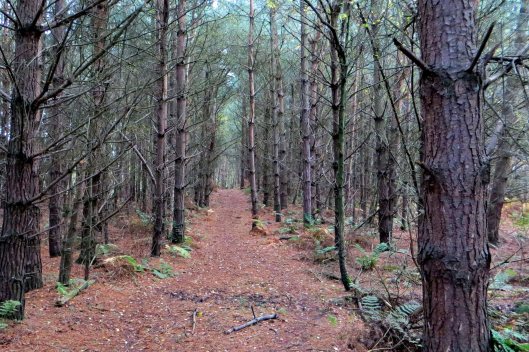
~ an extract from C. S. Lewis’s ‘The Future of Forestry’, for this the International Day of Forests and World Poetry Day. My photos are of Delamere Forest, Cheshire, in the autumn.

20 Monday Mar 2017
Posted in insects, nature, nature photography
Tags
British beetles, Oedemera, Oedemera (Oncomera) femoralis, Oedemera femoralis, Swollen-thighed beetle, Thick-legged beetle, Thick-legged flower beetle

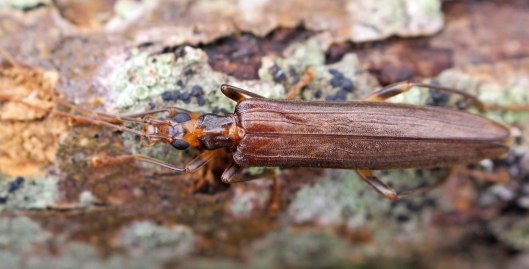
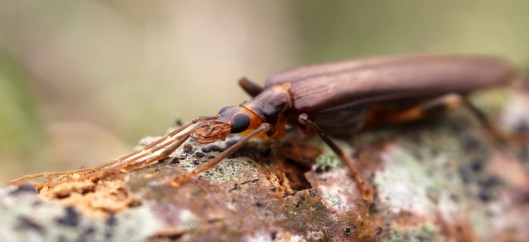
From the kingdom of Animalia, the phylum of Arthropoda, the class Insecta, the order Coleoptera, the family Oedemeridae and the genus Oedemera, may I present my first beetle sighting of 2017 – and a new beetle for me to boot – a stunning example of the species Oedemera (Oncomera) femoralis. There are only 4 species of Oedemera in Britain (here’s another) and only 1 – this one – in the subgenera Oncomera. In layman’s words, she is one of the thick-legged (some people say swollen-thighed) flower beetles and I know it’s a female precisely because she does not have those swollen thighs.
I was lucky to find her as her species is nocturnal, feeding at night on the pollen and nectar of ivy and willow. During the day, they lurk under twigs and branches, which is how I found her, by picking up twigs and branches looking at lichen and searching for slime moulds. These insects grow to between 13 and 20mm long, and can be found in the more southerly counties of England and Wales, though they are not often recorded – there are just 278 recorded sightings in the NBN database (see map above), of which 65 are in Wales. I count myself amongst those fortunate to have seen such a beautiful little creature!

If you’re an insect geek (and I do not use that word disparagingly), you can see the full details of this species on the website of the Watford Coleoptera Group.
19 Sunday Mar 2017
Tags
chicken, chicken idioms, chicken in language, chicken quotes, chicks, National Poultry Day, poultry, poultry around the world, World Poultry Day

When I read today was World Poultry Day and I was wondering how to honour the humble chicken (yes, poultry includes many other birds but I’m sticking with the chicken), it occurred to me how thoroughly the chicken has become interwoven in our daily lives. The chicken, which was domesticated from the Red junglefowl of South East Asia thousands of years ago, features heavily in famous quotes and proverbs, and in the idioms we use in our everyday language. And then there is the age-old joke opening line, ‘Why did the chicken cross the road?’, and the age-old philosophical question, ‘Which came first the chicken or the egg?’ Here are just a few examples from a very long list:
Famous quotes:
‘A hen is only an egg’s way of making another egg.’ ~ Samuel Butler
‘Business is never so healthy as when, like a chicken, it must do a certain amount of scratching for what it gets.’ ~ Henry Ford
‘Regard it as just as desirable to build a chicken house as to build a cathedral.’ ~ Frank Lloyd Wright

Proverbs:
It is better to be the head of a chicken than the rear end of an ox. – Japanese
Curses, like chickens, always come home to roost. – Spanish
Don’t count your chickens before they are hatched. – known in many countries
Idioms:
To chicken out – to decide not to do something, usually out of fear and at the last minute
chicken feed – a small amount of money
To be like a mother hen – to be very protective
To be as scarce as hen’s teeth – to be extremely hard to find
Hen-pecked – nagged
To fly the coop – to leave
To be chicken – to be afraid
To be no spring chicken – to be old

Dyed chicks in a market in Morocco, a bizarre sight and definitely not recommended or endorsed by me, I assure you!

18 Saturday Mar 2017
17 Friday Mar 2017
Tags
Goethe's Theory of Colours, green, green feathers, green leaves, green plants, green trees, psychology of colours
Happy St Patrick’s Day! It seemed appropriate to honour St Paddy and those from the Emerald Isle with a blast of green today. I think Goethe got the feel of green exactly right in his Theory of Colours:
The eye experiences a distinctly grateful impression from this colour. If the two elementary colours [blue and yellow] are mixed in perfect equality so that neither predominates, the eye and the mind repose on the result of this junction as upon a simple colour. The beholder has neither the wish nor the power to imagine a state beyond it. Hence for rooms to live in constantly, the green colour is most generally selected.
And this is why walking in a forest of green trees, sitting on a grassy lawn, or strolling in a garden all make us feel happy. Now, where did I put that paintbrush?
16 Thursday Mar 2017
Tags
bird-ringing, birding, birdwatching, British birds, BTO, colour rings on Redshank, European Colour-ring birding, Redshank
I first spotted this ringed Redshank on 27 January, near Penarth Marina in Cardiff Bay, and I saw it again, in almost the exact same location, on 11 March. I reported my initial sighting through the European Colour-ring Birding website – it’s really easy to do this and excellent for long-term research into bird behaviour so please do report any ringed birds you see. As the website is totally run by volunteers, it’s taken a little while to get information back on my bird but, today I got this email report from Emily at BTO (British Trust for Ornithology):

This bird was ringed (DK10753) as an adult on 22/2/2016 at Peterstone Great Wharf, and has been re-sighted a number of times at/around Cardiff Bay (on 3/3/16, 3/1/17 and 22/1/17). It was also seen at St Thomas Head on 11/3/16. It was ringed as part of a study examining the winter movements of Redshank, Curlew, Dunlin, Wigeon, Teal and Shelduck in relation to the proposed tidal lagoon (see HERE for more details).

So, my Redshank has spent his winter months – all the sightings were between January and March – in locations not very far from that initial ringing spot but I wonder where he goes in the summer to breed? Previous BTO research has shown that British-ringed Redshanks breed in Iceland and along the coastline of north-western Europe, so this little bird may soon be heading off on rather a long flight.
You must be logged in to post a comment.