• ABOUT
  • BIRDING 2018
  • Birding 2019
  • BLOG POSTS
  • Butterflies 2018
  • Resources

earthstar

~ a celebration of nature

earthstar

Category Archives: wildflowers

251/366 Bs and Ts

07 Monday Sep 2020

Posted by sconzani in insects, plants, wildflowers

≈ Leave a comment

Tags

Buff-tailed bumblebee, bumblebees, Burnet moth, Common carder bee, insects on teasels, Meadow Brown, Teasel

Bumblebees and Teasels – I’m not sure why but they seem to be a match made in heaven.

200907 bumblebee and teasel (1)
200907 bumblebee and teasel (2)

In fact, bumblebees are the insects I see most often nectaring on Teasels, though the Burnet moths also find Teasel to their taste, as did this Meadow brown butterfly yesterday.

200907 burnet and teasel
200907 meadow brown and teasel
Like Loading...

250/366 In a farm field

06 Sunday Sep 2020

Posted by sconzani in plants, wildflowers

≈ Leave a comment

Tags

British wildflowers, Common field-speedwell, Greater plantain, Persicaria maculosa, Plantago major, Redshank, Veronica persica

Earlier this year, when we were in full lockdown and our Council, in their stupidity, closed the spacious local country park even to local pedestrians, I was one of many who looked for alternative places, other than too-narrow pavements, to walk, and in the process discovered a disused lane that leads to farm fields, which, this year, have not been leased for crop growing. These fields are where, in recent months, I’ve seen many nice birds, and plants like the Musk thistle I blogged about in July and the Lesser burdock from August’s Burdock Beasties. These are a few more finds from those fields.

200906 redshank (2)
200906 redshank (1)

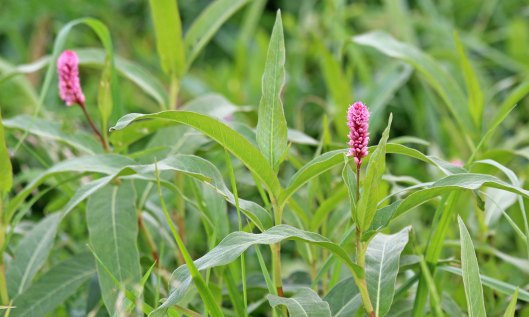
Redshank (Persicaria maculosa)
Of course, you can find Redshank in many diverse locations – it thrives along the lane behind my flat – but it seems to be doing particularly well in this arable landscape. You may notice that Redshank bears a strong resemblance to the Amphibious bistort I blogged about on Thursday – they are both from the genus Persicaria, and, if you want to know more about this fascinating plant, I recommend you read the entry on the Plant Lore website, which will explain why one East Anglian name for the plant is ‘devil’s arse-wipe’!

200906 Greater plantain (2)
200906 Greater plantain (1)

Greater plantain (Plantago major)
Its name may be Greater plantain but I think this is the Greatest plantain I’ve ever seen – it was huge. The Plantlife website has some fascinating information about this plant:
A common name is Rat’s tails which perfectly describes the plant’s flowering spike. Another vernacular name is Angels’ harps because when you pull the leaves apart you get the fibres showing between. This is also the likely explanation for the names Banjos and Beatles’ guitars.
Plantain has healing powers since the leaves contain tannins and astringent chemicals, which can make them useful styptics if crushed and applied to small cuts.

200906 common field-speedwell (1)

Common field-speedwell (Veronica persica)
I have trouble identifying the various members of the Speedwell family but I’m fairly confident about this one – it was low and sprawling and hairy, and its solitary flowers were on stems growing from the bases of the upper leaves. A check of its seed capsules would’ve clinched it but I forgot to look at those. As its name implies, Common field-speedwell is commonly found in fields – in fact, my footpath today took me along the edge of a field where the farmer is growing maize and the soil between the maize plants was completely covered by this lovely plant with its delicate blue flowers.

200906 common field-speedwell (2)
200906 common field-speedwell (3)
200906 common field-speedwell (4)
Like Loading...

247/366 Amphibious bistort

03 Thursday Sep 2020

Posted by sconzani in nature, plants, wildflowers

≈ 1 Comment

Tags

Amphibious bistort, amphibious wildflower, British flora, British wildflowers, Cosmeston Lakes Country Park, Persicaria amphibia

Initially, I doubted my identification of this plant – I’d seen it growing in clumps in the waters of Cosmeston Country Park’s west lake, so how could this be the same plant growing in a section of meadow, albeit a damp area where reeds are abundant?

200903 amphibious bistort (1)

The Great crested grebes like to park themselves amongst the plant, perhaps to stop them drifting while they snooze.

The clue, of course, is in its name: amphibious, ‘relating to, living in, or suited for both land and water’ (Oxford Dictionary). Amphibious bistort (Persicaria amphibia) has two forms, one that resembles a water lily, floating its leaves upon the water surface, and another that lives quite happily on land that can be quite a distance from water, as long as that land is moist.

200903 amphibious bistort (2)

This second type also shows the somewhat more elongated leaves that its generic name refers to – persicaria ‘relates the shape of leaves of this group of plants to those of a peach tree’ (First Nature) – and the land-based form has hairy leaves, which the water-growing form does not. To clinch the identification, my book (The Wild Flower Key) says to look for two stigmas in most flowers, which Amphibious bistort has but similar species do not. And very pretty flowers they are too!

200903 amphibious bistort (3)
200903 amphibious bistort (4)
200903 amphibious bistort (5)
Like Loading...

243/366 Wildflower oddities

30 Sunday Aug 2020

Posted by sconzani in nature, wildflowers

≈ Leave a comment

Tags

British wildflowers, Common knapweed, Devil's-bit scabious, odd-coloured wild flowers, pink-flowered Devil's-bit scabious, white-flowered Common knapweed

I’ve mentioned before here on the blog the white flowers of the usually pink-flowered Common centaury (Small and white, July 2020) and the blue flowers of the usually orange-red-flowered Scarlet pimpernel (The Pimpernels, July 2017). Today, I have another couple of wildflower oddities for you.

200830 pink devil's-bit scabious (3)

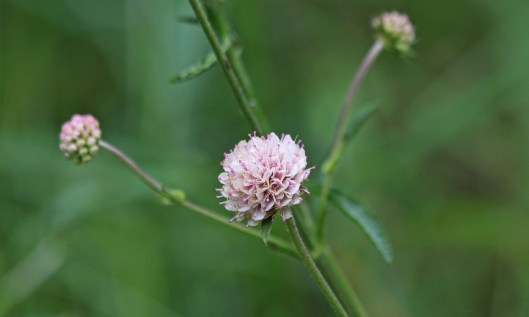
Pink Devil’s-bit scabious (Succisa pratensis)
As I’m sure you’re aware, the flowers of Devil’s-bit scabious are usually somewhere in the lilac, blue-mauve range but, at Lavernock Nature Reserve, there are quite a number of plants with pink flowers. I’ve read this is a natural variation but I don’t know if there is something specific that triggers the alteration in colour. At Lavernock, the pink-flowering plants grow right next to those with lilac flowers, so it’s certainly nothing to do with the soil.

200830 pink devil's-bit scabious (1)200830 pink devil's-bit scabious (2)

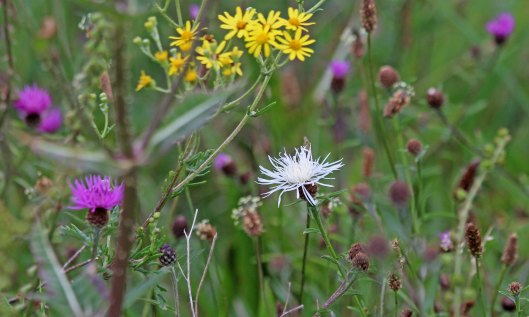
White Common knapweed (Centaurea nigra)
Also at Lavernock Nature Reserve, I recently found Common knapweed with stunning white flowers. This plant, of course, usually has flowers in the pink-purple range. Once again, plants with purple and white flowers were growing right next to each other, which presumably rules out soil composition as a factor. It’s a mystery, but a rather lovely mystery, to be sure!

200830 white knapweed (1)200830 white knapweed (2)

Like Loading...

239/366 Spurges

26 Wednesday Aug 2020

Posted by sconzani in nature, plants, wildflowers

≈ Leave a comment

Tags

British wildflowers, Cypress spurge, Euphorbia cyparissias, Euphorbia helioscopia, Euphorbia peplus, Petty spurge, spurge, Sun spurge

The Oxford Dictionary tells me that the word spurge was first used in Late Middle English and is a ‘shortening of Old French espurge, from espurgier, from Latin expurgare “cleanse” (because of the purgative properties of the milky latex)’. If you have sensitive skin, you may want to be wary of touching that latex, which both the stem and leaves will exude if broken, as it can irritate.

200826 Petty spurge (1)
200826 Petty spurge (2)

In fact, the latex in Petty spurge (Euphorbia peplus) is so caustic that it’s used in medications for the removal of warts and veruccas. This is the spurge I see most often, as it seems to enjoy the edges of pavements and lanes, road verges and waste ground and, though an annual, it can be seen over a long period, from April right through to October.

200826 sun spurge (2)

Sun spurge (Euphorbia helioscopia) is superficially similar to Petty spurge but is slightly larger and has a shorter growing period, from May to August. The easiest way to tell one spurge from the other is by counting the rays in the umbel: Petty spurge has three rays while Sun spurge has five. Although Sun spurge supposedly enjoys a similar growing environment to Petty spurge, I don’t see it very often in my urban area: as the photo below indicates, my find was growing in an arable field (where no crops were sown this season, but some residue crops have sprouted).
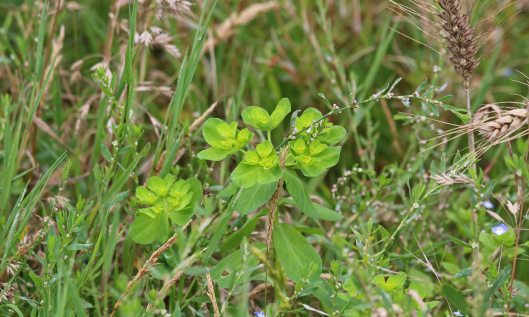
200826 sun spurge (1)

Perhaps because of its irritant sap, Sun spurge has a wealth of interesting common names. These are from the Royal Horticultural Society’s website: cat’s milk, churn staff, little good, little goody, mad woman’s milk, mare’s milk, mouse milk, wart grass and wartwort.

200826 cypress spurge (2)
200826 cypress spurge (1)

Cypress spurge (Euphorbia cyparissias) is the most unusual and intriguing of today’s spurges. I found a large area of this very attractive plant growing on top of the Aberbargoed coal spoil tip on 29 July but it’s taken a couple of weeks to get the identification confirmed. I’m not sure how the plant came to be on the tip – my guide book says Cypress spurge is ‘possibly native’ in southern Britain but a probable garden escape elsewhere (The Wild Flower Key).

Like Loading...

238/366 Midge galls

25 Tuesday Aug 2020

Posted by sconzani in autumn, insects, nature, plants, wildflowers

≈ 2 Comments

Tags

British galls, British insects, British wildflowers, Cosmeston Lakes Country Park, galls on wild carrot, Kiefferia pericarpiicola, midge gall, Wild carrot

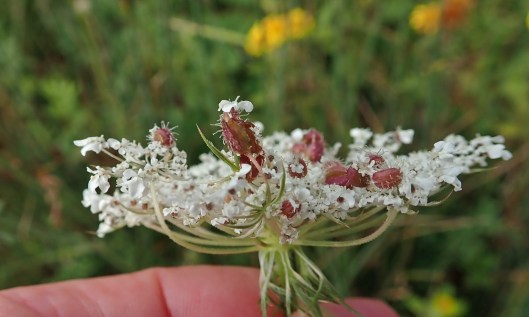
I was looking around at the various wildflowers yesterday at Cosmeston, seeing what insects might be about, when I noticed these odd growths on some of the Wild carrot flower heads. I split one open with my finger nail and a miniscule orange blob fell out; turns out that was the larva of a midge with the long-winded name of Kiefferia pericarpiicola.

200825 Kiefferia pericarpiicola (1)

The galls start off green (below left), before turning pinkish and eventually brown. According to the Nature Spot website, these galls can be seen from late summer through to autumn, after which the larvae will leave the gall and drop down to the soil to pupate. The midge only occurs in southern parts of Britain at the moment – and I only found two previous records in the Welsh biodiversity database – but perhaps that will change as our climate continues to warm and the midge flies further afield. It’s also possible, of course, that this insect is under-recorded – it seems the midge itself is almost never seen, only its gall creations.

OLYMPUS DIGITAL CAMERA
Like Loading...

236/366 On the fleabane

23 Sunday Aug 2020

Posted by sconzani in insects, nature, wildflowers

≈ 2 Comments

Tags

British butterflies, British insects, British wildflowers, Common fleabane, fleabane, insects on fleabane, Pulicaria dysenterica

The local fields are ablaze with Common fleabane (Pulicaria dysenterica), which the Plantlife website says has a
‘curious scent, with hints of carbolic soap and chrysanthemum, [which] is an insect repellent. In the past it was kept in houses specifically for the purpose of driving away fleas. Bunches were dried and burned as a fumigant or hung in rooms.’
Well, it may be the bane of fleas and it may act as an insect repellent when it’s been dried but, from what I can see, when it’s alive and fresh, most insects love it!

200823 speckled bush-cricket

As well as that Speckled bush-cricket, I’ve found 9 species of butterfly and 1 moth nectaring on Fleabane flowers.

200823 b brimstone
200823 b brown argus
200823 b common blue
200823 b gatekeeper
200823 b painted lady
200823 b meadow brown
200823 b pyrausta purpuralis
200823 b small copper
200823 b small tortoiseshell
200823 b small white

And then there are the hoverflies and assorted other flies, bees and bumbles. It’s more like a magnet than a repellent.

200823 honey bee
200823 syrphus sp
200823 helophilus pendulus
200823 buff-tailed bumble
200823 fly sp
200823 Chrysotoxum bicinctum
200823 eristalis pertinax
200823 nomada sp
200823 Sphaerophoria sp
200823 eristalis horticola
200823 picture-winged fly
Like Loading...

229/366 More peas please

16 Sunday Aug 2020

Posted by sconzani in nature, wildflowers

≈ Leave a comment

Tags

Black medick, British wildflowers, Common restharrow, Cosmeston Lakes Country Park, Ervilla hirsuta, Grangemoor Park, Hairy tare, Medicago lupulina, Ononis repens, Pea plant family

You’ll recall that a couple of weeks ago we had some members of the Pea family (A Pod of Peas, 26 July) – well, here are another three members of that extensive kin group.

Common restharrow (Ononis repens)
The name ‘restharrow’ comes from the fact that this wildflower’s thick long roots were ‘tough enough to stop a horse-drawn harrow in its tracks’ (Flora Britannica) and that esteemed publication also notes that those roots could be chewed, with a taste like liquorice. According to the Plantlife website, the plant’s shoots also had culinary uses: they could be boiled as a vegetable or eaten in salads.

200809 common restharrow (2)
200809 common restharrow (1)

200809 common restharrow (3)

Hairy tare (Ervilla hirsuta)
There’s an abundance of this little plant curling and winding itself through the rough grassland and wildflower fields at Grangemoor Park. As its flowers are rather small, it’s easy to miss how lovely they are but they’re definitely worth a closer look, anytime from May to August.

200816 hairy tare (3)200816 hairy tare (4)

Black medick (Medicago lupulina)
This is a plant I often see along the edges of roads but it’s also particularly numerous in one of the wildflower fields at Cosmeston Lakes Country Park. The First Nature website explains its scientific name thus:
‘The genus name Medicago refers to the region of Iran known as Media, where this plant was thought to have originated. The specific epithet lupulina means “wolf-like” – a reference to the flowers of the hop Humulus lupulus, which its inflorescence resembles.’

200816 black meddick (2)
200816 black meddick (4)

200816 black meddick (1)


Like Loading...

224/366 Burdock beasties

11 Tuesday Aug 2020

Posted by sconzani in insects, nature, plants, wildflowers

≈ 1 Comment

Tags

Arctium minus, Banded burdock fly, British insects, Common Green Shieldbug, Lesser burdock, Palomena prasina, Terellia tussilaginis

Lesser burdock (Arctium minus) seems to be having a good year as I’ve been finding lots of vigorous, flowering plants during my local walks, and they’re home to some interesting mini-beasties. One I always look for is the Banded burdock fly (Terellia tussilaginis), and it also seems to be thriving locally.

200811 lesser burdock (4)200811 lesser burdock (5)200811 lesser burdock (6)

And, on one particular clump of burdock, I found a bounty of Common green shieldbugs (Palomena prasina), as I’ve done before (see my previous post Keeping it in the family, from September 2017). Once again, these were a mix of juvenile stages, 3rd and 4th instars, I think.

200811 lesser burdock (1)
200811 lesser burdock (2)
200811 lesser burdock (3)

Of course, there are lots of other mini-beasties that also find Burdock flower nectar delicious – these two bees are just a couple of examples. What beasties have you seen on Burdock?

200811 lesser burdock (7)
200811 lesser burdock (8)
Like Loading...

222/366 Damp feet

09 Sunday Aug 2020

Posted by sconzani in flowers, nature, plants, wildflowers

≈ 4 Comments

Tags

British wildflowers, Common restharrow, Marsh woundwort, Purple loosestrife, wildflower

It’s Sunday – I think we need some wildflowers, and this week we have three plants that are all partial to living with damp feet, all with flowers in the pink-purple colour range.

200809 marsh woundwort (1)
200809 marsh woundwort (2)

200809 marsh woundwort (3)

Marsh woundwort (Stachys palustris)
As its common name implies, this wildflower thrives in locations where its roots can keep damp: near lakes and rivers, ponds and bogs. Its scientific name also refers to this: palustris means ‘of swamps’, while Stachys means ‘spike of flowers’, which is exactly what this lovely wildflower exhibits. And, of course, all the ‘woundworts’ were used extensively by herbalists, in this case, as an ointment to aid aching joints and as a dressing to help heal cuts and other wounds.

200809 purple loosestrife

Purple loosestrife (Lythrum salicaria)
Here’s another widespread plant of marshes and riversides, and that’s exactly where I found this example, alongside the River Ely in Cardiff. Unfortunately, I couldn’t get any closer for better photos of the individual flowers. In Flora Britannica, Richard Mabey gives this explanation for this plant’s intriguing name: ‘“Loose-strife” is a literal translation of the Greek name for the plants, which in classical times was believed to be so powerful “that if placed on the yoke of inharmonious oxen, [it] will restrain their quarrelling”.’

200809 mint (1)
200809 mint (2)
200809 mint (3)

200809 mint (4)

Water mint (Mentha aquatica)
And here’s another plant that prefers living with damp, not necessarily wet feet. Once again, this wildflower’s name tells the story: ‘Water’ and ‘aquatica’; and you only have to rub the leaves to release the delicious minty aroma, which is so refreshing. Insects love it too, as you can see from the hoverfly, butterfly and bee in the photos above.

Like Loading...
← Older posts
Newer posts →

About me

sconzani

sconzani

I'm a writer and photographer; researcher and blogger; birder and nature lover; countryside rambler and city strider; volunteer and biodiversity recorder.

View Full Profile →

Follow earthstar on WordPress.com

Enter your email address to follow this blog and receive notifications of new posts by email.

Recent blog posts

  • New cat: Large yellow underwing March 20, 2026
  • Curious Coal tit March 19, 2026
  • A huddle of 7-spots March 18, 2026
  • Busy Blue tits March 17, 2026
  • Cuttlebones March 16, 2026

From the archives

COPYRIGHT

Unless otherwise acknowledged, the text and photographs on this blog are my own and are subject to international copyright. Nothing may be downloaded or copied without my permission.

Fellow Earth Stars!

  • Unknown's avatar
  • Unknown's avatar
  • Unknown's avatar
  • Unknown's avatar
  • Unknown's avatar
  • Unknown's avatar
  • Unknown's avatar
  • Unknown's avatar
  • Unknown's avatar
  • Unknown's avatar
  • Unknown's avatar
  • Unknown's avatar
  • Unknown's avatar
  • Unknown's avatar
  • Unknown's avatar
  • Unknown's avatar
  • Unknown's avatar
  • Unknown's avatar
  • Unknown's avatar
  • Unknown's avatar
  • Unknown's avatar
  • Unknown's avatar
  • Unknown's avatar
  • Unknown's avatar
  • Unknown's avatar
  • Unknown's avatar
  • Unknown's avatar
  • Unknown's avatar
  • Unknown's avatar
  • Unknown's avatar
  • Unknown's avatar
  • Unknown's avatar
  • Unknown's avatar
  • Unknown's avatar
  • Unknown's avatar
  • Unknown's avatar
  • Unknown's avatar
  • Unknown's avatar
  • Unknown's avatar
  • Unknown's avatar
  • Unknown's avatar
  • Unknown's avatar
  • Unknown's avatar
  • Unknown's avatar
  • Unknown's avatar
  • Unknown's avatar
  • Unknown's avatar
  • Unknown's avatar
  • Unknown's avatar
  • Unknown's avatar

Blog at WordPress.com.

Privacy & Cookies: This site uses cookies. By continuing to use this website, you agree to their use.
To find out more, including how to control cookies, see here: Cookie Policy
  • Subscribe Subscribed
    • earthstar
    • Join 668 other subscribers
    • Already have a WordPress.com account? Log in now.
    • earthstar
    • Subscribe Subscribed
    • Sign up
    • Log in
    • Report this content
    • View site in Reader
    • Manage subscriptions
    • Collapse this bar
 

Loading Comments...
 

You must be logged in to post a comment.

    %d