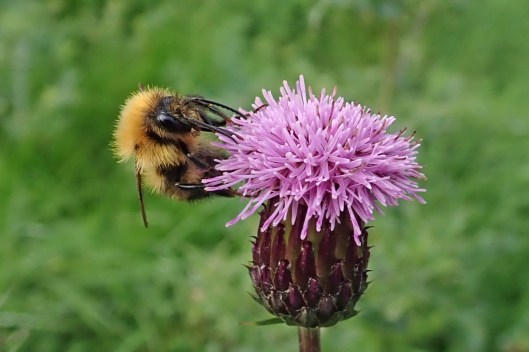
From me and the bee …

26 Friday Oct 2018
Posted in insects, nature, wildflowers
From me and the bee …
19 Friday Oct 2018
Posted in autumn, flowers, nature, wildflowers
Tags
#FloralFriday, autumn colour, British flora, British native flowers, British wildflower, Penarth, Penarth zigzag path, Zigzag path
Back in June, I wrote a blog post about the insects I’d found when out walking along one of my local trails, the zigzag path that runs down to the marina from upper Penarth. I was critical in that blog of the man-made wildflower patch I’d found, a rectangular area adjacent to the path, where perfectly good local wildflowers had been ploughed up and the area sown with some artificial wildflower mix.


I had some contact following that post with the Vale of Glamorgan Council’s Parks and Open Spaces Officer, who was pleased to learn the insects were doing well on the site and said he was ‘surprised if they [the landscape team] didn’t try and use native wildflowers. Hopefully they will spread out and add to the seed-bank all over the site in time.’ I haven’t had the heart to tell him that Council operatives strimmed that wildflower patch a couple of months later, before the plants had even had time to flower, let along spread their seed. What an incredible waste of money that planting scheme was!


Luckily, the Council operatives haven’t yet strimmed or mown the rest of the vegetation growing alongside the path, and the steep banks have been awash with wonderful colour over the summer months. Even as recently as this Wednesday, when I decided to photograph all the different flower species I could find, there was still a lovely variety as you can see.


17 Wednesday Oct 2018
Posted in autumn, insects, nature, wildflowers
What a difference a week makes! Seven days ago I was still seeing quite a few hoverflies, feeding on the remaining wildflowers and basking on leaves in the occasional sunshine.

Since then, we’ve had a couple of much cooler nights and the blast of wild, wet and windy weather that was Storm Callum, and the hoverflies seem mostly to have disappeared.


Is that the last I’ll see of them till 2019? Only time will tell.

11 Thursday Oct 2018
Posted in birds, insects, nature, walks, wildflowers
Tags
birding, birdwatching, British birds, Buttonweed, Cormorant, Curlew, Glamorgan Bird Club, Kestrel, Musk thistle, Ogmore, Pant Norton, Portobello House, Stonechat, The Pant, Wall butterfly, Wigeon
Though a cool wind was blowing in off the sea, yesterday was a gloriously sunny day for our Glamorgan Bird Club outing to Ogmore. The fine weather also meant we had a great turn out of 26 people, more than usual for our field trips.
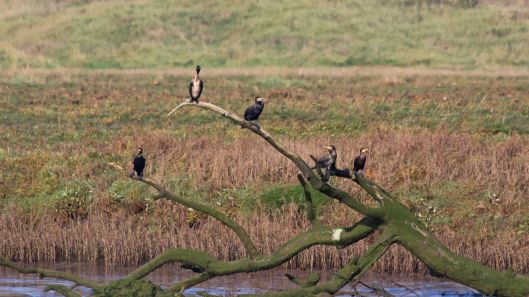
We started off near Portobello House, scanning the dunes of Merthyr Mawr and checking the River Ogmore, where the ubiquitous Cormorants were adorning this big dead tree in the water.
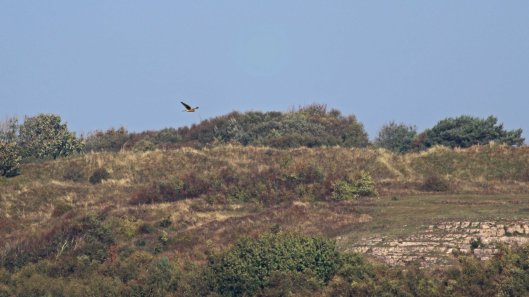
A Kestrel hovered over the dunes, and we witnessed a spectacular chase by a Sparrowhawk after a Meadow pipit – only very blurry photos of that, unfortunately. (The mipit escaped.)


Two Wigeon flew in to join the Canada geese, Mallards and gulls up river.

After grazing along the muddy banks down river for a time, this Curlew flew upstream to find another place to feed.


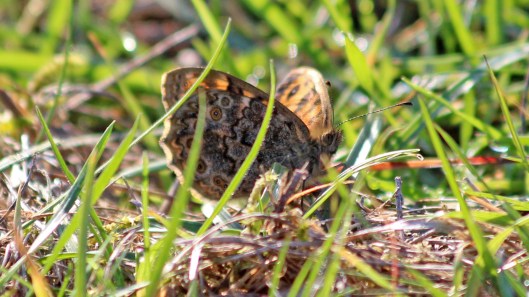
As I’ve mentioned in previous posts, our birding trips are not just about birds. Many birders are also interested in flora and other fauna so, yesterday, Dave was able to point out to us the invasive Buttonweed (Cotula coronopifolia) (he was the first to spot this plant in Wales!) and a Musk thistle (Carduus nutans). And another of our keen-eyed birders spotted this Wall butterfly, only the second time I’ve seen one of these beauties.

After a wander up and down the riverbank we headed across the road and up a track into a series of small valleys, an area known locally as The Pant. As well as many other small birds, there were several Stonechats popping up and down in the shrubs and bracken.

And then, what for me was the highlight of the day, really close views of a Kestrel hunting for its lunch. This handsome young male caught three creatures – probably voles or other small mammals – in the space of 10 minutes or so. It was incredible to watch how this bird’s amazing eyesight enabled it to hone in so accurately on its prey and, though I can’t help but have some sympathy for its victims, to see what an efficient hunter the Kestrel truly is.


My total number of species for the day was 41: Mute Swan, Canada Goose, Eurasian Wigeon, Mallard, Little Grebe, Little Egret, Cormorant, Sparrowhawk, Common Buzzard, Kestrel, Eurasian Curlew, Greenshank, Common Redshank, Black-headed Gull, Lesser Black-backed Gull, Herring Gull, Woodpigeon, Magpie, Carrion Crow, Blue Tit, Great Tit, Coal Tit, Skylark, Long-tailed Tit, Common Chiffchaff, Wren, Nuthatch, Blackbird, Song Thrush, Robin, European Stonechat, House Sparrow, Grey Wagtail, Pied Wagtail, Meadow Pipit, Chaffinch, Goldfinch, Siskin, Linnet, Bullfinch and Willow Warbler.
I must have wandered off when these birds were seen: Greenfinch, Stock Dove, Jay, Jackdaw, Rook, Raven, Goldcrest and Dunnock.
05 Friday Oct 2018
Posted in flowers, nature, wildflowers
Tags
blue flowers, British wildflowers, Chicory, Cichorium intybus, Penarth Docks, Penarth Marina Park, Succory

There’s just something about a blue-coloured flower that catches my eye and this Chicory grabbed me by the eyeballs as I walked home from Penarth Marina yesterday.

Although Chicory (Cichorium intybus) is a native British wildflower, these particular plants were not truly wild; they’re growing in a series of large wildflower beds planted around the edges of Penarth Marina Park. (Interestingly, the park itself is also artificial – it was once part of the inner basin of Penarth Docks, then became a rubbish dump, before being repurposed as a park in the 1980s – details and photos here.)

Chicory, also known as Succory, used to be widely cultivated. Its spears (buds) and leaves were eaten, and the dried and ground root has been used as a substitute for coffee. I think I’ll stick with my cup of tea, thanks.
03 Wednesday Oct 2018
Posted in flowers, nature, wildflowers
Tags
Blue fleabane, British flora, British wildflowers, Cosmeston, Cosmeston Lakes Country Park, Erigeron acris
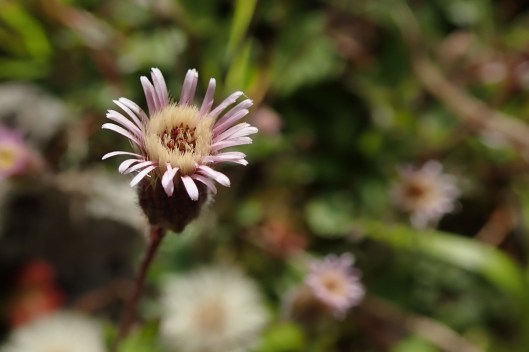
In case you think I’ve made a profoundly important botanical discovery, perhaps I should clarify that title: although I have noticed this plant growing in one particular place at Cosmeston Lakes Country Park during my walks in the past couple of weeks, Monday was the first time I had a close look at it, took some photos and worked out what it was, and it is a plant I had not previously seen.

This is Blue fleabane (Erigeron acris), a member of the daisy family, though why it is called Blue fleabane I have no idea as the flower petals I’ve seen are pink, and both my plant ID guidebook and the various online sites I’ve looked at describe them as lilac or purplish.


This is a coastal plant, which usually grows in dry areas of grassland, on sand dunes or on stone walls. That fits with the site at Cosmeston, where it’s growing in a very dry, stony location and it’s probably only a mile to the sea as the crow flies. As you can see from the fluffy seed heads in my photos, it’s actually at the end of its flowering period – usually between July and September – so I have been very remiss in not noticing it before now.
28 Friday Sep 2018
Posted in autumn, flowers, nature, wildflowers
Last week we had our first two named autumn storms, this week we’ve had glorious clear days but rather chilly overnight temperatures, so I think it’s fair to say autumn has well and truly arrived. Amazingly, though, wildflowers are still blooming in large numbers. Here are the species I’ve found during my walks around Cosmeston Lakes Country Park this week.


14 Friday Sep 2018
Posted in flowers, nature, wildflowers
This beauty is definitely a Mallow (Malva sp.) but it seems paler than the Common mallow (Malva sylvestris), whose flowers are usually a much deeper pinkish-lilac with even darker stripes.
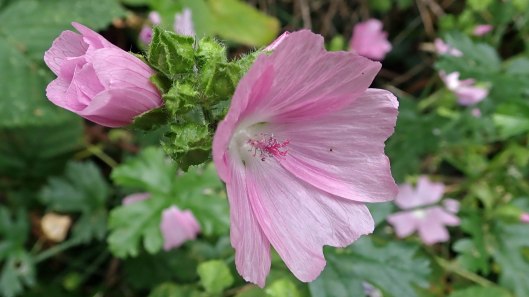
I found it growing on Penarth’s rail trail, a railway line to Barry that fell foul of the Beeching cuts in the 1960s and has since been converted, in part, to a much-used walking and cycle path. The trail is edged on both sides by houses so this plant could very easily have flitted over a back fence or been dropped as seeds by birds. Whichever, its flowers are a very pretty addition to the foliage that lines the trail.


11 Tuesday Sep 2018
Posted in birds, nature, plants, wildflowers
Tags
British wildflowers, Crithmum maritimum, Lavernock Nature Reserve, Rock pipit, Rock samphire, samphire
This lovely blast of botannical sunshine I found flowering on the clifftops at Lavernock is Rock samphire (Crithmum maritimum).

I’ve never eaten it – apart from the occasional blackberry at this time of year, I’m not a forager – I like to leave things to be appreciated by everyone and eaten by the wildlife that needs it more than me (anti-foraging mini-rant over!) – but I believe it can be eaten as a vegetable and is also used in pickling.
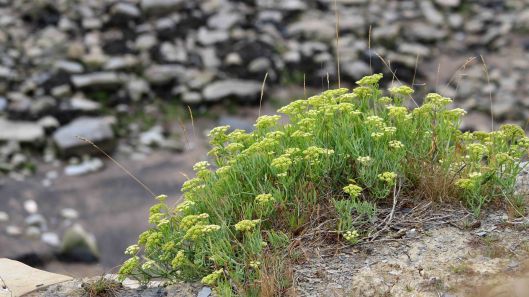
In fact, according to the Oxford Dictionary, the word samphire was once sampiere, from the French (herbe de) Saint Pierre or ‘St Peter(‘s herb)’. And in my trusty Flora Britannica, Richard Mabey writes
In the nineteenth century rock samphire from Dover and the Isle of Wight was sent in casks of brine to London, where wholesalers would pay up to four shillings a bushel for it. Shakespeare knew the plant from the south coast, and in King Lear, in a scene near Dover, has Edgar say to Gloucester, ‘half way down / Hangs one that gathers samphire, dreadful trade!’

Even if I did want to try this particular Rock samphire, its location is completely inaccessible to all but the most foolhardy. But one huge bonus of photographing a plant that grows along cliff edges is that sometimes, if you’re really lucky, a cute and curious little Rock pipit will pop up to see what’s happening.

10 Monday Sep 2018
Tags
Bute Park, Carrion crow, Goosander, Green alkanet, Grey heron, Grey wagtail, Mallard, Mute swan, River Taff, riverside walk, Speckled wood, woodland trail
On Friday, after I’d paid a visit to the tree I’m following, I enjoyed a stroll along the trail in Cardiff’s Bute Park that meanders through mature woodland alongside the River Taff. Despite this summer’s drought conditions, the recent rains have revived the local trees and plants so everything was looking wonderfully lush and vibrant.

A female Goosander sailing down river was a pleasant sight. Both males and females can often be seen on this part of the Taff from autumn through to spring.

Near the far river bank, a Grey heron stood tall on one of the many exposed rocks and boulders. The river is quite low at the moment.
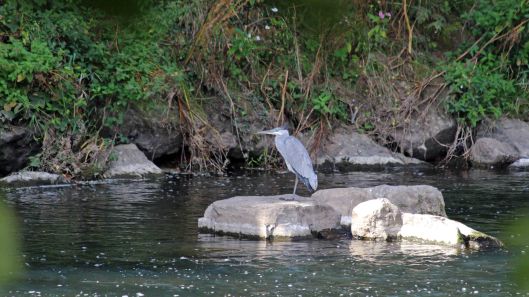
There weren’t a lot of signs of autumn yet – only the leaves of the Horse chestnuts were yellowing and curling up and beginning to drop.

A Speckled wood was well camouflaged on the woodland floor. There weren’t many butterflies around, just half a dozen Speckled woods and a few Small whites.

A Mallard enjoyed a snooze near the river’s edge.

I liked the colours and patterns of the pebbles and the occasionally blue sky reflected in the river water.

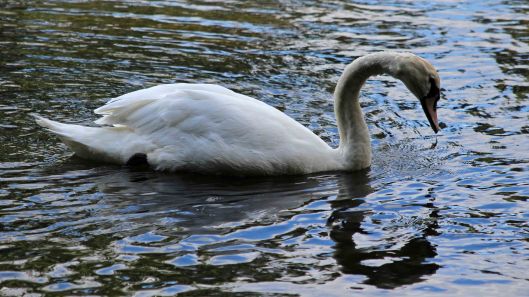
This was one of two Mute swans feeding.
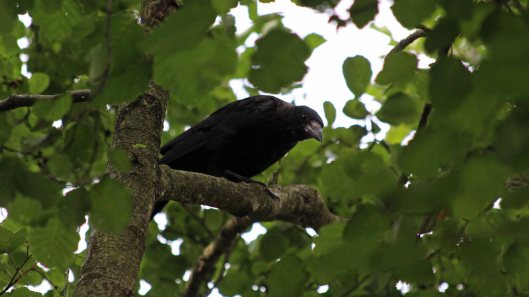
I’ve seen this particular Carrion crow many times before when I’ve walked this way. I know it’s the same crow, not because of how it looks but because it has virtually no voice. It tries to croak but hardly any sound comes out.
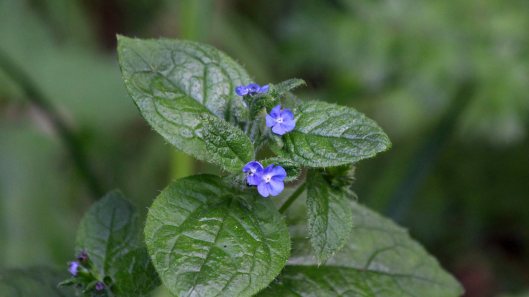
Most of the wildflowers have finished flowering but this Green alkanet was a pretty exception.
Just a few hints of autumn showing here. I love how this path meanders through these magnificent trees.

The woodland trail finishes just below Blackweir, where the current low water level means many rocks and boulders have been exposed. This was the perfect spot for a group of perhaps 20 Grey wagtails to fly-catch, and watching their aerial antics was the perfect end to my wander alongside the Taff.

 earthstar
You must be logged in to post a comment.