Yummy Aphids

Tags

, , , , ,

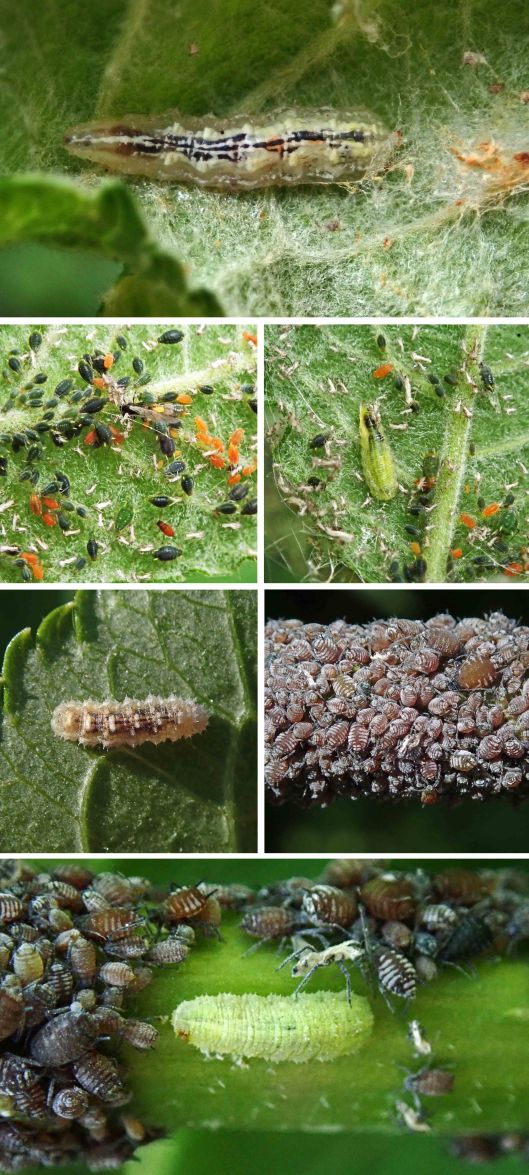
Whenever you see aphids (those shown below were on a willow species and on Elder), it’s always worth a look to see what other insects are nearby, particularly those that find aphids delicious! There’s usually a ladybird or two in the vicinity, and, as I’ve been finding, plenty of hoverfly larvae of various species. Their appetite for aphids is yet another reason to love hoverflies, if one were needed.

230621 aphids and hoverfly larvae

Toadlets

Tags

, , ,

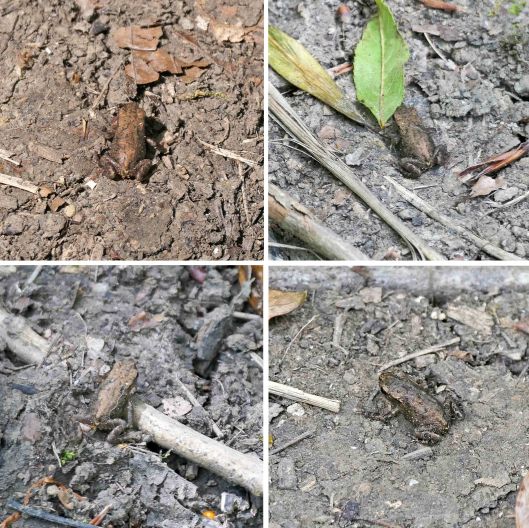
During yesterday’s walk around the local country park I witnessed something I’ve never seen before. I took a path through an area of woodland to escape the heat of the sun and found myself having to watch where I placed my feet to avoid stepping on the toadlets that were sitting in the dirt all along the path. There weren’t huge numbers all together in one place but every three or four strides a tiny Toad, disturbed by my approach, hopped across the path. It was certainly good to see such good Toad numbers but I have no idea why they had chosen yesterday to move en masse through the woodland.

230620 toadlets

Western bee-fly

Tags

, , , ,

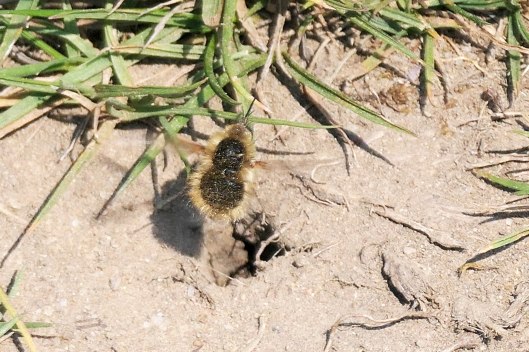
I was bending down to return my camera to my backpack as I was leaving Aberbargoed Grasslands NNR last week when I noticed something small and fuzzy flying over the earth below. Not a bee, not a hoverfly, too small for the one bee-fly (Dark-bordered) I recognise but its actions were typical of that bee-fly – hovering very low to the ground, taking particular interest in a small hole in the dirt and, as I continued to watch, seeming to flick its rear end towards that hole, the usual action of a bee-fly flicking its eggs into the hole of an unfortunate mining bee. Once home, I checked online and found an excellent resource from the Soldierflies and Allies Recording Scheme (‘Identifying bee-flies in genus Bombylius, compiled by Martin C. Harvey, version 3, May 2019), which pointed me towards Western bee-fly (Bombylius canescens). My identification was later confirmed by a representative of the Scheme, and an entomologist pal, when I posted photos on Twitter. A first for me!

230619 Bombylius canescens

Grasslands wildflowers

Tags

, , , , ,

Presumably as a result of our lingering hot dry weather, the wildflowers at Aberbargoed Grasslands NNR were neither as prolific nor as exuberant as I’ve seen in previous years. The Bluebells had already gone over, the Heath spotted-orchids were looking as frazzled as I was soon feeling but there were some floral highlights I enjoyed seeing.

230618 devil's-bit scabious

  • Devil’s-bit scabious (Succisa pratensis)

230618 marsh lousewort

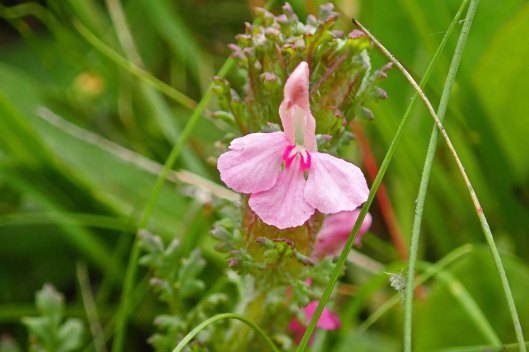
  • Marsh lousewort (Pedicularis palustris)

230618 milkwort

  • Common Milkwort (Polygala vulgaris)

230618 ragged robin

  • Ragged-robin (Silene flos-cuculi) and butterfly friend (Small pearl-bordered fritillary)

SPBFs

Tags

, , , , ,

On a very hot Thursday I made my annual pilgrimage to the Aberbargoed Grasslands National Nature Reserve to pay homage to these magnificent butterflies, the Small pearl-bordered fritillaries (SPBFs).
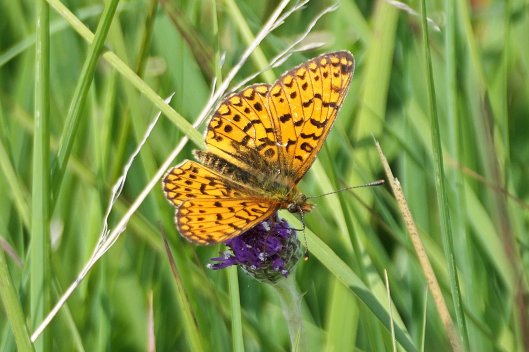
At first I thought I was going to be disappointed, as I headed to the field where I’d found them in 2022 and saw none. In fact, numbers of all butterflies were low – not as many Small heaths as in previous years, a couple of tatty Dingy skippers, a few Large skippers, a fly-past of a Red admiral, a single Speckled wood, and one very worn Marsh fritillary.

As I was retracing my steps to check the adjacent, much larger field, I bumped into two Rangers and we chatted butterflies. One said he’d only seen low numbers this year, and assumed our very wet Spring followed by the current very hot dry period was the cause of the decline in numbers. But they had just seen one SPBF in the big field so I was a little more hopeful.

And, as you can see, I was lucky! I’m not sure why numbers rise and fall in different areas of the reserve from one year to the next (particularly as the large field suffered a serious fire in 2022) but, turns out, this year the SPBFs were mostly concentrated in the centre of that large field, where I was fortunate to see at least six, possibly more, of these gliding orange beauties!

Lesser black-backed gull chicks

Tags

, , , , , ,

As I mentioned in yesterday’s post, here’s an update on the Lesser black-backed gulls that nest each year amongst the chimney pots of a house across the back lane from my flat. (I’ve posted many previous blogs about these birds, the most recent being Fledged, 19 July 2022.) Two chicks have hatched so far this breeding season, and I’ll be keenly watching their progress.

230616 lesser black-backed gull chicks

Herring gull chicks

Tags

, , , , , ,

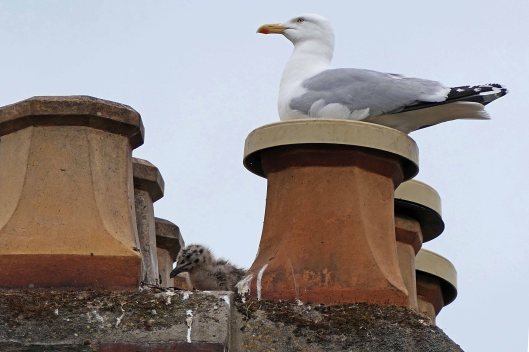
I was walking home from the local country park when I heard the desperate cheeping of a hungry young bird. Looking up and across the road, I noticed a gull sitting on top of the building that houses my local corner shop. It was an adult Herring gull and, sitting beneath their parent, amongst a collection of chimney pots, were two young chicks. I’ve seen many a family of Lesser black-backed gulls nesting locally (there’ll be an update on my local family tomorrow) but this was the first Herring gull I’d noticed (probably my poor observation skills, rather than a rare occurrence).

230615 herring gull and chicks

A streak of green

Tags

, , , ,

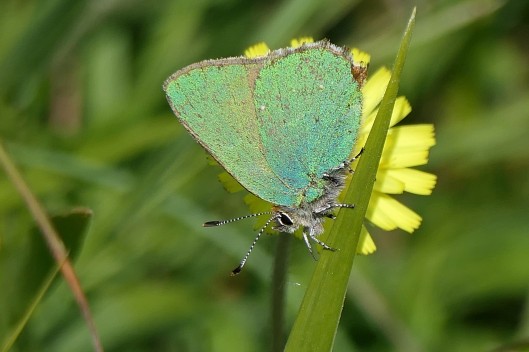
I just have to share one more find from my visit last week to Charlton King’s Common in Cheltenham, the gorgeous butterfly that is the Green hairstreak (Callophrys rubi). Its green wings provide this creature with such excellent camouflage that I was extremely lucky to spot it. They’re usually found on a favourite perch in a tree, from where they vigorously defend their territory, but this particular Green hairstreak flitted up from the ground as I walked along a narrow path. At first, I wasn’t sure what it was – a small flying creature in my peripheral vision – but I walked on a couple of paces, turned, waited and watched. I saw another flicker of movement and spotted the butterfly sitting on a flower. Fortunately, it stayed still long enough for me to get a few photos before flying up in to the foliage of a nearby tree and disappearing.

230613 green hairstreak

Galls: Psyllopsis fraxini

Tags

, , , , ,

There is a place locally I call the secret field because it has just a couple of quite well-concealed entrances and very few people visit it – in fact, of the many local people I know there’s only one who knows this place. It is surrounded by large mature trees, which means the location is quite sheltered, and the field itself seems to have been planted with saplings perhaps 10-15 years ago, judging by their size. This secret field is where I make many of my most interesting discoveries, and this is one of the most recent.

230612 psyllopsis fraxini on ash (1)

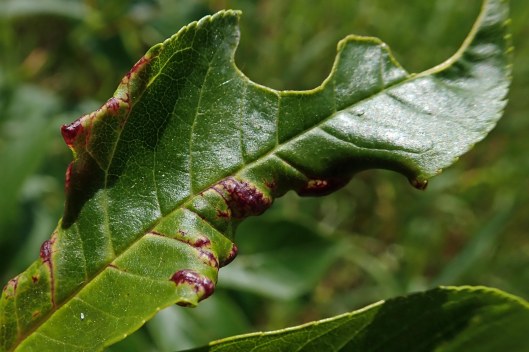
These are galls on the leaves of Ash trees (upper leaf above, lower leaf below) caused by the larvae of a small bug called Psyllopsis fraxini, also known as the Jumping plant louse according to the Naturespot website, though I’m not sure that’s an official name. There are, apparently, three species of this Psyllopsis bug whose larvae cause galls like these so when recording such finds the aggregate name is used, Psyllopsis fraxini agg. You can read more about these wee beasties and see photos of the adult on the British Bugs website here.

230612 psyllopsis fraxini on ash (2)