Cups aplenty

Tags

, , , ,

I was surprised but delighted to find this large colony of fungi on a pile of woodchips earlier this week. I think these are Cellar cups (Peziza cerea), as they fit perfectly with the description in my guide book:
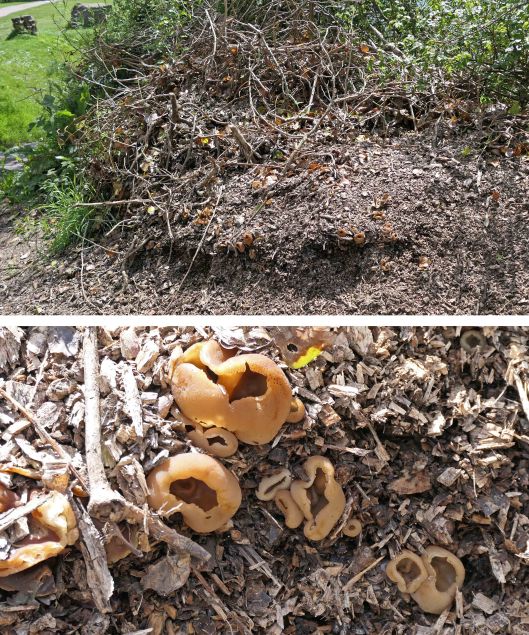
Pale cup associated with limestone and often found growing out of mortar joints in buildings. Solitary or in small groups on woody debris, sandbags, limestone rubble, lime mortar and, sometimes, in damp cellars. Fruit bodies to 5cm across irregular cup-shaped, with the margin inrolled at first; inner surface pale ochre or yellowish brown with a smooth texture; outer surface concolorous and finely granular.
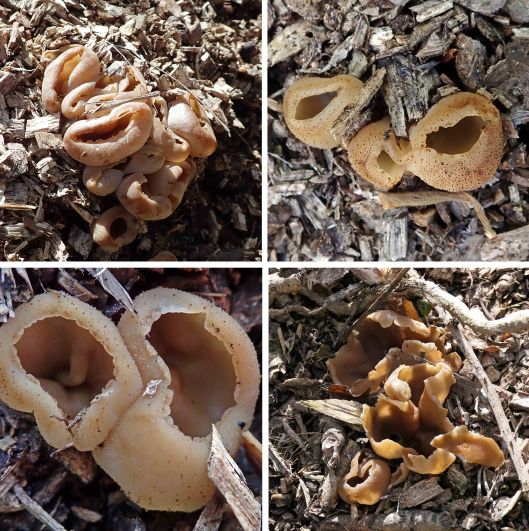
However, there are over 50 species of similar cups in Britain, many of which grow in similar locations, so microscopic examination is needed to be sure of identification.

Red admiral egg

Tags

, , , ,

During Sunday’s wander around the boundaries of some local horse fields (minus the nosey horses, this time), the sun wasn’t shining or warm enough for any butterflies to be found on the thick hedges and scrubby edges. This lovely female Red admiral was the one exception, appearing suddenly from behind a large bramble patch.

230511 red admiral

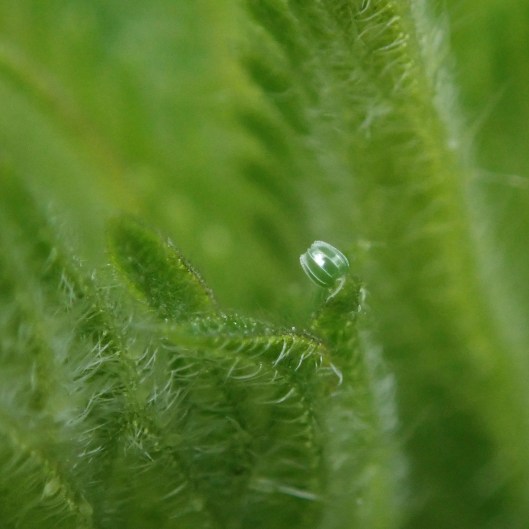
How do I know it was a female? Well, instead of flying off to patrol the bushes, she floated above and around the abundant, fresh Stinging nettles, looking for the best places to lay her eggs. How do I know they were Stinging nettles? Well, despite wrapping my fingers in the layers of my scarf, I still got stung on a couple of fingers while getting my first ever sighting and photographs of one of her eggs, a magnificent little ribbed barrel that should produce a tiny caterpillar in a week or so.

230511 red admiral egg

The gift

Tags

, , ,

With its bristly body, brown-tinged wings, black femora, and red/brown tibia and tarsi, I think this may be the dagger fly Empis tessellata, but these are tricky flies to identify so don’t take my word on that.

230509 empis tessellata (1)

And, to be honest, I’m not too concerned about identifying the exact species because what fascinates me more is their mating behaviour, which I was fortunate to witness during Sunday’s walk. According to the Naturespot website

Though it feeds on nectar it is also a predator and catches other insects using its long pointed proboscis to pierce their bodies. Males of Empis opaca and E. tessellata present a ‘gift’ to the female, in the form of a dead insect, before mating takes place. Females will not mate with males who do not present a gift.

230509 empis tessellata (2)

Pieris napi

Tags

, , ,

My first confirmed sighting of a Green-veined white of 2023 came later than usual, last Thursday, 4 May, but it more than made up for its tardiness by posing beautifully on some not-quite-opened Hawthorn blossom. I love its scientific name Pieris napi, the Latin Pieris coming from the Ancient Greek Πιερίς meaning a muse and its specific name napi being a reference to one of its larval foodplants, Oil-seed rape (Brassica napus).

230508 green-veined white

Field madder

Tags

, ,

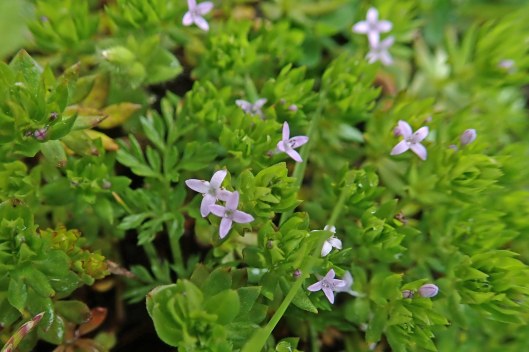
A member of the Bedstraw family, Field madder (Sherardia arvensis) is a low-growing annual that supposedly grows in both disturbed and cultivated ground on chalky soils. I write ‘supposedly’ because the Field madder pictured here grows along a sheltered damp and mossy road verge next to blocks of flats. Also, I’ve read – and my wildflower book states – that Field madder can grow up to 30cm tall but the plants I’ve seen have been tiny, only 5-10 cm. I guess wildflowers don’t read what’s written about them!

230507 field madder (2)

Popping out like stars against a dense background of bristly whorls of leaves, the clusters of four-petalled tiny flowers range in colour from pale pink to mauve. And, as you may have guessed from the name, the roots of Field madder can be used to make a red dye, though it is described as ‘an inferior source’ on the Oxford University Herbaria website. If you’re interested in learning more, the website also explains the source of the Sherardia name.

230507 field madder (1)

White not pink

Tags

, , , , ,

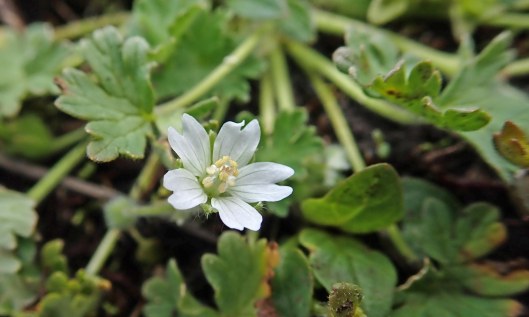
The flowers of Dove’s-foot crane’s-bill (Geranium molle) are usually described as pinkish-purple, and certainly all the plants I’ve seen previously have had tiny pink flowers, as shown in the comparison photos below. But I’ve discovered a small area at the Cosmeston Lakes Country Park where the flowers are a true white.

230505 Geranium molle (2)

I’m not sure what has caused this colour variation but it’s probably something in the soil. Before it became a country park, parts of Cosmeston were quarries, spoil tips and rubbish tips. If you follow this link to the Mary Gillham Archive website (a project I volunteered on, as my older followers will recall), you can see details – including maps and photographs – of Cosmeston during its transformation into a country park.

230505 Geranium molle (3)

One legacy of its former use is undoubtedly the presence of toxic chemicals in some areas. Indeed, the top portion of the east paddock is fenced off, not for conservation purposes but, I am reliably informed, to protect park users from whatever is buried there. Residues in the soil may well account for unusual qualities in the park’s flora and fauna.

230505 Geranium molle (1)

The first skipper

Tags

, , , ,

I tend to avoid the local country park on bank holidays, as it can be difficult to find the peace and solitude I prefer during my walks but, luckily, on the May Day holiday, most people were sticking to the walks around the lakes, the children’s playground and those places where they could buy food and drinks. So, a circuitous walk around the various paddocks and through a sheltered woodland clearing turned up my first Small tortoiseshell butterfly of the year and this beauty, my first Dingy skipper. Bank holiday bonuses both!

230504 dingy skipper

Wild words : extrafloral nectary

Tags

, , , ,

Nectary: noun, biology; ‘a nectar-secreting glandular organ in a flower (floral) or on a leaf or stem (extrafloral)’ (Oxford Dictionary).

230503 extrafloral nectaries (1)

Like most people, I knew that most flowers produce nectar as a reward to attract pollinators but I’ve only recently learned that many plants produce nectar through extrafloral nectaries, as the definition explains, on their leaves or stems. I read that these particular nectaries can be found on many species of fern, and I’ve finally found some examples on the stems of Bracken (Pteridium aquilinum) that has just begun to sprout locally. The nectaries are the small smooth pale lumps on the back of the stipe, and, in Bracken, their purpose is apparently to attract ants that will then defend the fern against the insects that might eat it, like some species of bug and fly, and the larvae of various moths, amongst others.

230503 bracken and ant

ant leaving nectary on Bracken

However, I also found a journal article, referenced below, which reported that the ants actually had ‘no significant effect on bracken-specific herbivores’ so, in this case, the plant may be producing nectar for nothing.

Reference: ‘Bracken, Ants and Extrafloral Nectaries. I. the Components of the System’, J. H. Lawton and P. A. Heads, Journal of Animal Ecology, vol. 53, no. 3, October 1984, pp. 995-1014. I do not have access to Jstor so was only able to read the information contained in the article summary.

230503 common froghopper nymphs

Common froghopper nymphs on Bracken