Non-biting midges

Tags

, ,

This is one of those posts where I’m not entirely sure of my identification, and precise identification to species requires microscopic examination, but I think I’ve got the right family, which is the Chironomidae or non-biting midges. So, if you think I’m wrong, please do let me know.
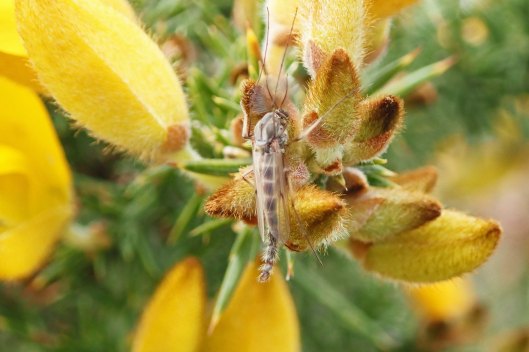
During recent walks, especially those around Cardiff Bay, I’ve been very aware of large clouds of these small flying insects. Indeed, there have been times when I’ve had to remember not to let my mouth gape open in delight or surprise for fear of swallowing one or two. The swallowing is okay if you’re a bird, of course – judging by the numbers of gulls grabbing these creatures in the air or from the surface of the water, the midges must be quite tasty and nutritious, but I doubt I will ever embrace the sometimes-fashionable idea of humans including insects in their diets. One thing that I am particularly grateful for is the fact that these midges are non-biting. I am particularly susceptible to insect bites so if these were biting midges, they would make my daily walks an absolute misery.

There’s a Chiffchaff in my tree

Tags

, , , ,

There’s a Chiffchaff in my tree, chiffchaffing happily!

230322 chiffchaff (1)

That was my tweet this morning after I’d spent a joyous 20 minutes standing by the open window, watching this little bird flit about the cherry tree outside my living room, catching tiny insects and singing almost the entire time.

230322 chiffchaff (2)

Although some Chiffchaffs now overwinter in the warmer parts of Britain, most still migrate, and they began arriving back in my area in good number last Friday. After this morning’s home-based Chffichaff encounter, I went for a walk around Cosmeston Lakes Country Park, during which I heard and/or saw at least 23 more Chiffchaffs. Their song will soon become one of the commonplace sounds of spring/summer but, for now, it’s pure magic!

230322 chiffchaff (3)

I bl**dy love butterflies!

Tags

, , ,

Sorry if my title offends some of you but it can be difficult to put into words how much I adore these stunning creatures.

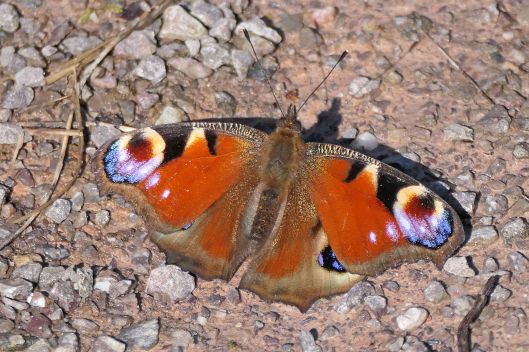
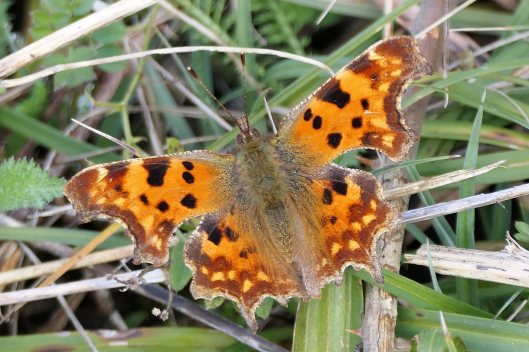
When first the Peacock and then this Comma, within a few minutes of each other, flew across my path and settled in the sunshine for me to admire and photograph, I felt as if I might burst with happiness. The beauty of these creatures speaks to my soul!

First Blackcap

Tags

, , , , ,

I heard him before I saw him – in fact, it took a while to spot this little chap, who was mostly hidden amongst the greenery as he sang his little tune. Was he celebrating the fact that he’d finally arrived on land after his long migration flight? Or was he practising his melody in preparation for trying to woo a potential mate? Though some Blackcaps now over-winter here, they are mostly to be found feeding in people’s gardens, taking advantage of the goodies on offer from feeders. This little fellow was by the sea, with no houses or gardens nearby, which is why I’m fairly sure he was a newly arrived migrant. And he was my first Blackcap of the year. I look forward to seeing more.

230320 first blackcap

Small white brassicas

Tags

, , , , , , , , , , , , , ,

This week I decided to have a go at the wildflower hour challenge to find the six brassica species that have small white flowers. Yesterday, when I wrote the first draft of this post, I had managed to locate five of them. During today’s walk, most unexpectedly, I found the sixth. You can find a pdf of the list, with photos and tips on how to identify each species, on dropbox (courtesy of the lovely botanist Dinky Moira).

230319 bitter-cress hairy and wavy

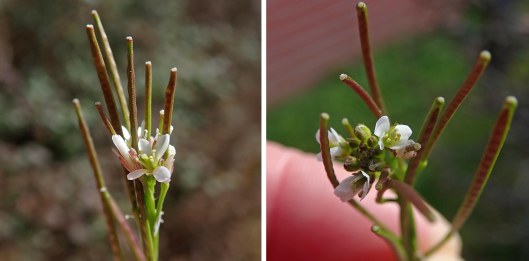
On the left above is Hairy bitter-cress (Cardamine hirsuta), whose flowers have four stamens and whose seed pods stand straight up, and on the right is Wavy bitter-cress (Cardamine flexuosa), with its six stamens and ‘sticky-out seed pods’ (Moira’s very apt description).

230319 common whitlowgrass

Common whitlowgrass (Erophila verna) seems to be everywhere at the moment, in particular alongside paths and at the edges of back lanes. It’s tiny but worth bending over for a look.

230319 shepherd's-purse

Shepherd’s-purse (Capsella bursa-pastoralis) is so named because of the shape of its seed pods, though, personally, I think they look like tiny hearts. Shepherd’s-heart anyone?

230319 thale cress

Thale cress (Arabidopsis thaliana) is a new plant for me so I was very chuffed to find this one. It’s rather like Shepherd’s purse but has slender rod-shaped seedpods.

230319 danish scurvygrass

And this is today’s find: Danish scurvygrass (Cochlearia danica), which I had seen before in Cardiff, alongside the River Taff near the city centre, but I hadn’t ventured that far during yesterday’s walk. Today, I found it on the edge of a pavement near Cardiff Bay, just one plant, but one is all I needed to complete this challenge.

New fungus: Linospora saligna

Tags

, , , ,

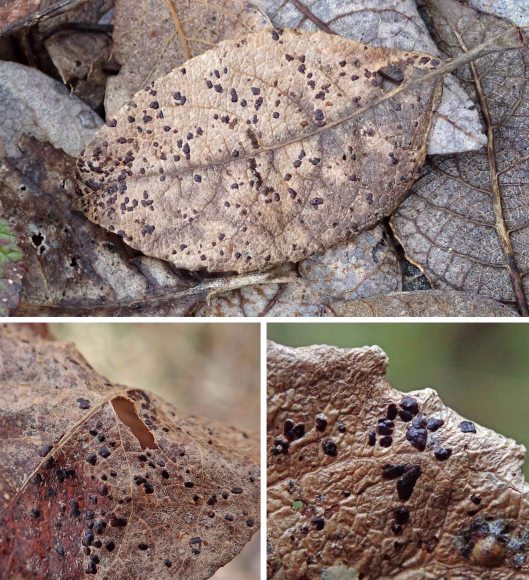
Inspired by Gwent birder and naturalist Lee Gregory’s recent (3 March) first record for Wales of the fungus Linospora saligna, which looks like small dark speckles on dead Salix leaves, I went searching last Saturday morning in areas where I knew Willow trees grow. And I was a little surprised at how easy they were to find. I spotted the fungus at two locations along the path around Cardiff’s Grangemoor Park, and I’ve also since found it under Salix trees near Cardiff Bay’s Barrage. Although Lee’s record was a Welsh first and the NBN Atlas shows very few confirmed records for the rest of Britain, this is obviously another instance where a species is under-recorded, presumably because no one knows to look for it. I’m aware that Lee has already found several further records, and I will certainly continue to check for these speckled leaves wherever I see Willow trees.

230317 Linospora saligna

His gift

Tags

, , , , ,

I was seconds too slow to catch the actual moment Mr Robin presented his potential mate with this courtship gift, a gigantic Ivy berry. From what I’ve read, this behaviour may help to convince the female of the male’s suitability as a mate and, according to the RSPB website, the feeding continues through the nest building phase and while the female is laying her eggs, one a day for 4 to 6 days, helping the female maintain her body weight.

230316 robin

With the feeding I witnessed, I’m not sure whether the courtship was successful. The male had rather overestimated the size of the female’s mouth and, from the look on her face, she didn’t know whether to be flattered or insulted. The moment the male flew away, she let the berry drop to the ground.

On fire

Tags

, , ,

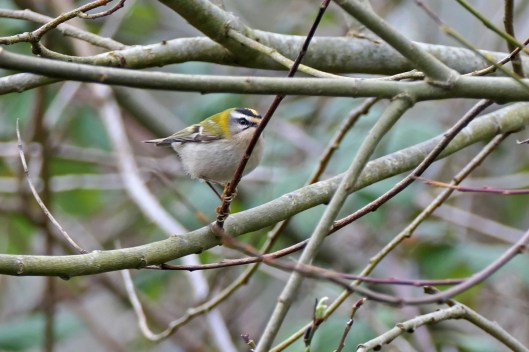
I was not long home from my first walk when Owen, one of my fellow local nature enthusiasts, posted on Twitter about the Firecrest he’d found on a local path, so my cup of tea was quickly abandoned and I was out the door again in record time. And result! Another birder had made it there before me and was searching further along the path to no avail when the gorgeous little bird popped up at the start of the path right in front of me. This wasn’t my first Firecrest of the year but they are always brilliant birds to see, and this was no exception. We watched it busily flitting to and fro in the scrub as it searched for tiny insects, until a band of heavy showers had me heading for home again.

230315 firecrest

Meliscaeva auricollis

Tags

, ,

In just a few days we’ve gone from sleet and snow to a high of 11ºc. We humans can easily change our clothes to suit the conditions but the see-sawing temperatures must be creating problems for the insect world.

230313 meliscaeva auricollis (1)

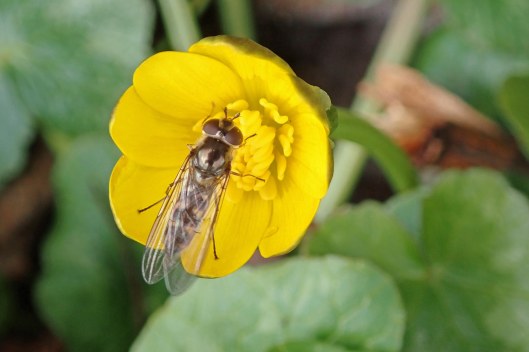
Some, like these Meliscaeva auricollis hoverflies, emerge from their winter hibernation when the temperatures start to rise, then get knocked sideways when the mercury plummets and the snow starts to fall. Hopefully, they’re able to find shelter from the icy blasts so they can re-emerge at a later date.

230313 meliscaeva auricollis (2)