American winter-cress

Tags

, , , , ,

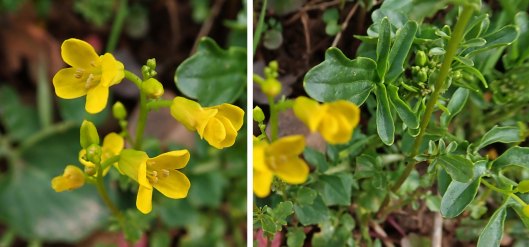
One of my local green spaces, Grangemoor Park, in Cardiff, an old landfill site, has been much churned up over the past year due to the need for repairs to its drainage system. Seeing the amount of damage done to the park, the huge numbers of trees cut down, the wide gravel paths laid down where once were wildflowers and scrub, has been very depressing but I’m hoping Nature will quickly repair the human damage. In the meantime, trying to be positive, I’ve been keeping an eye on the disturbed ground for any botanical surprises. And this is one!
230402 american winter-cress (1)

I’m 99% sure that this lovely little treasure is American winter-cress (Barbarea verna), a new plant for me. I’ve had a botanist confirm my identification but with one proviso. She thought ‘Yes I think it looks like it is B. verna as opposed to B. intermedia. If you should happen to see it again when it is in fruit, it should have long (over 4cm) curved fruits, whereas intermedia has shorter (less than 4cm) straight fruits.’ Needless to say, I will be checking the fruits in due course.

230402 american winter-cress (2)

In Flora Britannica, Richard Mabey writes that Barbarea verna has proven to be ‘popular and successful as a vegetable. Originally from south-west Europe, it has been introduced as a cultivated vegetable not just to the United States and northern Europe, but to South America and Australasia. It has become widely naturalised in all these places.’ I will be tempted, once it has grown, to harvest some of the leaves, which can be used like ‘rocket’ in a salad, though it is growing in the perfect spot for passing canines to anoint so will have to be washed very thoroughly.

230402 american winter-cress (3)

Changing colours

Tags

, , , ,

There hasn’t been a lot of Turnstone activity around Cardiff Bay this winter, perhaps because the milder weather has allowed them to forage and rest in more exposed locations, so it was delightful to see a flock of 13 birds on the River Ely embankment on Thursday. Several were showing signs of the colour changes, those splodges of rusty red that come as they moult into their breeding plumage.

230401 turnstone (1)

Judging by previous years, these superb little waders will be heading north to their breeding sites in the next few weeks and I won’t see them again until sometime in August, when they and their fledged youngsters will return to our shores.

230401 turnstone (2)

Cucumber green orb spider

Tags

, , ,

Last Monday, when we actually had a sunny day, I was checking the flowers of a Gorse bush for any tiny critters that might be lurking there (lots of weevils), when I spotted this stunning creature. With a yellow-green body and vibrant green legs, I think this is the aptly named Cucumber green orb spider (Araniella cucurbitina sensu lato) but, as the Nature Spot website entry for this spider explains, there are two very similar species, Araniella cucurbitina and A. opisthographa. So, for recording purposes, if you can’t distinguish one from the other, you can use the catch-all name Araniella cucurbitina sensu lato meaning ‘in the broad sense’.

230331 cucumber green orb spider

A line-up of Wheatears

Tags

, , , ,

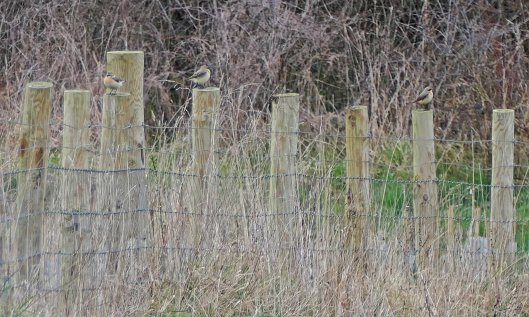
Another birder reported seeing two Wheatears in this particular field so I went for a look. And lo and behold, there weren’t just two Wheatears but three, happily lined up along the fenceposts (when they weren’t flitting down into the grass on either side, grabbing any insects they spotted).

230330 wheatears (1)

And then, blow me down, I spotted a fourth bird lurking on top of the bushes in the background – only a blurry photo of that one, so here’s the line-up again from a different angle, from when they flitted up to the top of the field. Birding magic!

230330 wheatears (2)

Nomad bees

Tags

, , , ,

Despite their kleptoparasitic behaviour (laying their eggs in the burrows of other bees rather than doing the rearing themselves), I rather like Nomad bees so was delighted to find this dandelion, as the only local pollen source, had attracted a small congregation. As usual at the beginning of bee season, I optimistically thought I’d try to identify these and was almost immediately reminded of how tricky that can be, despite some really excellent visual resources being available online (BWARS, the Bees, Wasps & Ants Recording Society, has very good species galleries, and Steven Falk has excellent collections of species photographs on his flickr site). Having pored through a ton of images, I have tentatively identified my Nomads as Painted nomad bees (Nomada fucata) and recorded them as such. When/if my record is ever verified (or rejected), I’ll add a postscript here.

230329 nomad bees

p.s. I’m adding a larger version of one of the above photos, as this might help with positive identification.

nomada fucata 230327 lavernock ST17946781 (4)

Tadpoles

Tags

, ,

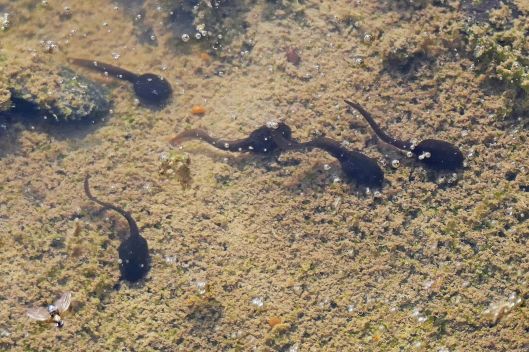
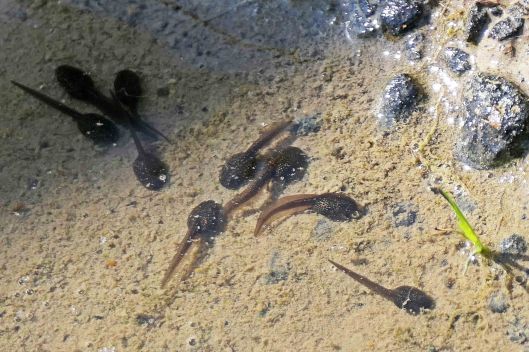
Are they Common frog tadpoles? Or are they Toad tadpoles? At this stage, I don’t think it’s possible to tell. I’ve read that toad tadpoles remain black and frog tadpoles change to a greenish colour, though I’m not sure when that happens. My photos here were taken four days apart, the first on 23 March and the second yesterday, 27 March, and there seems not to have been any change to them.

230328 tadpoles (1)

Though I have been checking areas of standing water, I’ve missed seeing any amphibian spawn this year. These particular tadpoles are living in a roadside puddle, fortunately one that seems to contain water most of the time, so I will check back on them in a week or so.

230328 tadpoles (2)

There is something magical about watching this tiny creatures wriggling – it carries me back to warm childhood days. Here’s a very short video that I hope the child in you will also enjoy.

Wheezing in the wind

Tags

, , , , ,

Trichomonosis, a disease that spreads through the birds’ contact with contaminated surfaces (like bird feeders – please clean them weekly!), has decimated the Greenfinch population in Britain, leading to a huge decline in numbers and to the bird being red-listed.

230325 greenfinch (1)

As I’ve only been in my current location for just over seven years, I don’t know how badly the local birds were hit, though birding friends say it got to the stage where they rarely saw a Greenfinch. Fortunately, that dire situation does seem to be improving hereabouts, and I can now be fairly confident that I’ll see or hear a Greenfinch during my daily walks.

230327 greenfinch (2)

At this time of year, I usually hear them before I see them, particularly males like the two pictured here, sitting in prominent spots atop a bush or in a tree, making their odd wheezing sound. They make other sounds too, of course, but it’s that odd buzzy wheeze that catches my attention – and, hopefully, also the attention of potential mates. If you haven’t heard the sound, I made a short video of one of these chaps giving it their all.

The Baccy plant

Tags

, ,

I wrote about this plant’s alternative common names and supposed medicinal properties several years ago (Coltsfoot for your cough?, 26 February 2016), but the Plantlife website entry for Coltsfoot has some additional interesting snippets:

Whilst the great herbalists of antiquity including Dioscorides and Pliny recommended smoking the herb to help the throat. Although this practice probably won’t help the throat to heal, smoking coltsfoot is still thought to be a good substitute to tobacco. Hence the common name Baccy plant. Also owing to the fact that the dry felt on the leaves smoulders well, it has been used as tinder.

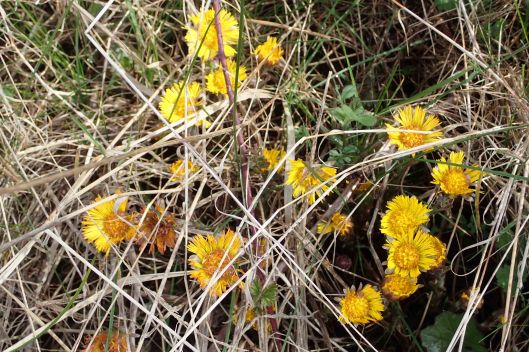
230326 coltsfoot (1)

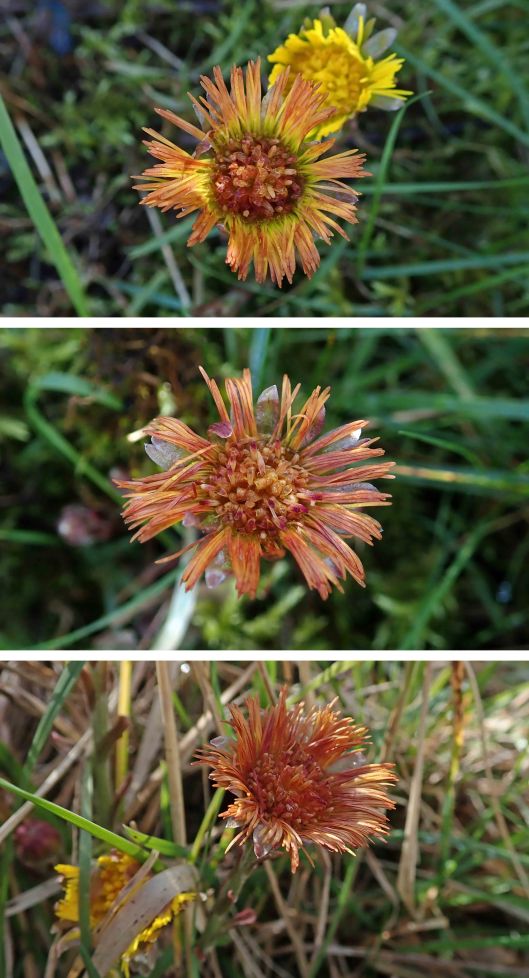
Rest assured, I have no wish to encourage any of you to start smoking any of the Coltsfoot plants you see – I simply thought the information interesting. And I also found interesting the variations in flower colour I noticed within this display of Coltsfoot in a local park. They reminded me of autumn … but let’s enjoy spring and summer before we head back to the colder months once more.

230326 coltsfoot (2)

Shieldbugs are go!

Tags

, , ,

Common green shieldbugs like these overwinter as adults so it’s not that they’ve just hatched out but rather that the warmer temperatures and, some days, actual sunshine combine to tempt them out of these cosy hideaways under leaf litter or in cracks in bark.

230325 green shieldbug (1)

As you can see, these shieldbugs (scientific name Palomena prasina) aren’t always true to their name. During the winter months, their colour turns more brownish. It’s during the summer months that they can be seen wearing their true, bright green livery.

230325 green shieldbug (2)

First winter Little gull

Tags

, , , , ,

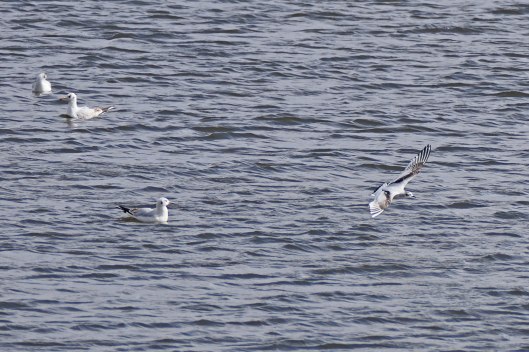
These photos are hot off the memory card, as we’ve had a lovely visitor in Cardiff Bay today, this beautiful first winter Little gull. The gull’s presence is not a huge surprise to local birders, as this is the time of year we often see one in the Bay. As the BTO website reports ‘This dainty gull is most often seen during its northward spring migration, when small parties can turn up along the coast or even at inland waters.’

230324 little gull (1)

Little gulls are incredibly active birds: while the Black-headed gulls were happy to bob about on the water, pecking at titbits as they floated past, the Little gull was almost constantly in flight, skilfully weaving and diving despite the strong winds, dipping down to the water’s surface when it spotted something to eat. It was magical to watch, though the other gulls weren’t as happy to see this stranger as we birders were!

230324 little gull (2)