Holm oak gall mites

Tags

, , , , , , ,

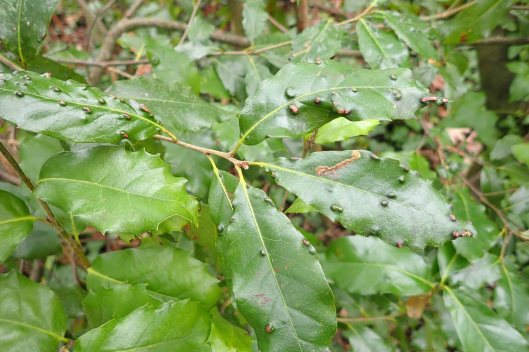
During yesterday’s walk, when checking for leaf mines on the leaves of Holm oak (large numbers of Ectoedemia heringella present – you can see one in the photo below), I noticed a huge abundance of small bumps covering many of the leaves.
220209 Aceria ilicis on holm oak (1)

These are the galls caused by the miniscule mite Aceria ilicis. On the underside (though sometimes also on top), the depression in the leaf is filled with tiny brown hairs (an erineum) where the mites make their home. The galls can be seen throughout the year, so next time you spot a Holm oak, check out its leaves.

Leafmines: Fenella nigrita

Tags

, , , , , ,

When reviewing my leafmine records yesterday and comparing them to those I’ve blogged, I realised there are several I’ve yet to cover here. Most are spring- and summer-time finds so I’ll post about them at the appropriate time but this is one I found in December – I didn’t cover it then as I was in the middle of my A-to-Z end-of-year countdown.

220207 Fenella nigrita (1)

These are the leafmines of the sawfly Fenella nigrita. Its larval mines can be found on Agrimony and on the various cinquefoils – I found these on Creeping cinquefoil (Potentilla reptans). Though the British Leafminers website reports that the mines are normally seen in summer and autumn, I found these on 3 December and the mines are occupied (I’ve added a pointer to one of the larvae in the photo below right). Presumably the mild weather meant a longer breeding season for these sawflies, as with many other creatures.

Colin’s story

Tags

, , , ,

I thought I would explain about Colin the caterpillar (<click to see yesterday’s video). He appeared on my living room carpet about a week ago (I almost stood on him!) and I can only assume he somehow hitched a ride home on some part of my clothing or my backpack. Like the Winter caterpillars I blogged about on 15 January, Colin is an Angle shades moth larva. At the moment, he’s living in a jar on my desk – I wasn’t sure how long he’d been on the carpet so wanted to feed him up before I took him back to the wild. He’s just been through a moult, from 2nd to 3rd instar I think, so he’ll need to be released soon so he can pupate in more natural surroundings.

Marsh tits x 4

Tags

, , ,

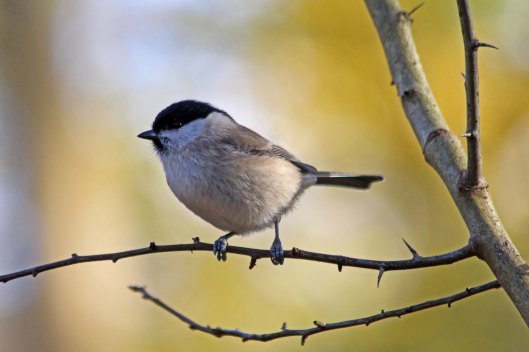
In mid December I spent a couple of hours watching and taking lots of photos of Marsh tits, as I was keen to try to work out how many there are living in our local woodland. Two separate birds came to seed at one end of the woodland ride and a single bird came to seed at the other end of the wood. The distance between the two locations, and my photos, led me to believe that these were three different birds. And I had previously seen another bird with a slightly deformed left claw, which had been photographed by a local birder just a week earlier. This all leads me to believe there are now at least four Marsh tits in the woodland, which is excellent news for their ongoing survival.

220201 marsh tit

Inside a Teasel seed head

Tags

, , , , , ,

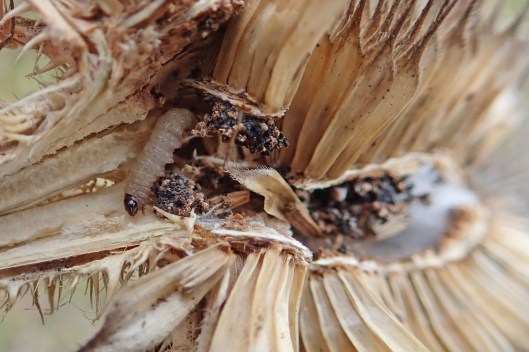
I’ve never looked inside a Teasel seed head before but I’m glad I braved the spines for a peek because each of the three I pulled open were occupied and, judging by the amount of frass, they’d been occupied for some time.

220131 Endothenia sp (1)

I think these are the larvae of one of the Endothenia species of moth, either E. marginana or E. gentianaeana, the former presumably being the more likely as there are more records of that species in south Wales. However, to be sure which is which you need to check each larva’s rear end to see if it has an anal comb. Not knowing this, I didn’t.

220131 Endothenia sp (2)

If you want to learn more about that anal comb, there’s a very detailed description, and clear photos, of the larvae of these two Endothenia species on the UK Moths website (E. marginana here and E. gentianaeana here). And, just to reassure you, I was able to close the seed heads (and wound stems of long grass around them, which should hopefully keep them closed so the larvae can complete their lifecycles) (I read later of someone who uses small rubber bands for the same purpose).