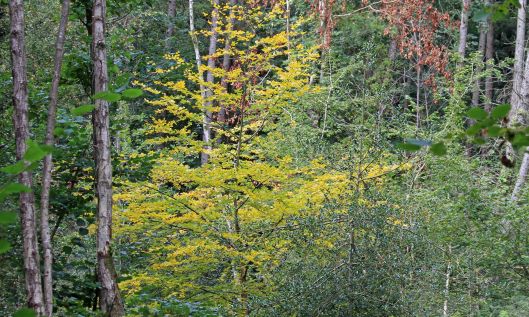
‘How beautiful the leaves grow old. How full of light and color are their last days.’ ~ John Burroughs



03 Sunday Oct 2021
‘How beautiful the leaves grow old. How full of light and color are their last days.’ ~ John Burroughs
02 Saturday Oct 2021
Posted in fungi
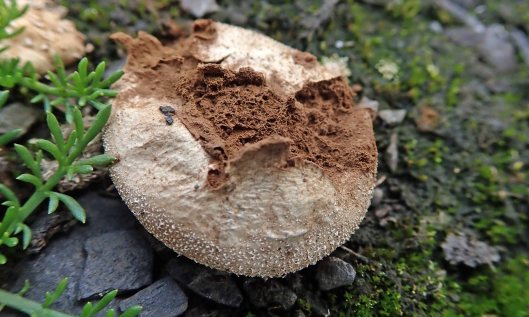
Happy UK Fungi Day 2021! We have heavy rain here and it’s forecast to last all day. Being something of a wet weather wimp, I’m not heading out on a fungi hunt so have only some puffballs to offer.


But I shouldn’t say ‘only’, as puffballs are fungi that many people will be able to find for themselves, and I think they’re rather stunning. Just look at their amazing textured surface, especially on the smallest, youngest specimen, above left. Though that looks quite spiny to me, I think these are all Common puffballs (Lycoperdon perlatum), as opposed to Spiny puffballs (Lycoperdon echinatum).

Puffballs lack gills from which to release their spores; instead, their surface is covered with tiny pores through which spores can be released to the wind. Of course, if the surface becomes damaged and rips open, as in my final photo, spores can be released en masse, and we might expect to see even more of these sculptural beauties in the future.
01 Friday Oct 2021
Tags
autumn migration, birding, British birds, Cardiff Bay birding, migrating birds, Oenanthe oenanthe, Wheatear
During a recent circuit of Cardiff Bay, I spent a wonderful 30 minutes with this very confiding Wheatear.

Though it was naturally very wary of the noisy people and dogs passing by, as I was quiet and non-threatening it allowed me to get quite close.
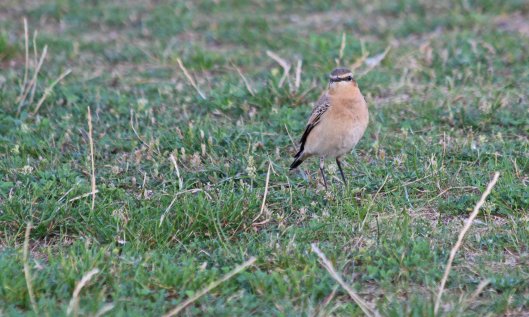
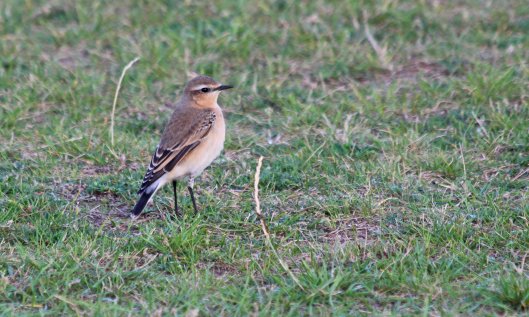
As I watched, it went scurrying across the grass after flying insects, dipping and flashing the white under-tail feathers it’s named for, constantly checking the sky for signs of danger.

And I particularly loved how, when there was no higher object to pop up on, it hopped on to a small rock to try to survey its surroundings. Magical moments with a special little bird!
30 Thursday Sep 2021
Posted in insects
Tags
British insects, moth caterpillars, moth larvae, mystery caterpillars, mystery larvae, sawfly caterpillars, sawfly larvae
To showcase their diversity, in colour, size, shape, pattern, habits and hairiness, I’ve been gathering photos of these (cater)pillars of the insect community, the larvae of moths, sawflies, and some mysteries, which could be one of these … or something other. Here they are:


Moths: 5-spot burnet (Zygaena trifolii), Drinker (Euthrix potatoria), and the delightfully named Maiden’s blush (Cyclophora punctaria).


Sawflies: a possible Allantus species (its identity cannot be confirmed as it was on the wrong plant), and the fluffy looking Eriocampa ovata.


Mysteries: if you can ID any of these, please leave a comment below. Thanks!
29 Wednesday Sep 2021
Posted in insects
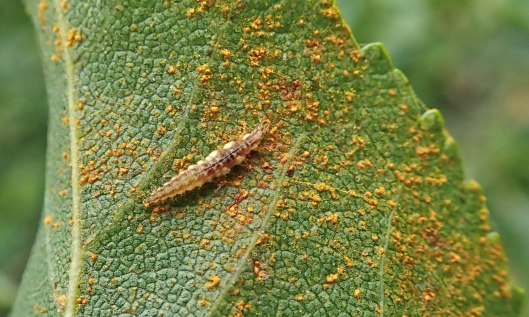
Last week I found two things I couldn’t identify and it turns out that they’re related. I’ve seen adult lacewings many times and always paused to admire their intricately patterned, delicate wings, the way their subtle colouring contrasts with their metallic eyes, and their hunger for aphids (they are used for biological pest control).


Last week, for the first time, I found some of their eggs, which, amazingly, dangle from the undersides of leaves on individual short silk strings. And, on a different day, under another leaf, I found what I initially thought was a hoverfly larva but later discovered was a lacewing larva. What intriguing creatures they are!
28 Tuesday Sep 2021
Tags
In recent weeks, craneflies have been getting a lot of bad press in some of the more environmentally ignorant media, with stories of ‘plagues of insects’ being used to attract readers, followers, and social media clicks. When you consider the current state of our planet, our climate emergency and biodiversity crisis, I believe this is highly irresponsible behaviour. I can’t do much to counter or challenge these media but I can blog in support of craneflies.

Not only are they harmless, but craneflies are also an important part of a healthy ecosystem, as they provide food at this time of year for birds, bats and other creatures. I had low-flying Swallows criss-crossing behind me the other day as my walk across a local field caused craneflies to flit up from the long grass – unfortunate for the craneflies, but essential nourishment for the migrating birds. If you’d like more information on these much-maligned insects, the Cranefly Recording Scheme, on the Dipterists website, provides a wealth of resources to assist.

27 Monday Sep 2021
Tags
British leafmines, leaf-mining fly, leaf-mining fly larvae, leafmine on Himalayan balsam, leafmine on Indian balsam, leafminer, leafmines, Phytoliriomyza melampyga
Here’s a leafmine I hope you don’t find but you probably will, and easily. So, why do I hope you don’t? Because this mine is found on plants of the Impatiens species, including the highly invasive plant Himalayan balsam (or Indian balsam, as it’s officially known; i.e. Impatiens grandulifera).

The leafminer is the larva of Phytoliriomyza melampyga, which creates an initial narrow twisting gallery that then widens into a variable whitish blotch. The larva’s frass can easily be seen within the mine. The adult fly is actually rather cute, with mostly yellow, a bit of black colouring. (You can see a short video of it on Wikipedia.)
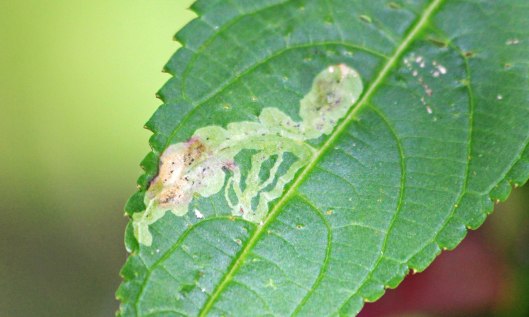
The NBN Atlas is currently showing just 192 records for this species in Britain, though, like most flies, it’s probably under-recorded.
26 Sunday Sep 2021
Posted in wildflowers
I seem to be seeing a lot of toadflax in flower at the moment – both Purple and Ivy-leaved are flowering in the lane behind my house, the former adorning the edges, the latter sprouting from niches in the old brick walls, and I spotted a lot of the yellow-flowered Common toadflax in bloom along the coastal path yesterday.
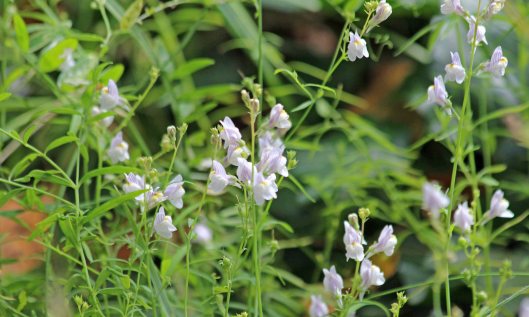
And, during another of this week’s walks, along a route I’ve only visited once before, I found a new-to-me species – this is Pale toadflax (Linaria repens). (You can read more about it on the excellent First Nature website.)


25 Saturday Sep 2021
Posted in insects
Many times in recent months, I’ve read of people hearing the characteristic song (or, more correctly, stridulation) of Roesel’s bush-cricket (Roeseliana roeselii). It’s supposedly ‘long, monotonous and mechanical’. And so I’ve gone to its usual habitat of coarse vegetation, marshy areas, field borders and scruffy urban wasteland to listen, but heard nothing (maybe, as I’m getting older, I’m losing that sound frequency).

So, I was over the moon earlier this week when I just happened to spot this handsome beastie enjoying the sunshine on a mound of dirt amongst the long grass at Cosmeston Lakes Country Park. I couldn’t get a very clear view, and didn’t want to get too close in case he jumped away, but I could see the distinctive ‘creamy border to the thorax’ so knew I’d finally found my cricket.

24 Friday Sep 2021
Fluttering at me from a log in the woodland … well, not really, but you get the picture. It’s always a delight to spot one of the Eyelashes, the Scutellinia species of fungi.

 earthstar
You must be logged in to post a comment.