273/366 Dock bugs young and old

Tags

, ,

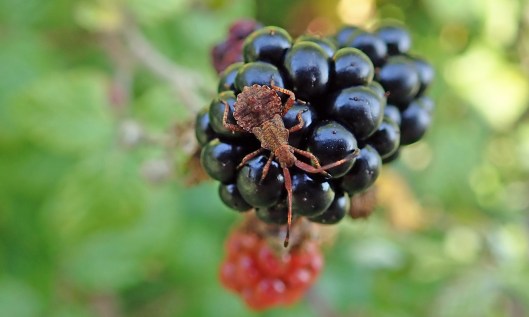
On recent sunny days, Dock bugs, both young and old, have been out basking in the sunshine.

200929 dock bug (1)

I often find them on Bramble leaves and, occasionally, on the berries, though, according to the British Bugs website (which also has a helpful chart showing their different stages of development), they don’t eat these (not surprisingly, their main food source is Dock, as well as other plants in the Polygonaceae family).

200929 dock bug (4)

Though their brown colour is quite obvious on Bramble leaves, that same non-descript colour and their ragged shape mean Dock bugs (Coreus marginatus) can be very inconspicuous. I only spotted the one below because it moved.

200929 dock bug (5)

269/366 Random Wrens

Tags

, , , ,

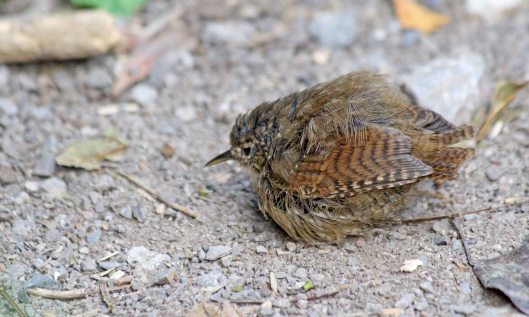
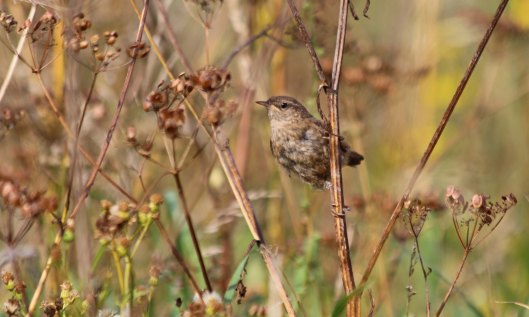
As the flow of migrating birds begins to slow, I’m seeing less of the locally unusual and more of the rowdy residents and, apart from a multitude of Meadow pipits flitting about the fields at Cosmeston on Monday, the highlights of my birding this week have been my encounters with these two wee Wrens.

200925 wren (1)

The first was tiny, sitting crouched on the coastal path, looking as if it should really be back in the cosiness of its nest, though when I slowly approached to encourage it off the path, it scuttled away quickly to shelter amongst the foliage. It may have looked young and a little poorly but I think that as long as its parents were nearby, it should be just fine.

200925 wren (2)

My second Wren encounter came during a quick circuit of Cosmeston’s east and west paddocks between belts of rain on Wednesday. I could see and hear birds feeding amongst the umbellifers and initially thought they were all Goldfinches and Linnets, when up popped this young Wren just in front of me.

200925 wren (3)

My Kiwi friends will understand when I say it looked like a possum in the headlights – it froze, unsure whether to feed or flee, not knowing if I presented a threat or could be ignored. I was able to walk a few steps closer and get quite a few photos before it decided that disappearing down into the long grass really was the safest option.

200925 wren (4)

268/366 Gone galling

Tags

, , , , , , , ,

I wanted a relatively short walk between rain showers so headed to a small local green belt where Oak saplings were planted a few years ago, and my wander turned into a challenge to see how many different types of gall I could find in just this one small copse of young Oaks. The answer? Six!
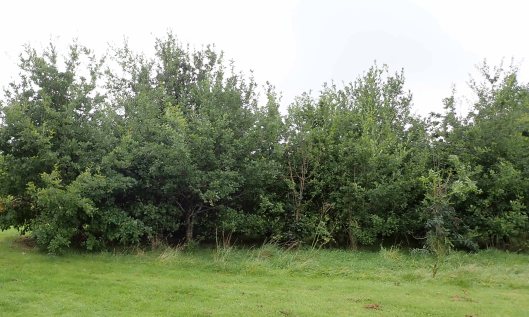
200924 oak galls (1)

First up, Knopper galls, caused by the wasp Andriscus quercuscalicis. For more on that gall, see my August 2017 post Oak galls: knoppers and artichokes.
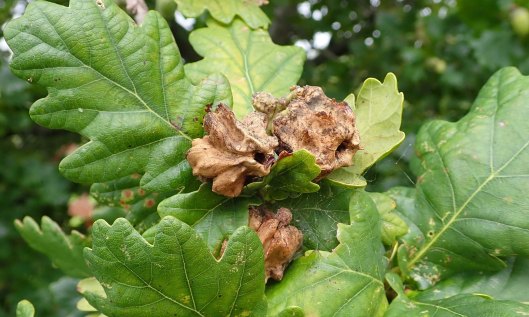
200924 oak galls (2) knopper

Next, Marbles, which I covered in Oak galls: marbles and apples, August 2017.
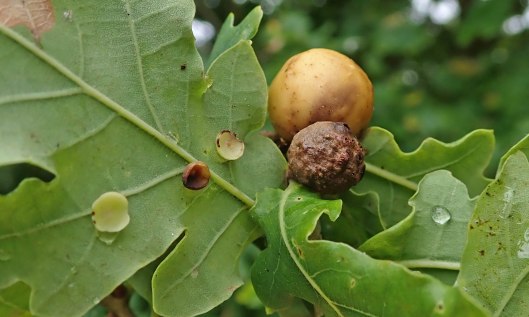
200924 oak galls (3) marble

Then, I found some Common spangles (below left), caused by the wasp Neuroterus quercusbaccarum. More on that mouthful in Oak galls: currants and spangles, August 2017.

You may have noticed my photo of Marble galls also had something else on the leaves. These were Smooth spangles (above right), a product of the wasp Neuroterus albipes.

I covered both Smooth spangles and this next gall, the Oyster, in the same blog: Oak galls: spangles and oysters, September 2017. The photo on the left above shows Oysters just beginning to form on the spine of the leaf; the one on the right shows two more developed examples, both on the same tree.
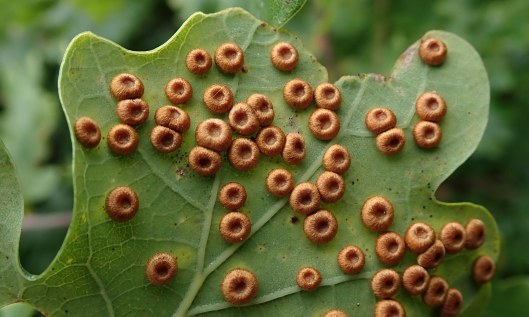
200924 oak galls (6) silk button

And, last but most certainly not least, as there were thousands of these on all the Oak trees I looked at, Silk button galls, caused by the wasp Neuroterus numismalis. I wrote about those in Oak galls: ram’s-horns and silk buttons, September 2017.

Not a bad haul for an hour turning over leaves and peering amongst branches. I didn’t find examples of all the Oak galls I’ve found before but I was very happy with this sampling.

267/366 A hitchhiker

Tags

, , ,

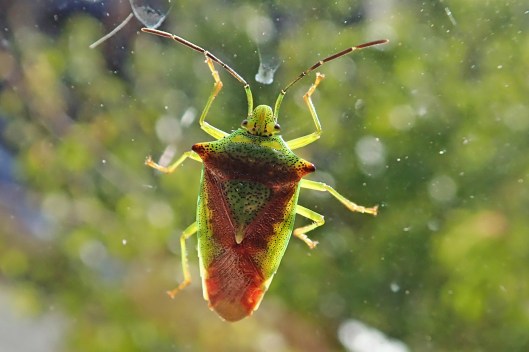
When I got home from today’s walk, I discovered I had a hitchhiker, tucked up snugly in the hood of my jacket. I presume this Hawthorn shieldbug got brushed off its bush and on to me as I pushed through the snagging branches of some young Hawthorns earlier in the day. After a couple of quick photos, I placed it on the window ledge and off it flew in search of the nearest Hawthorn.

200923 hawthorn shieldbug

266/366 A sweet necessity

Tags

, , , ,

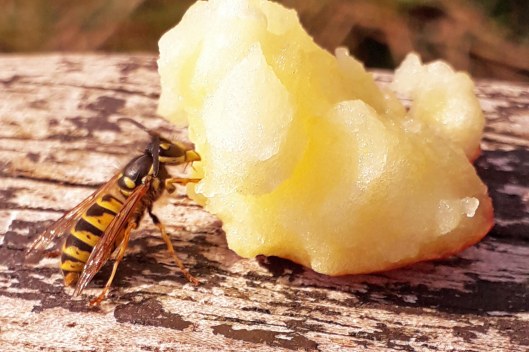
As I sat enjoying the coastal view, sipping my water, eating my apple, this wasp came a’visiting, buzzing annoyingly around the hand holding the apple, seeking sweet food, as they do on the fine days of late summer and early autumn. And, until I read this article on The Conversation website, I had no idea why. Take a look – it’s really interesting and well written. Oh, and my solution? I broke off a small piece of the apple and put it on the bench arm rest, so the wasp could help itself. As you can see, that worked a treat.

200925 wasp

265/366 Hutchinsoni

Tags

, , , , ,

If you happen to see a Comma butterfly on one of our fine autumnal days, have a good look at the colour of its wings. You may notice that both the upper and the undersides of its wings are quite dark, particularly when compared to some of the Commas you saw in the summer months. Why is that?

It may be that your paler summertime Comma was a hutchinsoni. The splendid Life Cycles of British & Irish Butterflies explains:

The Comma is known for a particular form named hutchinsoni that is much paler in appearance on both upperside and underside that the nominate form. This form is found throughout the butterfly’s range and is normally attributed to individuals that go on to produce a second brood in the same year. Its name is a tribute to Emma Hutchinson, a renowned Victorian entomologist … who ultimately discovered its double-brooded nature and the corresponding variation between broods. The name was announced by J.E. Robson in 1881 in The Young Naturalist: ‘The Summer form is so different, and so constant in its appearance, that it ought to have a distinctive name, and we suggest it be called var. Hutchinsoni, in compliment to the lady … whose knowledge of the species is not exceeded by that of any one living.’

In my photos, the Comma on the left, Polygonia c-album var. hutchinsoni, was photographed on 24 June, the Comma on the right on 17 September, both in the same location and on fine, sunny days. I think you can see how marked the difference in their colouring is.

264/366 Seedheads, 1

Tags

, , , , ,

200920 seedhead (1)

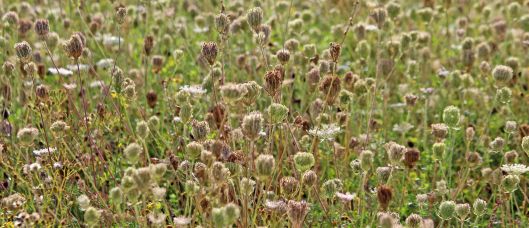
‘The vegetable life does not content itself with casting from the flower or the tree a single seed, but it fills the air and earth with a prodigality of seeds, that, if thousands perish, thousands may plant themselves, that hundreds may come up, that tens may live to maturity; that, at least one may replace the parent.’
~ Ralph Waldo Emerson, Chapter 6: Nature, Essays, Second Series, 1844.

This slideshow requires JavaScript.