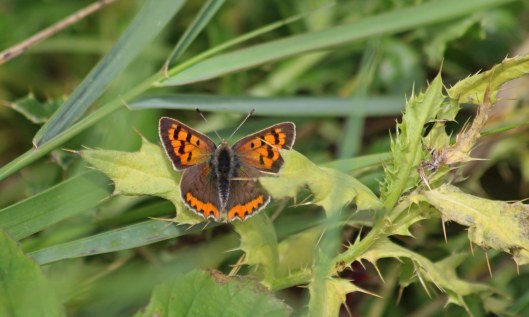
I was in seventh heaven yesterday because I found seven Small coppers, my favourite butterflies, at Cosmeston, the most I’ve ever seen in one place on one day. Here they are, the little beauties.




10 Thursday Sep 2020
I was in seventh heaven yesterday because I found seven Small coppers, my favourite butterflies, at Cosmeston, the most I’ve ever seen in one place on one day. Here they are, the little beauties.
09 Wednesday Sep 2020
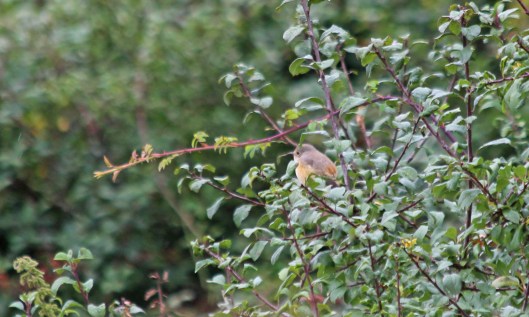
Yesterday I wrote about being reminded twice of the value of stillness – this was the second time. With a couple of fellow birders, I’d been enjoying a feast of migrant action all in one field – a Whinchat, a Spotted flycatcher, four Stonechats and these two Redstarts – though, as usual, the birds were a little too distant for my camera to get good photos.

Then, the unforecast rain came down in earnest, blowing across the field in vertical waves. The two chaps headed off but I figured I’d wait out the worst of the weather in the shelter of a large Oak tree growing along the hedgerow. Once again, my partial camouflage and my stillness – I waited 30 minutes or more – was rewarded, as one of the Redstarts came very near where I was standing. I couldn’t risk the camera being out in the rain for long but I was delighted with the couple of images I took and with being able to get such close views of this lovely bird.
08 Tuesday Sep 2020
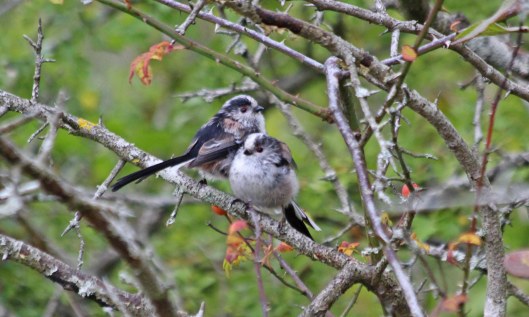
Twice today I was reminded of the value of standing still. There were a few spits of rain, so I pushed back against some low trees for shelter while I kept on watching a small flock of birds feeding in the bushes opposite.

As I was partly camouflaged and was keeping very still, the birds – the Long-tailed tits in my photos, plus Great and Blue tits, several Willow warblers, and a couple of Robins – mostly ignored me and came relatively close to where I was standing.

My stillness was rewarded with some reasonable photos, for a change, and with the joy of being close to these little cuties.
07 Monday Sep 2020
Posted in insects, plants, wildflowers
Tags
Buff-tailed bumblebee, bumblebees, Burnet moth, Common carder bee, insects on teasels, Meadow Brown, Teasel
Bumblebees and Teasels – I’m not sure why but they seem to be a match made in heaven.


In fact, bumblebees are the insects I see most often nectaring on Teasels, though the Burnet moths also find Teasel to their taste, as did this Meadow brown butterfly yesterday.


06 Sunday Sep 2020
Posted in plants, wildflowers
Tags
British wildflowers, Common field-speedwell, Greater plantain, Persicaria maculosa, Plantago major, Redshank, Veronica persica
Earlier this year, when we were in full lockdown and our Council, in their stupidity, closed the spacious local country park even to local pedestrians, I was one of many who looked for alternative places, other than too-narrow pavements, to walk, and in the process discovered a disused lane that leads to farm fields, which, this year, have not been leased for crop growing. These fields are where, in recent months, I’ve seen many nice birds, and plants like the Musk thistle I blogged about in July and the Lesser burdock from August’s Burdock Beasties. These are a few more finds from those fields.


Redshank (Persicaria maculosa)
Of course, you can find Redshank in many diverse locations – it thrives along the lane behind my flat – but it seems to be doing particularly well in this arable landscape. You may notice that Redshank bears a strong resemblance to the Amphibious bistort I blogged about on Thursday – they are both from the genus Persicaria, and, if you want to know more about this fascinating plant, I recommend you read the entry on the Plant Lore website, which will explain why one East Anglian name for the plant is ‘devil’s arse-wipe’!


Greater plantain (Plantago major)
Its name may be Greater plantain but I think this is the Greatest plantain I’ve ever seen – it was huge. The Plantlife website has some fascinating information about this plant:
A common name is Rat’s tails which perfectly describes the plant’s flowering spike. Another vernacular name is Angels’ harps because when you pull the leaves apart you get the fibres showing between. This is also the likely explanation for the names Banjos and Beatles’ guitars.
Plantain has healing powers since the leaves contain tannins and astringent chemicals, which can make them useful styptics if crushed and applied to small cuts.

Common field-speedwell (Veronica persica)
I have trouble identifying the various members of the Speedwell family but I’m fairly confident about this one – it was low and sprawling and hairy, and its solitary flowers were on stems growing from the bases of the upper leaves. A check of its seed capsules would’ve clinched it but I forgot to look at those. As its name implies, Common field-speedwell is commonly found in fields – in fact, my footpath today took me along the edge of a field where the farmer is growing maize and the soil between the maize plants was completely covered by this lovely plant with its delicate blue flowers.


05 Saturday Sep 2020
Tags
beetles, British insects, Brown-tail moth caterpillars, Brown-tail moth webs, Buff-tailed bumblebee, Emperor dragonfly, Knopper gall
Actually, it rained before my walk, during my walk and after I got home, but ‘Small creatures between showers’ was a bit long for a title. Here, then, are the said creatures …
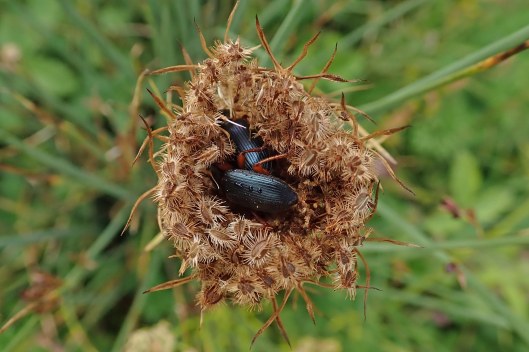
First up, these beetles were cosying up in an umbellifer flower head. I couldn’t see enough to identify them and wasn’t going to disturb their comfort to find out more.
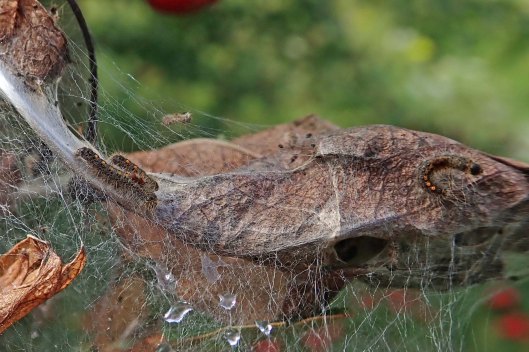
This is a web of Brown-tail moth larvae, the ones some people freak out about because their hairs can irritate the skin. The solution to that problem is, of course, easy: look, enjoy, wonder, admire, but don’t touch!
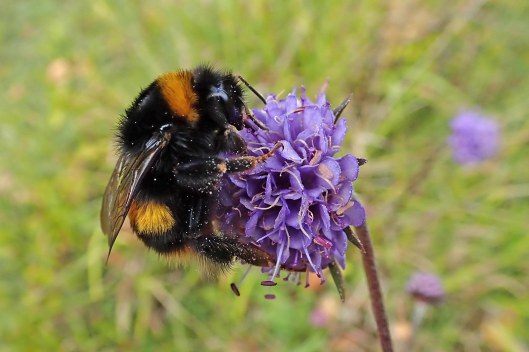
There weren’t many flying critters about but bumblebees will fly whatever the weather, as shown by this gorgeous queen Buff-tailed bumble.
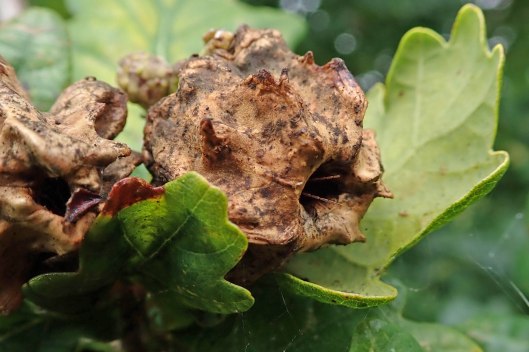
Perhaps the littlest creature, though I didn’t look in to investigate, was the one that was lurking in this Knopper gall (spot the antennae!).
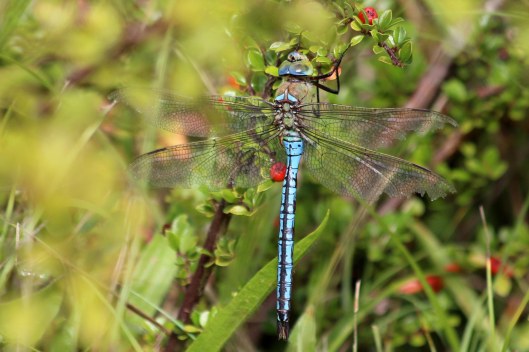
And, the prize for the most magnificent, was this male Emperor dragonfly. I had to linger a while, waiting for him to settle, and then sneak up behind the bushes, but His Imperial Majesty was definitely worth the wait. What a handsome creature he is, despite his somewhat ragged wings.
04 Friday Sep 2020
Tags
autumn berries, birding, birdwatching, blackberries, bramble, British birds, Cosmeston Lakes Country Park, Pheasant, pheasant eating blackberries
A rustle of vegetation … an eye … who’s this lurking behind the ‘snipe paddock’ fence at Cosmeston?
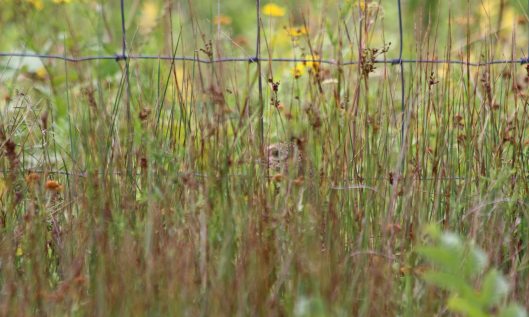
A female Pheasant? A common enough bird in the local countryside but not normally seen here in this dog-full park. She has quite short tail feathers and she’s not too bothered about my presence so I presume she’s a juvenile.

It seems she’s quite partial to blackberries.

Are there more of those delicious treats?
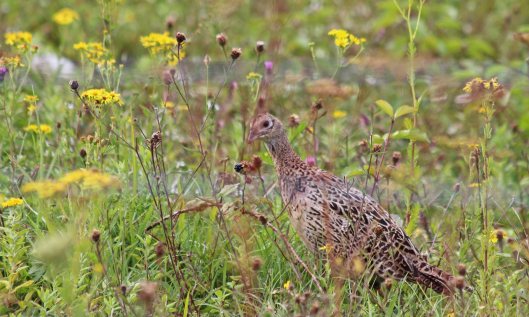
Aha, yes, another ripe one.

And, after scoffing those couple of berries, she wanders off in search of more.

03 Thursday Sep 2020
Posted in nature, plants, wildflowers
Tags
Amphibious bistort, amphibious wildflower, British flora, British wildflowers, Cosmeston Lakes Country Park, Persicaria amphibia
Initially, I doubted my identification of this plant – I’d seen it growing in clumps in the waters of Cosmeston Country Park’s west lake, so how could this be the same plant growing in a section of meadow, albeit a damp area where reeds are abundant?

The Great crested grebes like to park themselves amongst the plant, perhaps to stop them drifting while they snooze.
The clue, of course, is in its name: amphibious, ‘relating to, living in, or suited for both land and water’ (Oxford Dictionary). Amphibious bistort (Persicaria amphibia) has two forms, one that resembles a water lily, floating its leaves upon the water surface, and another that lives quite happily on land that can be quite a distance from water, as long as that land is moist.
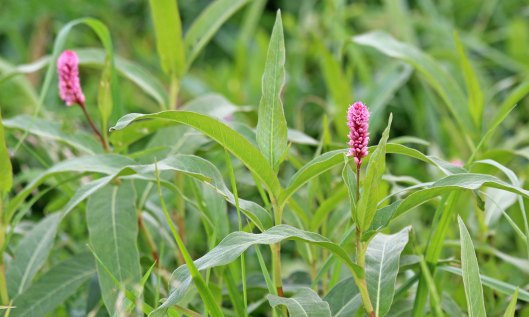
This second type also shows the somewhat more elongated leaves that its generic name refers to – persicaria ‘relates the shape of leaves of this group of plants to those of a peach tree’ (First Nature) – and the land-based form has hairy leaves, which the water-growing form does not. To clinch the identification, my book (The Wild Flower Key) says to look for two stigmas in most flowers, which Amphibious bistort has but similar species do not. And very pretty flowers they are too!


02 Wednesday Sep 2020
Tags
birding, birdwatching, British birds, gull chick, Lesser black-backed gull, Lesser black-backed gull juvenile, urban gull nest
I feel a bit like a proud parent sharing photos of their child when I post news of the Lesser black-backed gull that was born amongst a neighbour’s chimney pots but … here’s junior, a month on from the last update. It still comes back to the nest area almost every day, still screeches pleadingly at its parents for food, but it seems to be doing well, and looked rather splendid in the soft light early this morning.

01 Tuesday Sep 2020
Tags
birding, birdwatching, British birds, Cosmeston Lakes Country Park, juvenile Reed warbler, Reed warbler
One highlight of a bumper birding day at Cosmeston last Friday was seeing rather than just hearing a little family of Reed warblers (they frequently hide away amongst the reeds so only their distinctive call can be heard). I caught glimpses of birds moving in the greenery, then recognised the constant call of a youngster and figured I had a better than usual chance of seeing something, as young birds are often less wary than adults.

So, I waited … and I waited … and after 7-8 minutes, this little cutie popped out, foraged, hopped up and down the reed stems, and poked about in the bushes.

And then, judging by how often it kept closing its eyes, I think it headed back into cover amongst the reeds for a snooze.

 earthstar
You must be logged in to post a comment.