84/366 In the ponds

Tags

, , , , , ,

I saw my first-ever Common toad (Bufo bufo) spawn when I was checking out the local ponds yesterday. Their structure – double rows of dark round eggs within long see-through strings – is unmistakable.

200324 toad spawn

I couldn’t find any Common frog (Rana temporaria) spawn but that might be because the spawn has now all hatched into tadpoles. There weren’t too many of those either – perhaps the local Grey heron or other birds have been feasting on their version of caviar.

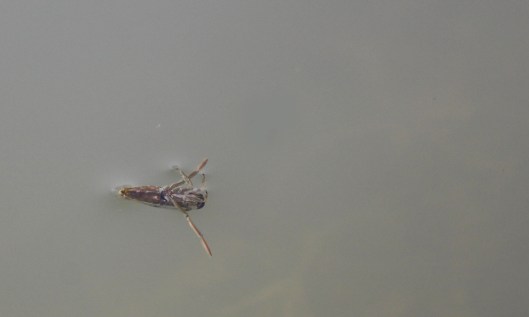
And the only other critter that was swimming about in the murky, still muddy water was this Water boatman (Corixa punctata), scooting along on the surface in that haphazard way they do.

200324 water boatman

83/366 Fabulous flying fuzzballs

Tags

, , , ,

I wish I could take the credit for that title but it came from a tweet I read earlier today by the social media team at Buglife, The Invertebrate Conservation Trust.

200323 beeflies (1)

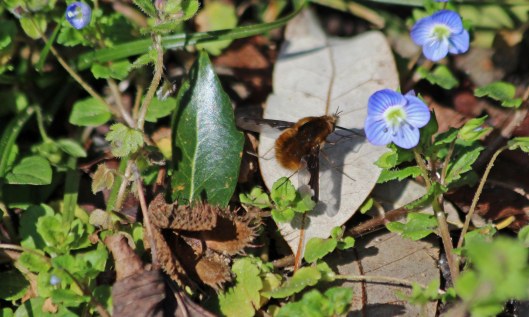
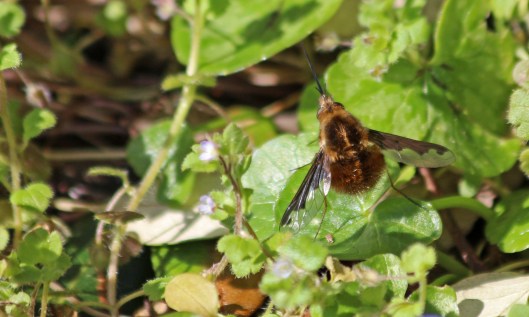
The tweet was reporting how the sunshine of the past couple of days has brought out the bee-flies and so it has been in my area too. Yesterday, on the sheltered slopes of a local park which, luckily, I had almost to myself, I saw my first four bee-flies of 2020.

200323 beeflies (2)

These are Dark-edged bee-flies (Bombylius major), the only species I’ve ever seen, and they were feasting on a glorious carpet of Lesser celandine and Speedwell.

200323 beeflies 3

There are several other species of bee-fly, and a couple of similar non-bee-fly species. The BRC (Biological Records Centre) website has a most excellent photo identification guide that can be downloaded here. Good luck with finding some fabulous flying fuzzballs in your locale.

200323 beeflies 4

82/366 Wildflowerhour : the Brassicas

Tags

, , , , , , , ,

This week’s challenge for #Wildflowerhour was to find as many of the Brassica family in flower as possible. I’m rather pleased with the number I’ve found, though I’m not 100% sure of my plant IDs, so if you think I’ve got any wrong, please do comment below. And I’ll edit this post if I need to, to reflect the corrected information.
200322 American winter-cress

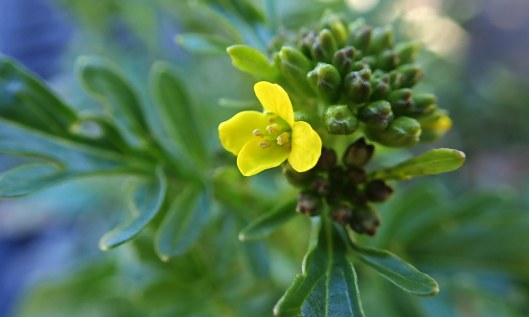
American winter-cress (Barbarea verna): this is the identification I’m least confident about, as it’s a plant I’ve not seen before, and only a couple of flowers were actually open, but the leaf shape seems to fit.

200322 Common whitlow grass

Common whitlowgrass (Erophila verna): his plant is very common in my area but it’s one I often overlook because of its small size. It’s a pretty wee thing though.

200322 cuckooflowers

Cuckooflower (Cardamine pratensis): found earlier this week but this is a new photograph as I’ve since revisited the site. It’s certainly earlier in this particular location than in the other places I’ve usually found this plant, which, I suspect, is due to aggressive cutting by the local council in those other locations (Cardiff Bay and Hamadryad Park).
200322 hoary mustard

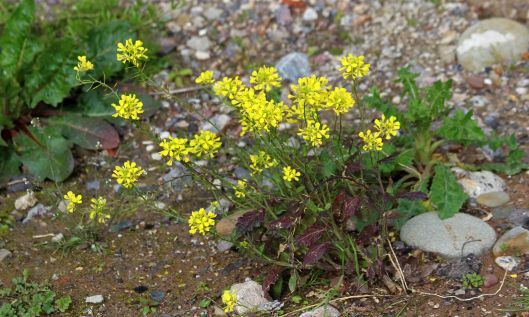
Hoary mustard (Hirschfeldia incana): Argh, so many plants that look similar! The only reason I’m reasonably confident about this one is that I’ve posted a photo of it previously on Twitter and an expert named it for me.

200322 sea radish

Sea radish (Raphanus raphanistrum ssp maritimus): This is another plant previously identified by one of the Twitterati and, though this was a slightly different location, it was also on the shores of Cardiff Bay so hopefully I’ve got this one right.
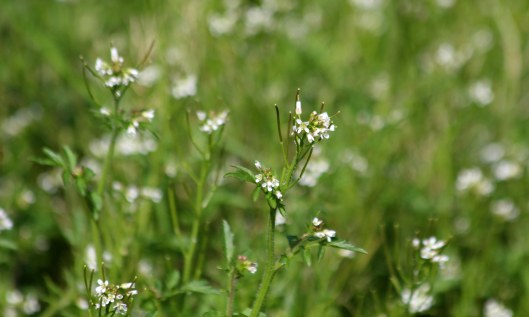
200322 wavy bitter-cress

Wavy bitter-cress (Cardmine flexuosa): The bitter-cresses always confuse me but, though it’s hard to see them, these flowers have six stamens, which is a key ID point to confirm this as Wavy rather than Hairy bitter-cress.

200322 Shepherd's-purse

Shepherd’s-purse (Bursa pastoralis): The purse-shaped seedpods of this lovely little plant make it unmistakable, thank goodness.

81/366 Number 3!

Tags

, , , ,

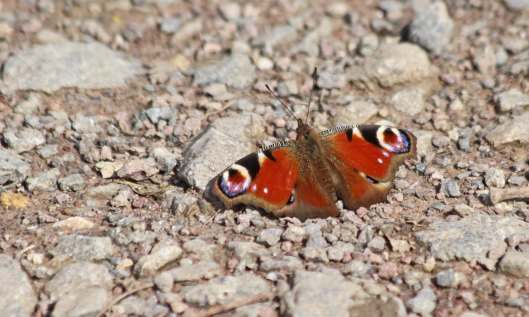
Yesterday’s walk around Cardiff Bay didn’t only bring nice birds, it also produced my second butterfly species for the year, a Small tortoiseshell. Unfortunately, the wind blew it away so quickly, twice, that I didn’t manage a photo. But I did get a couple of shots of today’s third species, this lovely Peacock. And I also saw number four, my first Brimstone, a male that was so intent on flying back and forth along the footpath trying to find a female that I only got a blurry shot of it. In these troubled times, it makes my heart sing to see the butterflies emerging again.

200321 Peacock

80/366 Today’s Bay birds

Tags

, , , , , , , , ,

Finally, we’ve had a rain-less day and, though there was a bitterly cold wind blasting across Cardiff Bay, I had to take advantage of the dry weather so walked an 8-mile circuit right round the Bay. The first highlight was my first two Wheatears of the year, a bit distant, and only popping up very briefly from amongst the huge Barrage boulders, but it was lovely to welcome them back for the summer.

200320 1 wheatear

The Bay was buzzing with Sand martins – I must’ve seen at least 20, perhaps more, at various times during my wander, and it was a joy to watch their aerial antics.

200320 2 sand martin

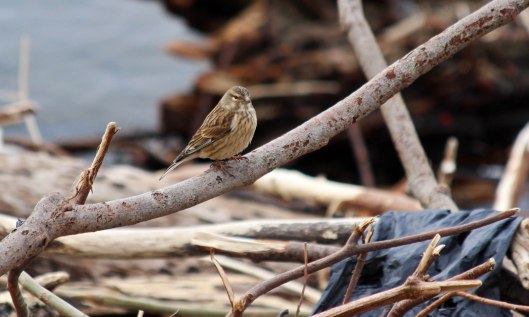
Though it’s now several weeks since the big floods pushed a ton of rubbish into the Bay, the huge accumulations have still not been cleared. In fact, most of the rubbish slicks have seen no clearance action taken at all. The ONLY positive thing about this is that the Goldfinches and Linnets seem to be finding plenty of food amongst the garbage.

200320 3 linnet

I simply had to include this male House sparrow, as today is World Sparrow Day.

200320 4 sparrow

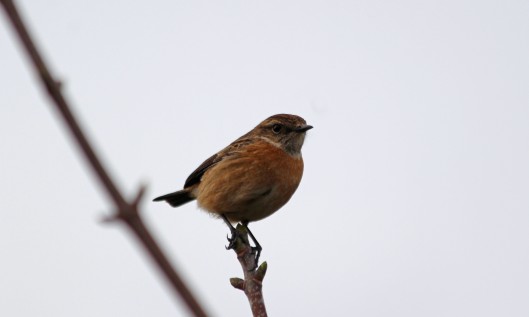
This lovely female Stonechat was dotting back and forth across the footpath through the wetlands reserve, and let me get quite close for photos. There was no sign of the male today though.

200320 5 stonechat

79/366 The twister

Tags

, , , , , , ,

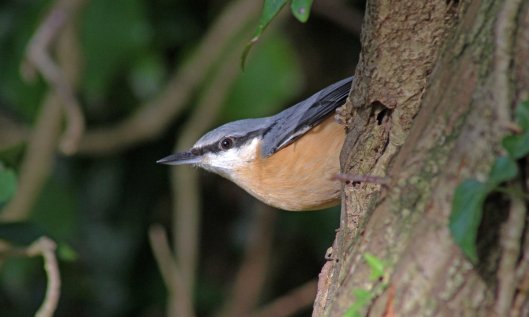
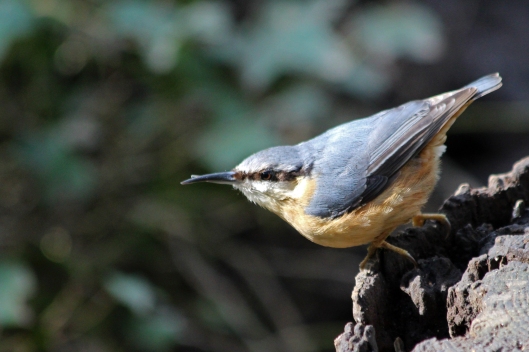
During a recent wander through Cogan Wood, after a spell of nasty weather, I was dishing out sunflower seeds to all the small birds, the tits and Robins and assorted others, when I noticed this Nuthatch with an elongated and twisted beak. The deformity wasn’t stopping it feeding or carting away and stashing two or three seeds at a time.

200319 nuthatch October2017

October 2017, the twist is not very pronounced

I had a nagging feeling that I’d seen the bird before and, sure enough, when I checked my photos, I had images from two previous sightings, the first in October 2017, the second just a couple of months ago, in January 2020, always in the same spot in the wood. The twist was minor in the first photo but appears to have got worse as the beak has grown longer.

nuthatch 200102 cosmeston

January 2020

Apparently, the Nuthatch lives about three years on average. Obviously, I don’t know how old this particular bird was when I first saw it but it will be interesting to keep an eye out for it to see how long it manages to survive. I hope it lives long and prospers!

nuthatch 200306 Cosmeston

March 2020

78/366 Dainty beauties

Tags

, , , ,

Yesterday’s star finds, during a walk around Grangemoor Park, were my first Cuckooflowers of 2020. They’re such dainty little beauties and, with a newly arrived Chiffchaff calling in the trees behind, it felt like Spring really had arrived.

This slideshow requires JavaScript.

77/366 Eyelash fungi

Tags

, , , ,

As you can see from my photos, the aptly named Eyelash fungi have hair-like bristles around their outer edges.

200317 eyelash fungi (1)

These particular Eyelashes can currently be found in large numbers in the west paddock at Cosmeston Lakes Country Park, where I presume they are enjoying the soggy muddy conditions, though they are growing on banks and slightly raised areas rather than in the completely sodden soil of the flatter parts.

When compared to the Eyelash fungi I blogged about back in May 2016 (see ‘Fluttering their eyelashes’ here), these latest examples have much shorter lashes. They are probably one of the Scutellinia species – possibly Scutellinia olivascens – but there are many very similar species of Eyelash fungi and you need to examine them under a microscope to be able to identify them correctly.

200317 eyelash fungi (4)

75/366 A plant of many names

Tags

, , ,

With its spotted leaves and flowers that start out pink but change quickly to blue, Common lungwort (Pulmonaria officinalis) is a very attractive plant. I’ve blogged before about the origin of its name and some of its other common names but the Royal Horticultural Society website has an even longer long list of vernacular names for this plant: Jerusalem sage, Adam and Eve, Bedlam cowslip, beggar’s basket, bugloss cowslip, Jerusalem cowslip, lady’s cowslip, lady’s milk, Mary’s honeysuckle, Mary’s tears, sage of Bethlehem, soldiers and sailors, spotted dog, and Virgin Mary’s honeysuckle.

200320 lungwort (1)

I’m sure many of the Lungwort plants I see are relatively recent garden escapes but the plants shown in today’s photos may perhaps be a little older. They were growing along the boundary fence of the medieval village at Cosmeston Lakes Country Park, a village which is a reconstruction of the actual buildings that existed on this site around 600 years ago. Was it one of the herbal plants used by the locals in those days? I like to think so.