193/365 Hairstreaks

Tags

, , , , , ,

Record shots only! Have you heard that term? Well, these photos are extremely good examples of what it means – really lousy photos, sometimes taken at long distance and then heavily cropped, often blurry, possibly adjusted in Photoshop or similar image processing software to try to enhance the features, but really only retained as proof that you did actually see what you say you saw. (So you can actually see what lovely butterflies these are, I’ve linked their names to the relevant pages on the Butterfly Conservation website.)

190712 white-letter hairstreak

Luckily, with this shot of a White-letter hairstreak, I was with another person, who actually showed me the location, so I have a witness to the sighting. From my ‘record shot’ you probably can’t even tell that the small blob in the sky is a butterfly flitting around in the top canopy of this Wych elm.

190712 purple hairstreak (1)

I did a little better with the Purple hairstreak. Again, this is a known location, where other people have seen and photographed these lovely little butterflies in recent days. The first time I visited, all I could see were small flutterings at the very top of the tall old oak trees where the Purple hairstreaks live. Luckily, on my second visit, some of the butterflies were moving around further down the tree. I just needed to be patient and wait for one to fly, then try to follow where it went – believe me, that’s not easy as they almost seem to disappear amongst the leaves and they really are quite small (a wing span of 37-39mm).

190712 purple hairstreak (2)

192/365 Essex skippers

Tags

, , , , ,

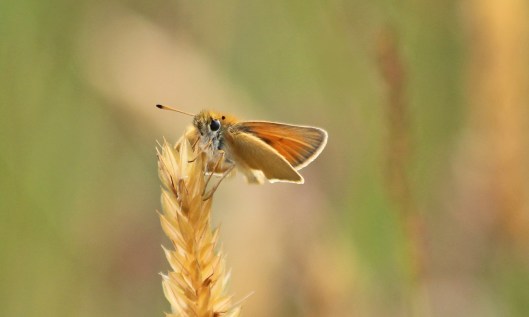
Tuesday was the first time I have knowingly seen and photographed Essex skippers. I visited a location where there’s been a colony in previous years so my chances were high but I knew they were tricksy little butterflies to identify – the only photo I have of one was taken two years ago in a different place and I didn’t realise what it was till I checked it more carefully a year later.

190711 essex skipper (1)

You see, the Essex looks superficially very similar to the Small skipper. They’re the same size, the same general colour and can be found in the same habitats. The defining feature for a novice like me is the tips of the butterfly’s antennae – in the Essex skipper these are black, both on top and below. And therein lies the difficulty! Because you just try seeing the colour on the underside of the antennae of very small butterflies that spend most of their time skilfully weaving their way in and around tall grasses in a meadow full of similar butterflies. It ain’t easy!

190711 essex skipper (2)

Still, it was a pleasant day, the meadow was full of lovely wildflowers, and I was surrounded by butterflies of several types and sizes – what could be nicer? It was really just a matter of time and patience, and eventually I had two definite sightings. One very cute little Essex even decided to pose for me, repeatedly settling on grass stems so I could get the front-on photos that I needed to be sure of its identity.

190711 essex skipper (3)

191/365 Six-belted clearwing

Tags

, , , , , ,

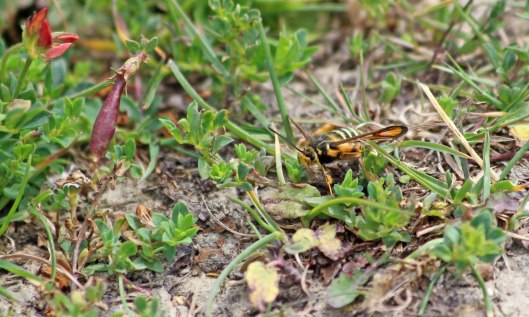
Believe it or not, this amazing creature is a moth, an aptly named clearwing moth – you can see parts of her wings are not covered by scales so are transparent. She is a Six-belted clearwing (Bembecia ichneumoniformis) and I know it’s a female because she only has five belts, i.e. five yellow stripes on her abdomen – the males have six.

190710 six-belted clearwing (3)

I discovered her completely by chance – I was scanning the ground at Cosmeston Lakes Country Park for butterflies and happened to notice her stripes. Cosmeston actually has the perfect habitat for these moths as they like chalk and coastal grasslands and quarries, and their caterpillars like to munch on Common Bird’s-foot trefoil, which grows locally in abundance. I’m amazed, then, that there have been very few locally recorded sightings – maybe everyone who spots them thinks they’re wasps or bees.

190710 six-belted clearwing (1)

These are day-flying moths and the adults are on the wing between June and August, so I’ll be on the look out for more of them over the coming weeks.

190710 six-belted clearwing (2)

190/365 Ivy broomrape

Tags

, , , ,

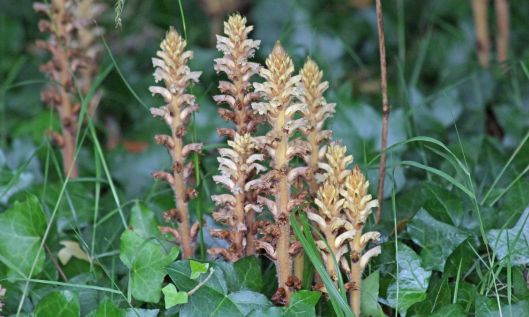
As I was walking through the park-like surroundings of All Saints Church in Penarth today, I noticed these curiosities growing amongst ivy under a couple of the trees. As the trees were different but they had ivy in common, I assume these are Ivy broomrape. Their scientific name is Orobanche hederae which, according to Wikipedia, translates as follows: ‘Orobanche is derived from Greek, and means ‘legume strangler’ … The name hederae means ‘of ivy’, in reference to its host plant, Hedera.’

190709 ivy broomrape (2)

All the broomrapes, the Orobanchaceae, are parasitic plants: they are unable to manufacture their own chlorophyll so cannot exist without tapping in to the roots of their host plants for nutrients. In this case the host is ivy but there are also broomrapes that parasitize trees like hazel and elm and plants like yarrow, greater knapweed and various thistles.

190709 ivy broomrape (1)

189/365 ‘A confetti of scent scales’

Tags

, , , , , , , , ,

The observant among you may have noticed silvery looking lines on the veins of the Silver-washed fritillary in yesterday’s post – those are its sex brands. In these particular frits, the males have four such brands, two on each top upper wing. The brands contain androconial scales, special scented scales that are used during courtship to attract females. As the Woodland Trust website explains, Silver-washed fritillary ‘courtship is an aerobatic spectacular: the female flies in a straight line while the male loops the loop around her, before showering her in a confetti of scent scales’.

190708 silver-washed fritillary

Silver-washed fritillaries are not the only butterflies to have sex brands: they can also be found, for example, in Large and Small skippers (below left and right, respectively). The Learn about Butterflies website (which has a much more detailed explanation for those who are interested in the nitty gritty of butterfly anatomy) explains, the dark diagonal marks on the skippers’ wings

are composed of hundreds of androconial scales. These disseminate pheromones that can be detected by females during courtship. As the male ages the strength of his pheromones diminishes, thus by analysing the strength of the pheromones a female can assess the age and virility of a potential mate.

The more I find out about butterflies, the more fascinated I become.

188/365 Silver-washed fritillary

Tags

, , , , ,

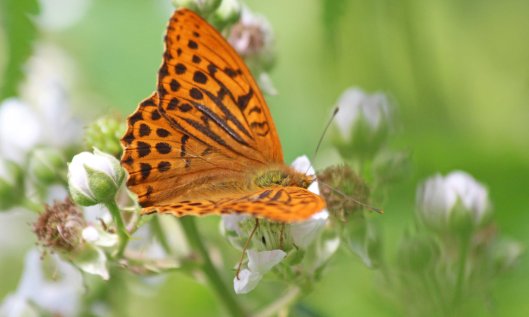
As well as the endangered High brown fritillaries and their cousins the Dark greens, Friday’s butterflying day out also turned up a couple of these beauties, the equally glorious members of the family, the Silver-washed fritillaries (Argynnis paphia).

190707 silver-washed fritillary (1)

If you’re wondering how an orange-and-black-patterned butterfly got the name silver-washed, it’s because the underside of its wings are streaked silver. Unfortunately, my photos don’t show that very clearly … next time.

190707 silver-washed fritillary (2)

187/365 Most threatened butterfly

Tags

, , , , ,

190706 High brown fritillary (1)

I had the very great privilege yesterday of spending time with some of Britain’s most threatened butterflies, in the only location in Wales where they can be found. These are the High brown fritillaries (Argynnis adippe), which, despite their large robust appearance, have declined by almost 80% since the 1970s and are now the subject of ongoing conservation efforts by the staff of Butterfly Conservation and their dedicated and hard-working team of volunteers.

190706 High brown fritillary (4)

It was one of their long-term volunteers, Richard, who willingly gave his time yesterday to show me around the site, to explain all about the work they’re doing to save this butterfly from extinction, and to show me how he surveys a transect to monitor their population. Brush cutting, bracken bashing, surveying, visitor management, tour guiding, newsletter writing – and he’s been doing all this since 1995! I simply can’t thank him enough.

190706 High brown fritillary (2)

And as for the High browns – what glorious creatures they are! There was one particular area, a wide bowl of head-high bracken, where we were treated to wonderful sightings. The males mostly raced past at high speed, frantically following the trail of an enticing female, and sometimes bounced around each other in their quest for dominance and territory. At other times, they wafted gracefully around the bracken tops, offering perfect close views when they stopped to nectar on bramble and thistle flowers; they even floated over to check out the human intruders in their space.

190706 High brown fritillary (3)

The High brown fritillary can be difficult to tell apart from the Dark green fritillary, both of which share this particular location – it’s all about the size of the third dot on their upper wings and the presence or absence of reddish markings on their under-wings but you do need clear views to see these differences. I think I’d cracked it by the end of the day but the best thing, the most wonderful thing was just being there amongst them. Bliss!

186/365 Humming-bird Hawk-moth

Tags

, , ,

I’ve had the most wonderful day out butterflying but it’s already 5:30, I have a lot of photos to go through, I’m hungry, and I desperately need a shower to wash off the heat and insect repellent – okay, probably too much information, but you get the picture. The butterfly blogs will have to wait till tomorrow and Sunday. So, here’s another gorgeous creature from today’s outing, a Humming-bird Hawk-moth.

190705 Hummingbird Hawkmoth

185/365 Beauty and the Beast

Tags

, , , , , , ,

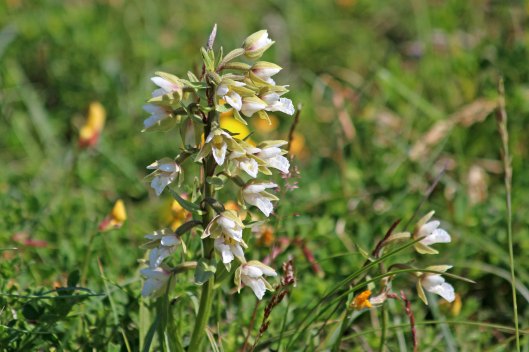
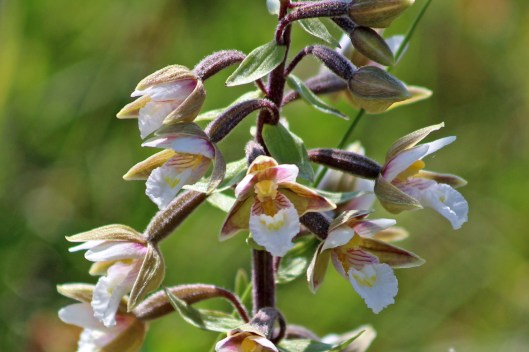
Like many brownfield sites, the former limestone quarries at Rhoose Point, the southernmost point in Wales, are now a nature-filled paradise, and yesterday one area was positively teeming with these beautiful Marsh helleborines (Epipactis palustris).

190704 marsh helleborines (1)

As their name implies, these orchids need water to flourish: the First Nature website says ‘This plant thrives in habitats which are usually submerged with water during the winter and maintain high levels of moisture during the summer. Dune slacks are often home to vast colonies, as are fens which are fed by alkaline springs running through limestone rocks – chalk being the other essential element to enable the Marsh Helleborine to flourish.’

190704 marsh helleborines (3)

I love what Richard Mabey has to say about orchids in Flora Botannica:

These days [their lightweight seed] often fetches up on artificially open habitats, low in nutrients and free of competition (quarries, for example), which replicate orchid-rich natural habitats such as sand dunes and cliff tops. It is this paradoxical, opportunistic quality of many orchids – the exquisite bloom transforming the spoil tip – that has become the basis for the true modern myth of the family, a botanical version of Beauty and the Beast.

190704 marsh helleborines (2)

The Marsh helleborines (and the many other species of orchid) that grow so well in the old Rhoose quarries are a stunning example of this transformation.

190704 marsh helleborines (4)

184a/365 The Big Yin lives!

Tags

, , , , ,

190703 LBB gull chick

The best news! The biggest of the three Lesser black-backed gull chicks is still alive. It must’ve fallen off the roof. I had searched the back of the house with my bins and found nothing and couldn’t hear anything, but now it’s on the roof of the lean-to attached to the back of the house. It’s moving around just fine and a parent has been down to feed it. I suspect it may have fallen into the front garden (a miracle it survived the tumble), the home owners have found it, and moved it around the back and on to the roof so it could be seen by its parents. Fingers crossed!