Aphid mummies

Tags

, , ,

I feel as if I’m standing at the top of a very slippery slope, at the bottom of which is a chasm filled with aphids and their parasites! I say this because I’m finding that these are creatures that have been little studied, are very tricky to identify, and thus could easily become a bottomless pit of specimens I’m frustratingly unable to put a name to. (I already have two jars on my windowsill with parasitised aphids inside, waiting to see what emerges.) I really really should back away from the edge of that slippery slope right now but, before I do, here are some photos I’ve already taken, of what are known as ‘aphid mummies’. The aphids have had eggs laid in them by parasitic wasps, whose larvae have slowly eaten their host while it was still alive, then pupated and emerged as adult wasps – you can see the tiny holes where they’ve left their mummies.
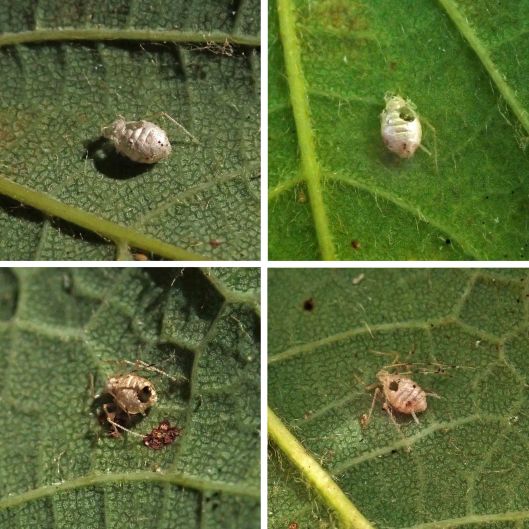
230926 aphid mummies

An itch, those feet!

Tags

, , , , , ,

Great crested grebes feature quite often on here but I couldn’t resist yet another grebe photo. I was watching this young bird successfully fishing for small fish when it stopped to scratch an itch. Great crested grebes spend most of their lives in the water, so we don’t get to see their feet very often. Grebe legs and feet are well adapted to their aquatic environment, with legs placed well back on their bodies and, as you can see, the lobes of their feet wide and flat to help propel them quickly through the water.

230925 great crested grebe feet

39

Tags

, , , ,

39. That’s the number of wildflowers I photographed as I wandered around Cosmeston Lakes Country Park yesterday. I was also on the look out for American birds (if you’re not local or a birder, you may not know that there’s been an unprecedented number of American birds found in western parts of Britain after the remnants of Hurricane Lee swept through last week), but the sheer numbers and varieties and colours of these wildflowers were very welcome compensation.

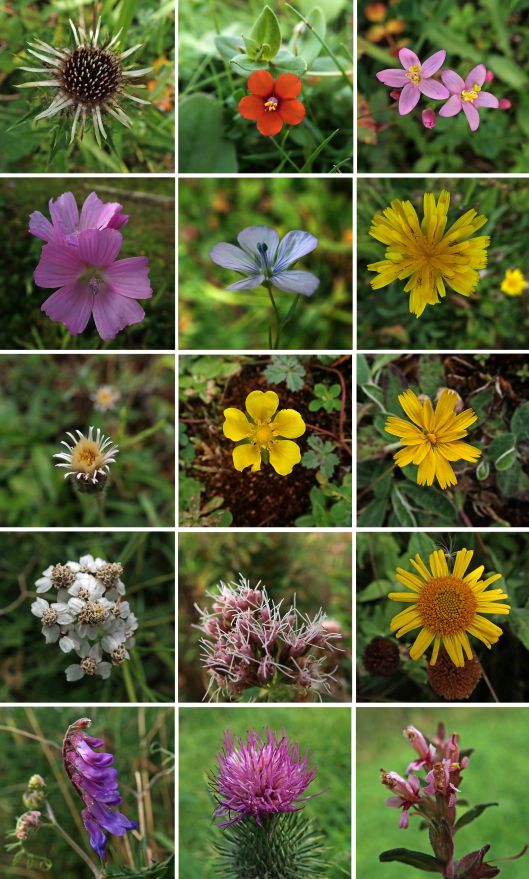
230924 cosmeston wildflowers (1)

These beauties are in the order I found them as I walked: Oxeye daisy, Common ragwort, Common knapweed (with unusual contrasting petal colours), Eyebright, Bird’s-foot trefoil, Red clover, Black medick, Agrimony, Wild parsnip, Devil’s-bit scabious, Selfheal, Wild carrot.

230924 cosmeston wildflowers (2)

Goat’s-beard, Yellow-wort, Meadow buttercup, Bramble, Creeping thistle, Large bindweed, Great willowherb, Common mouse-ear, Hogweed, White clover, Meadow vetchling, Daisy

230924 cosmeston wildflowers (3)

Carline thistle, Scarlet pimpernel, Common centaury, Musk mallow, Flax, Rough sow-thistle, Blue fleabane, Creeping cinquefoil, Mouse-ear-hawkweed, Yarrow, Hemp-agrimony, Common fleabane, Tufted vetch, Spear thistle, Red bartsia.

The Ivy is a’buzzing

Tags

, , ,

After the remnants of Hurricane Lee swept us with gusty winds and heavy rain for a couple of days, it was lovely to walk along the coast in the sunshine on Thursday. And that warm sunshine also brought out the little flying creatures to enjoy the now-flowering Ivy bushes. Migrating Red admirals sucked at their nectar and an assortment of flies, wasps, hoverflies and bees wallowed in the pollen. My favourites were the Ivy bees that only emerge at this time of year to enjoy this early autumn flowering treat.

230923 ivy bee

A Flatholm gull

Tags

, , , , , ,

At Cosmeston, during Monday’s walk, I spotted this juvenile Lesser black-backed gull and was able to read the code on its left leg ring, F:D94. With a little searching on the European Colour-Ring Birding website, I found that the bird was probably ringed on the island of Flatholm, just over 3 miles off the south coast of Wales and a well known breeding site for Lesser black-backed gulls. I fired off an email reporting my sighting.

230922 lbb fd94 (1)

Just a short time later I got an email back, saying that the ringing group on Flatholm has now set up a website for the birds they ring. I found the website easy to use and it gives you instant feedback about the gull you’ve seen. F:D94 is one of this year’s breeding successes and was ringed as a chick on Flatholm on 1 July. So, for any birders amongst my followers, if you happen to spot a Flatholm bird (they have a tiny metal ring on their right leg and, on their left, a blue plastic ring with an alpha-numeric code that starts with an F), please do report your sighting on their Flat Holm Gulls website.

230922 lbb fd94 (2)

A parasitised aphid

Tags

, , , , , , ,

*** This post has been edited to correct previously wrong information. ***

I’ve seen these odd sights previously but only recently learned what they were and have been searching for an example to show you since then. Finally, during last Friday’s walk, with a little Oak-leaf-turning, I found another. Unfortunately the light wasn’t great so my photos aren’t as crisp as I would’ve liked but hopefully you’ll get the idea.

230919 tuberculatus parasitised by Praon flavinode (1)

The creature is an aphid, most likely a Common oak aphid (Tuberculatus annulatus), but my poor photos mean I can’t be sure of that. The aphid has been parasitised by a tiny wasp that has laid its egg inside the aphid’s body. When it hatches, the larva cuts a hole in the aphid’s body and spins silk to attach itself and its host to the leaf. Then, once it has sucked the life out of the aphid and grown sufficiently, the wasp larva builds its cocoon beneath the aphid – I guess the aphid’s body acts as camouflage and protection for the wasp pupa.

230919 tuberculatus parasitised by Praon flavinode (2)

The Praon genus of parasitic wasps are the only ones that create this puff-pastry-like attachment beneath their host, and, according to a local expert I’ve consulted, this is likely to be the species Praon flavinode, which is known to parasitise aphids on Oak and Birch. I’ve a mind to try to find another of these and, if the adult wasp hasn’t emerged, bring it home, put it in a jar and wait to see what emerges. Watch this space!

Enjoying the scabious

Tags

, , , , ,

Monday’s blog featured the typical late summer/early autumn sight of a Meadow brown feasting on Devil’s-bit scabious. It’s one of the few plants that flower in abundance at this time of year at Cosmeston Lakes Country Park and, as you can see below, the east paddock is a sea of purple.

230917 scabious (1)

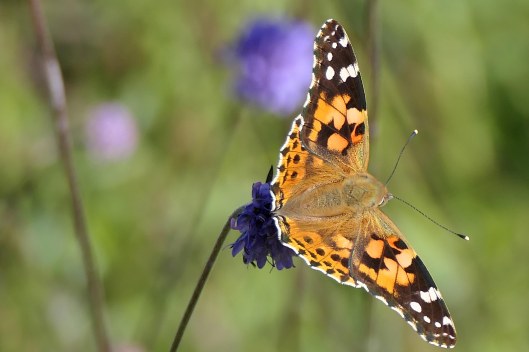
On Wednesday I noticed that the previous week’s heat had brought a small influx of Painted ladies, and counted four during my walk along one edge of the paddock. I’m sure there were, in fact, many more.

230917 scabious painted lady (2)

And, during Friday’s wander, the migrating Red admirals were pausing in the field to fuel their journey with slurps of scabious nectar. It’s such a valuable plant for the insects at this time of year.

230917 scabious red admiral (3)