A Cladius on rose

Tags

, , ,

Another day, another Cladius sawfly – actually, this time, 6 sawfly larvae, all munching away on the leaves of a Field rose. I was hoping their identification would be as easy as yesterday’s Cladius ulmi, with its distinctive black-spotted face, but no!
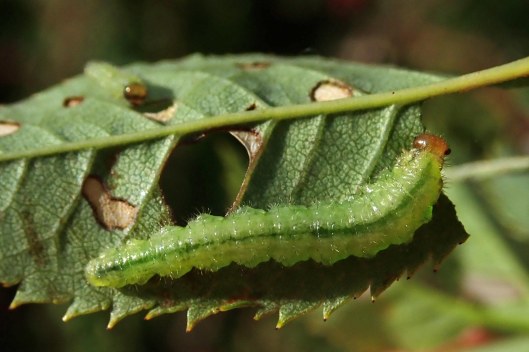
231006 Cladius on rose (1)

This time my expert confirmed it was definitely a Cladius species and that my guess of Cladius pectinicornis was the most likely but C. pilicornis and C. compressicornis also use rose as their larval plant of choice. When I consulted The Sawflies (Symphyta) of Britain and Ireland website I found for C. pilicornis that the only larva shown on the website had a broad dark stripe down its back and the text said the larvae associated with Hawthorn, not rose, so that seemed unlikely. However, when I checked C. compressicornis, it did look to be a likely contender, with features and larval plants very similar to C. pectinicornis.
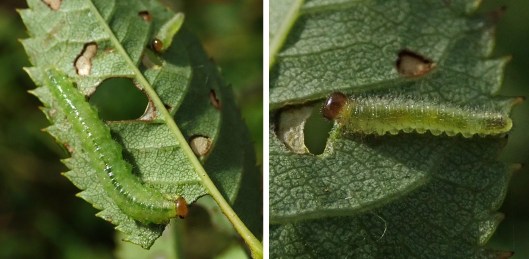
231006 Cladius on rose (2)

So, once again I have to concede that I can’t put an exact name to these very cute little sawfly larvae, but I certainly enjoyed watching them. When much in the world around us seems maddening and/or depressing, I find there’s something very calming about watching caterpillars eating and gliding about.

231006 Cladius on rose (3)

A Cladius on Wych elm

Tags

, , , , , ,

There are just seven species of Cladius sawfly found in Britain, which, you might think, would make them relatively easy to identify. Sadly, this isn’t the case, especially in their larval forms, as all their caterpillars look very similar, and even the expert I consulted said he was unsure about the larval differences.

231005 Cladius ulmi (1)

However, I seem to have struck it lucky with this particular species as The Sawflies (Symphyta) of Britain and Ireland website says: ‘They can be distinguished from the other elm feeding species, Cladius rufipes, by the presence of a black spot on the front of the face which is absent in rufipes.’ As you can clearly see in the photo above, this larva has that black spot, so meet Cladius ulmi, a sawfly species that feeds on elm, in this case Wych elm (Ulmus glabra).

231005 Cladius ulmi (2)

A Cardiff Bay regular

Tags

, , , ,

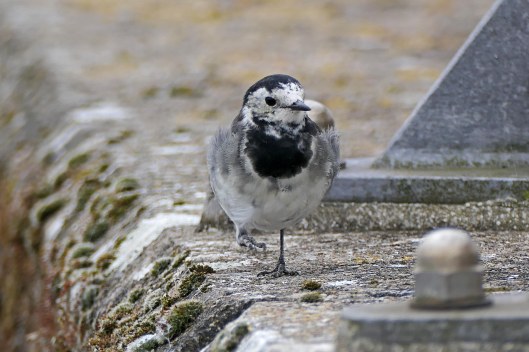
Though the numbers of Pied wagtails frequenting Cardiff Bay Barrage can vary considerably, from half a dozen to a couple of dozen depending on the time of year, there are a few permanent residents that have their own little territories. This is one that can often be seen, as here, stepping out along the tops of the concrete walls next to the sluice gates, searching around the mosses and lichens for the myriad of tiny insects that fill its tummy each day.

231004 pied wagtail

A rat-tailed maggot

Tags

, , , , ,

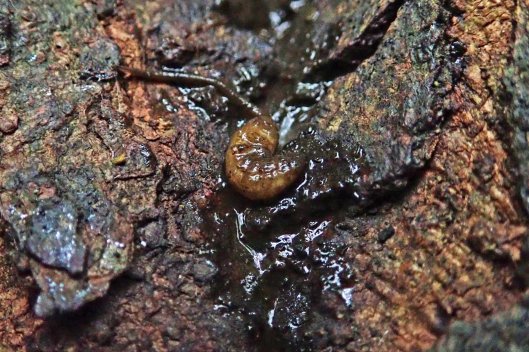
‘What fresh hell is she sharing with us now’, I sense you thinking. For me, though, this was Sunday’s star find, something I’ve wanted to find for ages. This is the larva of a Myathropa florea species of hoverfly that I found living in a sap run on a Sycamore tree. The ‘tail’ is actually its breathing tube, a bit like a long snorkel.

231003 myathropa florea larva

When I spotted it at the edge of a cleft in the Sycamore, I used a stick to move it gently out into the open a little more so I could get some photos. I expected to have to nudge it back but, as you can see in this short video, it turned itself around and slowly undulated itself back in to its home in the puddle of watery sap, leaf litter and insects. Now to find more maggots!

Leafmines: Bucculatrix bechsteinella

Tags

, , , ,

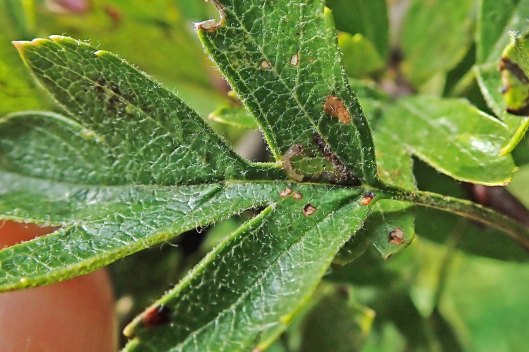
This is another of my ‘I think it might be this but it might not be’ posts. One of the people I follow on Twitter (I refuse to call it X) has begun sharing a ‘Lepidoptera leafmines to find’ monthly post, and one of this month’s six is Bucculatrix bechsteinella, found on Hawthorn.

231002 bucculatrix bechsteinella (1)

The post warns that Bucculatrix bechsteinella (also known as Hawthorn bent-wing) ‘may be confused with those of Paraswammwerdammia nebulella, which tend to be smaller, more numerous and with irregular exits and occurring anywhere on the leaf, but those of B. bechsteinella usually occur in a vein axil.’ This description leads me to think my finds are correct but I’ll need to await verification of my records to be sure. (You can see the adult moth on the UK Moths website.)

231002 bucculatrix bechsteinella (2)

Acorns and galls

Tags

, , , , , , , , , ,

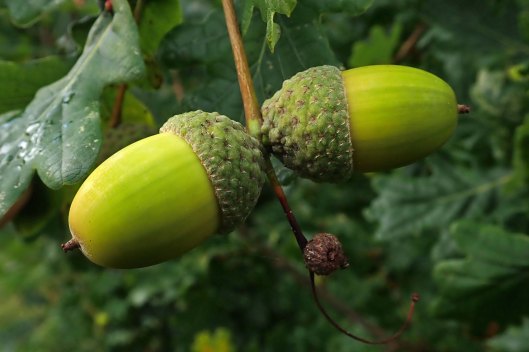
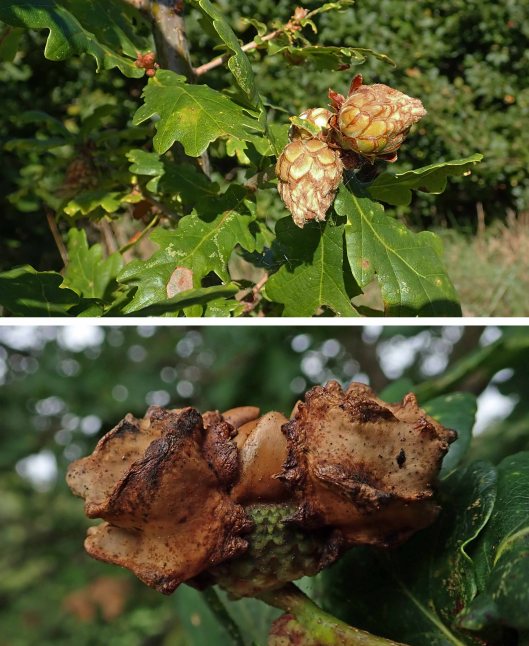
I was taking photos of acorns, thinking I’d perhaps write a blog about the many varied types of nuts, when it occurred to me how many galls I’ve been seeing on acorns this year. The gall-causers are having a good year.

230930 acorns (1)

I’ve covered these before (in Oak galls: knoppers and artichokes, August 2017) so won’t repeat myself here. But if you’re interested in what causes these particular galls, just click on the link to that previous blog. The galls in the first photo are Artichoke galls, caused by the tiny wasp Andricus foecundatrix, and the galls in the second photo, which have almost totally consumed the acorns, have been caused by another wasp Andriscus quercuscalicis.

230930 acorn galls (2)

The mipits are moving

Tags

, , , , , ,

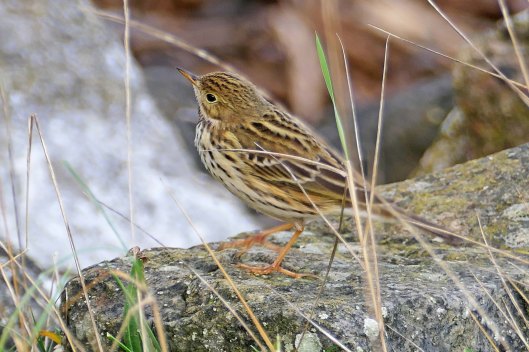
Yesterday, and on several other days over the past couple of weeks, I’ve heard the ‘pip pip pip’ call of birds passing overhead, a call I now recognise as that of the Meadow pipit (their name is shortened to mipit by most birders). At this time of year, these pipits move from their breeding grounds down to more southerly parts of Britain to overwinter where the weather is slightly milder. Though most fly straight across my area (yesterday I watched them heading out across the Bristol Channel towards Somerset and Devon), a few plop down in to the local fields to rest and refuel. Though they can be flighty and elusive, I’ve managed to grab photos of a couple before they’ve flitted up and off, on their journey south.

230929 meadow pipit

A new beetle

Tags

, , ,

I was searching Hawthorn leaves for a particular leafmine when I spotted this tiny beetle sitting on a Hawthorn berry. It also spotted me so didn’t stay still for long and I only managed three slightly blurry photos.

230928 Cryptocephalus pusillus (1)

I think this is Cryptocephalus pusillus but there are a couple of very similar beetles (Cryptocephalus fulvus is another strong contender but seems to be more of a ground plant dweller). Although I’ve recorded this little critter, my record hasn’t yet been checked – the checking process can sometimes be lengthy / not happen at all, as there aren’t always experts available to check records, and most of those who do are volunteers so have to fit their checking in with the other demands on their time. When/if I get confirmation, or otherwise, I’ll update this post.

230928 Cryptocephalus pusillus (2)

Clouded yellow incoming

Tags

, , ,

A bit of butterfly magic happened yesterday when I was birding on Cardiff Bay’s Barrage. I’d just managed to get quite close to one of three Wheatears feeding on insects in the grass and had headed back to the path that runs along the top of the Barrage when I noticed something small and very yellow-looking flying in from the sea side of the rocks, across the road and the path I was standing on, then down in to the grassy area I’d just left. I followed it down the slope as quickly as I could, watching to see where it landed. And there it was, sitting quietly as if resting, a Clouded yellow butterfly, only my second of the year and the first I’ve been able to get photographs of. Just brilliant!

230927 clouded yellow