• ABOUT
  • BIRDING 2018
  • Birding 2019
  • BLOG POSTS
  • Butterflies 2018
  • Resources

earthstar

~ a celebration of nature

earthstar

Tag Archives: British butterflies

A tale of two Hairstreaks

23 Monday Jul 2018

Posted by sconzani in insects, nature, trees

≈ Leave a comment

Tags

British butterflies, butterflies, butterflies in elm trees, butterflies in oak trees, Favonius quercus, Purple hairstreak, Satyrium w-album, White-letter hairstreak

First off, let me just say I have not started blogging about hairstyling: the Hairstreaks are a group of butterflies, so named because of the thin streak of white across their underwings, that usually live their whole lives in the upper canopies of various trees. This year, due to the extremely hot dry weather, their tree-top food sources have dried up, forcing them to come down to ground level for sustenance.
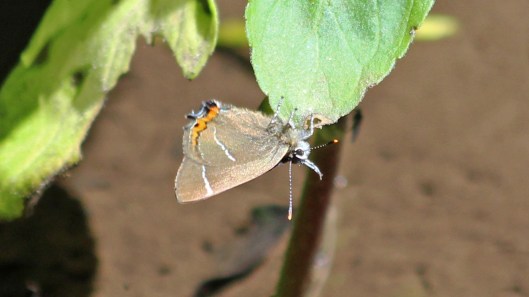
180723 white-letter hairstreak

I spotted this lovely little butterfly purely by chance. I was wandering along the Glamorgan Canal in Forest Farm Nature Reserve, north of Cardiff, taking photos of the Demoiselle damselflies, when something small and brown fluttered down to water level, settled briefly on a leaf, then was chased off by one of the Demoiselles (hence the poor images). The White-letter hairstreak (Satyrium w-album) can usually be found in the tops of Elm trees and suffered a severe decline in numbers due to Dutch Elm disease killing off so many Elm trees in the 1970s but it seems slowly to be recovering. Its name comes from the shape of the letter W on its lower underwing.

180723 purple hairstreak

I can’t take the credit for spotting this Purple hairstreak (Favonius quercus) – my friend Jill noticed it sitting on the woodland trail as we explored Abbot’s Wood in East Sussex last week. (This was my third new butterfly of the week!) Purple hairstreaks usually live in the tops of Oak trees, mostly in southern areas of Britain. Unfortunately, I only managed a couple of quick photos and didn’t get to see its purple-coloured upper wings.

Like Loading...

Silver-washed fritillaries

22 Sunday Jul 2018

Posted by sconzani in insects, nature

≈ 5 Comments

Tags

Abbot's Wood, Argynnis paphia, British butterflies, butterflies, fritillaries, Silver-washed fritillary

What an absolute delight it was to see these beauties during my recent visit to Sussex, my second new butterfly sighting for the week!

180722 Silver-washed fritillary (3)

My friend Jill can testify to the fact that I was grinning from ear to ear as we followed the Abbot’s Amble trail through Abbot’s Wood, a Forestry Commission site near Polegate, and were entertained at every sunlit spot by Silver-washed fritillaries (Argynnis paphia) flitting about the bracken, bramble, thistles and burdock.

180722 Silver-washed fritillary (5)

With a wingspan between 7 and 8 cms, they’re large butterflies, and so very vibrant.

180722 Silver-washed fritillary (4)

These are woodland butterflies, feeding on the flowers that grow along the edges of paths and trails in wooded areas. Apparently, they also lay their eggs on tree trunks, rather than on their caterpillar’s food plant. Once hatched, the caterpillars hibernate through the winter, awakening and descending to the forest floor come the springtime to feed on the leaves of violets.
180722 Silver-washed fritillary (1)

The bumblebee has its eye on that flower but the fritillary isn’t moving!

180722 Silver-washed fritillary (2)

Like Loading...

Marbled whites

21 Saturday Jul 2018

Posted by sconzani in insects, nature

≈ Leave a comment

Tags

Arlington Reservoir, British butterflies, butterflies, Half-mourner, Marbled white, Marmoress, Melanargia galathea, West Park Local Nature Reserve, Woods Mill Nature Reserve

The week before I went down to visit my friend Jill in East Sussex I thought I spotted a Marbled white butterfly at Lavernock Nature Reserve but it flew off before I could get close and I couldn’t find it again.

180721 Marbled white at Arlington

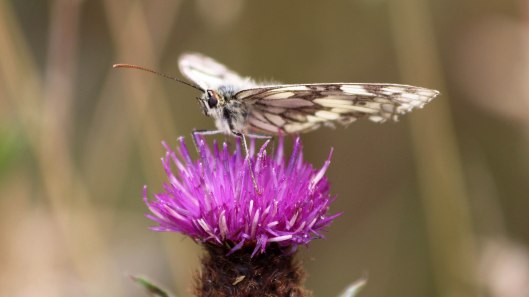
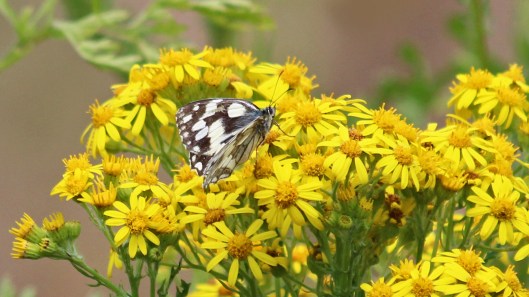
In Sussex, a Marbled white (Melanargia galathea) was the first of seven new species of butterfly I saw in just seven days, and I managed to see three of them at three different places. The first was at Arlington Reservoir, the second at Sussex Wildlife Trust’s Woods Mill Reserve, and the third was at West Park Local Nature Reserve near Uckfield.

180721 Marbled white at Woods Mill

According to Patrick Coulder’s book A Natural History of the Cuckmere Valley:

… 200 years ago, this butterfly was known as the half-mourner, because women then wore black and white dresses during the period of ‘half-mourning’ which followed full mourning for a dead relative. Its name then changed to marmoress, meaning ‘marble-like’, and finally about a hundred years ago it became known as the marbled white.

180721 Marbled white at West Park

Like Loading...

Here’s lookin’ at you back, Skippy!

19 Thursday Jul 2018

Posted by sconzani in insects, nature

≈ Leave a comment

Tags

British butterflies, butterflies, butterfly, Large skipper, Lycaena dispar

180719 large skipper (1)

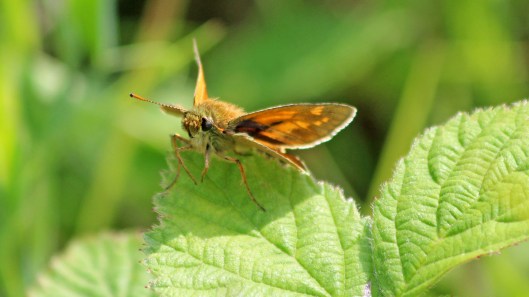
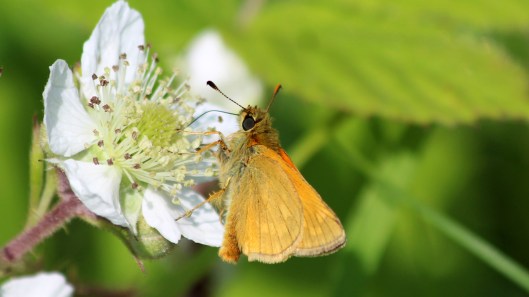
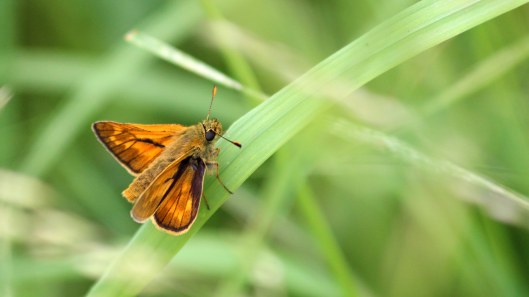
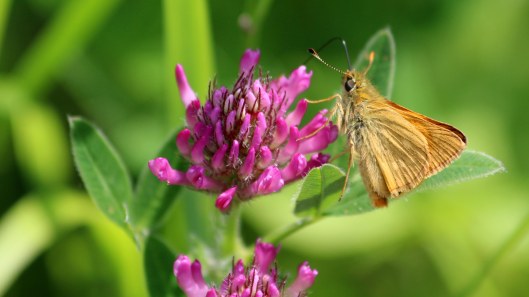
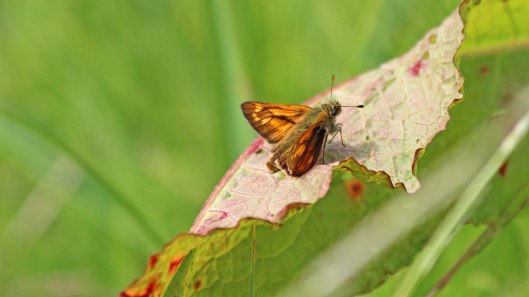
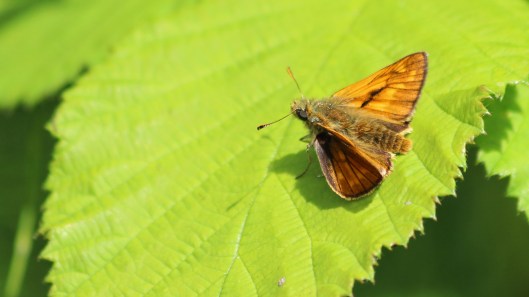
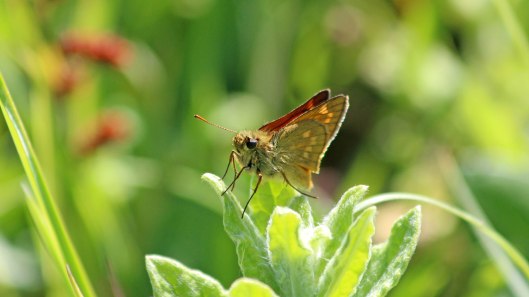
I know I’ve already posted a lot of Large skipper (Lycaena dispar) butterfly photos over the past couple of months but I just can’t help myself.

180719 large skipper (2)180719 large skipper (4)

They are so adorable, especially the males when they’re posing.

180719 large skipper (3)180719 large skipper (5)

Of course, I do know they’re not actually posing – it’s more likely that they’re holding a territory and are trying to look intimidating to scare me off.

180719 large skipper (6)180719 large skipper (7)

Or perhaps they’re just as curious about me as I am about them?

180719 large skipper (8)180719 large skipper (9)

Well, here’s lookin’ at you back, Skippy!

Like Loading...

Birding at Peterston & Pendoylan Moors

12 Thursday Jul 2018

Posted by sconzani in animals, birds, insects, nature, walks

≈ 2 Comments

Tags

birding, birdwatching, British birds, British butterflies, butterflies, Cinnabar caterpillars, Comma, Cows, Glamorgan Bird Club, Green-veined white, Meadow Brown, Peacock, Red fox, Red kite, River Ely, Sand martin, Small tortoiseshell, Stock dove

Yesterday I enjoyed another wonderful, if rather hot day’s birding with my friends from the Glamorgan Bird Club, this time wandering a trail alongside the River Ely near Peterston-super-Ely and Pendoylan.

180711 2 red kites

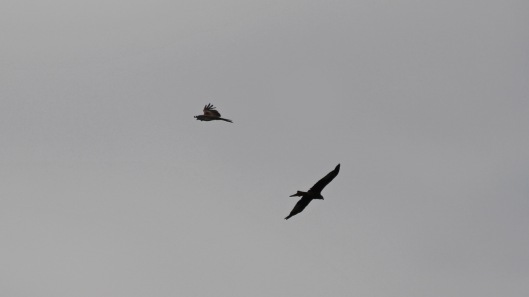
On the way there, my friend John and I had incredibly close views of three Red kites and more of these magnificent birds of prey were gliding overhead during our walk.

180711 1 stock dove

We saw Stock doves (one pictured above) sitting obligingly close to Woodpigeons so we could see the differences in the two species.

180711 2 red fox

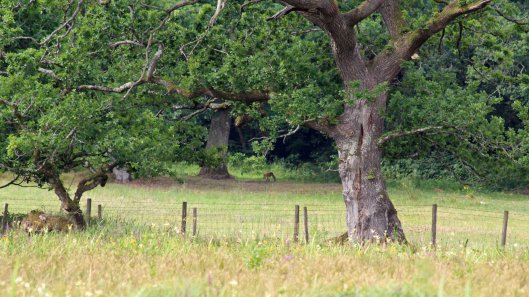
A Red fox was spotted trotting along in a distant field, its lunch in its mouth.

180711 4 meeting the locals

A large herd of large cows moved reluctantly away from the river so we could pass by. You’d have to be crazy to mess with this lady, who was keeping a steady eye on us in case we ventured too close to her calves.

180711 5 participants

The fifteen participants … well, fourteen really, as I was taking the photo.

180711 6 river ely

The meandering River Ely was running low due to the recent drought conditions here in south Wales.

180711 b cinnabar caterpillars
180711 b comma
180711 b green-veined white
180711 b meadow brown
180711 b peacock
180711 b small tortoiseshell

As well as birds, we also saw lots of butterflies, including these: Cinnabar caterpillars, Comma, Green-veined white, Meadow brown, Peacock, and more Small tortoiseshell than I’ve ever seen in one day before.

180711 7 sandmartins

The highlight of the day for me was watching these Sand martins hawking for food over the fields and then returning to their burrows in the river bank to feed their hungry young. Magic!

Like Loading...

Aberbargoed Grasslands revisited

06 Friday Jul 2018

Posted by sconzani in insects, nature

≈ 2 Comments

Tags

Aberbargoed Grasslands, British butterflies, British moths, Burnet companion, butterflies, Common purple & gold, Large skipper, moths, Riband wave, Ringlet, Silver Y, Small heath, Small skipper

On Wednesday I made my second visit to Aberbargoed Grasslands National Nature Reserve with my friend Sharon. Last time we dipped on seeing the Marsh fritillaries because it was too overcast; this time, we dipped again because the recent spell of hot dry weather has meant their season has finished for the year. Still, we have now walked most of the paths around the reserve so we’ll know exactly where to look next year. And, though we missed out the fritillaries, there were still plenty of other butterflies and moths to charm and delight us.

180705 1 small heath

Small heath (Coenonympha pamphilus)

180705 2 Ringlet

Ringlet (Aphantopus hyperantus)

180705 3 Small skipper

Small skipper (Lycaena phlaeas)

180705 4 Large skipper

Large skipper (Lycaena dispar)

180705 5 Burnet companion

Burnet companion (Euclidia glyphica)

180705 6 Pyrausta purpuralis

Common purple & gold (Pyraustra purpuralis)

180705 7 Riband wave

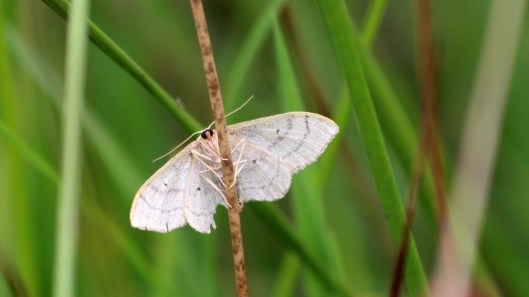
Riband wave (Idaea aversata)

180705 8 Silver Y

Silver Y (Autographa gamma)


Like Loading...

The Gatekeeper

03 Tuesday Jul 2018

Posted by sconzani in insects, nature

≈ 1 Comment

Tags

British butterflies, butterfly, Gatekeeper, Pyronia tithonus

I saw my first Gatekeeper of the year on Saturday and was curious about its name. The consensus seems to be that the common name comes from this butterfly’s tendency to frequent those areas of rough grassland adjacent to hedgerows and field edges, like, for example, the areas around farm gates. Makes sense.

180702 gatekeeper (1)

Its scientific name, Pyronia tithonus, is a little less obvious. Pyronia is derived from the Greek πυρ (pyr) meaning fire, presumably a reference to the bright blazing orange on the butterfly’s wings, but the epithet is odd. Tithonus was a figure in Greek mythology, a member of the Trojan royal family who was kidnapped and loved by Eos, the goddess of the dawn. Wanting to keep her lover with her always, Eos asked Zeus to grant him immortality but forgot to ask for eternal youth, so Tithonus was doomed to grow old and remain old forever. Perhaps this tale held some special meaning for Hubner, the man who classified this genus, but I haven’t been able to discover what that was.

180702 gatekeeper (2)

Like Loading...

My first Graylings

01 Sunday Jul 2018

Posted by sconzani in insects, nature

≈ 1 Comment

Tags

British butterflies, Grayling, Hipparchia semele, Rhossili

It’s called multi-tasking, when you go out for a day’s birding with the bird club but the best photo you come home with is of a butterfly!

180701 Grayling

Today, at Rhossili, with the help of 15-year-old Tate, one of my fellow birders, I saw my first ever Grayling (Hipparchia semele). And then one of the other birders, Rob, spotted another, so I actually saw two. I’m really glad I had the help of my birding friends, as these little butterflies are so well camouflaged I could easily have missed them.

Like Loading...

Leptastic!

25 Monday Jun 2018

Posted by sconzani in insects, nature

≈ Leave a comment

Tags

#30DaysWild, 30 Days Wild, British butterflies, British moths, butterflies, Common blue, Large skipper, Meadow Brown, moths, Pyrausta purpuralis, Ringlet, Six-spot burnet, Small skipper, Small white, Speckled wood

Day 25 of #30DaysWild was hot – the hottest day of the year so far in Wales! I’m not a huge fan of the heat or the burning sun – one of the reasons I moved to Britain was to escape them, but the climate is a’changing. The only good thing about sunshine is that it brings out the Lepidoptera, the butterflies and moths, though even they looked a bit frantic, as if the heat was making them crazy. Still, on my Penarth – Lavernock – Cosmeston – Penarth circuit, I did manage to see my first Small skipper for the year and a host of other fantastic Leps as well.

180625 6-spot burnet

Six-spot burnet moth

180625 common blue

Common blue

180625 large skipper

Large skipper

180625 meadow brown

Meadow brown

180625 Pyrausta purpuralis

Pyrausta purpuralis moth

180625 ringlet

Ringlet

180625 small skipper

Small skipper

180625 small white

Small white

180625 speckled wood

Speckled wood

Like Loading...

Insects of the zigzag path

23 Saturday Jun 2018

Posted by sconzani in flowers, insects, nature, walks, wildflowers

≈ 3 Comments

Tags

#30DaysWild, British butterflies, British insects, flowers for pollinators, National Insect Week, Penarth, wildflowers, Zigzag path

180623 zigzag insects (1)

For day 23 of #30DaysWild, as it’s National Insect Week, I went seeking insects along one my local trails, the zigzag path that runs from upper Penarth down to the marina. This was once a heavily wooded hillside but now has a concrete path that gives pedestrians and cyclists easy access up and down the steep hill. Of course, people sometimes want a more direct route and you can see that the frequent stomping of feet has worn alternate paths down the hillside.

180623 zigzag path

Though it looks quite grassy in this photo from a couple of weeks ago, the hillside is now a mass of self-sown native wildflowers and today it was alive with insects, from bees and hoverflies to butterflies, beetles and damselflies. This is a perfect site for wildflowers to grow – it is steep so difficult and presumably expensive to mow, and its steepness means it can’t be safely used by children playing (though, with a covering of snow, it is perfect for sledging!).

180623 zigzag insects (2)
180623 zigzag insects (3)
180623 zigzag insects (4)
180623 zigzag insects (5)

Though the local council usually strim this slope to death, utterly destroying the wildflowers and the wildlife, they have recently – and rather ironically – ploughed up a small flat area and dumped upon it soil seeded with wildflowers. That might sound hopeful, a positive action, but the ploughed area has not been maintained and, though I may be wrong, I doubt whether the wildflowers were locally sourced. I wonder too why the council would go to the expense of ploughing up perfectly good local wildflowers to plant others – do they think wildflowers should only be of the type they prescribe and only grow within a prescribed rectangular area? Surely they misunderstand the very essence of WILDflowers.

180623 zigzag insects (6)
180623 zigzag insects (7)
180623 zigzag insects (8)
180623 zigzag insects (9)

This blog post, then, is partly a celebration of the amazing variety of insects that enjoy the wildflowers that grow naturally around the zigzag path and partly a plea to the council not to kill those wildflowers and their pollinators but instead to celebrate and foster this wonderfully biodiverse area of Penarth.

180623 zigzag insects (10)
180623 zigzag insects (11)
180623 zigzag insects (12)
180623 zigzag insects (13)
180623 zigzag insects (14)
180623 zigzag insects (15)
Like Loading...
← Older posts
Newer posts →

About me

sconzani

sconzani

I'm a writer and photographer; researcher and blogger; birder and nature lover; countryside rambler and city strider; volunteer and biodiversity recorder.

View Full Profile →

Follow earthstar on WordPress.com

Enter your email address to follow this blog and receive notifications of new posts by email.

Recent blog posts

  • Alder flies April 9, 2026
  • Lily beetle April 8, 2026
  • First bee-flies April 7, 2026
  • Bloody-nosed beetle April 6, 2026
  • Gorse and its weevil April 5, 2026

From the archives

COPYRIGHT

Unless otherwise acknowledged, the text and photographs on this blog are my own and are subject to international copyright. Nothing may be downloaded or copied without my permission.

Fellow Earth Stars!

  • Unknown's avatar
  • Unknown's avatar
  • Unknown's avatar
  • Unknown's avatar
  • Unknown's avatar
  • Unknown's avatar
  • Unknown's avatar
  • Unknown's avatar
  • Unknown's avatar
  • Unknown's avatar
  • Unknown's avatar
  • Unknown's avatar
  • Unknown's avatar
  • Unknown's avatar
  • Unknown's avatar
  • Unknown's avatar
  • Unknown's avatar
  • Unknown's avatar
  • Unknown's avatar
  • Unknown's avatar
  • Unknown's avatar
  • Unknown's avatar
  • Unknown's avatar
  • Unknown's avatar
  • Unknown's avatar
  • Unknown's avatar
  • Unknown's avatar
  • Unknown's avatar
  • Unknown's avatar
  • Unknown's avatar
  • Unknown's avatar
  • Unknown's avatar
  • Unknown's avatar
  • Unknown's avatar
  • Unknown's avatar
  • Unknown's avatar
  • Unknown's avatar
  • Unknown's avatar
  • Unknown's avatar
  • Unknown's avatar
  • Unknown's avatar
  • Unknown's avatar
  • Unknown's avatar
  • Unknown's avatar
  • Unknown's avatar
  • Unknown's avatar
  • Unknown's avatar
  • Unknown's avatar
  • Unknown's avatar
  • Unknown's avatar

Blog at WordPress.com.

Privacy & Cookies: This site uses cookies. By continuing to use this website, you agree to their use.
To find out more, including how to control cookies, see here: Cookie Policy
  • Subscribe Subscribed
    • earthstar
    • Join 642 other subscribers
    • Already have a WordPress.com account? Log in now.
    • earthstar
    • Subscribe Subscribed
    • Sign up
    • Log in
    • Report this content
    • View site in Reader
    • Manage subscriptions
    • Collapse this bar
 

Loading Comments...
 

You must be logged in to post a comment.

    %d