• ABOUT
  • BIRDING 2018
  • Birding 2019
  • BLOG POSTS
  • Butterflies 2018
  • Resources

earthstar

~ a celebration of nature

earthstar

Tag Archives: butterflies

Aberbargoed Grasslands revisited

06 Friday Jul 2018

Posted by sconzani in insects, nature

≈ 2 Comments

Tags

Aberbargoed Grasslands, British butterflies, British moths, Burnet companion, butterflies, Common purple & gold, Large skipper, moths, Riband wave, Ringlet, Silver Y, Small heath, Small skipper

On Wednesday I made my second visit to Aberbargoed Grasslands National Nature Reserve with my friend Sharon. Last time we dipped on seeing the Marsh fritillaries because it was too overcast; this time, we dipped again because the recent spell of hot dry weather has meant their season has finished for the year. Still, we have now walked most of the paths around the reserve so we’ll know exactly where to look next year. And, though we missed out the fritillaries, there were still plenty of other butterflies and moths to charm and delight us.

180705 1 small heath

Small heath (Coenonympha pamphilus)

180705 2 Ringlet

Ringlet (Aphantopus hyperantus)

180705 3 Small skipper

Small skipper (Lycaena phlaeas)

180705 4 Large skipper

Large skipper (Lycaena dispar)

180705 5 Burnet companion

Burnet companion (Euclidia glyphica)

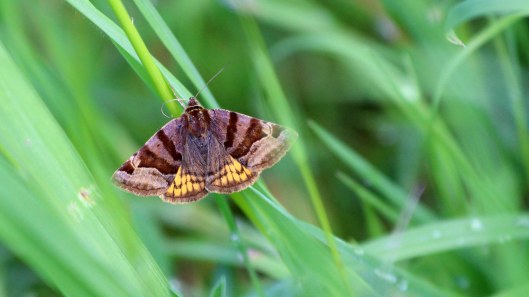
180705 6 Pyrausta purpuralis

Common purple & gold (Pyraustra purpuralis)
180705 7 Riband wave

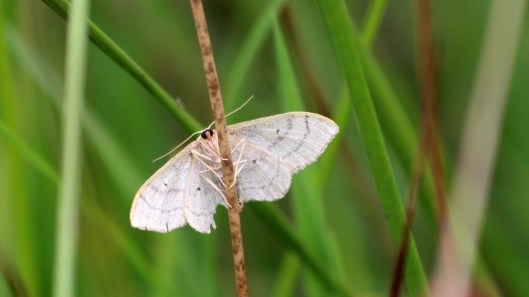
Riband wave (Idaea aversata)

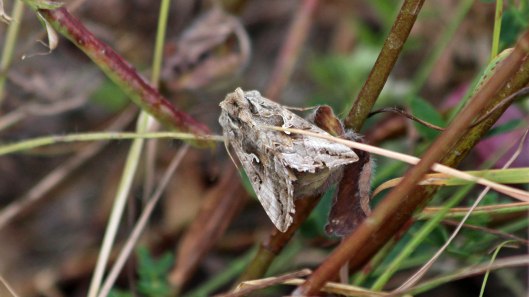
180705 8 Silver Y

Silver Y (Autographa gamma)


Like Loading...

Leptastic!

25 Monday Jun 2018

Posted by sconzani in insects, nature

≈ Leave a comment

Tags

#30DaysWild, 30 Days Wild, British butterflies, British moths, butterflies, Common blue, Large skipper, Meadow Brown, moths, Pyrausta purpuralis, Ringlet, Six-spot burnet, Small skipper, Small white, Speckled wood

Day 25 of #30DaysWild was hot – the hottest day of the year so far in Wales! I’m not a huge fan of the heat or the burning sun – one of the reasons I moved to Britain was to escape them, but the climate is a’changing. The only good thing about sunshine is that it brings out the Lepidoptera, the butterflies and moths, though even they looked a bit frantic, as if the heat was making them crazy. Still, on my Penarth – Lavernock – Cosmeston – Penarth circuit, I did manage to see my first Small skipper for the year and a host of other fantastic Leps as well.

180625 6-spot burnet

Six-spot burnet moth

180625 common blue

Common blue

180625 large skipper

Large skipper

180625 meadow brown

Meadow brown

180625 Pyrausta purpuralis

Pyrausta purpuralis moth

180625 ringlet

Ringlet

180625 small skipper

Small skipper

180625 small white

Small white

180625 speckled wood

Speckled wood

Like Loading...

Random acts of wildness

01 Friday Jun 2018

Posted by sconzani in insects, nature

≈ 2 Comments

Tags

#30DaysWild, British butterflies, British moths, Burnet companion, butterflies, Cinnabar, Common blue, Latticed heath, moths, random acts of wildness, Silver Y, Small white

From today until the end of June, I’m taking part in 30 Days Wild, a month-long nature challenge run by the Wildlife Trusts. The idea is to do something wild every day for 30 days, whether ‘you take time out to simply smell a wildflower, listen to birdsong, explore a local wild place or leave a part of your garden to grow wild for a month’ and the aim is that by ‘making nature part of your life for 30 days’, you will feel ‘happier, healthier and more connected to nature’. This is pretty much what I do most days anyway but this month I’m going to ensure I go wild every single day! You can join in too, if you want – the info is here.

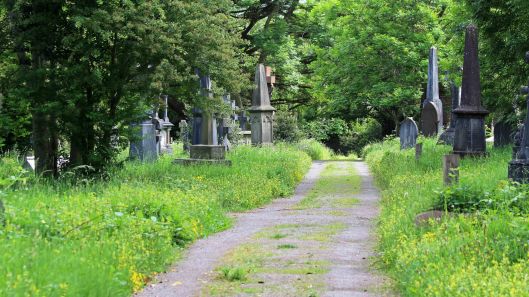
180601 (1) Cathays Cemetery

So, today, on day one, I went for a lovely long wander in Cathays Cemetery, Cardiff’s magnificent, huge, Victorian cemetery. Sadly, some parts of the cemetery are poorly managed – large areas without gravestones, which could be easily become wildflower meadows, are savagely mown, the clippings not removed. But there are a couple of areas where the grasses and wildflowers have been allowed to grow, and additional wildflowers – in particular, a lot of Yellow rattle – have been sewn. These two areas were alive with insects today: bees and hoverflies, bugs and beetles, and damselflies galore. My favourites, though, were all the lovely Lepidoptera: here are some I saw …

180601 (2) Latticed heath

Latticed heath moth

180601 (3) Common blue female

Common blue butterfly (female)

180601 (4) Common blue male

Common blue butterfly (male)

180601 (5) Silver Y

Silver Y moth

180601 (6) Burnet companion

Burnet companion moth

180601 (7) Small white

Small white butterfly

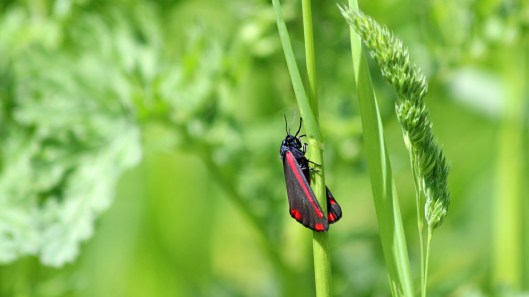
180601 (8) Cinnabar

Cinnabar moth

Like Loading...

Holly blues

20 Sunday May 2018

Posted by sconzani in insects, nature

≈ 5 Comments

Tags

blue butterfly, British butterflies, butterflies, Holly blue, Holly blue butterfly, Lavernock Nature Reserve

180520 Holly blue (2)

With clear blue skies and temps in the mid 20s, it was hot work chasing the Holly blue butterflies (Celastrina argiolus) around Lavernock last Monday. I think I saw five but they move so quickly along the scrub and up and over the trees that it was hard to be sure. Those fast fliers are mostly the males, I think, constantly sniffing for the female pheromones.

180520 Holly blue (1)

I know there were at least two Holly blues, as I managed to get a male and female together in one photo, and then was lucky enough to catch the female laying an egg on a Dogwood plant. Once she’d departed I carefully examined the plant but couldn’t find the egg. I think she must have tucked it well in amongst the flower buds, which I didn’t pry apart in case I damaged the newly laid egg. But I remember where it was so will try and go back in a week or so to check for a caterpillar.

180520 Holly blue (3)180520 Holly blue (5)

Holly blues are the first of Britain’s blue-coloured butterflies to emerge each year, which is one way to distinguish them from the many other blue butterflies. Another is their flight pattern – the other blues usually fly close to the ground. And the Holly blues are the only ones with small black dots on the undersides of their wings though, unless you see one perched, you’ll need to be quick to spot those dots ’cause these little beauties are speedy.

180520 Holly blue (4)

Like Loading...

Cavorting at Cossie

03 Thursday May 2018

Posted by sconzani in insects, nature, spring

≈ 6 Comments

Tags

Brimstone butterfly, British butterflies, butterflies, Comma, Cosmeston, Cosmeston Lakes Country Park, Orange-tip butterfly, Peacock, Speckled wood

180503 Brimstone & Comma

I think it’s fair to say it’s not been much of a Spring so far, weather wise at least. It’s often been cool, frequently wet, and the sun has been elusive. I’m hoping Monday, the last day of April, was a hint of days to come – though there was a cool wind, the skies were mostly blue and it was warm in sheltered spots. Those conditions at Cosmeston persuaded the butterflies to come out to play, and I saw the highest numbers so far this year: 7 Brimstones, 2 Orange-tips, 2 Speckled woods, 2 Commas and 4 Peacocks. And it was such fun to be cavorting like a crazy woman again, flitting across fields and dancing along hedgerows to try to get photographs.

180503 Brimstone (2)180503 Comma180503 Orange-tip180503 Peacock180503 Speckled wood

Like Loading...

Getting the flutters

16 Monday Apr 2018

Posted by sconzani in insects, nature, spring

≈ 6 Comments

Tags

Bee-fly, British butterflies, butterflies, Comma, Comma butterfly, Peacock, Peacock butterfly, Speckled wood, Spring has sprung, springtime

Spring came to south Wales on Saturday at approximately 3.30pm and lasted about 4 hours. (It’s supposed to return again next week and stay a few days but, in the constantly changing contemporary climate, it pays not to count your chickens – or, maybe that should be, your rays of sunshine!) Amazingly, as soon as the sun appeared, so too did the butterflies. It was like a door had been opened – where had they been hiding, I wonder? In the space of about 30 minutes, I saw Peacocks and Commas, several never-settling Brimstones, a distant large-or-small White, and my first Speckled wood of the year. Oh, and a couple of Bee-flies – not butterflies, obviously, but the cutest wee flying things you ever did see so I’ve included one here. It was delightful!

180416 1 Peacock180416 2 Comma180416 3 Peacock180416 4 Comma180416 5 Speckled wood180416 6 Bee fly

Like Loading...

Leps at Combefield Quarry

24 Tuesday Oct 2017

Posted by sconzani in insects, nature

≈ Leave a comment

Tags

British butterflies, butterflies, butterfly, Clouded yellow, Colias croceus, Colias croceus f. helice, Combefield Quarry, Comma, Peacock, Red Admiral

171024 Combefield Quarry

We went for a wander around Combefield Quarry in Portland looking for birds but found butterflies instead. And very nice butterflies they were too, especially considering we are now half way through autumn. There were two Peacocks, a Comma, Speckled woods and Red admirals …

171024 Peacock (1)

171024 Comma
171024 Red admiral

And the icing on the cake was not one but two Clouded yellows (Colias croceus). But wait there’s more … I’ve been told that the paler of these Clouded yellows may well be the helice variety (Colias croceus f. helice), which is something of a rarity. So, we were privileged indeed with our Lepidoptera sightings that day.

171024 Clouded Yellow f. helice
171024 Clouded yellow
Like Loading...

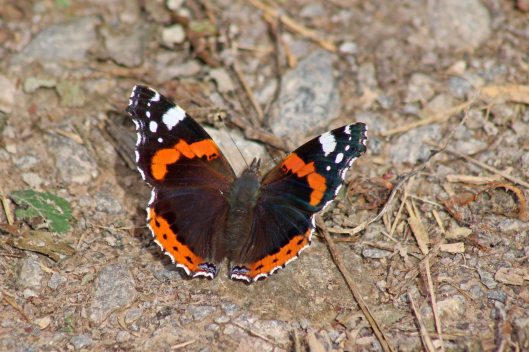
Autumn migration: Red admiral

21 Thursday Sep 2017

Posted by sconzani in insects, nature

≈ 2 Comments

Tags

autumn migration, British butterflies, butterflies, butterflies on migration, butterfly, migrating butterflies, Red Admirable, Red Admiral

170921 Red admiral (3)
170921 Red admiral (1)

During my walk along the coastal path near Penarth earlier this week, I saw more than 20 Red admiral butterflies. Now, it may be that they had gathered in such large numbers in that particular location because the ivy flowers had recently opened and they fancied drinking deeply of their nectar (as did a huge number of bees and hoverflies) but it may also be that they were heading south on their autumn migration to southern Europe and north Africa.

170921 Red admiral (4)

The Red admiral (Vanessa atalanta) was once known as the Red admirable – a bit of a mouthful, which is probably why the name changed – and has a surprisingly ominous history. In Bugs Britannica Richard Mabey reviews the evidence, in various texts and old paintings, and concludes that the Red admiral was once thought to represent sin or temptation:

The flickering band of scarlet on the butterfly’s forewings, vivid against a dark, smoky background, suggests the flames of a smithy – hence its French name, le Vulcain, after Vulcan, the blacksmith of the Gods. But, to Christians, it also suggested the flames of Hell … This surprisingly hellish image of the Red admiral was gradually forgotten during the Enlightenment, when artists started to draw butterflies for their own sake. But perhaps the story of a ‘red butterfly’ said to have been hunted in the north of England and the Borders as a witch is an echo of a previous, more sinister characterisation.

How anyone could imagine something as beautiful as this harmless butterfly could be so malevolent is beyond me!

170921 Red admiral (2)

Like Loading...

Shaped like a fallen leaf

19 Tuesday Sep 2017

Posted by sconzani in insects, nature

≈ 5 Comments

Tags

British butterflies, butterflies, butterflies that hibernate, butterfly, Comma, Comma butterfly, Polygonia c-album

170919 Comma (1)

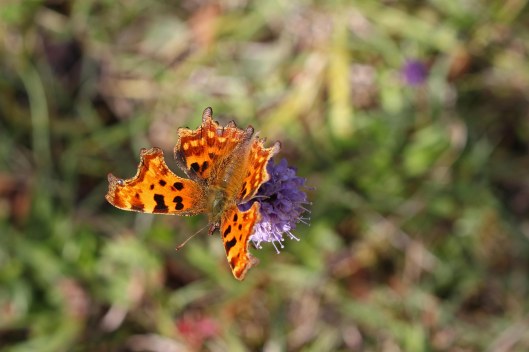
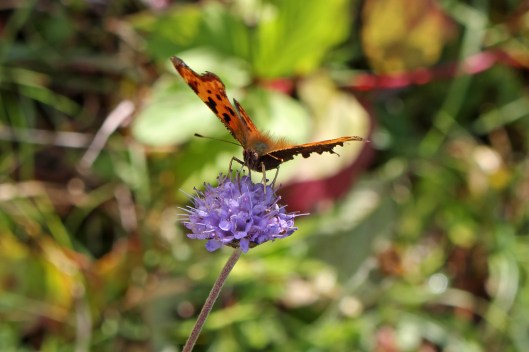
In Fauna Britannica, Stefan Buczacki describes this butterfly’s ragged outline as being the ‘shape of a fallen leaf’ and its colours, too, are quite autumnal. This is the most grammatically correct of Britain’s butterflies, the Comma, Polygonia c-album.

170919 Comma (2)170919 Comma (3)

Though I have no personal experience of this, the Comma is, apparently, one of the three butterflies most likely to be found hibernating in sheds and outhouses – the other two are the Small tortoiseshell and the Peacock. Adult Commas can usually be seen flying between March and September so maybe these ones I’ve seen recently were having their last feeds before looking for a cosy spot to snooze away the cold months of winter. If I had a shed, they’d be most welcome.

170919 Comma (4)

Like Loading...

Small tortoiseshells

13 Wednesday Sep 2017

Posted by sconzani in insects, nature

≈ 4 Comments

Tags

Aglais urticae, British butterflies, butterflies, butterfly, Small tortoiseshell

I’ve just realised that I haven’t shared any photos of Small tortoiseshells (Aglais urticae) this year – how very remiss of me!

170913 Small tortoiseshell (3)

My excuse is that I’ve hardly seen any and, now that I’ve checked my photos, I’ve also realised that I’ve only seen them on three occasions this summer, the first on 21 August and the most recent on the 27th (though on that last date, at Aberthaw, when I was out with my bird group, a total of fifteen were seen).

170913 Small tortoiseshell (1)

It’s still a worry though, as the population of Small tortoiseshells has plummeted in recent years, down 73% since the 1970s according to the Butterfly Conservation website. Speculation about the reasons for such a severe decline vary from pollution and climate change to predation by the grubs of a parasitic fly that’s popped over from Europe and made itself at home, especially in southern Britain. I hope my few sightings this year are not the norm but somehow I doubt it.

170913 Small tortoiseshell (2)

Like Loading...
← Older posts
Newer posts →

About me

sconzani

sconzani

I'm a writer and photographer; researcher and blogger; birder and nature lover; countryside rambler and city strider; volunteer and biodiversity recorder.

View Full Profile →

Follow earthstar on WordPress.com

Enter your email address to follow this blog and receive notifications of new posts by email.

Recent blog posts

  • Birch polypore January 30, 2026
  • The Marl Med gull January 29, 2026
  • Recording Grey squirrels January 28, 2026
  • Jimmy Wren January 27, 2026
  • Millipede: Nanogona polydesmoides January 26, 2026

From the archives

COPYRIGHT

Unless otherwise acknowledged, the text and photographs on this blog are my own and are subject to international copyright. Nothing may be downloaded or copied without my permission.

Fellow Earth Stars!

  • Unknown's avatar
  • Unknown's avatar
  • Unknown's avatar
  • Unknown's avatar
  • Unknown's avatar
  • Unknown's avatar
  • Unknown's avatar
  • Unknown's avatar
  • Unknown's avatar
  • Unknown's avatar
  • Unknown's avatar
  • Unknown's avatar
  • Unknown's avatar
  • Unknown's avatar
  • Unknown's avatar
  • Unknown's avatar
  • Unknown's avatar
  • Unknown's avatar
  • Unknown's avatar
  • Unknown's avatar
  • Unknown's avatar
  • Unknown's avatar
  • Unknown's avatar
  • Unknown's avatar
  • Unknown's avatar
  • Unknown's avatar
  • Unknown's avatar
  • Unknown's avatar
  • Unknown's avatar
  • Unknown's avatar
  • Unknown's avatar
  • Unknown's avatar
  • Unknown's avatar
  • Unknown's avatar
  • Unknown's avatar
  • Unknown's avatar
  • Unknown's avatar
  • Unknown's avatar
  • Unknown's avatar
  • Unknown's avatar
  • Unknown's avatar
  • Unknown's avatar
  • Unknown's avatar
  • Unknown's avatar
  • Unknown's avatar
  • Unknown's avatar
  • Unknown's avatar
  • Unknown's avatar
  • Unknown's avatar
  • Unknown's avatar

Blog at WordPress.com.

Privacy & Cookies: This site uses cookies. By continuing to use this website, you agree to their use.
To find out more, including how to control cookies, see here: Cookie Policy
  • Subscribe Subscribed
    • earthstar
    • Join 670 other subscribers
    • Already have a WordPress.com account? Log in now.
    • earthstar
    • Subscribe Subscribed
    • Sign up
    • Log in
    • Report this content
    • View site in Reader
    • Manage subscriptions
    • Collapse this bar
 

Loading Comments...
 

You must be logged in to post a comment.

    %d