• ABOUT
  • BIRDING 2018
  • Birding 2019
  • BLOG POSTS
  • Butterflies 2018
  • Resources

earthstar

~ a celebration of nature

earthstar

Tag Archives: Cosmeston Lakes Country Park

I found a new plant!

03 Wednesday Oct 2018

Posted by sconzani in flowers, nature, wildflowers

≈ 1 Comment

Tags

Blue fleabane, British flora, British wildflowers, Cosmeston, Cosmeston Lakes Country Park, Erigeron acris

In case you think I’ve made a profoundly important botanical discovery, perhaps I should clarify that title: although I have noticed this plant growing in one particular place at Cosmeston Lakes Country Park during my walks in the past couple of weeks, Monday was the first time I had a close look at it, took some photos and worked out what it was, and it is a plant I had not previously seen.

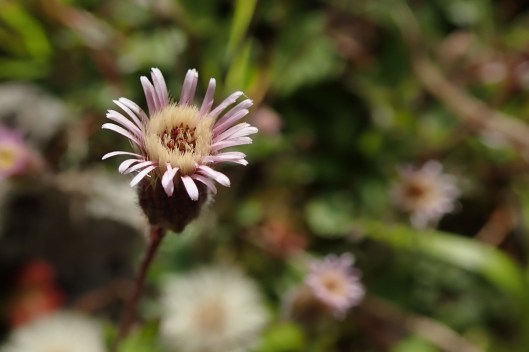
This is Blue fleabane (Erigeron acris), a member of the daisy family, though why it is called Blue fleabane I have no idea as the flower petals I’ve seen are pink, and both my plant ID guidebook and the various online sites I’ve looked at describe them as lilac or purplish.

181003 blue fleabane (4)
OLYMPUS DIGITAL CAMERA

This is a coastal plant, which usually grows in dry areas of grassland, on sand dunes or on stone walls. That fits with the site at Cosmeston, where it’s growing in a very dry, stony location and it’s probably only a mile to the sea as the crow flies. As you can see from the fluffy seed heads in my photos, it’s actually at the end of its flowering period – usually between July and September – so I have been very remiss in not noticing it before now.

181003 blue fleabane (6)

Like Loading...

Blooming autumn

28 Friday Sep 2018

Posted by sconzani in autumn, flowers, nature, wildflowers

≈ Leave a comment

Tags

British flora, British wildflowers, Cosmeston, Cosmeston Lakes Country Park, wildflowers

Last week we had our first two named autumn storms, this week we’ve had glorious clear days but rather chilly overnight temperatures, so I think it’s fair to say autumn has well and truly arrived. Amazingly, though, wildflowers are still blooming in large numbers. Here are the species I’ve found during my walks around Cosmeston Lakes Country Park this week.

180928 Cosmeston flowers (1)
180928 Cosmeston flowers (2)
180928 Cosmeston flowers (3)
180928 Cosmeston flowers (4)
180928 Cosmeston flowers (5)
180928 Cosmeston flowers (6)
180928 Cosmeston flowers (7)
180928 Cosmeston flowers (8)
180928 Cosmeston flowers (9)
180928 Cosmeston flowers (10)
180928 Cosmeston flowers (11)
180928 Cosmeston flowers (12)
180928 Cosmeston flowers (13)
180928 Cosmeston flowers (14)
180928 Cosmeston flowers (15)
180928 Cosmeston flowers (16)
180928 Cosmeston flowers (17)
180928 Cosmeston flowers (18)
180928 Cosmeston flowers (19)
180928 Cosmeston flowers (20)
180928 Cosmeston flowers (21)
180928 Cosmeston flowers (22)
180928 Cosmeston flowers (23)
180928 Cosmeston flowers (24)
180928 Cosmeston flowers (27)
180928 Cosmeston flowers (26)
180928 Cosmeston flowers (25)


Like Loading...

A Whinchat family

08 Saturday Sep 2018

Posted by sconzani in autumn, birds, nature

≈ 2 Comments

Tags

autumn migration, bird migration, birding, birdwatching, British birds, Cosmeston, Cosmeston Lakes Country Park, migrating birds, Saxicola rubetra, Whinchat

180908 2 whinchats (1)

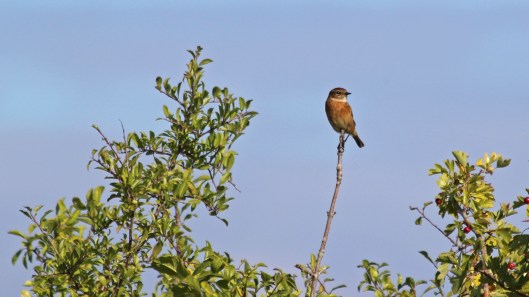
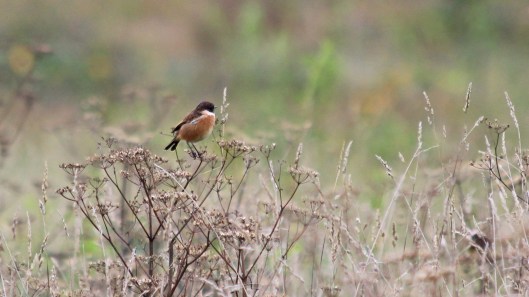
One of the highlights of this week at Cosmeston Lakes Country Park has been watching the party of three Whinchats that have stopped off to feed up prior to their migration to central and southern Africa. I think they’re a family group because this one appears still to have the plumage of a juvenile.

180908 whinchat (1)

Another (below) is still part way through the moulting process. I read recently that birds don’t usually migrate until after their moult is complete, as the lack of all their proper flight feathers, in particular, can affect their ability to fly long distances. Perhaps that’s another reason why they’ve broken their journey at Cosmeston.

180908 whinchat (2)

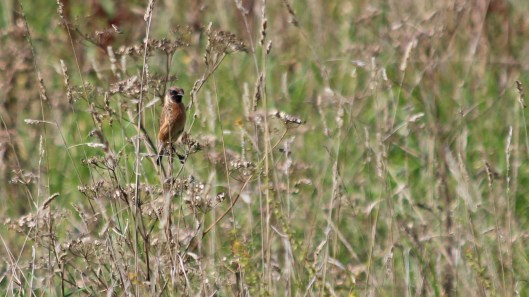
This is the third Whinchat, or Saxicola rubetra, to give it its scientific name.

180908 whinchat (3).jpg

Their common name, as with many birds, reflects their behaviour – whin is another word for gorse, as these little birds are commonly found amongst gorse and bracken and areas of low shrubs and bushes. Chat relates to their call, which combines the sound of two stones being tapped together with a series of melodic whistles.

180908 2 whinchats (2).jpg

Like Loading...

I got a Gropper!

06 Thursday Sep 2018

Posted by sconzani in birds, nature

≈ Leave a comment

Tags

birding, birdwatching, British birds, Cosmeston, Cosmeston Lakes Country Park, Grasshopper warbler, Gropper, Locustella naevia

Non-birders will be wondering what on earth my title is about; birders, on the other hand, will immediately recognise the name and understand the reason for my excitement. Gropper is birder shorthand for Grasshopper warbler (Locustella naevia) and this is one difficult bird to photograph, except perhaps in the springtime, when it pops up a little more often to advertise itself to potential mates. Although Groppers are present in many parts of Britain, it’s usually their grasshopper-chirping-like song (called reeling) that lets you know one’s about.

180906 grasshopper warbler (3)

I was alerted to this bird’s presence by my birding friend Graham, who got a photo the previous day, and he’d also seen migrating birds in this general location, one of the outer fields at Cosmeston Lakes Country Park, so I figured it was worth a look.

180906 grasshopper warbler (2)
180906 grasshopper warbler (4)
180906 grasshopper warbler (5)

I found this particular bird and stood still watching it for so long that a grasshopper (the insect, not the bird) started climbing up the inside of my trouser leg, which, sadly, didn’t end well for the grasshopper as I freaked slightly about what it might be. And, to be completely honest, not having seen a Gropper up close before, I actually thought the bird I was watching was an immature Reed warbler. It was only when I sent Graham a photo later that he confirmed its identity. I might just have to go back and see if I can find it again.

180906 grasshopper warbler (1)

Like Loading...

More migrants passing through

01 Saturday Sep 2018

Posted by sconzani in birds, nature

≈ 4 Comments

Tags

autumn migration, birding, birdwatching, British birds, Chiffchaff, Cosmeston, Cosmeston Lakes Country Park, migrating birds, Pied plycatcher, Redstart, Wheatear, Whinchat, Whitethroat, Willow warbler

My local country park, Cosmeston Lakes, has been awash with migrating birds this past week. And it’s not just me getting better at finding them – according to birders who’ve been checking the area much longer than I’ve lived nearby, this has been a bumper year for sightings.

180901 Redstart female 2408180901 Redstart male 2408

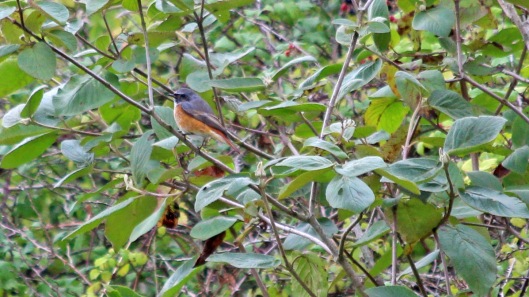
On 24 August I found two Redstarts, a male and another that may have been a female or an immature bird that hadn’t yet developed its full adult colouration.

180901 wheatear 2408

Also on the 24th I had a very fleeting view of a Wheatear that popped up from grass to fencepost, then was off in the blink of an eye.

180901 whinchat 2708

On the 27th my birding friend Della texted me to say she’d found a Whinchat. That was the fastest I’d ever walked to Cosmeston and, luckily, the bird waited for me – and, in fact, stayed around most of the week so I saw it several times.

180901 common whitethroat

180901 chiffchaff180901 willow warbler

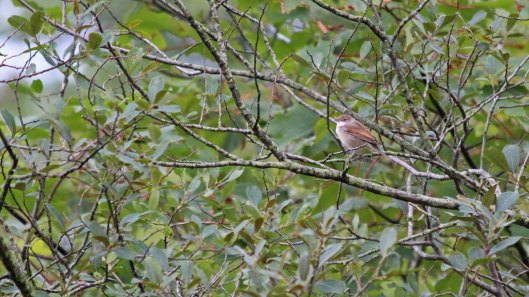
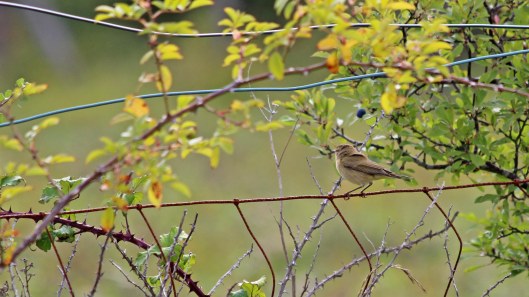
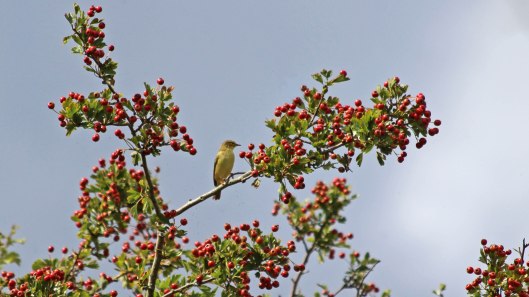
During my frequent visits to Cossie this week, I’ve seen ones and twos of Whitethroat and Chiffchaff, and tens of Willow warblers. These are the ones I spotted on the 30th.

180901 redstart 2908

Also on 30 August, I spotted another Redstart and, from the dark head colours, I could tell this one was definitely a male.

180901 pied flycatcher

The week ended with a bang! My birding friend, Graham, let me know that he’d seen a Pied flycatcher with a small group of Spotted flycatchers, a most unusual visitor. Luckily, I was on the coastal path heading homeward so was able to divert towards Cosmeston and, with Graham’s help, got distant views of this beautiful little bird catching flies along the tree line. What a stunning week it has been!

Like Loading...

Seeing spots before my eyes

27 Monday Aug 2018

Posted by sconzani in autumn, birds, nature, seasons

≈ Leave a comment

Tags

autumn migration, bird migration, birding, birdwatching, British birds, Cosmeston, Cosmeston Lakes Country Park, Muscicapa striata, Spotted flycatcher

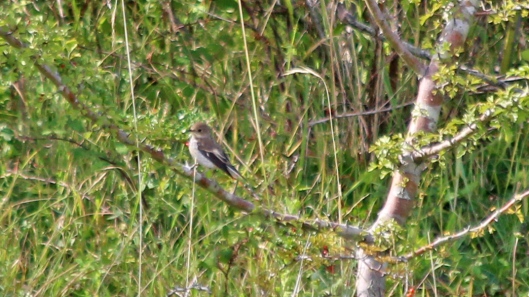
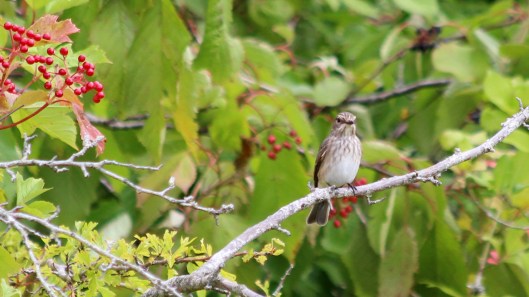
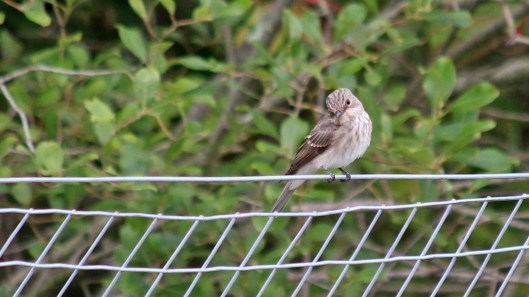
The autumn bird migration is now in full swing in south Wales and almost every day migrating birds are being spotted at Cosmeston Lakes Country Park, where they’re stopping off to refuel before they tackle their long flights to warmer over-wintering locations in Europe and Africa. One that I find particularly charming is the Spotted flycatcher (Muscicapa striata), which is not really spotted at all, more streaky and stripy. The scientific name is more accurate: Muscicapa is a combination of the Latin word musca, meaning fly, and capere, meaning to catch, and the epithet striata is from the Latin striatus, meaning striated.

180827 spotted flycatcher (1)

I saw my first Spotted flycatcher at Cossie on 7 August.

180827 spotted flycatcher (2)
180827 spotted flycatcher (3)

A week later, on the 15th, I had two sightings.

180827 spotted flycatcher (4)
180827 spotted flycatcher (5)
180827 spotted flycatcher (6)

The 20th was a bumper day, with three birds, two obviously travelling together, and another doing its own thing.

180827 spotted flycatcher (7)

And last Friday, the 24th, a birding friend put me on to a single bird, that was catching flies in the paddock I walked through on my way home. Fingers crossed I manage to see a few more before they all disappear for the winter.

Like Loading...

Descrying dragons

21 Tuesday Aug 2018

Posted by sconzani in insects, nature

≈ 3 Comments

Tags

Black-tailed skimmer, British dragonflies, Common Darter, Cosmeston Lakes Country Park, dragonflies, Emperor dragonfly, Lavernock Nature Reserve, Migrant hawker

I’ve not seen a huge number of dragonflies this summer, possibly because of the heatwave, which has seen water levels shrink to record lows and the pond at Lavernock Nature Reserve dry up altogether. Luckily, not all dragonflies spend their adult lives in close proximity to water so I have enjoyed some close encounters along field edges and pathways. Here are a few of those recent dragons.

180821 migrant hawker (1)
180821 migrant hawker (2)

These two are both Migrant hawkers; one was near the pond at Lavernock before it dried up completely, the other was just hanging around on vegetation beside the south Wales coastal path, a good choice as there are always an abundance of flying insects along the path’s hedgerows.

180821 emperor

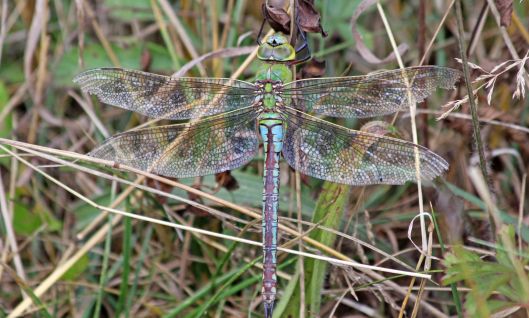
This Emperor was hawking low over the tall wildflowers and grasses in one of the paddocks at Cosmeston. I had to wait quite a while for it to settle, then creep up very slowly and silently to get this photo, but it was worth the wait.

180821 Common darter male
180821 Common darter female

180821 Common darters mating

Last year at this time Cosmeston Lakes Country Park seemed to be swarming with Common darters – they sat like mini sculptures on every gate and fencepost, and there were so many sitting warming themselves on every piece of stone along the pathways that you had to be careful not to step on them. This year I’ve seen very few so it was a delight first to see this male (the red) and female in one paddock and then to spot the mating pair in another field. Let’s hope they return in numbers next year.

180821 black-tailed skimmers

Those Common darters weren’t the only mating dragonflies I almost disturbed at Cosmeston this week, as my stomping carelessly along the path homeward caused these two Black-tailed skimmers to fly up and away. Luckily, they didn’t fly far and I was able to get my camera out and take a few photos before leaving them to carry on their sterling efforts.

Like Loading...

Common purple & gold

20 Monday Aug 2018

Posted by sconzani in insects, nature

≈ Leave a comment

Tags

British moths, Common purple & gold, Cosmeston, Cosmeston Lakes Country Park, moth, moths, Pyrausta purpuralis, UK moths

Every step I take across the west paddock at Cosmeston seems to send at least two tiny beige-looking insects flicking off in different directions in front of me. At first, I think they might be grasshoppers or crickets, springing quickly out of the way of my trampling feet but no – these creatures are not making straight leaps, they are fluttering and flying. They’re not easy to follow – as soon as they touch the ground they seem to disappear so I have to focus intently to follow each flight and then approach very slowly to discover what they are.

180820 Pyrausta purpuralis (1)

It turns out they’re not beige at all – they’re a quite striking combination of maroon and yellow, hence their common name, Common purple & gold. This is Pyrausta purpuralis, not to be confused with Pyrausta aurata, a very similar moth of the same family (see more here).

180820 Pyrausta purpuralis (4)
180820 Pyrausta purpuralis (5)

180820 Pyrausta purpuralis (2)

With a wingspan of just 20mm, this moth really is tiny but it’s relatively common throughout Britain, particularly on chalky downs and dry grasslands. The moths I’m seeing now in such abundance are the second brood of the year and fly, both during the day and at night, from July to August. I saw their parents during May and June, though they didn’t seem as plentiful. Perhaps this is a moth species that has enjoyed our hot dry weather this summer.

180820 Pyrausta purpuralis (3)

Like Loading...

Bugs are like buses

16 Thursday Aug 2018

Posted by sconzani in insects, nature

≈ Leave a comment

Tags

British bugs, Coreus marginatus, Cosmeston Lakes Country Park, Dock bug

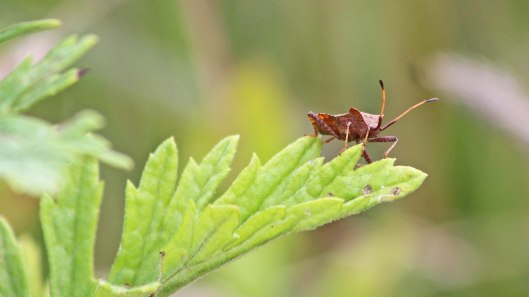
I hadn’t seen any Dock bugs (Coreus marginatus) for a couple of months and then suddenly, at Cosmeston the other day, I saw 11 on one plant!

180816 dock bugs (3)

Now that I’ve read up on them, I understand the sightings gap: it seems adults mate and lay their eggs in the springtime, the nymphs munch away on dock and their other favourite plants for a couple of months and, by August, they have developed into new adults. And here they are …

180816 dock bugs (5)
180816 dock bugs (4)
180816 dock bugs (2)
180816 dock bugs (1)
Like Loading...

The aphid-eaters

15 Wednesday Aug 2018

Posted by sconzani in birds, insects, nature, plants

≈ 8 Comments

Tags

aphids, birding, birdwatching, British birds, Cosmeston, Cosmeston Lakes Country Park, ladybirds, Wild parsnip, Willow warbler, Willow warbler migration

180815 willow warbler (5)

Do you remember last Friday I blogged about the abundance of ladybirds at Cosmeston? They were feasting on the huge numbers of aphids on the Wild parsnip plants. Well, it turns out the ladybirds have had some competition for those aphids this week, as the migrating Willow warblers move through. I don’t think we need to worry though – there are more than enough aphids to go around!

180815 willow warbler (1)180815 willow warbler (2)180815 willow warbler (3)180815 willow warbler (4)

Like Loading...
← Older posts
Newer posts →

About me

sconzani

sconzani

I'm a writer and photographer; researcher and blogger; birder and nature lover; countryside rambler and city strider; volunteer and biodiversity recorder.

View Full Profile →

Follow earthstar on WordPress.com

Enter your email address to follow this blog and receive notifications of new posts by email.

Recent blog posts

  • Kestrel 2026 : 86 January 31, 2026
  • Birch polypore January 30, 2026
  • The Marl Med gull January 29, 2026
  • Recording Grey squirrels January 28, 2026
  • Jimmy Wren January 27, 2026

From the archives

COPYRIGHT

Unless otherwise acknowledged, the text and photographs on this blog are my own and are subject to international copyright. Nothing may be downloaded or copied without my permission.

Fellow Earth Stars!

  • Unknown's avatar
  • Unknown's avatar
  • Unknown's avatar
  • Unknown's avatar
  • Unknown's avatar
  • Unknown's avatar
  • Unknown's avatar
  • Unknown's avatar
  • Unknown's avatar
  • Unknown's avatar
  • Unknown's avatar
  • Unknown's avatar
  • Unknown's avatar
  • Unknown's avatar
  • Unknown's avatar
  • Unknown's avatar
  • Unknown's avatar
  • Unknown's avatar
  • Unknown's avatar
  • Unknown's avatar
  • Unknown's avatar
  • Unknown's avatar
  • Unknown's avatar
  • Unknown's avatar
  • Unknown's avatar
  • Unknown's avatar
  • Unknown's avatar
  • Unknown's avatar
  • Unknown's avatar
  • Unknown's avatar
  • Unknown's avatar
  • Unknown's avatar
  • Unknown's avatar
  • Unknown's avatar
  • Unknown's avatar
  • Unknown's avatar
  • Unknown's avatar
  • Unknown's avatar
  • Unknown's avatar
  • Unknown's avatar
  • Unknown's avatar
  • Unknown's avatar
  • Unknown's avatar
  • Unknown's avatar
  • Unknown's avatar
  • Unknown's avatar
  • Unknown's avatar
  • Unknown's avatar
  • Unknown's avatar
  • Unknown's avatar

Blog at WordPress.com.

Privacy & Cookies: This site uses cookies. By continuing to use this website, you agree to their use.
To find out more, including how to control cookies, see here: Cookie Policy
  • Subscribe Subscribed
    • earthstar
    • Join 670 other subscribers
    • Already have a WordPress.com account? Log in now.
    • earthstar
    • Subscribe Subscribed
    • Sign up
    • Log in
    • Report this content
    • View site in Reader
    • Manage subscriptions
    • Collapse this bar
 

Loading Comments...
 

You must be logged in to post a comment.

    %d